
If you’ve ever driven I-75 through Florida in May, you know lovebugs: the paired, drifting, seemingly infinite black flies that coat windshields, radiators, and regrets from Tampa to Mobile — and inspire 33,000 searches a month from people wondering what they are, why they fly attached, and whether the windshield-acid stories are true. Here’s the complete file, including the answer to the question Ohio readers are actually asking: no, lovebugs haven’t reached Ohio — and the black drifting flies you saw swarming a Dayton field edge last spring were their close native cousins, with a much better local reputation. The species, the myths (one involving a fictional university experiment), the real windshield chemistry, and the Ohio lookalike lineup, all below.
What Lovebugs Actually Are
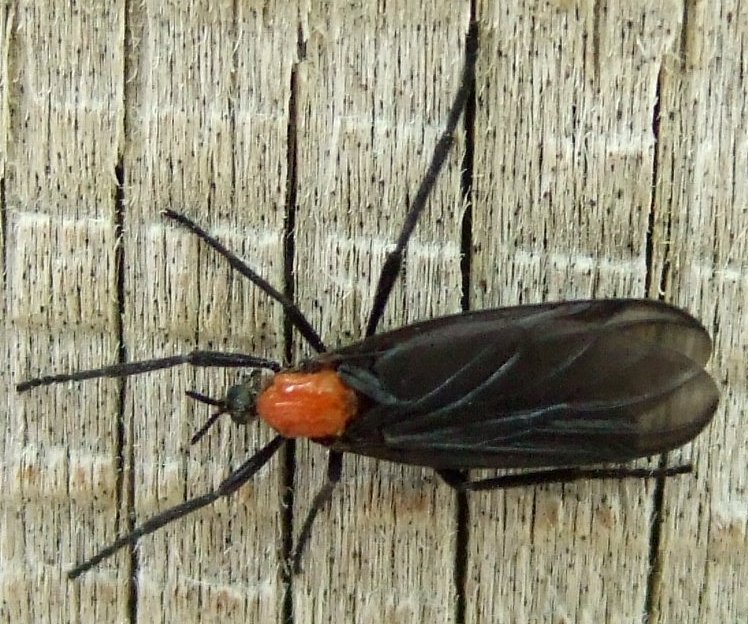
The lovebug (Plecia nearctica) is a march fly — family Bibionidae — about a third of an inch long, velvet black with a red-orange thorax, harmless in every individual sense: no bite, no sting, no disease, larvae that eat decaying vegetation and genuinely improve soil. Their fame comes from two habits. First, the coupling: mating pairs stay attached in flight for days — the female towing the smaller male backward through the air — which is the “two-headed bug” drifting past your mirror. Second, the synchronized emergence: twice a year, in roughly May and September, Gulf-state populations emerge in astronomical numbers for a few weeks, drifting over highways in clouds dense enough to slick windshields, clog radiators, and force gas-station squeegee lines. It’s a spectacular case of a harmless insect becoming a genuine infrastructure nuisance through sheer synchronized biomass.
Lovebugs are a Gulf Coast problem, so what Ohioans are seeing is something else. Identifying it is the job of pest control in Dayton.
The Myths, Retired
“Lovebugs escaped from a University of Florida genetics experiment”: the South’s favorite entomology legend, and completely false — lovebugs are natural natives of Central America that expanded along the Gulf Coast through the twentieth century, reaching Florida around mid-century by ordinary range expansion (likely aided by highway corridors and landscaping). No lab, no escape, no mad scientist; entomologists have been formally debunking this one since the 1970s, and it remains unkillable because it’s a better story than “flies moved northeast gradually.” “Their guts eat paint”: half true, all timing — lovebug body chemistry is mildly acidic and grows more so as residue bakes and bacteria work; cleaned within a day, splatter is just splatter, while a week of sun can etch clear coat. The real advice is a washed car and a bug-screen in season, not fear. “They’re attracted to cars specifically”: functionally yes, accidentally — heat, vibration, and exhaust compounds mimic the decaying-vegetation cues females use to find egg-laying sites, which is why highways host the densest clouds. The windshield isn’t bad luck; it’s chemistry doing its honest best in a world with interstates.
The Ohio Question: Are Lovebugs Here?
Not as an established population, and not close. Lovebug range runs the Gulf and southern Atlantic states — the northern boundary flirts with the Carolinas and southern Tennessee — because the species’ eggs and larvae depend on the long warm seasons and mild winters of the subtropics. Ohio’s winters remain a hard wall (one climate-change caveat: the range has crept north for a century, so “not in your lifetime” is a forecast, not a law). A stray individual riding a vehicle or a storm front is possible and meaningless. What Ohio does have — abundantly, natively, every spring — is the rest of the lovebug’s family: our own march flies, and they’re the answer to nearly every “I saw lovebugs in Ohio” report we’ve ever fielded.
Ohio’s Own March Flies: the Lookalike You Actually Met
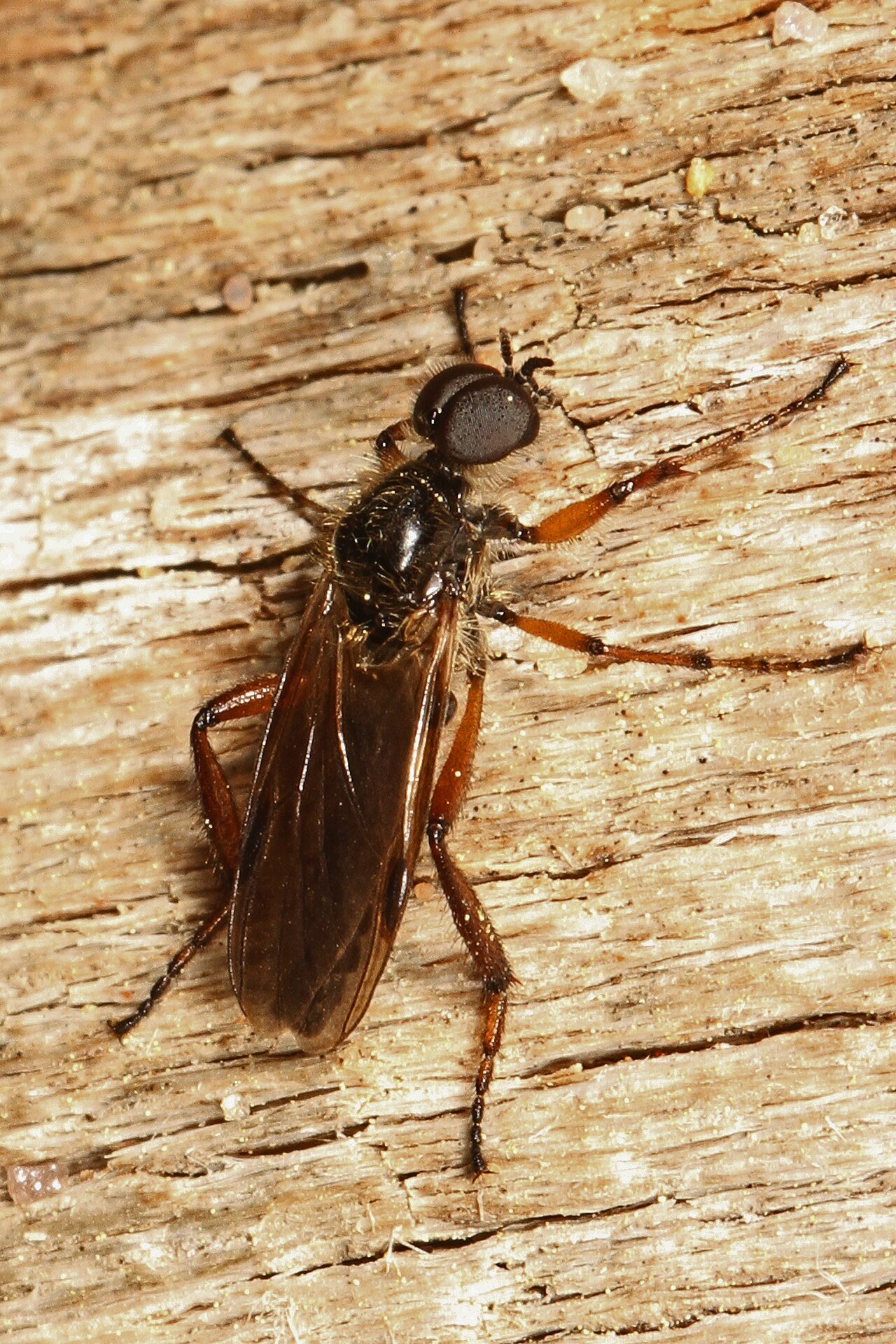
Every April and May, Ohio field edges, lawns, and woodland margins host slow, drifting swarms of black flies with dangling legs — genus Bibio, the lovebug’s literal family. Same velvet-black bodies (some with reddish legs or thorax), same weak drifting flight, same decaying-vegetation-eating larvae, same total harmlessness — occasionally even the same attached-pairs flying, which is a Bibionidae family trait rather than a lovebug invention. The differences are scale and season: our march flies emerge once in spring (a few species add a modest fall flight), in swarms measured in hundreds rather than millions, for a week or two per site, and then vanish into the soil for another year. They don’t reach windshield-slicking density, don’t enter houses in numbers, and don’t warrant any treatment whatsoever — a march fly swarm over your lawn is a soil-health compliment and a free bird-feeding event. If the swarm you’re seeing is over turf in spring and gone by Memorial Day, you’ve met the native, and the correct response is none.
The Rest of the Ohio “Lovebug Report” Lineup
- Attached-flying insects over the yard in summer: usually damselflies or dragonflies in tandem — predators, welcome ones — or mating crane flies, the gangly harmless “giant mosquitoes.”
- Black-and-red bugs massing on sunny walls in fall: boxelder bugs — Ohio’s actual autumn aggregation champion, and a genuine (if harmless) household nuisance in a way march flies never are.
- Small dark flies drifting from the lawn after rain: often fungus gnats or additional bibionids — soil-decomposer traffic, self-resolving.
- Paired black beetles on flowers in June: mating fireflies or soldier beetles, both firmly on the beneficial roster.
The pattern worth keeping: paired or swarming flight over Ohio vegetation is almost always reproduction traffic from a decomposer or predator species — the yard’s infrastructure working — and the correct treatment budget is zero dollars. The insects that actually cost Ohio homeowners money enter quietly, alone, and stay: the termite swarmers, the carpenter ant scouts, the October mouse. Spectacle and threat are nearly inverse in this business — a rule this page shares with our whole acquittal series, from cicada killers to the great black wasp.
For Snowbirds and Southern Transplants: Managing Real Lovebugs
Since a share of readers found this page packing for I-75: season timing (late April–May and late August–September, each flight running about four weeks), morning driving beats afternoon (flight peaks in warm midday hours), a fresh coat of wax or a hood deflector genuinely reduces adhesion, and the only cleaning advice that matters is within a day — soaked microfiber and patience beat every miracle spray after residue bakes. Screens handle the patio; nothing handles the highway. And no, there is no spray program for lovebugs even in Florida — synchronized emergence from every roadside in the county is not a treatable condition, a sentence Gulf pest companies say daily to disappointed callers. Some insects you control; some you schedule around. Lovebugs are weather.
Seeing swarms in Ohio you can’t place — or something paired, drifting, and worrying? Send us a photo; identification is free, and if it’s the native march fly we’ll happily tell you to spend nothing. Serving Dayton and all of Montgomery, Greene, Miami, Clark, Warren, Butler, Preble, and Darke counties.
The Deeper Story: Why Synchronized Emergence Exists at All
The lovebug’s defining trick — a whole region’s population emerging inside the same few weeks — is a survival strategy called predator satiation, and it’s worth understanding because Ohio runs the same play with different actors. An insect that trickled out year-round would feed predators at a sustainable rate forever; one that erupts all at once so overwhelms every bird, dragonfly, and spider that the vast majority survive by sheer arithmetic — the predators are full by breakfast. Periodical cicadas are the strategy’s most famous practitioners (seventeen years of patience for two weeks of overwhelming abundance), mayflies run it nightly along Lake Erie each June, and our spring march flies run the modest local version over your lawn. The signature is unmistakable: staggering numbers, brief duration, total harmlessness, and absolute untreatability — you cannot poison a strategy whose entire premise is producing more individuals than any mortality source can absorb. Recognizing predator satiation on sight is one of the most useful filters a homeowner can own: it converts “invasion!” into “calendar event,” and it flags the opposite pattern — small numbers, persistent presence, hidden activity — as the profile that actually deserves the phone call.
Lovebugs and the Northward Question, Honestly Handled
Because “are lovebugs spreading north” deserves better than a shrug: the species’ documented history is one long northward and westward expansion — from Central America through Texas and Louisiana in the early twentieth century, across the Gulf states by the 1950s, and up the Atlantic coast since — with winter cold as the consistent brake. Warming winters loosen that brake slowly; entomologists watching the range edge report creep, not leaps, and Ohio remains multiple hardiness zones beyond the current boundary. Our honest forecast: your children might conceivably meet lovebug season in southern Ohio decades out; you will not meet it next May. Meanwhile, the same warming trend is doing far more consequential local work — longer mosquito seasons, milder winters that spare more overwintering stink bugs and ticks, expanded ranges for genuinely destructive species — which is where climate-and-pests attention actually belongs. The lovebug is the range-shift story people ask about; it’s nowhere near the one that matters.
A Field Guide Postscript: Telling the Family Apart at a Glance
For the reader who wants the thirty-second version to carry outdoors: lovebug — black with a distinctly red-orange thorax shield, often paired, Gulf states, May and September; Ohio march fly (Bibio) — all-black or black with reddish legs, males with oversized bug-eyed heads hovering over turf, females drifting heavily through them, April–May, gone fast; fungus gnat — a fraction the size, delicate, around potted plants and damp soil rather than swarming over lawns; black caddisflies and dark mayflies — near water, wings held tent-like or upright, part of the river’s economy. None of the four bites, none breeds indoors, and only the fungus gnat ever warrants action (dry the soil). If the insect in question is doing something none of these do — trailing along your baseboards, emerging from a windowsill, appearing in winter — it’s left this page’s jurisdiction, and the rest of our site is waiting.
And one last piece of trivia for the road, since this is fundamentally a road-trip insect: the “double-headed bug” illusion works because the towed male flies backward, his wings beating in reverse coordination with hers — one of the odder feats of insect flight, performed by the billion over Gulf asphalt twice a year. The natural world’s most mundane-looking flies contain multitudes; they just picked the wrong place to demonstrate it.
(Etymology corner, unavoidable here: they’re called march flies for the month their European relatives favor, honeymoon flies and double-headed bugs in Gulf folk usage, and — in the least imaginative regional coinage — simply “those bugs” from Houston to Jacksonville every May. All names describe the same gentle decomposer having its fortnight.)
Frequently Asked Questions
What are lovebugs?
March flies (Plecia nearctica) of the Gulf and southern Atlantic states — velvet black with red-orange thoraxes, harmless individually (no bite, no sting), famous for twice-yearly synchronized emergences that coat southern highways and for flying in attached mating pairs for days.
Are lovebugs in Ohio?
No established population — their range tops out around the Carolinas and southern Tennessee because Ohio winters kill their larvae. What Ohioans see every spring are native march flies (genus Bibio), the lovebug’s close cousins: same look, same harmlessness, a fraction of the numbers, gone in two weeks.
Did lovebugs really escape from a university experiment?
No — the University of Florida genetics-experiment story is a thoroughly debunked legend. Lovebugs are natural natives of Central America that expanded along the Gulf Coast over the twentieth century by ordinary range expansion. Entomologists have been retiring this myth since the 1970s.
Why do lovebugs fly attached to each other?
They’re mating — pairs remain coupled for days, the larger female towing the male in flight. It’s a family trait of march flies generally, which is why Ohio’s native Bibio occasionally show the same two-headed drift.
Do lovebugs damage car paint?
Baked residue does — body chemistry turns increasingly acidic as splatter sits in sun, etching clear coat after days. Cleaned within 24 hours it’s harmless. In season: wax beforehand, wash promptly, and a hood deflector genuinely helps.
Why are lovebugs attracted to highways and cars?
Heat, vibration, and exhaust compounds mimic the decaying-vegetation chemistry females seek for egg-laying. The interstate reads as one long, irresistible compost signal — which concentrates the clouds exactly where drivers are.
What are the black flies swarming my Ohio yard in spring?
Almost certainly native march flies — slow, drifting, dangling-legged, over turf and field edges for a week or two in April–May. Their larvae are soil decomposers; the swarm is harmless, self-ending, and needs no treatment. A photo settles it if you’re unsure.
Can pest control get rid of lovebugs?
Not even in Florida — synchronized emergence from every roadside in a county isn’t treatable, and honest Gulf companies say so daily. They’re managed with timing, wax, and squeegees. Ohio’s version needs even less: patience measured in days.