
A tiny mouse just appeared in the middle of your kitchen floor — pink or barely furred, wobbly, oddly fearless — and your first instinct was probably equal parts “aww” and “uh oh.” Trust the second instinct. A baby mouse in the open is one of the most information-dense finds in residential pest control: it tells you there’s an active nest within a few dozen feet, that breeding is underway, and that the population math is about to get worse on a three-week cycle. This page covers how to age the mouse you found, what its appearance says about the nest, the baby-mouse-or-something-else ID question, what to do with the animal itself, and the plan that has to follow — because the one thing a baby mouse never is, is alone.
Aging the Mouse You Found: the Two-Week Tour
Mice go from newborn to independent in about three weeks, and each stage looks distinct enough to read. Days 0–5, “pinkies”: hairless, pink, eyes sealed, ears flat — thumb-sized or smaller, incapable of leaving the nest; one on the open floor means the nest was disturbed (or a cat or another mouse moved it) and is very close. Days 5–10, “fuzzies”: gray-brown fur coming in, eyes still closed; same verdict — this animal did not travel. Days 10–14: eyes open, ears up, a miniature mouse that can scramble but stays nest-bound. Days 14–21, juveniles: fully furred, disproportionately large head and feet, clumsy-bold behavior — this is the “baby mouse in the kitchen” most people actually find, taking its first foraging trips. Week 4 onward: functionally adult, and — here’s the number that matters — females are breeding themselves by six to eight weeks. The full arithmetic lives on our mouse reproduction page, and it’s the reason this page keeps using the word “plan” instead of “trap.”
One pup means a nest, and a nest means more on the way. Sealing the entries is the point of rodent control in Dayton.
What a Baby Mouse Means: Reading the Find
Any baby mouse means an established breeding population, not a stray visitor — adults wander in from outside; babies are born on site. Beyond that headline, the details refine the map. A pinkie or fuzzy in the open points to a disturbed nest within feet — recent renovation, a moved box, a cat working an area, or a mother relocating litters (they do, carrying pups one at a time, which is when drops happen). A juvenile in the kitchen at dusk marks the nest within ten to thirty feet and the family’s foraging territory running right through your food zone. Multiple juveniles over days mean a litter has fledged into the household economy — and since mothers re-breed immediately after birth, the nest that produced them likely holds a new litter right now. Daylight sightings of any age, in a species this committed to the night shift, suggest population pressure — enough mice that the pecking order pushes some onto the day shift. None of these readings is good news, but all of them are useful: they size the response before a single trap is placed.
Is It Even a Baby Mouse? The Small-Rodent Lineup
- Baby mouse: big head and feet for its body, prominent ears, long tail relative to body, gray-brown. The proportions look “wrong” — that’s the tell.
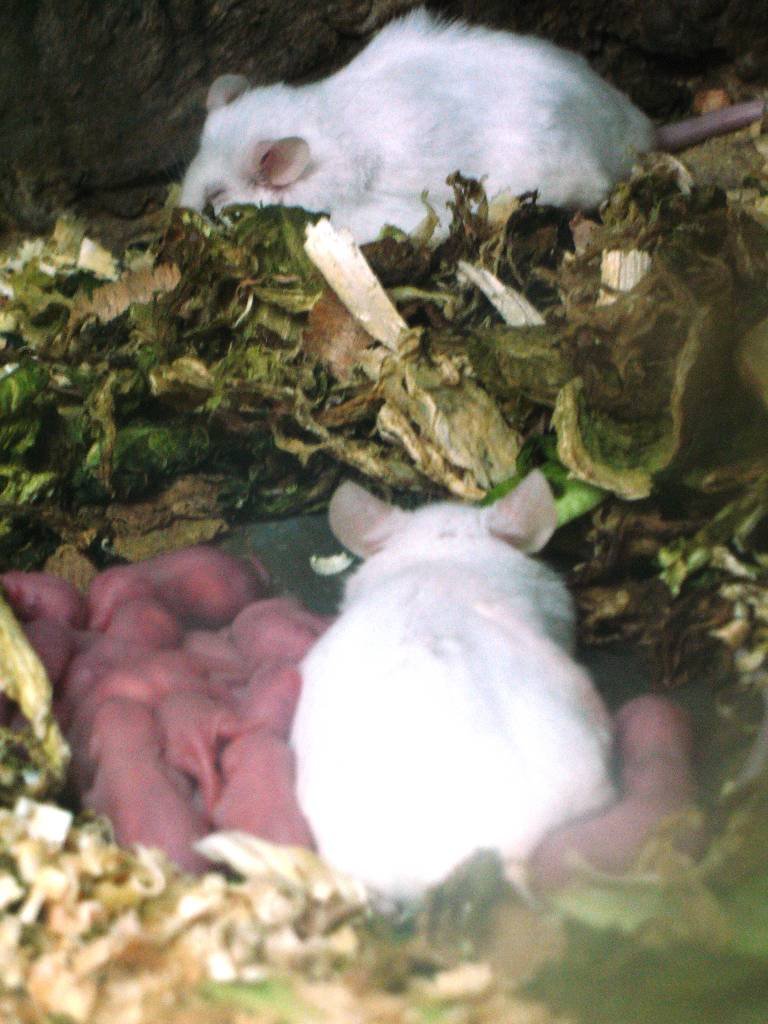
- Adult house mouse: balanced proportions, 2.5–3.5 inch body — what a “small mouse” usually turns out to be. See it beside its young in the plate below.
- Shrew: pointed twitchy snout, tiny eyes, velvet fur, short tail — an insect-eater passing through, not a pantry threat, and not evidence of a nest.
- Vole: stocky, blunt-faced, short-tailed, found near the lawn and mulch rather than the pantry — a yard animal that occasionally wanders in.
- Baby rat: the one that changes the plan — heavier build, thicker tail, blunter face, and feet it hasn’t grown into. A juvenile rat reads “chunky mouse,” and if the droppings run raisin-sized rather than rice-grain (our droppings guide shows both), you’re on the rat page’s problem, at rat scale.

What to Do With the Mouse You Found
Handle the moment first, then the problem. Don’t touch it barehanded — even pinkies can carry the pathogens their mother tracks through droppings and urine; use gloves or slide it into a container with a piece of cardboard. Don’t try to raise it — orphaned wild pinkies almost never survive hand-rearing, wildlife rehabilitators generally don’t accept house mice, and keeping one turns a pest event into a weeks-long project with a sad ending. The humane-and-honest options: for a juvenile, release outdoors well away from structures (knowing its odds are what nature sets for naive juveniles) or a swift dispatch; for pinkies, the kindest realistic option is swift dispatch — slow death by exposure in the yard is not the gentle choice it feels like. Then wash up, and treat the find location as contaminated: disinfect the floor patch and any bedding material, because where baby mice appear, the mother’s traffic pattern crosses. Our humane control guide covers this decision tree at full length, without judgment in either direction.
What not to do with the find: shrug it off. The single mouse in hand is the least significant part of the event — it’s a field report from a nest you haven’t found yet.
Finding the Nest the Baby Came From
Nests sit within thirty feet of food, in the dark and undisturbed: behind and under kitchen appliances (the stove drawer and refrigerator compressor bay are the two we open first), in the backs of deep cabinets and pantry corners, inside stored boxes in garages and basements, in wall voids near plumbing penetrations, under bathroom vanities, and in upholstered furniture in quiet rooms. You’re looking for a softball-sized wad of shredded paper, insulation, or fabric, dense droppings, and an ammonia edge to the air. Track backward from the find: babies appear on the family’s runways, so the nest is along the wall-hugging route between the find spot and the nearest food. Don’t demolish a found nest bare-handed or dry — gloves, and mist it with disinfectant first so disturbed dust stays down; the cleanup protocol matters as much as the discovery.
The Plan That Has to Follow
A baby mouse converts the situation from “maybe a mouse” to “confirmed breeding population,” and the response has to match: a real trapping array (a dozen-plus traps on the runways, not two in the middle of the floor — the full playbook has the layout), food locked down so traps out-compete the pantry (the menu page is the checklist), skip the poison shortcut (nursing females dying in wall voids is the worst version of an already bad method), and once monitors go quiet, seal every quarter-inch entry with metal that holds. Expect the campaign to run two to three weeks precisely because of the nursery math — litters keep fledging into your trap line as they wean, which feels discouraging and is actually the plan working through the population’s pipeline.
Or hand us the whole arc — nest location, removal, sanitation, exclusion, verification — in one service. Get a quote. Serving Dayton and all of Montgomery, Greene, Miami, Clark, Warren, Butler, Preble, and Darke counties.
The Cat Brought Me a Baby Mouse — Does That Count?
It counts double. First, the obvious reading: your cat found an active nest zone, probably indoors, and is working it — cats are superb detection and mediocre eradication, taking the clumsy juveniles while adults learn to route around the predator. Serial gift deliveries over days almost always map to a single nest the cat can’t reach, and the delivery spot tells you nothing; the hunting spot — wherever the cat has been staring at baseboards and appliances lately — tells you everything. Second, the health reading: intercept gifts with gloves, and keep the cat’s flea prevention current, because prey rodents are exactly how fleas and their less famous passengers enter a household. A mousing cat is a useful early-warning system and a terrible complete strategy — population math beats predation every time, which is why farm barns with six cats still have mice.
One Baby Mouse, Zero Other Signs: the Edge Case
Occasionally the find genuinely is isolated — a juvenile that rode in with a box from the garage, a pinkie dropped by a relocating mother mid-move between buildings, a delivery from an outdoor-hunting cat. The way to earn that comfortable conclusion is to test it: a week of detection, not a shrug. Set a few monitored snap traps on likely runways, dust a suspect zone with a flour patch to read tracks, check the classic evidence spots (under the sink, stove drawer, garage corners) with a flashlight at night, and listen at the quiet hour for wall scratching. A true one-off produces a silent week — box checked, story over. An infestation produces evidence within two or three nights, and you’ve converted an ambush into an early start. Either result beats assuming, and the test costs ten dollars and ten minutes.
A note on timing, since baby-mouse finds cluster by season: indoor litters peak twice — spring, when winter populations that moved in around October hit full production, and late fall, when newly arrived females drop their first indoor litters. An August baby mouse is the quieter tell: it means the population never left after last winter and has been breeding through the comfortable months unnoticed. Whatever the month, the response is the same; only the head start differs.
Frequently Asked Questions
I found a baby mouse in my house — what does it mean?
A breeding population is established: adults wander in, but babies are born on site. A pinkie or fuzzy means a disturbed nest within feet; a juvenile means the nest is within ten to thirty feet with your kitchen inside its foraging territory. Either way, the find is a field report, not a stray.
How can I tell how old a baby mouse is?
Pink and hairless with sealed eyes: under 5 days. Fuzzy fur, eyes still closed: 5–10 days. Eyes open, nest-bound mini-mouse: 10–14 days. Fully furred with oversized head and feet, exploring clumsily: 2–3 weeks — the stage most people find. By week 4 it’s functionally adult; females breed at 6–8 weeks.
Is it a baby mouse or a shrew or vole?
Baby mice have big ears, long tails, and head-and-feet proportions they haven’t grown into. Shrews have pointed snouts, tiny eyes, and short tails; voles are stocky, blunt, and short-tailed. A “chunky baby mouse” with a thick tail may be a baby rat — check the droppings size, because that changes the whole plan.
What should I do with a baby mouse I found?
Don’t touch it barehanded — gloves or a container. Don’t try to raise it; hand-rearing wild pinkies almost never succeeds and rehabbers don’t take house mice. Release a juvenile away from structures or dispatch swiftly; for pinkies, swift dispatch is the honest kind option. Then disinfect the find spot and start looking for the nest.
Can a baby mouse survive on its own?
Not before about 3 weeks old — pinkies and fuzzies are fully dependent and die quickly without the mother. Juveniles can survive but are naive; outdoors their odds are what nature sets. The one thing no baby mouse means is “lone survivor” — the litter and mother are nearby.
Where is the nest if I found a baby mouse?
Within about thirty feet, dark and undisturbed, near food: behind the stove or fridge, deep cabinets, stored boxes, wall voids at plumbing, under vanities. Look for a softball-sized wad of shredded material, dense droppings, and an ammonia smell. Wear gloves and mist with disinfectant before removal.
Do baby mice mean a big infestation?
They mean a growing one — mothers re-breed the day they give birth, so the litter you’re seeing has a sibling litter in the pipeline. One breeding female can put dozens of mice into a house in a season. Respond at plan scale: full trap array, food lockdown, then sealing.
Why do I keep finding baby mice but no adults?
Adults are cautious and nocturnal; juveniles are clumsy and bold, so they get seen and caught (by cats especially) far more often. The adults are there — running the walls at 2 a.m. between your find spots.