
“How to get rid of wasps” is a search people type with one hand while holding a citronella candle in the other, usually about four minutes after a yellowjacket helped itself to a bite of somebody’s burger. It is also — and this is the part most articles skip — a question with two completely different answers depending on which insect you’re actually looking at and where its nest actually is. A paper wasp comb under a porch rail is a Saturday-morning job with a $9 can and a ten-foot head start. A yellowjacket colony inside a wall void is a professional job, full stop, and the internet advice that treats them as the same insect is how people end up with two hundred defenders pouring into their living room through an outlet. This guide is the complete Dayton-area version: identification first, because everything downstream depends on it; the DIY protocols that genuinely work for the DIY-viable tier; the bright lines where the job stops being DIY; prevention that actually reduces next year’s nests instead of just relocating this year’s; and the honest economics of both paths.
First, the identification — because the protocol depends entirely on it
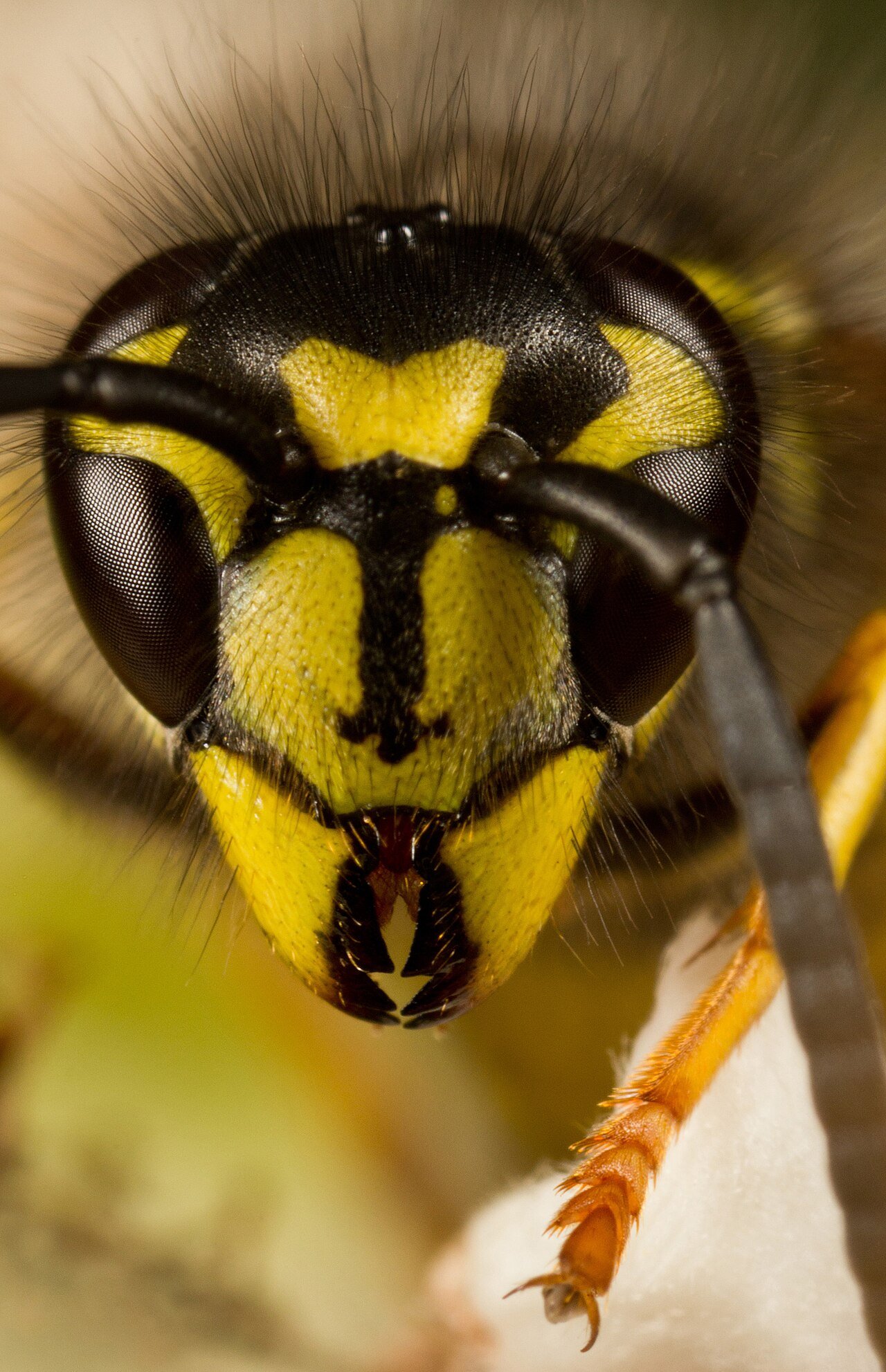
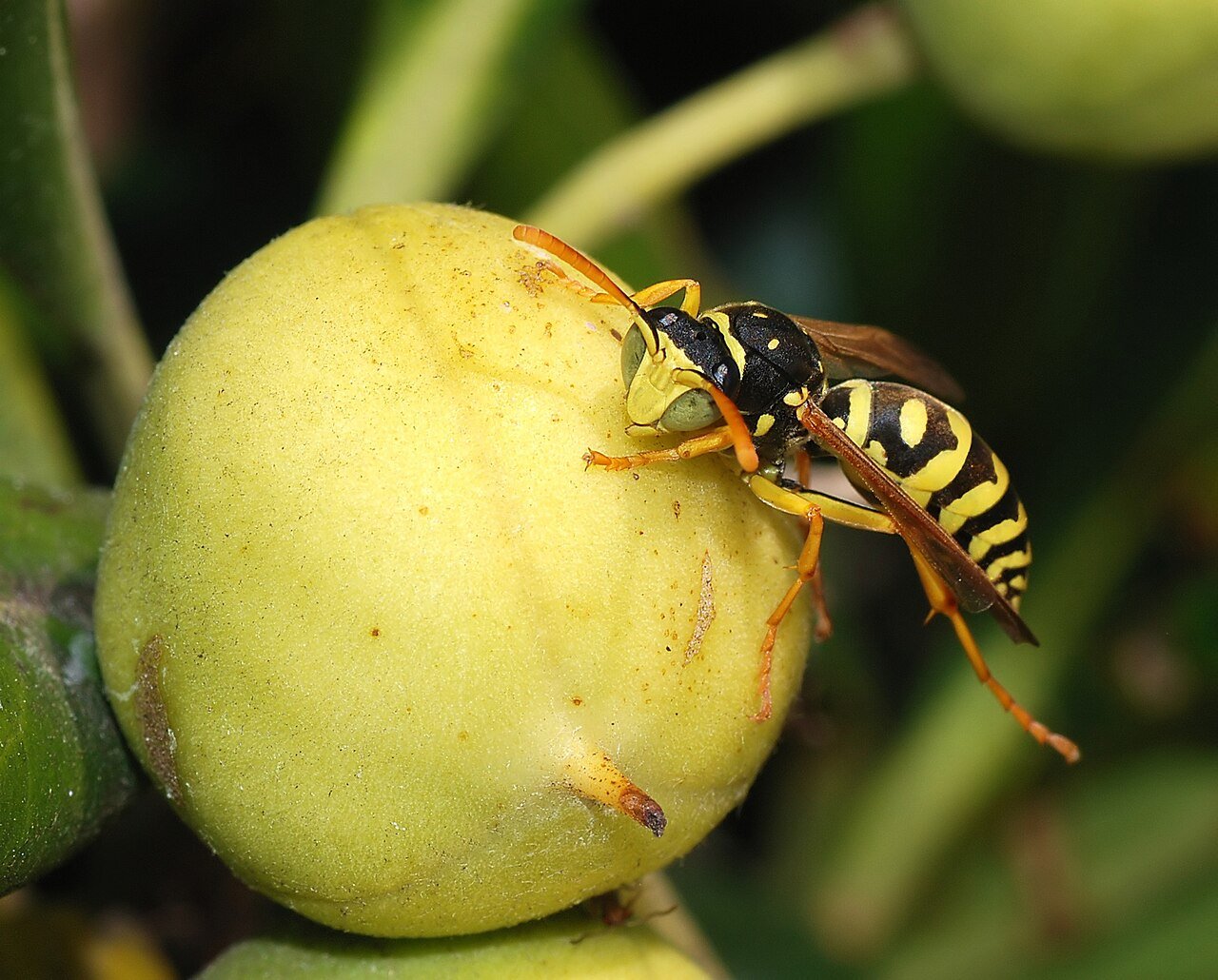
Southwest Ohio’s stinging-insect roster sorts into four working files, and the whole strategy of this page hangs on telling them apart. Paper wasps (Polistes) build the open, umbrella-shaped combs you can see cells in — under eaves, porch ceilings, railings, grill lids, mailbox flaps. Long-legged, slow-flying, brownish to rust-and-yellow, and comparatively reluctant to sting away from the nest. Colonies are small: dozens, not thousands. Yellowjackets (Vespula) are the compact, fast, brightly-banded wasps of picnic fame. Their nests are enclosed and hidden — underground in old rodent burrows, inside wall voids, behind siding — and colonies run from hundreds to several thousand by September. They defend those nests in force. Bald-faced hornets (actually a yellowjacket cousin) build the gray basketball-sized paper globes in trees and on building corners; same aggressive defense, more altitude. And the solitary crowd — cicada killers, mud daubers, ground-nesting digger wasps — which look alarming, nest alone, and almost never sting people at all. We’ve covered those separately in our cicada killer guide, and the short version is: they’re on the do-not-treat list. The sorting rule that runs this whole page: open comb you can see = paper wasp file. Hidden or enclosed nest with heavy traffic = yellowjacket/hornet file. Lone wasp digging in the lawn = leave it alone.
The playbook covers what you can safely do yourself. Where it ends — height, allergy, a nest in a wall — is wasp and hornet removal in Dayton.
The paper wasp protocol — the genuinely DIY-viable file
A paper wasp comb the size of your palm or smaller, in a spot you can retreat from, is the one wasp job we’ll cheerfully tell you to do yourself. Here’s the version that works. Timing is the whole trick: go at dusk or just after dark, when every forager is home and the colony is sluggish with the evening cool. A daytime strike misses half the workforce and leaves angry survivors rebuilding by Wednesday. Use a jet-stream aerosol rated for wasps — the kind that throws a stream fifteen to twenty feet — and stand at the far end of that range with a clear exit path behind you, not a ladder. Soak the comb thoroughly, walk away, and leave it overnight. The next morning, knock the comb down with a broom handle and scrape the attachment point, because the pheromone signature on that spot is a re-nesting invitation all season long. A dab of soapy water on the scar helps. That’s it — three steps, nine dollars, done by breakfast.
The caveats that keep this file honest: don’t do it from a ladder (a defensive swarm plus eight feet of altitude is how emergency rooms meet DIYers); don’t do it if anyone in the household has had a systemic sting reaction — hives beyond the sting site, wheezing, swelling of the face — because the stakes stop being a welt and start being anaphylaxis; and don’t bother with the “spray the nest with the hose” folklore, which converts a stationary problem into an airborne one. If the comb is bigger than your hand, higher than you can reach flat-footed, or over a doorway you can’t close, the $9 math stops working and the phone starts.
The yellowjacket file — where DIY goes to get people stung
Now the other half, and the reason this page exists. A yellowjacket colony in August is not a comb of thirty slow-moving paper wasps. It is an enclosed fortress of one to four thousand fast, boiling-tempered defenders with a single visible entrance and a nest you cannot see. The DIY failure modes are all versions of the same mistake: treating the entrance as if it were the nest. Spraying the hole kills the doorman and enrages the building. Plugging the hole — the single worst move available — traps thousands of workers who then chew a new exit, and if the nest is in a wall void, the new exit is frequently indoors, through drywall or an outlet box, into your kitchen. Pouring gasoline down a ground nest is a real thing people still do; it poisons your soil, violates label law, occasionally catches fire, and works about as well as the other two. A wall-void or high-traffic ground colony is a protective-equipment, dust-application, know-the-anatomy job — which is to say, it’s our job. One visit, the right material carried into the nest by the workers themselves, and the colony collapses within a day or two without the boiling-out phase that makes the DIY versions so memorable.
The picnic problem — when the wasps aren’t nesting on your property at all
A good share of “get rid of wasps” searches aren’t about a nest — they’re about the September patio tax, when every outdoor meal draws a rotating cast of yellowjacket foragers and nobody can find where they live. Here’s what’s actually happening: in late summer, yellowjacket colonies stop rearing brood, the workers lose their protein mission, and the whole workforce pivots to sugar — your soda, your fruit, your grill sauce. The foragers on your table may be commuting from a nest three properties away, which is why spraying your own yard accomplishes nothing. The countermeasures that actually move the needle: serve drinks with lids (a can of pop is the number-one sting-in-the-mouth delivery vehicle in America); put out a decoy — a small dish of sugar water or a piece of fruit fifteen feet downwind, set out twenty minutes before you eat, gives the foragers a better offer than your table; keep trash lidded and rinsed, because an open garbage can is a yellowjacket restaurant with a standing reservation; and pick up fallen fruit if you have any fruit trees, since fermenting windfalls are the single biggest forager magnet in any yard that has them. What doesn’t work: citronella (mosquito-marketing, wasp-indifferent), fake paper nests (foragers ignore them; they deter nest-founding at best, weakly), and swatting — a crushed yellowjacket releases an alarm pheromone that recruits its coworkers, which is why the swat is always followed by reinforcements.
The trap question, answered with a grade sheet
The hardware-store wasp trap aisle deserves the same honest grading we give every deterrent aisle. Bag and bottle traps (grade: C+, seasonal) — they catch yellowjackets by the hundred in late summer, which feels productive, but a colony fields thousands and replaces foragers faster than the trap drowns them. Where they earn the plus: placed at the property line, away from your patio, as interception, they thin the traffic at your table. Placed on the patio itself they’re bait, drawing more wasps to exactly where you eat — the most common trap mistake in America. Homemade two-liter traps (C+) — same physics, same rules, free. Spring queen-trapping (B) — the one genuinely leveraged play: every queen caught in April is a whole colony that never happens in August. A few traps out early, when the big slow overwintered queens are prospecting, buys more relief than a dozen traps in September. Electric zappers (D) — indiscriminate, kill more beneficial insects than wasps, and do nothing about the colony. The through-line: traps manage symptoms. Nests are solved at the nest.
Prevention — the off-season program that decides next summer
Wasp control’s best-kept secret is that the season is decided in April, not August. Every colony in the county — every one — starts as a single overwintered queen looking for a cavity, and the properties that make cavity-hunting difficult get fewer colonies. The program: seal the openings — gaps under siding, unscreened weep holes wider than a pencil, torn soffit vents, the gap where cable enters the wall; every one is a yellowjacket vestibule waiting for a tenant. Screen or cap the classic void entrances: railing post caps, fence pipe ends, playset tubing, the hollow arms of patio furniture. Fill old rodent burrows in the lawn and beds — abandoned vole and chipmunk tunnels are the number-one ground-nest real estate in Ohio, which is one more line on the long list of reasons a rodent program pays compound interest. Knock down early paper wasp starts in May, when a “nest” is a queen and a comb the size of a quarter and removal is a broom-flick with essentially zero risk. And do the spring queen-trap play from the grade sheet above. None of this guarantees a wasp-free summer — queens are numerous and persistent — but it reliably converts “three nests a year” properties into “maybe one” properties.
The sting file — first aid, allergy math, and when to take it seriously
Since this page will be read by people who’ve just been stung, the practical medicine, briefly and without drama. A normal sting reaction is sharp pain, a red welt, and local swelling that can be impressive — a stung hand can puff up for two or three days and still be completely normal. Cold compress, an antihistamine for the itch, elevation if it’s a limb, done. Unlike honey bees, wasps don’t leave a stinger behind, and they can sting repeatedly — which is why the retreat-first advice throughout this page isn’t cowardice, it’s arithmetic. The line that matters: symptoms away from the sting site. Hives on the chest from a sting on the ankle, tightness in the throat, wheezing, dizziness, swelling of lips or eyelids — that’s a systemic reaction, that’s a 911 call, not a wait-and-see. Roughly three percent of adults carry that kind of allergy, many without knowing until the second or third sting. If anyone in your household has ever had a systemic reaction, two standing rules: an epinephrine auto-injector lives wherever they do, and no wasp job on the property is a DIY job anymore — the risk calculus is permanently different, and a $150 service call is cheap insurance against a $3,000 ambulance ride. Multiple stings at once — the boiling-nest scenario — deserve a same-day call to a doctor even without allergy symptoms, especially for kids, seniors, or anyone with heart conditions.
The seasonal calendar — what the wasp year looks like in the Miami Valley
- April–May: overwintered queens emerge and prospect. Colonies are one insect and a golf-ball comb. Everything is easy now — queen traps, broom-flick removals, sealing. The cheapest month on the calendar.
- June: first workers hatch; paper wasp combs reach palm size; yellowjacket colonies are still small and mild-mannered underground. Dusk treatments on visible combs are routine.
- July: colony growth goes exponential. Wall-void colonies become audible — a papery rustle in the wall on quiet evenings. This is the month to call about any enclosed nest, while “hundreds” hasn’t become “thousands.”
- August: peak population, peak defensiveness. Ground nests announce themselves via lawnmower. The wall-void DIY horror stories all date from August.
- September–early October: the sugar pivot — patio harassment peaks even as nests begin declining. New queens and males fly; colonies are at maximum size but past their prime. Patience plus interception traps carries the patio; enclosed nests still warrant treatment if traffic is heavy.
- Hard frost: the amnesty. Every worker dies; only mated queens survive, in leaf litter and under bark — not in the old nest, which is never reused. A frost-killed nest in a wall can be left or removed at leisure; it’s insulation with a history now, though large ones are worth removing before carpet beetles find the leftovers.
“Do wasps do anything good?” — the beneficial-split, wasp edition
Same honest split we ran on the spider page, because it changes what’s worth treating. Paper wasps are among the most effective caterpillar predators in a home landscape — a single comb’s workforce clears hundreds of cabbage worms, armyworms, and hornworms a season, which is why organic gardeners sometimes install nest boxes for them. Yellowjackets, for all their September crimes, spend June and July hauling flies, grubs, and caterpillars into the nest by the thousand. The practical conclusion isn’t “learn to love them” — it’s triage: a paper wasp comb on the back fence, away from doors and play areas, is doing free pest control and can often simply be left to its one-season life. A comb over your front door, a void colony in your wall, a ground nest by the swing set — those get treated regardless of their resume, because proximity trumps ecology every time. The point of a wasp program isn’t zero wasps on the property; it’s zero wasps in the collision zones.
The eight-county wasp report
The pattern holds across our whole service map, with local flavor. Montgomery County’s older housing stock — Dayton, Kettering, Oakwood — runs to wall-void yellowjacket work, because ninety-year-old balloon framing offers cavity real estate a queen can’t resist. Greene County’s newer builds in Beavercreek and Fairborn skew toward ground nests at the lawn-to-woodline seam and paper wasps on young, sun-baked vinyl. Warren County’s big lots in Springboro and Franklin produce the classic mower-meets-ground-nest call every August. Miami County’s farm-adjacent properties add outbuildings — barns and pole buildings are paper wasp condominiums — and Preble County’s rural parcels give us the county’s biggest bald-faced hornet globes, hung fat and gray in fencerow maples. Different architecture, same physics, same protocols.
When to call us — the bright lines, gathered in one place
- Any enclosed nest: wall voids, soffits, attics, under siding, in the ground with heavy traffic. This is the file where DIY injuries live.
- Any nest over a door, walkway, deck stair, or play area — the collision zones, where “mostly docile” isn’t docile enough.
- Anything above flat-footed reach. Ladders and defensive swarms are a combination with its own wing of the ER.
- Bald-faced hornet globes, any size, any location. The defense radius and sting budget are simply out of DIY range.
- Any household with a sting allergy — the standing rule from the sting file, permanent and non-negotiable.
- Repeat offenders: a property growing multiple nests a year has a cavity problem, and our visit pairs removal with the sealing audit that ends the cycle.
What a visit looks like: identification confirmed on sight, the nest treated with the right material for its architecture — dust for voids and ground nests, direct treatment for combs and globes — the entrance left open so returning foragers carry the material inward, and removal of accessible nest structure once the colony is down. Under our Protection Plan, wasp coverage is part of the standing service, and re-treatment within the plan’s terms is on us. One-time wasp jobs are flat-priced by nest type — call (937) 569-3330 and describe what you’re seeing, and we’ll tell you on the phone whether it’s a $9 dusk job you can do yourself or a visit. We routinely talk people out of service calls on palm-sized paper wasp combs; the trust is worth more than the trip charge.
The bottom line
Identify first: open comb, hidden fortress, or harmless loner. DIY the small visible combs at dusk with a jet aerosol and a retreat path. Never spray, plug, or fuel-douse an enclosed nest — that’s the entire injury file in three verbs. Manage the September patio with lids, decoys, and interception, not swatting. Win next year in April with sealing, cavity-capping, burrow-filling, and queen traps. And keep two files permanently professional: enclosed nests and allergic households. That’s the whole playbook — the season’s worth of wasp calls, condensed to a page you found before the second sting.
If the nest is in the ground or inside a wall and it is August, you are most likely dealing with yellow jackets specifically. Yellow jackets in Ohio covers that case in detail, including why sealing the entrance of a structural nest is the wrong move.
Frequently asked questions
How do I get rid of wasps around my house?
Sort by nest first: visible palm-sized paper wasp combs are a DIY dusk job with a jet aerosol; anything enclosed — ground holes, wall voids, gray globes — is professional work at any size. For nestless patio harassment, it’s lids, decoy stations, and interception traps at the property line, not sprays.
What kills wasps instantly?
Jet-stream wasp aerosols knock down individuals and small exposed combs on contact — that is their one legitimate job. Nothing kills an enclosed colony “instantly,” and products that claim to are how the wall-void horror stories start.
When is the best time to spray a wasp nest?
Dusk or just after dark, when the full workforce is home and cold-sluggish — never midday, when half the colony is out and returns angry. Stand at the aerosol’s full range with a clear retreat path, soak the comb, walk away, knock it down next morning.
How do I get rid of wasps without getting stung?
Distance, darkness, and the right target: only attempt visible reachable combs, work at dusk from fifteen feet, never from a ladder, and never touch enclosed nests. Most stings come from the never-list — sprayed entrances, plugged holes, and mower-versus-ground-nest — not from careful comb treatment.
What keeps wasps away from my patio?
Lidded drinks (the sting-in-the-mouth vehicle), rinsed trash cans, a decoy dish of sugar water fifteen feet downwind set out before you eat, and interception traps at the property edge — never on the patio, where traps recruit. Citronella and fake nests grade D; the decoy play genuinely works.
Why are wasps so aggressive in late summer?
Colonies peak in August–September just as brood-rearing ends and the workforce pivots to sugar — more wasps, less mission, maximum patio interest. It is a calendar event, not a mood; the same colony was docile in June.
How do I get rid of wasps in the ground?
Do not pour anything in the hole — gasoline is illegal and dangerous, spray enrages, plugging redirects. Flag the entrance, mow around it, and have it dusted professionally: workers carry the dust inward and the colony collapses in a day or two.
What if wasps are going into my siding or soffit?
That is a void colony — the never-DIY file. Do not seal the hole (trapped colonies chew new exits, sometimes indoors). Call promptly; the price includes the treatment, the die-off window, and the return visit to seal, in the only order that works.
Do wasp traps work?
As interception at the property line, modestly — grade C+; as spring queen traps in April, genuinely — grade B, because every trapped queen is a canceled colony. On the patio itself they recruit more than they catch; placement is the whole game.
Will wasps go away on their own?
Yes — every Ohio colony dies at hard frost and never reuses the nest, making November the free treatment date for any nest positioned where you can wait. The honest question is whether the location lets you wait; collision zones usually cannot.
What smells or plants repel wasps?
Nothing reliably — peppermint folklore and repellent plants fail every controlled test worth citing. Prevention that works is mechanical: sealing, cavity caps, early comb patrol, and the spring queen play.
How do I keep wasps from coming back next year?
Seal by late August: siding gaps, vents, railing ends, weep holes, old rodent burrows in the lawn. Nests are never reused, but good cavities re-audition annually — the caulk gun is next year’s wasp control, applied this year.
Are wasps good for anything?
Genuinely — paper wasps clear caterpillars by the hundreds and yellowjackets haul flies and grubs all summer. The strategy is triage, not extermination: back-fence combs can stay on payroll; collision-zone nests get treated regardless of their resume.
What is the difference between a wasp sting and a bee sting?
Wasps sting repeatedly and leave no stinger; honey bees sting once and die. Treatment is identical — cold compress, antihistamine — and the emergency line is identical too: symptoms beyond the sting site (hives elsewhere, wheezing, facial swelling) mean 911, whatever the insect.
How dangerous are wasp stings really?
For most people: pain, swelling, done. For the ~3% with systemic allergies: potentially anaphylactic, which is why allergy households get our standing rules — no DIY wasp work ever, epinephrine wherever the person is, and priority routing when they call.
What are the wasps flying at night around my porch light?
European hornets — Ohio’s only night-flying wasp, big, chestnut-brown, and calmer than they look. The porch light is an insect buffet, not an attack; the nest is a cavity nearby and usually not on your structure.
How much does professional wasp removal cost?
By situation: accessible combs at the low end, ground and aerial colonies mid-range, wall voids highest (two visits built in). Describe or photograph the nest and we quote on the phone, free — and we regularly talk callers out of paying us for $9 dusk jobs: (937) 569-3330.
Can you prevent wasps entirely with regular service?
The Protection Plan gets close: quarterly inspections catch founding combs at golf-ball size (a thirty-second removal), the sealing stays maintained, and re-service between visits is free. Plan customers rarely ever meet an August colony.
What should I do about a wasp inside my house?
Open a window and dim the room — it navigates to light and self-deports more often than not. Otherwise: cup-and-card at a window, or the vacuum. One indoor wasp is a straggler; a stream of them means a void entrance worth finding.
Wasps keep landing on my hummingbird feeder and pool. Help?
Both are sugar-and-water stations. Feeders: switch to bee-guard ports and move the feeder — wasps re-map slowly. Pools: nothing personal, they are drinking; a shallow decoy water dish with landing stones ten yards away out-competes the pool edge surprisingly well.