Nobody in Ohio calls about yellow jackets in June. The phone starts in the second week of August and does not stop until the first hard frost, and the reason is not that the wasps arrived in August. They were there all summer, quietly, in a hole in the lawn or a gap under the siding. What changes in August is the colony, and understanding that one shift explains almost everything people find confusing about yellow jackets: why they suddenly seem aggressive, why they want your drink, why the nest that was invisible in July is now a stream of traffic, and why the thing you tried at dusk did not work.
This page is about the Ohio version of that story: which species we actually have, the calendar they run on in this climate, where the nests turn out to be, and the specific things people do every year that make it worse. If what you have is up under a soffit and shaped like a gray paper football, you may want the bald-faced hornet page instead, and if you are not sure what you are looking at, start with nest identification.
A ground nest in August is the one that sends people to hospital, and it is not a shovel job. That is wasp and hornet removal in Dayton.
Which yellow jackets Ohio actually has
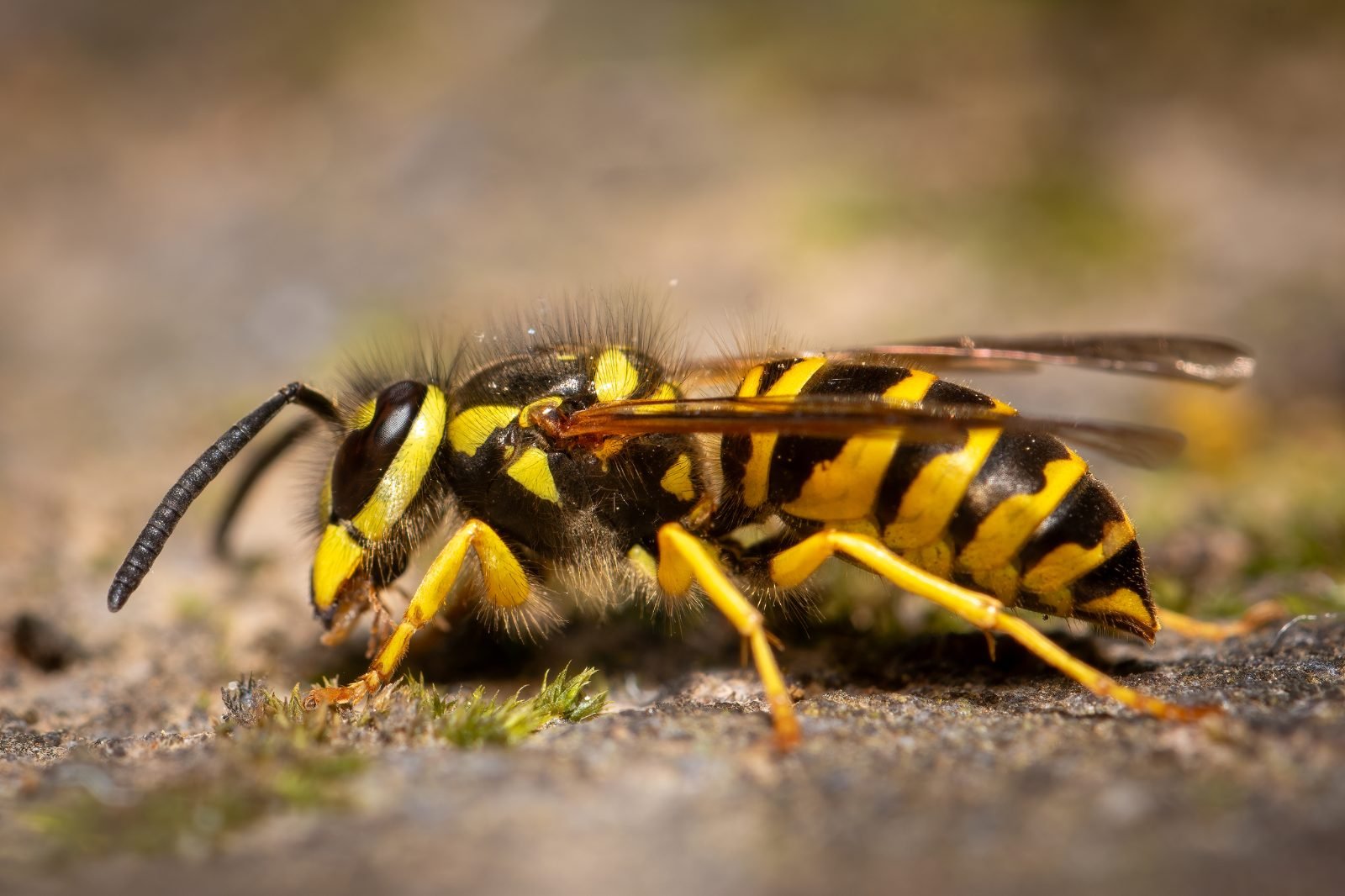
Two species account for most of the trouble here. The eastern yellow jacket, Vespula maculifrons, is the native ground nester and the one behind the classic experience of running a mower over a patch of lawn and being stung six times before reaching the porch. The German yellow jacket, Vespula germanica, is introduced, and its important habit is a preference for cavities in structures, which is why it turns up in wall voids, attics, and the space behind soffits far more often than the eastern does.
A third insect gets grouped in and should not be. The common aerial yellow jacket, Dolichovespula arenaria, builds an exposed gray paper nest in shrubs, under eaves, and in low tree branches. It is a yellow jacket by name and looks broadly similar, but it nests in the open rather than in a cavity, and an exposed nest is a fundamentally different job from a colony inside a wall. Bald-faced hornets, which are black and white rather than yellow, are close relatives that build the same style of exposed nest.
The distinction that matters most in practice, though, is yellow jacket versus honey bee. Honey bees are fuzzy, amber and brown, deliberate in flight, and they die after stinging. Yellow jackets are smooth, glossy, sharply banded black and yellow, quick and darting, and they sting repeatedly without harm to themselves. Honey bee colonies should be removed by a beekeeper, not killed, and every year somebody in the Miami Valley destroys a honey bee colony because it was called a yellow jacket over the phone. If there is any doubt, a photograph settles it in seconds. Our guide to Ohio bees covers the ones worth protecting.
The Ohio colony calendar, which explains everything else
A yellow jacket colony lives one year and then dies. Nothing overwinters except mated queens, which spend the cold months tucked under bark, in leaf litter, or in a wall void, alone. In April and May each surviving queen starts a nest by herself, builds a few cells, and raises the first small batch of workers personally. Through June and July the colony grows quietly, and it is genuinely small; a nest that will eventually hold thousands might have a few dozen workers in early July. This is why nobody notices.
By mid-August the colony is at or near peak population, which for an eastern yellow jacket nest in Ohio commonly means several hundred to a few thousand workers, occasionally more in a mild year. At the same time the queen shifts from producing workers to producing next year’s queens and males, and brood rearing winds down. That shift is the hinge.
Here is why. Through the growing season, workers hunt insects and feed the protein to the larvae, and the larvae reward them with a sugary secretion. It is a closed loop, and the workers get most of their carbohydrate from it. When brood rearing stops, that reward disappears, and a few thousand workers with nothing to do and no sugar source go looking for one. They find it at your cookout, in your open soda can, at the hummingbird feeder, around fallen pears and rotting apples, and in the trash can behind the garage. The insects did not turn aggressive. They ran out of a job and a food source at the same time.
The whole thing ends at frost. The colony dies, the queens disperse to overwinter, and the nest is never reused; next spring’s nest will be a new one in a new place, though a good site often gets reused by a different queen. That means a nest found in late October is often already finished, and a nest found in early August has six to eight weeks of increasing traffic ahead of it.
Where the nests actually are
Ground nests are the classic. Yellow jackets take over abandoned rodent burrows, voids under tree roots, gaps beneath landscape timbers and railroad ties, and the space under a slab or a stoop. From above, the entire nest is a single hole in the dirt about the diameter of a quarter, often with no visible structure at all, which is why they are so reliably found by lawnmowers and string trimmers rather than by eye. Watch the hole from a safe distance in mid-morning and the traffic pattern is unmistakable: a steady in-and-out stream on a fixed flight line.
Structural nests are the ones that cause the expensive problems. German yellow jackets in particular will move into a wall void through a gap in siding, a weep hole, a gap around a dryer vent, or a soffit seam, and build a nest between the exterior sheathing and the interior drywall. The entrance may be twenty feet from the nest itself. These are the colonies that eventually chew through drywall into a bedroom, which sounds like a horror story and is simply what happens when a growing colony expands in the only direction with soft material.
The Miami Valley pattern we see most: ground nests along the edges of yards backing onto woods or fields, structural nests in older homes with wood siding and imperfect soffit closure, and aerial nests in the ornamental shrubs and low maples people plant near patios. Decks are their own category, because the void under a low deck combines darkness, shelter, and easy access, and it puts the colony precisely where people sit.
Stings: what is normal and what is not
A yellow jacket defends its nest, and the defensive radius grows as the colony does. In August, ground vibration from a mower thirty feet away is enough. Unlike a honey bee, a yellow jacket has a smooth stinger and can sting repeatedly, and an alarmed colony recruits: the first sting releases an alarm pheromone that brings others to the same spot, which is why yellow jacket incidents are rarely a single sting.
A normal reaction is immediate sharp pain, then redness and swelling around the site that peaks within a day or two. Swelling that extends well beyond the sting, such as an entire forearm from a sting on the hand, is a large local reaction; it is uncomfortable and alarming but generally not dangerous, though it is worth telling a doctor about. The reaction that matters is systemic: hives away from the sting site, swelling of the lips, tongue, or throat, difficulty breathing, dizziness, or vomiting. That is anaphylaxis, it can develop within minutes, and it is an emergency. Call 911.
If someone in the household has a known sting allergy, treat a nest on the property as a genuine priority rather than a nuisance, and do not attempt it yourself. The same applies if the nest is near a doorway, a walkway, a child’s play area, or anywhere a person will pass without thinking. Position matters more than size when we prioritize these jobs.
The five things people do every August that make it worse
We get called after these more often than before them, so here they are plainly.
Gasoline or fire on a ground nest
This is the one that occasionally makes the news. Pouring gasoline into a ground nest does not reliably kill the colony, it contaminates soil and groundwater, and it creates a vapor pool that has burned people badly and set houses on fire. Lighting it is worse. There is no version of this that is a good idea, and the fact that it worked for somebody’s grandfather is survivorship bias.
Plugging the entrance of a structural nest
Sealing the hole in the siding feels decisive and is close to the worst possible move. The colony does not starve quietly; it looks for another way out, and the only soft material between it and open air is your drywall. Foam or caulk over a wall-void entrance is the standard prelude to yellow jackets in an upstairs bedroom. Seal the entrance only after the colony is confirmed dead, which is a real step and one we do.
Flooding a ground nest with a hose
Ground nests survive rain routinely and are built to shed water. A garden hose typically produces a very angry colony, a muddy yard, and nothing else. Soapy water has a slightly better reputation and still does not reach the brood in a nest of any size.
Spraying the visible opening in the middle of the day
Half the colony is out foraging at noon, so a daytime treatment kills the wrong half and leaves several hundred returning workers with a damaged nest and an alarm pheromone plume. If a nest is treated, it is treated at dusk or after dark when the colony is home, with a planned exit route, and by someone dressed for the possibility that it goes badly.
Standing on a ladder to reach an aerial nest
The failure mode here is not the stings; it is the fall. Almost every serious yellow jacket injury we hear about involved a ladder and a startled reflex. If the nest requires a ladder, that alone is a reason to make it someone else’s problem.
Living with them until frost, if the nest is not a threat
Not every nest needs treating. A ground nest at the back of a two-acre property, well away from anywhere people walk, will be dead by November whether or not anyone touches it, and yellow jackets are meaningful predators of caterpillars and other soft-bodied insects through the summer. If it is genuinely out of the way, leaving it alone is a legitimate choice and we will say so.
If you are living alongside one, a few things reduce contact substantially. Keep outdoor trash cans closed and rinsed, since fermenting sugar in a can is a stronger attractant than anything on the table. Use cups you can see into rather than cans, because the standard emergency-room yellow jacket story is a sting inside the mouth from a wasp in a soda can. Pick up windfall fruit. Move the hummingbird feeder away from seating. Cover food until it is being eaten, and do not swat, since crushing a yellow jacket releases the alarm pheromone that brings others.
And mow the perimeter carefully in August. Walk the edges first and watch for flight lines before starting the mower, particularly along fence rows, around tree bases, and near any old burrow. Two minutes of looking has saved a great many people a very bad afternoon.
When to call, and what we do
Call when the nest is near a door, walkway, deck, patio, or play area; when it is inside a wall, soffit, attic, or under a low deck; when anyone on the property has a sting allergy; when the nest needs a ladder to reach; or when a previous attempt has already stirred it up. Those are the cases where the risk of a do-it-yourself attempt genuinely exceeds the cost of the visit.
Structural nests are the ones worth calling about early rather than late, because a colony in a wall void gets harder every week it grows and because the wrong move seals it inward. For ground and aerial nests we treat the colony directly at the nest rather than spraying the surrounding area, and for structural nests we treat through the entrance and then close it once the colony is confirmed dead, in that order. Wasp and hornet removal covers what a visit involves, and professional nest removal goes into the structural cases.
Frequently asked questions about yellow jackets in Ohio
What kind of yellow jackets are in Ohio?
Two species cause most of the trouble: the eastern yellow jacket, Vespula maculifrons, which nests in the ground, and the German yellow jacket, Vespula germanica, which is introduced and prefers cavities in structures such as wall voids and soffits. The common aerial yellow jacket, Dolichovespula arenaria, builds exposed gray paper nests in shrubs and under eaves and is often lumped in with them.
Why are yellow jackets so aggressive in August and September in Ohio?
Because the colony stops raising brood. Through the summer workers feed insects to the larvae and receive a sugary secretion in return, which is their main carbohydrate. When brood rearing ends in late summer, that food source disappears at the same moment the colony hits peak population, leaving hundreds or thousands of workers with no job and no sugar. They go looking, which puts them at your cookout.
Do yellow jackets die in the winter in Ohio?
The colony does. At frost the workers, males, and old queen die, and only newly mated queens survive, overwintering alone under bark, in leaf litter, or in a wall void. The nest is never reused. A nest discovered in late October is often already finished, which is why timing changes the advice.
How many yellow jackets are in a nest?
An Ohio ground nest at peak commonly holds several hundred to a few thousand workers, occasionally more after a mild winter and an early spring. In early July the same nest might have a few dozen. That growth curve is why a nest nobody noticed in June becomes obvious in August.
Can yellow jackets sting more than once?
Yes. Unlike a honey bee, a yellow jacket has a smooth stinger and can sting repeatedly. Worse, the first sting releases an alarm pheromone that recruits nestmates to the same target, which is why yellow jacket incidents usually involve several stings rather than one.
Is it safe to pour gasoline in a yellow jacket nest?
No. It does not reliably kill the colony, it contaminates soil and groundwater, and the vapor pool it creates has caused serious burns and house fires. Lighting it is worse still. This is the single most dangerous piece of folk advice about yellow jackets and it circulates every August.
What happens if I plug the hole where yellow jackets are getting into my siding?
They find another way out, and the softest material between the nest and open air is usually your drywall. Sealing the entrance of an active structural nest is a common prelude to yellow jackets inside the house. The entrance gets sealed after the colony is confirmed dead, never before.
How do I tell a yellow jacket from a honey bee?
Yellow jackets are smooth and glossy with sharp black and yellow banding, and they fly quickly and erratically. Honey bees are fuzzy, amber and brown, and fly deliberately. Honey bees also die after stinging, while yellow jackets do not. The distinction matters because honey bee colonies should be relocated by a beekeeper rather than killed.
When should I worry about a yellow jacket sting?
Pain, redness, and local swelling are normal. Swelling spreading well beyond the site is a large local reaction, uncomfortable but usually not dangerous. Hives away from the sting, swelling of the lips, tongue, or throat, trouble breathing, dizziness, or vomiting indicate anaphylaxis, which can develop within minutes and is a medical emergency. Call 911.
Do I have to treat a yellow jacket nest at all?
Not always. A ground nest far from where anyone walks will die at frost on its own, and yellow jackets are useful predators of garden caterpillars through the summer. Treat when the nest is near a door, walkway, deck, or play area, when it is inside a structure, when someone has a sting allergy, or when reaching it would require a ladder.