
Mouse poison is the pest aisle’s biggest seller and this library’s most requested honest review — so here it is, from a company that stocks rodenticide on its trucks and reaches for it last: poison is the worst first move in residential mouse control, not for sentimental reasons but for engineering ones, and the household that understands what the little blocks actually do — to the mouse, to the wall it dies in, to the owl that eats it, and to the problem it never solves — almost always chooses differently. The complete file: how the modern anticoagulants and their newer cousins actually work (the days-long mechanism is the source of every downstream problem), the wall-void die-off that converts a $15 purchase into a $300 odor call, the secondary-poisoning ledger the humane page introduced and the wildlife data has since made grim, the child-and-pet file with its poison-control statistics, the regulatory shift that already pulled the worst products from consumer shelves, the narrow scenarios where professional baiting genuinely earns its place (they exist — in tamper-proof stations, at scale problems, placed by license), and the alternative program that outperforms the blocks at every residential job we run. Greater Dayton Pest & Rodent, exclusion-first and poison-last on every truck: (937) 569-3330.
How the blocks work (and why slow is the whole problem)
Modern rodenticides run three chemistries, and their shared design choice explains everything downstream. Anticoagulants dominate: first-generation compounds (warfarin lineage) requiring multiple feedings, and the second-generation single-feed compounds (brodifacoum, bromadiolone) — all blocking vitamin-K recycling so clotting fails over three to seven days, ending in internal bleeding. The delay is deliberate: rodents are bait-shy and learn to associate quick sickness with new foods, so effective poisons must strike days after the meal — the same colony-economics insight the bait doctrine uses honorably against insects, here producing an animal that feeds normally for days while lethally dosed (and keeps feeding — accumulating multiples of the lethal dose, a detail the owl section cashes out). Bromethalin — the fast-rising non-anticoagulant — kills via nerve-cell energy failure in one to three days, with no antidote (the veterinary emergency the pet section flags). Cholecalciferol — megadose vitamin D — runs a similar no-antidote course through calcium toxicity. The engineering takeaways before any ethics arrive: every product needs days of post-feeding mobility — days the mouse spends wherever it likes, which for an indoor population means the wall voids, and days its body spends loaded — which for everything that eats mice means the food chain. Slow was the feature; slow is the problem; and the next two sections are just that sentence, itemized.
The wall-void ending (the $15 purchase’s $300 sequel)
The residential poison story ends the same way often enough that our schedule reserves slots for it: the dosed mouse, dehydrated and failing over its final days, retreats to the safest place it knows — the nest, in the wall void, under the tub, behind the cabinet kickplate — and dies there, beginning the sequel nobody priced. Days later the odor arrives (a mouse-sized carcass scents a room for one to three weeks; a rat-sized one, longer), then the blow-fly bloom that announces the address, then the larder-beetle cleanup crew, and sometimes the mite dispersal that converts a dead rodent into a biting mystery — the full cascade this library has documented from four different directions, all downstream of one bait block. The retrieval call — locate by smell and fly evidence, open the wall, remove, sanitize, repair — runs real money and rarely lands on the poison’s receipt. (The folk belief that poisons “make mice seek water outside” is packaging mythology with no biological basis — anticoagulant thirst is real; the direction of dying is not steerable.) Tally the full residential ledger: the blocks kill some mice, in your walls, over days, while the reachable-everywhere population back-fills through the entries nothing sealed — the subscription model this library keeps finding wherever biology gets fought instead of buildings.

The owl ledger: secondary poisoning’s field data
The wildlife file has moved from concern to documentation, and the numbers deserve plain statement: surveys of dead and injured raptors across North America now find anticoagulant residues in overwhelming majorities of tested birds — the published figures run 80-plus percent in red-tailed hawks and great horned owls in multiple studies, with second-generation compounds dominating — because a dosed mouse’s final mobile days are spent slow, exposed and easy to catch, carrying accumulated multiples of a lethal dose into whatever eats it. The same pathway runs through foxes, coyotes, and the neighborhood’s cats; the fisher and bobcat literature reads similarly; and the bitter arithmetic for a household is the one this library’s predator-recruitment doctrine makes obvious: a barn owl family takes a thousand-plus rodents a season — the best standing rodent control any rural property will ever host — and the bait block’s food-chain tax falls precisely on that workforce, trading the permanent patrol for a week’s corpses. This is why the regulatory tide turned (second-generation compounds pulled from consumer retail in 2015-era EPA action, California’s broader moratorium since, litigation ongoing), why our own rodenticide use lives in tamper-proof stations at documented scale problems rather than residential first-response — and why the honest answer to “what should I buy instead of poison” has been sitting in this library’s rodent wing all along: steel, snap, and seal, next section.
The child-and-pet file, and the narrow case for professional baiting
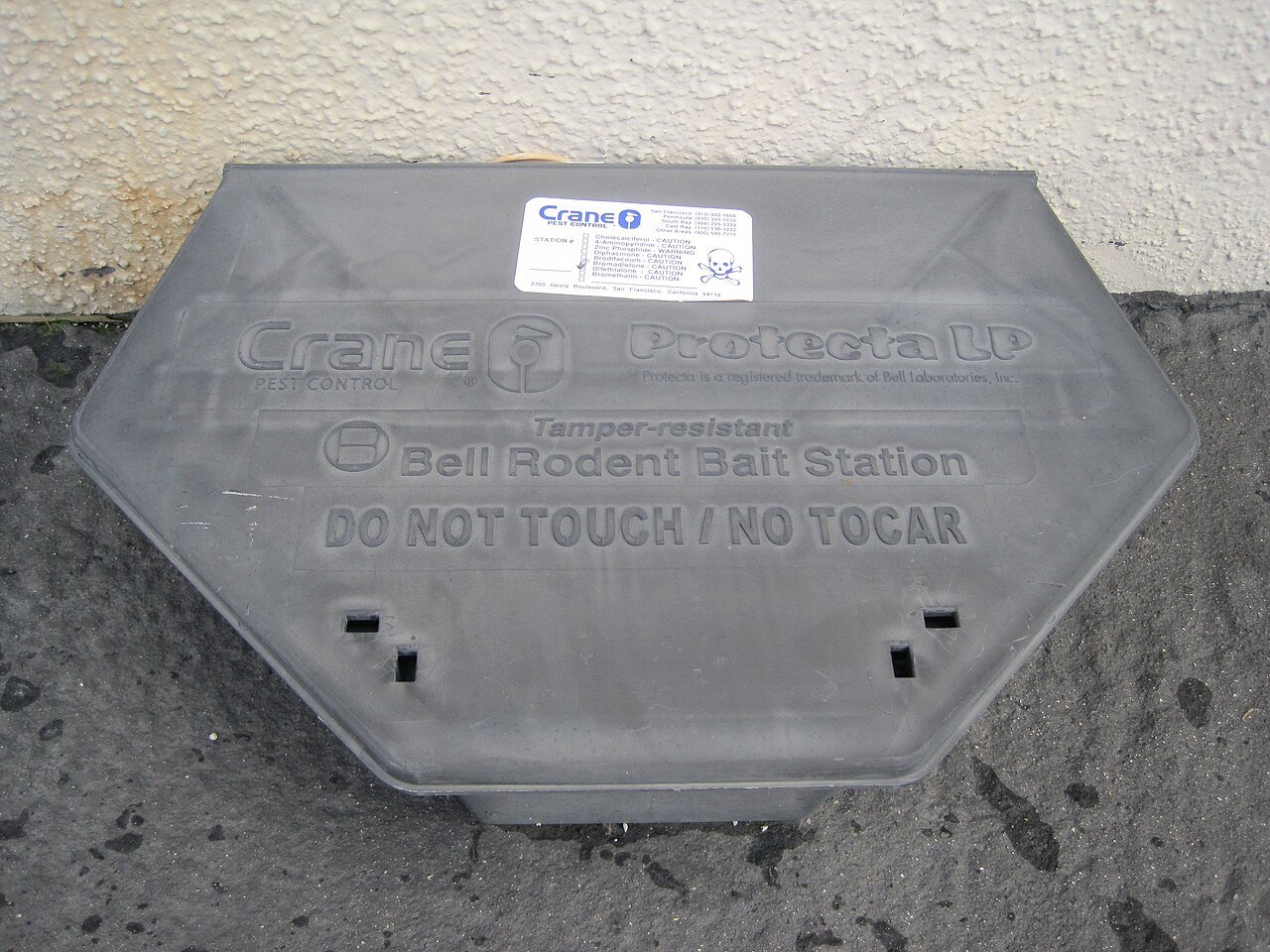
Two more ledger lines complete the residential case. The exposure file: rodenticides rank among poison control’s most-reported household exposures year after year — tens of thousands of annual US calls, the majority involving children under six, because the blocks are grain-and-sugar formulated to be eaten and are deployed, in the classic residential pattern, loose behind the stove and under the sink at exactly toddler-and-terrier height. Dogs account for the veterinary side’s steady traffic (the anticoagulants have a vitamin-K antidote if caught; bromethalin does not — a product-label detail that decides emergency outcomes), and relay toxicosis — the pet that eats the poisoned mouse — adds a slower second route. Every line of this file is a placement failure as much as a product one, which frames the honest professional exception: where rodenticide genuinely earns deployment — established rat populations at structural scale, farm-and-commercial pressure the rural accounts know, sites where trapping capacity can’t match reproduction — it goes into locked, tamper-resistant, anchored stations, labeled and mapped, placed by licensed hands at documented intervals, with the die-off managed as part of the program. That’s the entire legitimate residential-adjacent role: a controlled tool inside a monitored program — never a loose block behind the fridge, and never the program itself.
What outperforms the blocks (the program, one more time)
The alternative isn’t a gentler product — it’s the program this wing has built across five pages, and it wins on pure results: exclusion — the twelve doors plus the vertical tier, sealed at the dime standard, ending supply rather than managing inventory; population clearance by snap trap — instant, targeted, retrievable (the carcass ends up in your trash, not your wall), run on the seal-all-but-one protocol that clears residents before the final door closes; food discipline — the pantry-and-pet-food hygiene that makes traps compelling and re-invasion pointless; and verification — monitors and the date-stamped evidence stage proving quiet instead of assuming it. Cost comparison, honestly run: the DIY version of that program prices near the poison aisle’s annual spend; the professional version costs more once and ends the file — guaranteed, since re-entry through our seal is our return trip. The blocks’ only genuine advantage was ever effortlessness, and the wall-void sequel bills for that too. Steel, snap, seal, verify: the residential answer, four words long, no antidote required.
Mouse poison questions, answered
I already put poison out and now there’s a smell. What’s the sequence?
Stop the baiting, ventilate, and run the locate protocol: follow the odor gradient room to room, watch for the fly concentration at the source wall, and check the accessible voids first (under tubs, cabinet kickplates, drop ceilings). Found = respirator-and-gloves removal per the cleanup protocol, then enzyme treatment. Unfindable = the honest options are the borescope call or the two-to-three-week wait the odor timeline runs, plus the mite-watch the timing occasionally warrants. Then the program above, so the sequel has no sequel.
The dog ate a bait block — or maybe a poisoned mouse. Now what?
The block: veterinary contact NOW with the product name in hand — anticoagulant ingestions caught early respond to vitamin-K therapy; bromethalin has no antidote and the early window is everything; the ASPCA poison line runs 24/7 as backup. The mouse: lower single-event risk but same call, especially for repeated scavenging. And either way the incident retires loose baiting at your address permanently — the stations-or-nothing rule exists because this exact afternoon is common enough to have a protocol.
Do the “natural” poison alternatives (corn gluten, cellulose baits) grade any better?
Marginally on the food-chain axis, poorly on everything else: the dehydration-mechanism products still deliver the slow wall-void ending, efficacy runs weaker and slower than the chemistry they replace, and the child-pet palatability problem is identical. They solve the poison aisle’s guilt, not its engineering — and the program that actually solves both was never in that aisle.
Why does your company carry rodenticide at all, given this page?
Because the narrow case is real: rat-scale and commercial-scale problems where trapping arithmetic genuinely fails, served by licensed placement in locked stations inside monitored programs — the tool’s honest habitat. The page’s argument was never that the chemistry has no use; it’s that residential mouse control isn’t it, and a company that reaches for the blocks first at a house call is solving its own labor cost, not your mouse problem. Ask any operator where poison sits in their sequence; the answer is the whole audit.
The verdict on the little blocks
Mouse poison, fully accounted: a days-long mechanism that parks carcasses in walls, taxes the owl-and-fox workforce that out-hunts every product ever shelved, tops the poison-control call logs, and never once seals the gap the next mouse is already using — against a program of steel mesh, snap traps, food discipline and verification that costs comparable money and ends the file. The blocks keep their narrow, stationed, licensed role at scale problems; the residential first-response verdict goes — permanently, and on the engineering alone — to the building. For the retrieval calls, the station-scale programs, and the exclusion work that makes this entire page moot at your address: (937) 569-3330, Greater Dayton Pest & Rodent, Dayton and all eight counties — poison-last, and proud of the sequence.
The regulatory arc (where the law already agrees)
For the reader wondering whether this page’s verdict is one company’s opinion: the regulatory record has been converging on it for fifteen years. The EPA’s 2008-2015 risk-mitigation cycle pulled second-generation anticoagulants from general consumer retail and mandated the bait-station formats that now define the shelf — a direct response to the child-exposure and wildlife data above; California’s 2020 moratorium went further, suspending most second-generation use statewide pending ecological review, with litigation and legislation still expanding the carve-outs; British Columbia ran a similar suspension; and the EU’s biocide framework has ratcheted its own restrictions on the same compounds for the same reasons. The professional industry’s own trajectory tracks alongside: integrated-pest-management standards now place rodenticide behind exclusion and trapping in the published hierarchies, the certification curricula teach the sequence this page argues, and the market’s growth products are the monitoring and exclusion technologies, not new chemistries. None of this outlawed the tool — the stationed, licensed, scale-problem role survives every regime — but the direction is unambiguous: the era of the loose block behind the stove is closing by statute where it hasn’t already closed by sense, and the household that adopts the steel-snap-seal program today is simply early to where the rules are headed. This library enjoys being ahead of folklore; it’s rarer, and better, to be ahead of the Federal Register.
A eight-county poison postscript
The local casework, briefly, because the map makes the argument concrete: the retrieval calls — the wall-void sequels — run steadily across every county and peak each spring when winter’s DIY baiting campaigns mature into April’s odor mysteries; the owl country of the Preble and Miami grids hosts the barn owls, red-tails and fox families whose unpaid rodent work the loose-bait economy quietly taxes — and whose farm landlords increasingly write the nest-box-and-stations-only programs our rural accounts now run as standard; the station-scale legitimate cases concentrate at the grain and livestock operations plus the urban commercial corridors, licensed and locked per the narrow role; and the residential conversions — the households that arrived at this page mid-bait and left with the steel-snap-seal program — supply the file’s happiest statistic: the callback rate after full exclusion runs near zero, which no bait block in the aisle has ever printed on its box. The little blocks promised effortless; the building delivered permanent; and the eight counties’ owls, walls and toddlers all vote the same way this page does. Poison last — and at most addresses, never.
The decision card (for the pest-aisle moment)
- One or a few mice, ordinary house: skip the poison shelf entirely — snap traps on the evidence map + the twelve-doors seal; two weeks, done, no sequels.
- Recurring seasonal mice: the exclusion audit (ground + vertical tiers) is the purchase; the September timing is the discount.
- Heavy established population: the professional program — clearance trapping at density, seal-all-but-one, verification monitors; poison still not the tool.
- Rats, farms, commercial scale: the one legitimate baiting habitat — licensed placement, locked stations, monitored program, die-off managed. Never loose, never DIY.
- Already baited, now regretting: pull the bait, run the odor-and-retrieval protocol, watch for mites, convert to the program — the sequel ends where the sealing starts.
- Pet or child exposure, any amount: product name in hand, poison control or the vet, immediately — and the stations-or-nothing rule at your address forever after.
Six scenarios, one consistent answer, zero little blocks in the residential rows — the decision card this page exists to hand you at the shelf. The mouse dies fast or the mouse never enters; everything between those options was always the expensive part.
Slow chemistry, hidden endings, a taxed night shift and a gap still open behind the stove — the little blocks’ complete biography, told once, honestly, so the next aisle visit ends differently: with mesh in the cart, traps in the map, the owls on the payroll, and the wall voids empty of everything but insulation. The poison shelf will survive the loss; your mouse problem won’t survive the program; and the rodent wing’s hardest-nosed page closes on its softest fact — the kindest option and the effective one were, as ever, the same option, sealed at the dime and verified by monitor. Steel, snap, seal: still the whole answer.
Frequently asked questions
Should I use mouse poison in my house?
We advise against it indoors: mice die on a delay inside wall voids (a weeks-long odor problem you cannot reach), baits put kids and pets at real risk, and you get zero feedback on progress. Snap traps are faster, cheaper, safer, and self-reporting.
How does mouse poison actually work?
Most consumer baits are anticoagulants — death over three to seven days from internal bleeding after repeated feeding — with newer single-feed and non-anticoagulant actives (bromethalin, cholecalciferol) working faster but carrying harsher pet-poisoning profiles. None kills where you can see it.
What happens if a pet eats mouse poison?
Veterinary emergency, immediately — and note the bait type from the package, because antidotes differ (vitamin K works for anticoagulants; bromethalin has none). Secondary poisoning from eating poisoned mice is a real, documented route for cats and dogs.
Does poison work faster than traps?
Slower — days per feeding cycle against a trap’s first night, and the 21-day mouse breeding clock punishes every delay. The “set it and forget it” appeal is precisely the problem: forgotten bait is unmonitored progress.
Why do professionals still use bait stations?
Exterior and outbuilding pressure, locked tamper-resistant stations, label-trained placement, and documentation — a different product from open trays behind the fridge. Where stations genuinely fit, we use them; inside occupied homes, trapping leads.
Where do mice go to die after eating poison?
Wherever the timeline catches them — and their final days of lethargy favor the nest, which is inside your wall, under the tub, or in the ceiling. The die-in-the-wall smell (weeks, unreachable) is the most common poison regret call we get.
Is mouse poison dangerous to owls and wildlife?
Documented extensively — anticoagulants accumulate up the food chain, and raptor necropsies routinely find them. Every poisoned mouse that staggers outside is a loaded meal for the owls that would otherwise be your best rodent control.
Are there pet-safe or natural mouse poisons?
No consumer product honestly carries that label — “natural” actives like cholecalciferol are among the worst for dogs. The pet-safe rodent program is the trap-and-steel one; it is not a product, it is a method.
The poison disappeared but I still have mice. Why?
Bait consumption is not body count — you may be feeding the colony’s protein budget, poisoning non-target visitors, or watching resistant feeding (behavioral bait-shyness is real). Meanwhile the breeding clock ran. Switch to the trap-line protocol and get honest data by morning.
What should I do with old poison in the garage?
Keep it locked, original-labeled, and dispose via county household-hazardous-waste collection — never the trash loose. And check the garage corners for old trays previous owners left; found-bait incidents with new puppies are a genuinely common story.