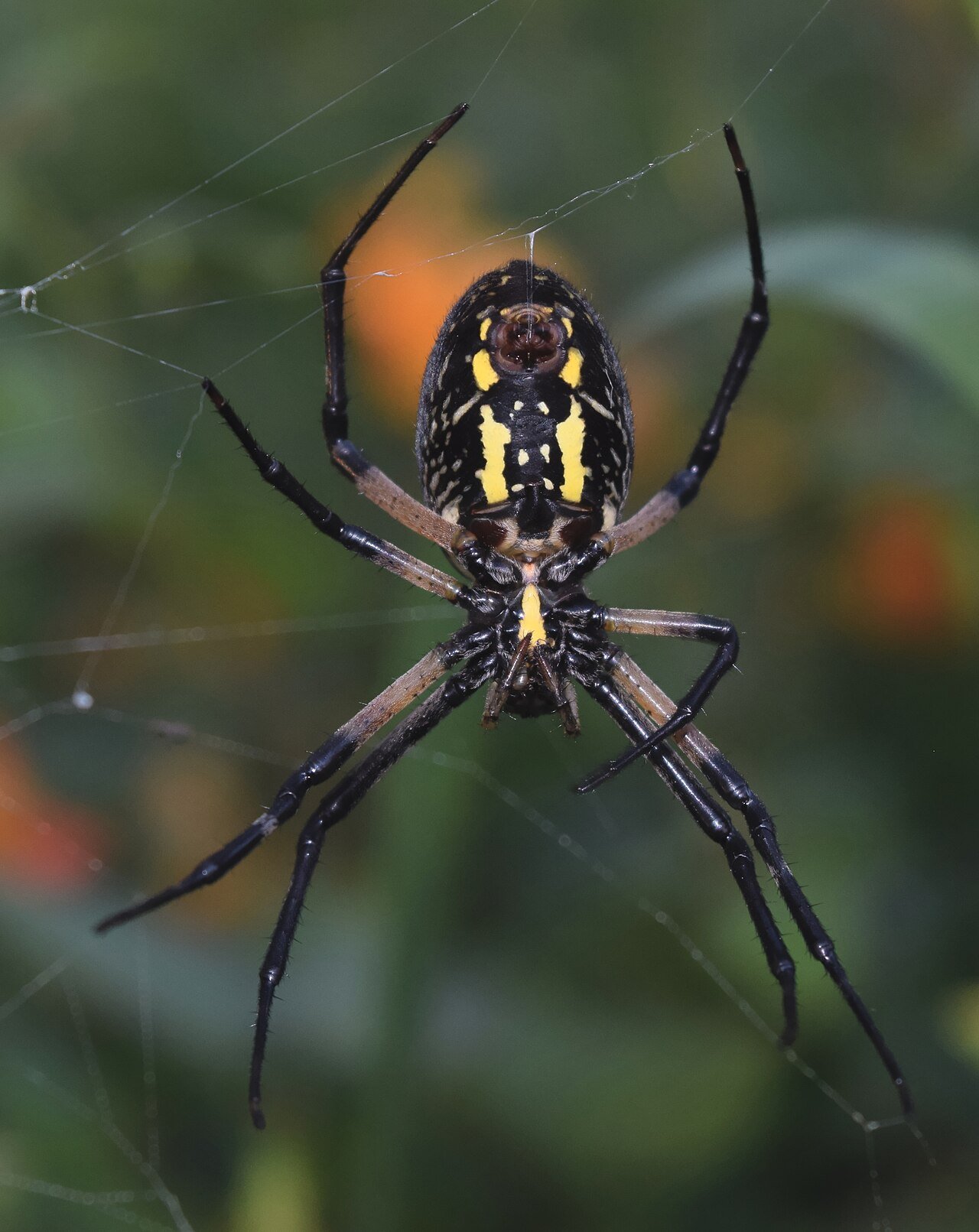
Late August delivers the annual discovery: a wheel of silk two feet across strung between the tomato stakes, and at its hub a spider of genuinely startling size and pattern — yellow-and-black and big as a half-dollar, or orange as a pumpkin, or armored with actual spines — that was absolutely not there in June. Orb weavers are the garden’s late-summer showpieces and the source of a reliable seasonal panic, so the verdict leads: every orb weaver in Ohio is harmless to people — reluctant to bite even when handled, milder than a bee when physically forced to, and dedicated entirely to the flying-insect interception business, at which they are the yard’s undisputed champions. This page is the field guide the August discovery deserves: the local celebrity cast (the garden spider and her zigzag signature, the marbled and spotted orb weavers of porch-light fame, the spined micrathena of every wooded trail), the golden-orb and banana-spider confusions the search results import from other latitudes, why the webs appear overnight in August (they didn’t — the spiders grew into visibility), the web-placement negotiation for doorways and decks that beats any spray, and the one impostor check that matters. From Greater Dayton Pest & Rodent, the photo line that grades spider pictures all September for free: (937) 569-3330.
The celebrity cast: Ohio’s orb weavers by sight
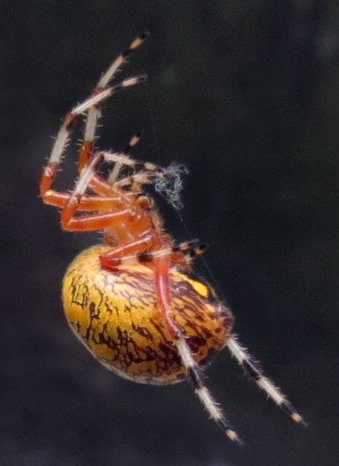
The yellow garden spider (Argiope aurantia — “writing spider,” “zipper spider”) is the headliner: females an inch-plus in gloss black and school-bus yellow, webs up to two feet across in sunny garden margins, and the signature no other local builds — the stabilimentum, a dense zigzag of white silk stitched down the web’s center like a zipper. (Its function is genuinely debated science — bird-warning banner, prey attractant, or camouflage; the spider isn’t telling.) Her web placement is stable for weeks — the same corner of the garden, rebuilt nightly — making her the season’s most watchable resident. The marbled orb weaver is October’s pumpkin: a swollen orange-and-cream marbled abdomen on a spider that hides in a curled-leaf retreat at the web’s edge by day — the one that drops dramatically on a thread when the retreat is disturbed, and the star of every “Halloween spider” photo the season produces. The spotted and cross orb weavers run the porch-light franchise: brown, round-bellied, and the builders of the head-height webs across your front steps every single morning (their economics below). The spined micrathena is the trail-walker’s spider: small, white-and-black, armored with ten genuine spines, and the architect of the face-height webs across every wooded path in the eight counties from July through September — walked through by every hiker, mourned by neither party, rebuilt by lunch. Round out the cast with the furrow orb weavers along wet margins and bridge rails, and you have the whole local guild: builders of vertical wheels, hubs down at dusk, none with any interest in the indoors and none — one more time — with a bite worth the name.
The imports and impostors: golden orbs, banana spiders, and the one real check
Search results import confusion from warmer latitudes, so the sorting: “golden orb weaver” and “banana spider” properly belong to the Trichonephila giants of the Gulf states — leggy, gold-silk-spinning spiders larger than anything Ohio hosts; the recently famous Joro spider (the parachuting headline generator) is their East Asian cousin established in Georgia and drifting northward, but despite annual media cycles it is not established in Ohio — every local “Joro” photo our line has received has been a garden spider or marbled orb weaver in good lighting, a streak we’re content to extend. (“Banana spider” also gets applied to the genuinely dangerous Brazilian wandering spiders of produce-shipment legend — vanishingly rare events, and grocery-bunch stowaways of any kind warrant a photo before a panic.) The one check that matters: the only Ohio spiders with medical significance — the widows and the recluse, per the venomous guide — are disqualified by the web itself: widows build chaotic tangle-webs low in dark corners (never symmetrical wheels in the open), and recluses build no prey web at all. A true orb — the symmetrical wheel — is a safety certificate: nothing that builds one in Ohio can hurt you, which makes the web the fastest spider triage in this entire library: read the architecture before the animal, and the wheel ends the workup on the spot.
Why the giant web “appeared overnight” (and where it went by morning)
Two bits of orb weaver biology explain the season’s twin mysteries. The August apparition: the spider was there all summer — hatched in spring, rebuilding tiny webs nightly in the same territory, growing through molts — until the final molts put her past the visibility threshold, and the household “suddenly” hosts a giant. Nothing arrived; something graduated, on the same schedule as the hornet football’s August reveal. The vanishing web: most orb weavers eat their web at dawn — silk is metabolically expensive protein, the night’s web is loaded with pollen and micro-prey, and recycling it funds the next evening’s rebuild — which is why the porch-corner web exists at dusk, catches all night, and is gone when you leave for work: a nightly manufacturing cycle, not a haunting. The wheel itself deserves its paragraph of respect while it’s up: radial dry-silk spokes for structure, a sticky capture spiral laid on top with metered glue droplets, the hub where she reads prey vibrations by leg (orb weavers are nearly blind; the web is their sensory organ), non-sticky walking lanes she alone knows — a complete instrument rebuilt in under an hour, nightly, from recycled materials. Engineering criticism aside, the operational note: a big orb catching the porch light’s moth traffic removes hundreds of flying insects a week — mosquitoes included — making the orb weaver the dragonfly’s night-shift colleague and the yard’s cheapest interception system. The management question was never how to kill her; it’s where to let her build — next section.
The placement negotiation: better than any spray, free forever
Orb weaver “control” is a real-estate negotiation, and the homeowner holds every card. The insight: orb weavers select web sites by anchor geometry and insect traffic — they need attachment points at the right spacing and a flight corridor to intercept — and they relocate readily when a site stops paying or keeps getting destroyed. The playbook: for the doorway and walkway webs, take the web down (a broom, or the time-honored spider stick, spider unharmed) two or three mornings running — the builder relocates to a quieter corridor by the third eviction, no chemistry involved; speed the negotiation by switching the porch light to the warm-LED bug bulb (dimming the moth corridor makes the site worthless — she leaves on her own) and offering better anchors nearby (shepherd’s hooks, the fence line, the garden stakes — genuinely, a deliberately placed pair of tall stakes in the flowerbed recruits the displaced builder to the exact spot you’d enjoy watching her). For the deck and play-set webs, same eviction cadence plus anchor denial — removing or spacing the attachment points reshapes the geometry. For the trail-face webs, the hiker’s stick held vertical ahead of you on wooded paths is the ancient and complete answer. What earns no place: spraying a web (kills one recyclable instrument and zero spiders — she’s in the retreat), fogging the yard for an animal that eats fog casualties, and any purchase whatsoever. The entire management budget for the yard’s most dramatic resident is a broom, a bulb, and taste in real estate — the library’s cheapest program, for its most photogenic subject.
Orb weaver questions, answered
The garden spider has a huge body now — is she about to lay eggs in my tomatoes?
She’s about to lay eggs NEAR your tomatoes — the September swelling precedes one to three papery brown egg sacs, each holding hundreds of eggs, lashed to sturdy vegetation or eaves near her web. The sacs overwinter; the spiderlings emerge in spring and balloon away on silk threads (the “spider rain” of children’s literature, and real). Leave the sacs where found if you can — each is next year’s interception fleet — or relocate them intact to a hedge line. The tomatoes were never involved; she eats moths, not marinara.
Do orb weavers come inside for winter?
No — the annual lifecycle ends outdoors: adults die with the hard frosts (the same October curtain as the hornets), the sacs carry the generation, and the occasional indoor October orb weaver is a lost wanderer to cup-and-card, not a settler. The spiders that DO live indoors year-round — cellar spiders, house spiders, the odd wolf — have their own pages; the wheel-builders are strictly seasonal outdoor talent.
One built across my car mirror overnight. How?
Car mirrors are premium orb real estate — perfect anchor spacing, sheltered, near lights — and small orb weavers commute the parking-lot economy shamelessly. The web is rebuilt after every drive because the biology assumes storms; the fix is the eviction cadence (wipe three mornings) or a week of parking elsewhere. She is not riding along on purpose, and highway speeds relocate her about as effectively as anything in this section.
Are the webs bad for hummingbirds or bees?
Marginal on both, honestly: hummingbirds actually RAID orb webs — stealing both trapped insects and silk for nest-building — and get entangled only in rare, oversized-web accidents; bees are caught occasionally, but orb weavers overwhelmingly harvest the night shift (moths, beetles, mosquitoes, midges) while bees fly the day. The pollinator-protection play isn’t web removal; it’s the same one as the bee page: don’t spray blooms, and let the ecosystem run its shifts.
The wheel, appreciated
The orb weavers close the spider file the way the season closes the garden: dramatically, harmlessly, and on schedule. Read the wheel as the safety certificate it is, learn the four celebrity faces, negotiate the doorway placements with a broom instead of a spray can, and spend one August evening actually watching the rebuild — the hour’s free, the engineering is world-class, and the household that has watched a garden spider recycle and respin her instrument at dusk never sends her photo to a pest line with alarm again (they send it with pride, and we grade those too). For the web that’s genuinely in the wrong place, the impostor check that won’t resolve from a photo, and everything else eight-legged in the eight counties: (937) 569-3330, Greater Dayton Pest & Rodent — where the zigzag gets read correctly the first time, and the garden keeps its showpiece.
An hour at the hub: the rebuild, narrated
For the household ready to convert alarm into admission-free theater, the dusk viewing guide: find the day retreat first (the curled leaf or eave corner at the web’s upper margin — the anchor thread running from it to the hub is her commute), and settle in about half an hour before full dark. The show runs in strict order: demolition — if last night’s web survived the day, she eats it, spiral first, in minutes (watch the wheel vanish inward); the bridge — a single line floated on the breeze to a downwind anchor, walked and doubled; the frame and radii — the Y-fork that establishes the hub, then spoke after spoke, each tensioned by leg-feel in near-blindness; the auxiliary spiral — a quick non-sticky scaffold outward; and the capture spiral — the long inbound lay of glued silk, the scaffold snipped and eaten as she goes, droplets metered by an internal economy science still models imperfectly. Total elapsed: forty-five minutes to an hour, after which she takes the hub, head-down, and the night’s interception business opens. Bring a flashlight held at an angle (backlit webs photograph absurdly well — the year’s best macro subject after the eyeshine census), bring the household’s resident child or skeptic, and bring the takeaway this whole page has been building: the biggest, scariest-looking spider of the Ohio year is a nearly blind engineer who eats her own factory every dawn and rebuilds it every dusk, forty feet from your door, without ever once considering you part of the plan.
The eight-county web map
Where the wheels concentrate locally: the garden suburbs host the Argiope headliners — the sunny perennial borders of Kettering, Centerville and Springboro supply the anchor geometry and pollinator traffic the big webs monetize, and the August photo wave on our line maps those zip codes almost exactly. The wooded corridors — the Little Miami and Stillwater trail systems, Waynesville’s valley edges, Oakwood’s old canopy — run the micrathena face-web franchise all summer and the marbled orb weaver’s October showcase after. The river and porch-light towns stock the spotted orb weavers — bridge rails, dock posts and every lit porch from Troy to Eaton — and the farm belt’s fencerows and barn eaves host the whole guild at agricultural density, where they’ve been the unpaid fly control since the fences went up. One map, one architecture, one verdict: wherever the wheel turns up on it, the safety certificate holds, the broom-and-bulb negotiation stands ready, and the photo line keeps grading — proudly, these days, as often as anxiously. The garden’s giants were never the problem; they were the September show, and the eight counties get front-row seats annually.
The complete Ohio spider triage, one paragraph
With the orb weavers filed, this library’s spider wing is complete enough to compress into the one-paragraph triage worth memorizing: symmetrical wheel-web outdoors — orb weaver, safety certificate, broom negotiation if misplaced. Sheet web with a funnel in the lawn or window well — grass spider, harmless, ignore. Chaotic tangle low in a dark corner, spider glossy black — the widow check from the venomous guide: red hourglass = the one local spider worth careful handling and a call. No web, big, striped, sprinting on the floor — wolf spider, cup-and-card, check the door sweep. No web, small, tan, in undisturbed storage, six eyes — the recluse workup, photo first, panic never. Delicate long-legs shivering on a basement ceiling web — cellar spider, the basement’s ally. Fuzzy, tiny, watching you back in the window sill — jumping spider, the internet’s favorite, harmless and frankly charismatic. Six architecture reads, one color check, and the entire eight-legged question resolves for the Miami Valley — with the photo line standing by for every tie, and the standing result across thousands of graded submissions: overwhelmingly innocent, occasionally magnificent, and vanishingly rarely a job for the truck. The spiders were mostly working for you all along; the library just finished the paperwork.
One wheel, one zigzag, one broom-based diplomacy program — and September’s most dramatic architecture stays exactly where it belongs: outside, at dusk, catching what bites you so nothing has to.
Read the architecture; trust the wheel.
Frequently asked questions
Are orb weaver spiders dangerous?
No — despite peak-season sizes that stop people mid-stride, orb-weavers are reluctant, mild, and interested exclusively in flying insects. Bites require handling and rate below bee stings; the drama is all architecture.
What is the big yellow and black spider in my garden?
The yellow garden spider (Argiope aurantia) — Ohio’s showpiece orb-weaver, with the zigzag “stabilimentum” signature woven down her web’s center. A single season’s tenant: egg sac by fall, gone at frost, offspring ballooning away in spring.
Why are orb weaver webs so big in September?
Peak everything — the spiders reach full size, prey is abundant, and mating season demands calories. The wheel webs spanning garden paths were building toward this all summer; frost closes the show within weeks.
Should I destroy orb weaver webs?
Only where they cross doorways and paths — and relocation beats destruction: sweep the web line down and the spider rebuilds overnight a few feet away, usually re-siting away from the disturbance. Each intact web clears hundreds of flying insects weekly, free.
Why does the web have a zigzag stripe down the middle?
The stabilimentum — garden spiders’ trademark, with debated purpose: bird-collision warning, camouflage, or prey attraction. Practically, it is the field mark that IDs the builder at a glance.
Do orb weavers come inside houses?
Essentially never on purpose — they are anchored to their webs and their webs to vegetation and eaves. Porch-light webs are as close as they come, drawn by the insect traffic your bulb aggregates; amber bulbs relocate the whole arrangement.
What happens to orb weavers in winter?
The adults die at hard frost, the species overwinters as egg sacs — papery marbles in eaves, bark, and shrubs holding hundreds of spring hatchlings each. The winter sac-sweep on porch ceilings is the highest-leverage spider control of the year.
What are the baby spiders floating on silk in spring?
Ballooning — orb-weaver hatchlings riding silk strands on the wind to disperse, occasionally blanketing fields in gossamer on the right morning. It is how last year’s garden spider seeds the neighborhood; nearly all balloonists perish, which is why each sac holds hundreds.
Do orb weavers eat wasps and mosquitoes?
Whatever flies into the wheel — moths, flies, mosquitoes, beetles, and yes, the occasional yellowjacket; a productive web logs hundreds of intercepts weekly. Free air-defense, positioned exactly where flying insects travel.
When should orb weavers involve pest control?
Nearly never for the spiders — but web pressure on eaves and porches signals the insect traffic that feeds them, and THAT diagnosis (lighting, moisture, prey base) is our spider program’s actual product: (937) 569-3330. The garden tenants themselves get our professional endorsement.
The Spiny-Backed Orb Weaver: the Crab-Shell Oddball
One family member deserves its own paragraph because its searches arrive from every direction: the spiny-backed orb weaver (Gasteracantha) — a thumbnail-sized spider wearing a white, red-spiked crab shell that looks nothing like a spider at first glance. It’s primarily a southern species (Florida vacationers meet it on every trail), with Ohio sightings rare and summer-only; the “spiky white spider” found around Dayton is usually the native spined micrathena of the woods in late summer. Both are exactly as harmless as the rest of this page’s cast, and both spin the same textbook orb — the shell is predator armor, not weaponry.