The pantry wing’s third dynasty completes the shelf: weevils — the snout-nosed beetles of the flour bag and rice canister, the “bugs in the flour” discovery whose defining feature separates it from both the drugstore file and the moth file: true grain weevils develop INSIDE individual kernels — egg, larva and pupa all sealed within one grain of rice or wheat, invisible until the adult chews its exit — which is why weevil discoveries feel like spontaneous generation (the rice that “grew bugs”), why the infested batch shows hollowed kernels and mysterious dust before it ever shows insects, and why the freezer-quarantine doctrine matters most of all for this family: the eggs ship inside the food, sealed beyond any inspection. The complete file: the snout ID and the three-species roster (plus the flour-mess complication — the “weevils” in actual milled flour are usually the flour beetles’ file, and the fork matters), the inside-the-kernel life cycle that writes every rule, the float-test and dust-signs evidence read, the purge-and-glass campaign restated for the sealed-egg case, and the whole-grain economics that make the bulk-buying household this dynasty’s favorite address. Greater Dayton Pest & Rodent: (937) 569-3330.
The snout roster (and the flour fork)
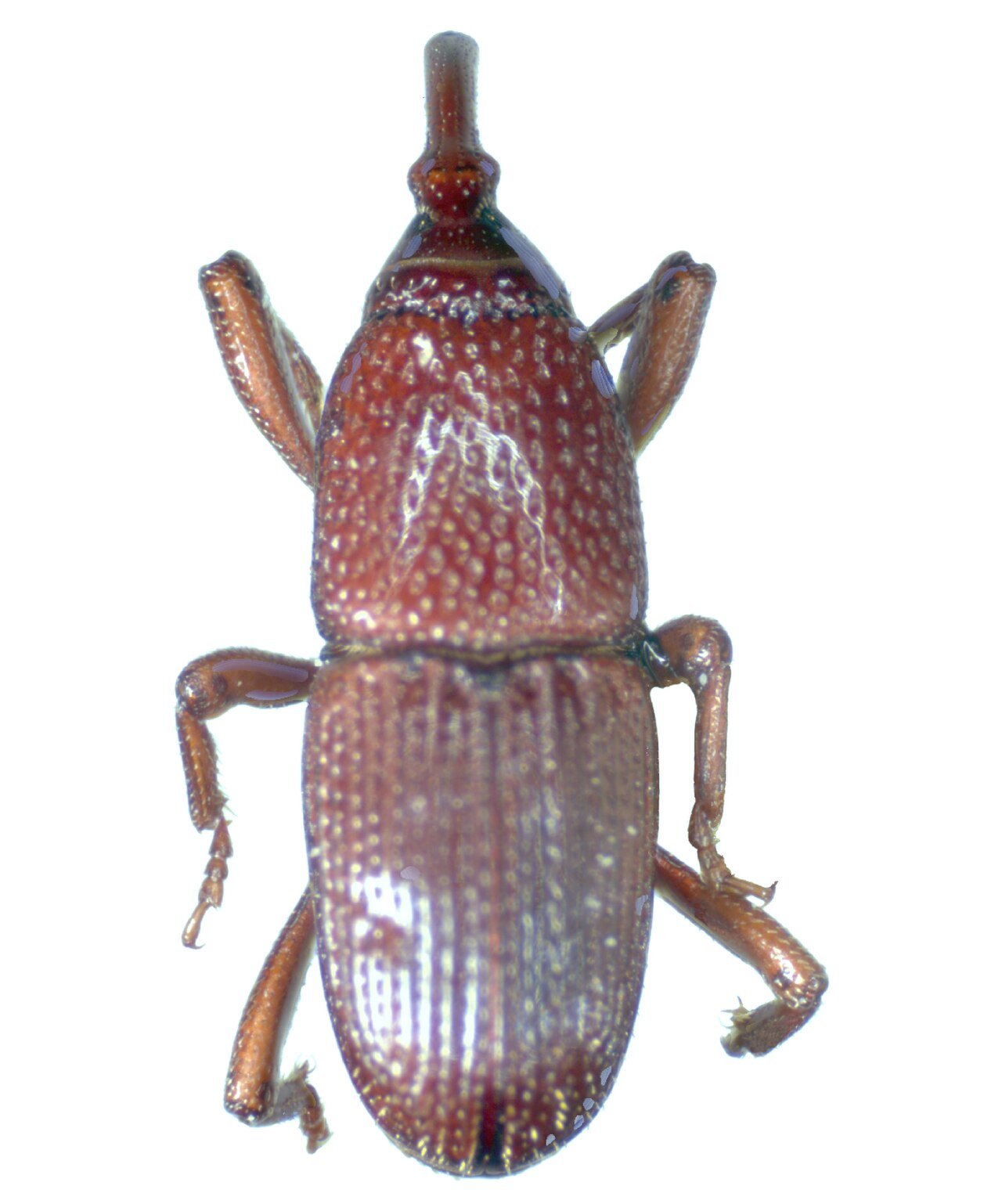
“Weevil” properly names the snout-beetles — the rostrum-bearing family whose pantry division runs three species: the rice weevil (an eighth-inch, dull red-brown with four faint orange spots, a flier — the warm-climate cosmopolitan and the most common household find), the granary weevil (slightly larger, darker, flightless — the cool-climate storage specialist whose entire modern existence runs through human grain, having lost flight so long ago in storage that no wild population exists: a species domesticated by accident, living in our granaries since the pharaohs), and the maize weevil (the rice weevil’s corn-loving twin). All three share the diagnostic package: the snout (visible at phone-macro range — no other pantry resident wears one), the kernel-development cycle, and the whole-grain address list — rice, wheat berries, popcorn, dried corn, barley, and the birdseed bag’s standing role. The flour fork: the household word “weevils” covers every flour bug colloquially, but true weevils need intact kernels — milled flour can’t host their cycle — so the reddish beetles IN the flour bag route to the flour beetle file (no snout, flourishes in the milled), while the snouted find in the rice routes here; the fork costs ten seconds and aims the purge correctly (the flour-beetle campaign sweeps milled goods; the weevil campaign hunts whole grains — different shelves, different suspects). The webbing check completes the pantry triage: silk = moth, snout = weevil, neither = beetle — three dynasties, ten seconds, one doctrine waiting below.
Inside the kernel: the cycle that writes every rule
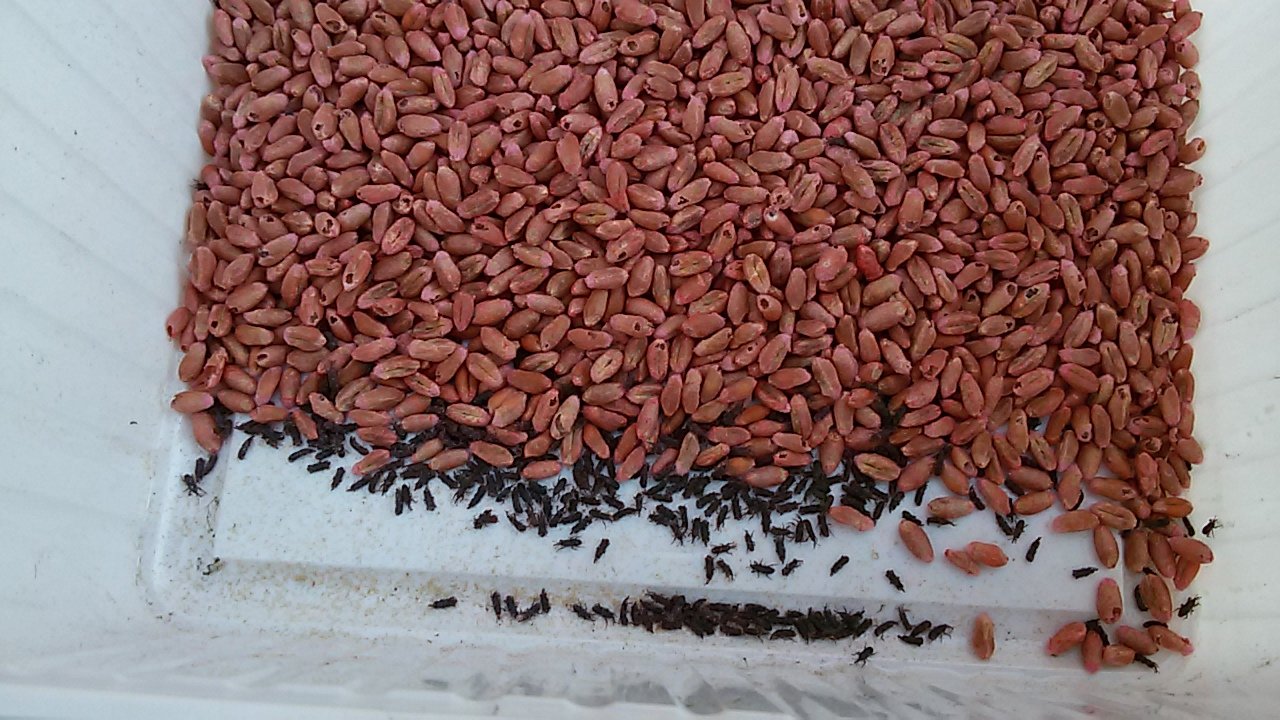
The weevil’s life cycle is the file’s entire strategy briefing. The female drills a kernel with her rostrum, deposits one egg inside, and seals the bore with a gelatinous plug — leaving a grain indistinguishable from its neighbors while the larva within eats the endosperm hollow, pupates in the cavity, and chews out as an adult weeks later (four-to-six warm, longer cool; adults then living months and females placing hundreds of eggs, one kernel at a time). The consequences cascade: visible adults mean invisible generations — the walking discovery is the graduation class of a cohort already sealed throughout the batch, which is why “I picked out the bugs” never works and why the purge rules below treat the container, not the count; the evidence precedes the insects — hollowed kernels (the float test: infested grains, eaten light, float where sound grain sinks — the pantry’s cheapest diagnostic), exit-holed kernels (the pinprick portholes), and the flour-fine dust of bore-work accumulating at the bag’s bottom all report tenancy before any snout shows; and the supply chain ships the eggs — the meal moth’s arrival story with deeper concealment: no inspection reads a sealed kernel, so the freezer week on every whole-grain purchase (the quarantine doctrine’s strictest constituency) is the one intervention that reaches where the eyes can’t. The heat alternative serves the cooks: oven-parching per extension guidance kills all stages in grain destined for prompt use — and the perspective line the discovery always needs: weevil-tenanted grain is revolting, not dangerous; the wing’s standing verdict on accidental consumption applies unshaken.
The campaign: purge, glass, and the whole-grain audit
The pantry doctrine runs its third edition with the weevil’s amendments. The purge: the whole-grain shelf empties completely — rice, berries, popcorn, cornmeal-adjacent stocks, the specialty grains, and the birdseed-and-pet tier that leads every wing census; the float-and-dust reads sort the batches, the infested exit sealed same-hour, and the borderline verdicts default to the freezer (a week frozen renders any sealed cohort moot — the doubt-eraser the sealed-egg case demands). The architecture pass runs lighter than the moth’s (no wandering pupation — weevils stay with the grain), concentrating on spill archaeology: the shelf-corner rice grains, the under-canister drift, the toaster-adjacent crumbscape — each stray kernel a potential sealed tenant, each vacuumed per the crevice mandate. The restock: glass-and-gasket for every whole grain, the freezer week on arrival as standing policy, and the bulk-buying audit this dynasty specifically demands — the twenty-pound rice bag’s economics assume it outlasts its eggs’ incubation, so the bulk household either freezes on arrival (bag by bag, a week each, then glass) or accepts the periodic discovery as a subscription; the warehouse-club pantry runs this dynasty’s heaviest files for exactly this arithmetic. The verification: no pheromone shortcut here (weevil lures exist commercially but grade poorly at household scale) — the meter is the monthly glass-jar glance, where any new adult walks visibly against clean grain: the transparent container as monitoring device, the doctrine’s architecture doing its own verification, which was always the glass’s second job.
Weevil questions, answered
The rice was sealed and store-fresh — how are there bugs in it?
The kernel kept the secret: the eggs were sealed inside individual grains at the mill or warehouse, the package’s integrity irrelevant to tenants already home — the “spontaneous generation” illusion that puzzled humanity until Redi and friends, solved nightly in modern pantries by the same answer: life arrives as eggs, and these arrived pre-installed. The freezer week is the counter; the store shares your innocence; and the discovery says nothing about your kitchen and everything about grain’s oldest passenger.
Are the “flour weevils” in my actual flour bag this page or the other one?
Run the snout check: milled-flour residents without the rostrum are flour beetles (their file’s purge sweeps the milled shelf); a snouted find in flour usually means whole grains nearby seeded wanderers (hunt the rice, berries and birdseed — the flour was the sidewalk, not the address). The ten-second fork aims a purge that differs by whole shelves; the photo line arbitrates the tiny ties.
Can I salvage a big expensive batch — the specialty rice, the brewing grain?
The honest tiers: light tenancy in grain destined for cooking survives the freeze-then-parch route (a week frozen, oven-dried per extension temps, the float-test cull — aesthetics restored to tolerance, safety never in question); heavy tenancy’s frass-and-hollow economics usually argue for the compost (the protein went to the tenants); and the brewing-and-seed-grain cases warrant the parch skipped (viability matters) in favor of freeze-and-sort. The bulk bag’s best salvage was always the freezer week it skipped on arrival — the subscription-cancellation this page exists to sell at the price of freezer space.
Do weevils infest anything beyond the pantry — the garden, the lawn, the house itself?
The pantry trio, no — their world is stored grain entire. The name’s wider family, yes-elsewhere: the garden’s root weevils notch rhododendron leaves by night, the pecan weevil runs the nut-orchard files, and the occasional strawberry-root or vine weevil case routes to the bench — different species, different pages, same snout signature. Structure, fabric, and everything the household actually worries about: untouched across the whole family. The rostrum drills plants and kernels; the house was never on the menu.
The verdict in the kernel
Weevils, completely filed: a snouted trio whose sealed-kernel cycle makes discovery late, counting useless and the freezer indispensable; whose evidence — floaters, portholes, bore-dust — reports before any insect walks; and whose campaign runs the pantry doctrine’s strictest edition — purge by batch, glass by policy, freeze by default, verify by transparency. The three dynasties now stand fully shelved — beetle, moth and weevil, each with its ten-second tell and its shared constitution — and the pantry wing closes as the library’s most complete: every crawler, flyer and driller of the stored-food economy documented, doctrined, and defeated at the shelf’s edge by cold, glass and one honest audit. For the fork’s ties, the bulk-bag consults and the snout-or-not photos: (937) 569-3330, Greater Dayton Pest & Rodent, Dayton and all eight counties — where the rice stays rice, the manifest gets checked, and the kernel keeps no more secrets.
The oldest roommate (a history panel for grain’s first passenger)
The weevil’s tenure with humanity outranks nearly every relationship in this library, and the panel earns its place: granary weevils turn up in the archaeology of storage itself — Egyptian tomb grain, Bronze Age silos, Roman warehouse strata — the species tracking the invention of the granary so faithfully that archaeologists read weevil remains as evidence of storage practice, and the granary weevil’s lost wings (no wild population, no flight, no existence outside human grain anywhere on Earth) make it perhaps the only pest species we created: domesticated by accident, bred by our storage into permanent dependence, the shadow-livestock of the agricultural revolution. The economics scale with the history — stored-grain insects claim meaningful percentages of the world’s post-harvest grain annually, with the weevil trio leading the ledger, which funds the modern counter-industry: the fumigation science, the hermetic-storage revolution (sealed bags suffocating infestations for smallholder farms — the gasket doctrine at development scale), and the controlled-atmosphere silos running the household’s glass-jar physics at ten thousand tons. The pantry translation keeps its proportion: the snout in your rice is agriculture’s oldest overhead, riding the same supply chains since the pharaohs’ accountants first wrote off the loss — and the household counter, glass and cold, achieves in a kitchen what empires funded granary priesthoods to attempt. Five thousand years of roommate; one freezer week to evict: history’s longest tenancy, ended at last by the appliance the pharaohs lacked.
The pantry constitution, final text (three dynasties, one law)
- Article one — the freezer week: every vulnerable arrival (flour, meal, whole grains, rice, birdseed, pet food, spices in bulk) frozen four-to-seven days before shelving — the one clause that reaches sealed kernels, glued eggs and shipped larvae alike.
- Article two — the glass: gasketed transparency for everything the dynasties eat — containment converting any miss to a one-jar event, and the jar itself serving as the monitoring instrument no lure matches.
- Article three — the rotation: first-in-first-out, the annual spice-rack honesty review, and the bulk-purchase audit that matches package size to consumption speed or freezer capacity.
- Article four — the ten-second triage: silk = moth; snout = weevil (this page); neither = beetle or the flour file — each verdict aiming its own purge geography.
- Article five — the crevice mandate: shelf corners, lid threads, ceiling seams and spill archaeology vacuumed with every campaign — the architecture’s micro-refugia denied.
- Article six — the proportion clause: revolting is not dangerous, arrival is not judgment, and the photo line grades every ambiguous speck free — the wing’s constitution, like the library’s, running on evidence over alarm.
Six articles, three dynasties, five thousand years of precedent — the pantry’s complete legal code, ratified across four pages and enforceable with a freezer, a jar and ten honest seconds. The shelf legislates; the dynasties comply; and the wing adjourns, permanently, in glass.
A eight-county grain report
The local files, closing the wing: weevil discoveries track the bulk-and-specialty grain economy — the warehouse-club households’ twenty-pound bags, the home-brewing and bread-baking movements’ berry stocks, and the farm belt’s feed rooms and seed stores (where the granary weevil’s five-thousand-year franchise still runs at original scale, and the hermetic-drum upgrade is standing rural counsel); the birdseed route completes its wing-wide sweep as the one founding source all three dynasties share (the garage bag’s steel-can upgrade now carries four endorsements); and the discovery-call pattern holds the wing’s cheerful constant — alarm at the scoop, relief at the verdict, conversion at the constitution, and the follow-up files that simply stop arriving from the glass-and-freezer households. The wing’s final tally across its four pages: zero dangerous species, zero structural threats, zero justified sprays — and one complete doctrine, enforced at the shelf’s edge, that ends the stored-food story wherever it’s read. The grain rests; the snout retires; the manifest, at last, gets checked at every port.
One snout, one sealed kernel, five thousand years of quiet tenancy — and a discovery that felt like spontaneous generation until one page explained the plug in the bore-hole. The float test reads the batch; the freezer reads the future; the glass reads itself; and the pantry’s longest lease terminates the way the wing always ends them — not with a spray, but with a constitution: cold at the door, transparency on the shelf, and ten seconds of honest triage between every scoop and every alarm. The pharaohs’ accountants would have wept for the freezer; your pantry just has one. Use it, jar it, glance monthly — and let history’s first stowaway finally miss the boat.
The scoop-moment protocol (for the reader mid-discovery)
Since this page’s traffic arrives holding the scoop, the immediate protocol, sequenced for the next ten minutes: photograph first (the specimen against the grain, coin for scale — the snout-silk-neither triage runs from one clear frame, and the line grades it same-day); seal the batch (bag it whole — the sorting happens later, the containment now); run the shelf census per the campaign above (the whole-grain tier first, the float test on the borderline batches, the spill archaeology last); freeze the precious, exit the infested, glass the survivors; and schedule nothing else — no sprays, no foggers, no shelf-paper insecticides (the food-adjacent no-chemistry rule is the wing’s firmest, and every product marketed at “pantry pests” in aerosol form violates it on arrival). Dinner, remarkably, survives the discovery — the unaffected shelves stay unaffected, the verdict on the sampled batch stays cosmetic, and the household’s only genuine loss is the twenty minutes this protocol just organized. The scoop found the tenant; the protocol found the ending; and the pantry’s three-dynasty era closes, for your address, tonight.
Snout checked, batch bagged, freezer loaded, glass gleaming: the kernel’s last secret, filed — and the wing’s final scoop, clean.
One page remains in the batch: the scorpion question, answered the Ohio way — with a pseudoscorpion, a whip-tailed legend, and the usual good news.
Frequently asked questions
What are the little bugs in my flour?
Most often flour beetles (reddish-brown, cylindrical) or granary/rice weevils (darker, with the diagnostic snout) — collectively “flour weevils.” All arrive IN the products; none wander in from outside. The insect is the announcement; the infested package is the problem.
How did weevils get in my flour if it was sealed?
They were already aboard — eggs laid at the mill or warehouse hatch in your pantry (weevil females lay inside whole grains; flour beetle eggs sift invisibly through product). Sealed-at-the-store means nothing; the infestation predates your receipt.
Is flour with weevils safe to use?
Safe but unappealing — no disease or toxin at household levels, and sifting-and-baking folklore is technically survivable. Practical verdict: discard infested product, freeze-quarantine its shelfmates, and call the loss groceries rather than hazard.
How do I get rid of weevils in my pantry?
The same purge-and-seal protocol as pantry moths: full empty, package-by-package inspection (look for beetles, fine dust, and holed grains), discard and freeze accordingly, vacuum shelf cracks, wash, restock airtight. The two infestations are roommates; one protocol evicts both.
Does freezing flour kill weevils?
Four days at 0°F kills all stages — the standard quarantine for questionable packages and the preventive habit for bulk-bought grains: freeze new flour four days before shelving and imported eggs never mature. The cheapest prevention in the stored-food file.
Why do weevils keep appearing after I cleaned?
A missed source (the birdseed and pet food again, plus decorative grain crafts and heat-pack filler), crack-dwelling pupae outside packages, or re-importation. Pheromone-free sticky monitors plus the freeze-new-purchases habit close the loop.
What is the difference between weevils and flour beetles?
The snout: true weevils carry the elephant-trunk rostrum and infest WHOLE grains (rice, wheat berries, popcorn); flour beetles are snoutless and own the milled products. The protocol is identical; the distinction just aims your inspection.
Do weevils spread to other rooms?
They follow the food — birdseed in the garage, pet kibble in the laundry, decorative corn in the dining room; multi-room sightings map your grain-storage geography, not a structural invasion. Consolidate stored grains into airtight containers in one place and the map shrinks.
How do I prevent weevils permanently?
Airtight glass or heavy plastic for everything grain-adjacent, the four-day freeze on new bulk purchases, first-in-first-out rotation, and quarterly glance-inspections of the deep shelf. Stored-product pests are a packaging problem; packaging solves it.
When should I call about pantry weevils?
Persistent re-infestation after two full protocols (hidden sources, including rodent seed caches in walls, are genuinely our department), or commercial food-handling settings where documentation matters: (937) 569-3330.