
You reached for the flour, tipped the bag, and something moved — small, reddish-brown, unhurried, and horrifyingly plural. Meet the flour beetle: the most common uninvited ingredient in American pantries, a tenth-of-an-inch insect that can turn a baking afternoon into a kitchen-emptying archaeology project. The immediate reassurances first, because they’re real: flour beetles don’t bite, don’t sting, don’t carry disease to your family, and — despite the revulsion — accidentally baking a few has harmed nobody in the history of bread. The genuine problem is subtler and more persistent: by the time beetles are visible in one bag, their eggs and larvae are usually distributed through several, the population is cycling in spilled meal you can’t see behind the shelf liner, and the “throw out the flour” response that feels decisive typically misses two-thirds of the infrastructure. This is the complete flour beetle file from Greater Dayton Pest & Rodent — identification (including the “weevil” confusion), how they actually get in (spoiler: they were probably in the groceries), the purge-and-freeze protocol that clears a pantry for good, and the line where a stubborn kitchen problem earns the professional call: (937) 569-3330, photo identification free as always.
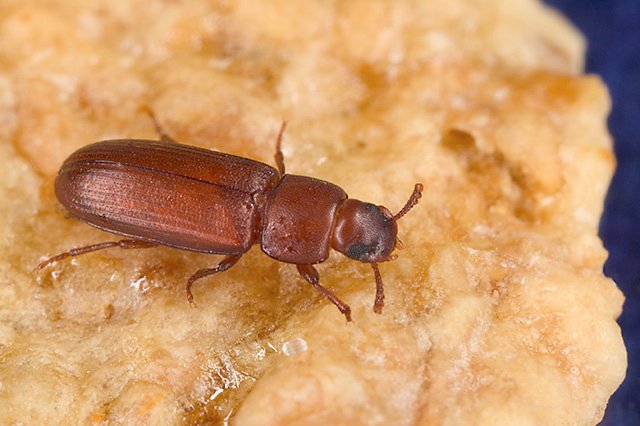
Meet the two culprits (and the “weevil” that usually isn’t)
Two nearly identical species split the American pantry between them: the red flour beetle and the confused flour beetle — the latter named for the taxonomic mix-up, not its mental state, though the joke writes itself. Both are flat, elongated, shiny red-brown beetles about an eighth of an inch long, distinguishable only under magnification (antennae shape: the red’s clubs abruptly, the confused’s gradually — trivia with one practical edge: red flour beetles fly short distances and confused flour beetles don’t, which matters when you find them windowsill-wandering). Both are secondary pests of grain: their mouthparts can’t breach intact kernels, so they specialize in anything already milled, cracked, or processed — flour above all, plus cornmeal, cake and pancake mixes, cereal dust, crackers, pasta ends, spices, dried pet food, and birdseed fines. Households reflexively call every pantry bug a “weevil,” and the distinction is worth thirty seconds: true grain weevils have the unmistakable elephant-trunk snout and live inside whole kernels (rice, popcorn, wheat berries — you’ll find hollowed grains with exit holes); flour beetles have no snout and swim loose in the powder. Different insect, overlapping playbook — this page’s protocol clears both, and the photo line happily referees, free. The third pantry regular — the Indian meal moth, whose webbing and cocoons are their own signature — gets covered in the protocol below because the three so often turn up together.
Pantry beetles usually arrive in a sealed bag from the shop rather than through a door. Clearing the source is pest control in Dayton.
How they got in: the grocery-borne truth
The infestation almost never walked in — it rode. Flour beetles are premier pests of the milling, warehousing, and distribution chain, and the typical household introduction is eggs or larvae already inside a purchased product: a bag of flour filled months ago, a bulk-bin scoop, a discount-store mix that sat a summer in an un-airconditioned warehouse (the corrugated seams of the box itself are habitat — a theme our warehouse page fights at industrial scale). Nothing about your kitchen invited them; everything about time and temperature decides what happens next. At Ohio summer kitchen temperatures the egg-to-adult cycle runs about six to eight weeks, a female lays several hundred eggs across her months-to-years lifespan (flour beetles are marathon-class for insect longevity — two or three years is routine), and the population compounds quietly in any product opened, forgotten, or spilled. The practical translations: buy sizes you’ll finish in a couple of months, rotate first-in-first-out like the restaurant program teaches, and treat the back-of-shelf archaeology layer — the crusted pancake mix from two winters ago, the birthday-cake sprinkles of administrations past — as the reactor core it usually is. And the freezer preempts the whole story: four days at 0°F kills every stage, which is why the protocol below starts new purchases there.
The purge-and-freeze protocol: one afternoon, done right, done once
- Empty completely: every shelf, every item — half-purges are how pantries relapse; the unopened box you skip is statistically the reservoir
- Triage in three piles: TOSS anything with visible beetles, larvae (cream-colored, wireworm-slim), webbing, clumping, or an off, faintly acrid smell (heavy flour beetle populations taint flour with quinone secretions — if the flour smells sharp, it’s telling you something); FREEZE everything opened-but-clean and every paper/cardboard-packaged grain product regardless of appearance — four days at 0°F sterilizes all stages; KEEP-AS-IS only cans, jars, and factory-sealed plastics beetles can’t breach
- Bag the toss pile outside immediately — a trash can under the sink is just a satellite pantry
- Vacuum the architecture: crevice tool along shelf corners, screw holes, bracket pins, and the shelf-liner underworld — spilled meal in cracks is the off-menu breeding stock; discard the vacuum bag outside
- Wash, dry, and skip the fog: hot soapy water on shelves, fully dried; no pesticide sprays where food sits — they’re unnecessary here and off-label besides (the one exception professionals use is targeted crack treatment, and that’s our call to make on the stubborn cases)
- Re-shelve into glass and heavy plastic: screw-top jars and gasket containers end the vulnerability permanently — a beetle that can’t reach flour can’t infest flour, and the pantry that converts once never runs this protocol again
- Quarantine the incoming: new flour, meal, and mixes take a four-day freezer pass before joining the shelf — the habit that beats the supply chain at its own game
- Set the sentinel: a pheromone pantry trap (they exist for beetles and meal moths both) in a corner reads the rebound; empty trap at week six = verified clean
When the pantry protocol isn’t enough: the spread cases
Most flour beetle stories end with the afternoon above. The ones that don’t share a signature: beetles reappearing weeks after a thorough purge, which means a breeding site outside the pantry’s obvious inventory — and the candidate list is where professional pattern experience earns its keep. The classics we find: the forgotten satellite stock (holiday baking supplies in the basement, the bread machine’s hopper, the camping bin’s pancake mix, decorative Indian corn and pasta-art from a kid’s project); pet-adjacent reserves (the 40-pound dog food bag in the garage, birdseed and its scattered fines, the hamster’s bedding mix); structural spill zones (meal sifted under the stove and refrigerator, into the drawer-slide cavities, or through the gap behind a lazy Susan — reachable only by pulling appliances and hardware); and, in older Miami Valley houses, rodent caches — a previous mouse tenancy’s hoarded kibble in a wall void, hosting beetles years after the mice left, a crossover our inspections find more often than anyone expects. These cases get the targeted professional response: source-hunt with the same flashlight discipline as our fruit fly method, crack-and-crevice treatment where warranted, and pheromone monitoring to verify the curve dies. Stubborn pantry pests are a small job for us and an endless loop without the source — the free call sorts which yours is.
Flour beetle questions, answered
We definitely ate some before we noticed. How worried should we be?
Not meaningfully — this is the question everyone whispers and the answer is genuinely reassuring: flour beetles carry no human pathogens of significance, cooking neutralizes everything anyway, and the world’s food-safety systems treat light insect fragments in grain as an unavoidable background reality (there are federal defect tolerances for exactly this). The exceptions worth noting: heavily infested flour tastes off (those quinone secretions) and should be tossed on quality grounds, and the rare individual with severe grain-mite or beetle allergies should be more careful. For everyone else: the ick is real, the harm isn’t, and the muffins were fine.
Do bay leaves in the flour actually work?
The most charming entry in the folk-remedy file, and — unlike the mouse-smell aisle — not entirely empty: bay, like several aromatic herbs, shows mild repellent effects on stored-product insects in lab settings. But mild repellency inside an already-sealed jar is redundant, and inside an unsealed bag it’s hope with a garnish. The container is the technology; the bay leaf is décor. Use both if it pleases you — just know which one is working.
My flour was in the freezer-safe bag the store sold it in. How did they still get in?
Two ways: the eggs predated the bag (filled at the mill, hatched at your house — the most common answer), or the beetles chewed in — adults can breach paper, thin poly, and foil liners given time and motivation, which is why the protocol’s endpoint is glass and heavy gasket plastic, the two materials with an unbroken defensive record. The bag was never the fortress; it was the wrapping paper.
Is this the same bug that’s in my birdseed / the garage / the basement window sills?
Very possibly — flour beetles, their dermestid cousins, and meal moths all commute between household grain reserves, and birdseed is the most under-suspected reservoir in the Miami Valley (the “fines” at the bag’s bottom are essentially pre-milled beetle chow). The same protocol applies at garage scale: sealed bins for seed and pet food — which, as regular readers will note, is the same bin advice our rodent page gives for entirely different predators. One container upgrade, three pest categories retired: the best hardware bargain on this site.
The commercial stakes: when flour beetles meet a business license
Scale the pantry up to a bakery, restaurant dry-storage room, or food warehouse and the flour beetle graduates from nuisance to citation. Ohio health inspections read stored-product insect evidence as a sanitation and rotation failure; a customer finding beetles in a bakery case item is a review catastrophe; and for the distribution operations along the I-70/75 corridor, a beetle find at a customer’s receiving dock rejects whole lots and triggers supplier audits — the exact scenarios our restaurant and warehouse programs are engineered against. The commercial playbook is the household protocol with paperwork: pheromone trap grids by zone with counted trends, first-in-first-out rotation enforced as procedure, six-inch floor-and-wall clearances so spill zones stay visible and cleanable, incoming-lot inspection with supplier documentation for chargebacks, and targeted crack-and-crevice treatment on evidence rather than calendar fog. Miami Valley food businesses inherit one advantage the household doesn’t: the beetles’ two-to-three-year adult lifespan means an established commercial population is a durable asset of the building until someone runs the full program — which means the operator who runs it inherits a durable absence instead. If your dry storage has a beetle history and an inspection calendar, the free walkthrough belongs on this month’s schedule: (937) 569-3330.
The one-screen protocol
- ID: flat red-brown eighth-inch beetles loose in milled products = flour beetles; snouted beetles inside whole kernels = true weevils; webbing and cocoons = meal moths — same protocol clears all three
- They arrived in the groceries — eggs in milled products from the supply chain; nobody’s kitchen is to blame
- The purge: empty everything → toss visible+smelly → freeze the rest 4 days at 0°F → crevice-vacuum the shelf architecture → hot-soap wash → no sprays near food
- The fortress: glass and gasket-plastic containers forever; 4-day freezer quarantine for new grain purchases; FIFO rotation; sealed bins for pet food and birdseed
- The sentinel: pheromone trap in the corner — empty at week six means verified clean
- The escalation: rebounds after a real purge = hidden source (satellite stock, spill zones, appliance gaps, old rodent caches) — free inspection, targeted treatment, monitored verdict
- The comfort: no bites, no disease, cooked beetles have harmed no one — the harm was always to the appetite, and the protocol restores that too
One afternoon, one container upgrade, one freezer habit — and the flour pours clean for the rest of your baking career. Screenshot the list, run the purge this weekend, and save the number for the rebound cases: the pantry is the smallest territory we defend, and we defend it with the same guarantee as everything else.
The deep history in your flour bag
Since the pantry is emptied and the freezer is humming, enjoy the strange pedigree of your adversary: the red flour beetle is one of the most-studied insects on Earth. Its genome was sequenced decades ago, it’s a foundational model organism for genetics and development labs worldwide, and its populations have been riding human grain stores since the granaries of ancient Egypt — archaeologists find flour beetle remains in pharaonic storage jars, making this one of humanity’s oldest continuous roommates. That history explains the insect’s uncanny fit to our food systems: thousands of years of selection inside human storage bred a specialist in exactly the warm, dry, milled-grain niches every civilization keeps rebuilding, from clay jar to grain elevator to the third shelf of a Kettering pantry. It also explains why eradication was never the realistic goal and containment always was: the species is a permanent passenger of agriculture itself, endlessly re-introduced by the supply chain, and the households and businesses that stay clear aren’t the ones that killed every beetle — they’re the ones whose containers, rotation, and freezer habits give arriving eggs nowhere to go. Five thousand years of coexistence, solved in your kitchen by a screw-top jar: some pest control victories are engineering, and the oldest roommate finally gets a lease it can’t break.
The pantry as pest-control classroom
If this site has a teaching pantry, this page is it, because the flour beetle demonstrates every principle the bigger pests obey — at stakes low enough to practice on. Source over symptom: the visible beetles are overflow, the breeding stock is in the forgotten bag, and the hunt matters more than the swat — the same law that runs the fruit fly method and the rodent program. Exclusion over chemistry: the glass jar is the pantry’s door sweep, permanent and reapplication-free, while every spray-adjacent impulse is off-label near food and unnecessary besides. Verification over vibes: the pheromone trap is the pantry’s monitoring station, converting “I think we got them” into a counted zero. Quarantine over trust: the freezer pass on incoming grain is the luggage-rack protocol from the bed bug page, translated to groceries. And honesty over alarm: no bites, no disease, no shame — just biology, logistics, and an afternoon’s fix. Run the pantry protocol once and you’ve rehearsed the entire method this company applies from kitchens to warehouses; the only differences upstream are the size of the containers and the length of the paperwork. Graduation gift, as ever: the free line for whatever the flashlight finds next — (937) 569-3330.
Final practical note for bakers, brewers, and bulk-buyers — the households most likely to meet this beetle twice: your volume habits are compatible with a clean pantry, they just need infrastructure. Twenty-five-pound flour sacks decant into gasket buckets (food-grade five-gallon with gamma-seal lids — the homebrew store sells the good ones); grain mills and bread machines get a monthly crumb-tray audit; brewing grains live in the sealed bin their sugars deserve; and everything passes the freezer gate on arrival day. The serious-baker pantries running this setup are the cleanest we inspect — proof that the fix scales with the hobby, and that nobody has to choose between buying flour like a bakery and pouring it beetle-free.
Frequently asked questions
What are flour beetles?
Red and confused flour beetles — 1/8-inch reddish-brown cylinders that are the world’s most successful milled-grain pests: flour, meal, cereal dust, baking mixes, and the powdered corners of every pantry. (“Confused” is taxonomy’s joke — the two species were historically mixed up, not the beetle.)
How are flour beetles different from weevils?
No snout, different venue: true weevils bore whole grains with their rostrum; flour beetles own the milled products — they cannot damage intact kernels but thrive in anything ground. Both answer to the same purge-and-seal protocol.
Why does my flour have beetles in it?
They arrived with it — eggs sifted invisibly through milled product at the mill or warehouse hatch on your shelf. Sealed packaging at purchase proves nothing; the four-day freezer quarantine on new flour is the only real customs inspection.
Do flour beetles make flour unsafe?
Heavily infested flour turns gray, sharp-smelling (benzoquinone secretions), and unpalatable — discard it — but no disease or toxin threatens at household exposure. The loss is groceries; the response is the protocol, not alarm.
How do I get rid of flour beetles completely?
Full pantry purge with powder-focused inspection (they live IN the product mass — sift a sample onto white paper and watch for movement), discard infested, freeze the borderline, vacuum shelf cracks and can rims, wash, restock airtight. The crack-vacuuming carries the relapse prevention.
Can flour beetles chew through packaging?
Through paper, thin plastic, and cardboard seams readily — and through foil and heavy plastic, no. Restocking into glass and gasketed containers ends both the current infestation’s spread and the next importation’s reach.
Why do flour beetles keep coming back?
The classic trio: a missed source (baking-mix boxes and pancake mix hide them), crack-dwelling stragglers, or fresh importation. Add the flour-beetle special: they colonize the DUST — the spilled flour film in shelf corners sustains populations between purges; the vacuum is the cure.
How long do flour beetles live?
Adults run one to three YEARS — extraordinary for the size — with generations every four to twelve weeks in warm kitchens. Longevity is why “wait them out” fails and the physical protocol wins.
Do flour beetles fly to lights like drugstore beetles?
Red flour beetles fly weakly; confused flour beetles cannot fly at all — so window accumulations point AWAY from flour beetles toward their drugstore cousins. One more free diagnostic from beetle geography.
When should flour beetles involve a professional?
Recurrence after two full protocols (hidden bulk sources — garage grain, rodent caches — want finding), or commercial bakeries and food-handling settings where documentation and treatment-grade response matter: (937) 569-3330.