
Mason’s subdivisions were built the way Mason does everything — at scale, on schedule — and that efficiency created a termite phenomenon most towns never see: entire neighborhoods that share a birthday. When a builder closed out a 300-home community in 2003, every foundation got its soil pretreatment the same season, from the same applicator, with the same product — which means every one of those barriers is aging out on the same schedule too. Termite control in Mason runs on that arithmetic. We call it the cohort clock: your house’s termite protection expires when your street’s does, and the first confirmed colony in a subdivision is rarely news about one house — it’s news about the vintage. In a town this young, that clock is the whole strategic picture.
Reading the Cohort Clock
Builder pretreatments are liquid soil barriers, and their effective life runs years — not the decades homeowners assume. A subdivision finished in 2000 has been effectively unprotected for well over a decade; a 2010 street is past the reliable window now; even mid-2010s vintages are entering the gray zone, because barrier life varies with soil, grading, and how much the lot’s landscaping has disturbed the treated zone. Every flower bed dug against the foundation, every irrigation trench, every patio and egress-window retrofit cut a gap in a barrier that was continuous on closing day. So the clock reads in two hands: the vintage year sets the baseline, and the lot’s renovation history sets the exceptions. Our Mason inspections open with both questions — when was the street built, and what’s been dug since — because together they predict where the perimeter is honest and where it’s a memory.
The First-on-the-Street Signal
The cohort logic changes what a neighbor’s termite treatment means. In an older, mixed-age town, the house down the block getting treated is their problem. In a single-vintage Mason subdivision it’s a street-level data point: the colonies working your soil are the same regional population, your barrier is the same age as theirs, and their discovery usually means the vintage has reached the failure window. The practical move when the first yard sign appears on your street is not alarm — it’s a scheduled inspection while the season’s still early, because catching the cohort’s wave at house two beats catching it at house ten. We track the vintages we service; when a subdivision starts producing confirmations, we say so to the neighbors who ask.
Protection at Mason’s Scale
- The two-question inspection: vintage year plus dig history, then a perimeter and slab-penetration walk mapped against both
- Barrier renewal or bait: full liquid re-treatment where trenching can reach the foundation honestly; monitored bait stations where patios, decks, and landscaping have closed the trench line — the lot picks, not the script
- Swarm triage in April–May: winged emergences ID’d free from a photo — straight antennae and equal wings mean termite, elbowed and unequal mean ant — before anyone buys the wrong treatment
- The renovation rule: any project that opens soil against the foundation — addition, patio, egress window — is the moment to re-treat that segment, at its cheapest
The commercial half of Mason runs the same logic at campus scale: office parks and retail centers whose slab-era pretreatments share the town’s vintages, with expansion-joint and utility-penetration routes into structures full of framed interiors and stored cellulose. Monitoring programs there slot into the facilities calendar — documented, scheduled, and priced as the rounding error it is against one tenant build-out’s worth of hidden damage. The town’s full file lives on our Mason service page.
Check Your Street’s Birthday
One inspection reads your vintage, your dig history, and your actual perimeter — and tells you honestly whether your street’s clock has struck, is striking, or still has time. Before the first yard sign is the cheap moment; we’d rather you use it.
Buying or selling in Mason? What a lender, a VA file, or a listing agent asks for is not a treatment — it is a written report. That is a termite and WDI inspection in Mason: $99 flat on the lender-ready NPMA-33, next business day, PDF the day we inspect. Treatment only enters the conversation if the report actually finds something.
Frequently asked questions
My Mason house was pretreated when it was built — am I still protected?
Read the clock: builder soil barriers last years, not decades. A 2000-vintage street has been unprotected for over a decade, a 2010 street is past the reliable window, and every flower bed, irrigation trench, or patio dug since closing cut gaps in whatever remained.
A neighbor on my street just got treated for termites — should I worry?
In a same-vintage subdivision, treat it as a street-level data point, not gossip: their barrier is your barrier’s age, and the first confirmation usually means the cohort has reached its failure window. The smart response is a scheduled inspection now, not alarm — house two beats house ten.
How would termites even get into a newer slab home?
Past the slab, not through it: expansion joints, plumbing and utility penetrations, the garage-slab seam, and any soil-contact wood at porches and deck posts. Newer homes show fewer warnings, not fewer termites — which is why the perimeter walk matters more than the build date.
What are the signs I should watch for in Mason?
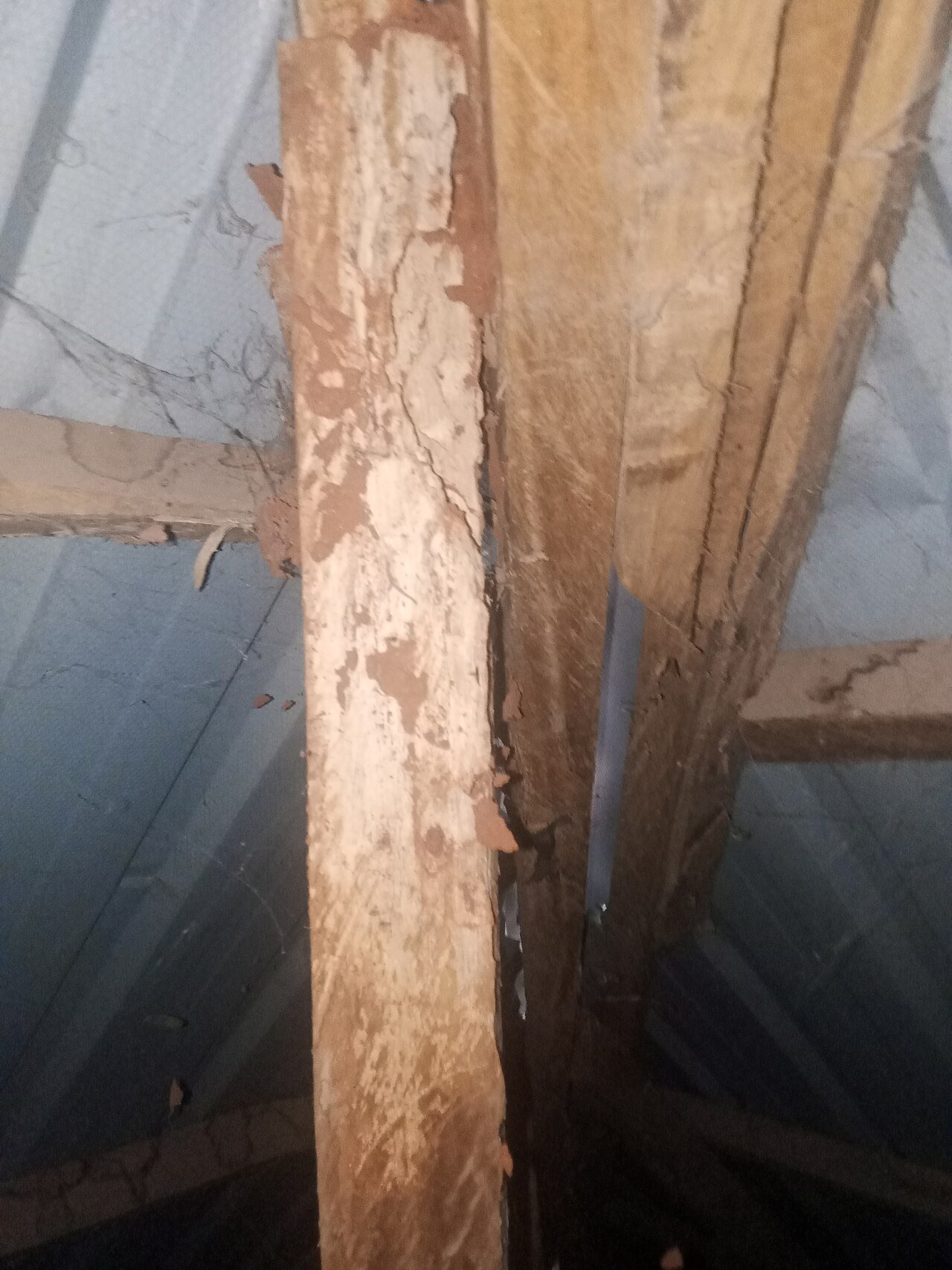
April–May swarmers at windows (straight antennae, equal wings — elbowed means ant), pencil-wide mud tubes on foundation walls, blistered paint or hollow baseboards, and mud spotting at slab joints. Any of them warrants a same-season inspection; the photo ID is free.
Liquid barrier or bait stations — which is right for my lot?
The lot picks: full trench-and-treat renewal where equipment can honestly reach the foundation line, monitored bait where patios, decks, and mature landscaping have closed the trench. Anyone naming the method before walking your perimeter is selling, not inspecting.
Does homeowners insurance cover termite damage?
Almost never — carriers class it as preventable maintenance. That’s the whole economic case for reading the cohort clock early: renewal costs a fraction of one repair bill that no policy will touch. Our neighbors at Ingram Insurance Group wrote the full policy-clause breakdown — including the one narrow collapse exception worth knowing about.
We’re adding a patio and egress window — anything termite-related to know?
Yes, and it’s good news: open soil against the foundation is the cheapest re-treatment moment that segment will ever have. Fold the barrier work into the project and the dig history stops being an exception on your clock.
What does termite control cost in Mason?
Quoted from the inspection — footage, foundation type, and access drive it. Renewal and bait programs both run small against Mason’s home values, and the monitoring line-item on commercial campuses prices as a rounding error against one build-out’s worth of hidden damage.
Reading the rest of Mason’s files fills in the picture: ant control in Mason and wasp & hornet removal in Mason.