
An old stone or brick basement is one of the best spider habitats in Ohio, and Hamilton has thousands of them. Irregular masonry gives endless anchor points for web, the ledges and joist pockets provide sheltered harborage, humidity stays high, and the insects spiders eat are drawn in through the same gaps the spiders use. Add mature street trees, deep window wells, and a century of settled openings at grade, and the autumn spider wave in these neighborhoods is heavier than it is in newer parts of the county. Most of it is harmless, and most of it is a symptom of something else.
Why the Basement Is Full of Them
The long-legged, fragile spider hanging in a loose, untidy web in a basement corner or a joist bay is a cellar spider. They are harmless to people, their fangs cannot do anything meaningful to human skin, and they are genuinely useful because they prey on other spiders and on insects. In stone-walled Hamilton basements they are the single most common complaint we hear, and the honest answer is usually a broom rather than a treatment.
What makes an old basement so hospitable is texture and humidity. A poured concrete wall offers almost nowhere to anchor a web and dries out reasonably well. A stacked stone wall offers a thousand anchor points, deep shadowed recesses, joist pockets, and mortar joints, and it holds moisture against the soil behind it. Every one of those features favors both spiders and the small insects they feed on.
That is why moisture correction does more for a spider problem in Hamilton than almost anything else. A basement that gets drier — through downspout extensions, grade correction, a functioning sump, and addressing standing water — supports fewer of the insects spiders eat, and the spider population follows the food down over the following season.
The Autumn Wave
Spider calls cluster in September and October, and it has very little to do with spiders deciding to move indoors for warmth. What actually happens is that mature males abandon their webs and wander in search of females, and a wandering spider that meets an old house with settled openings at grade tends to end up inside it.
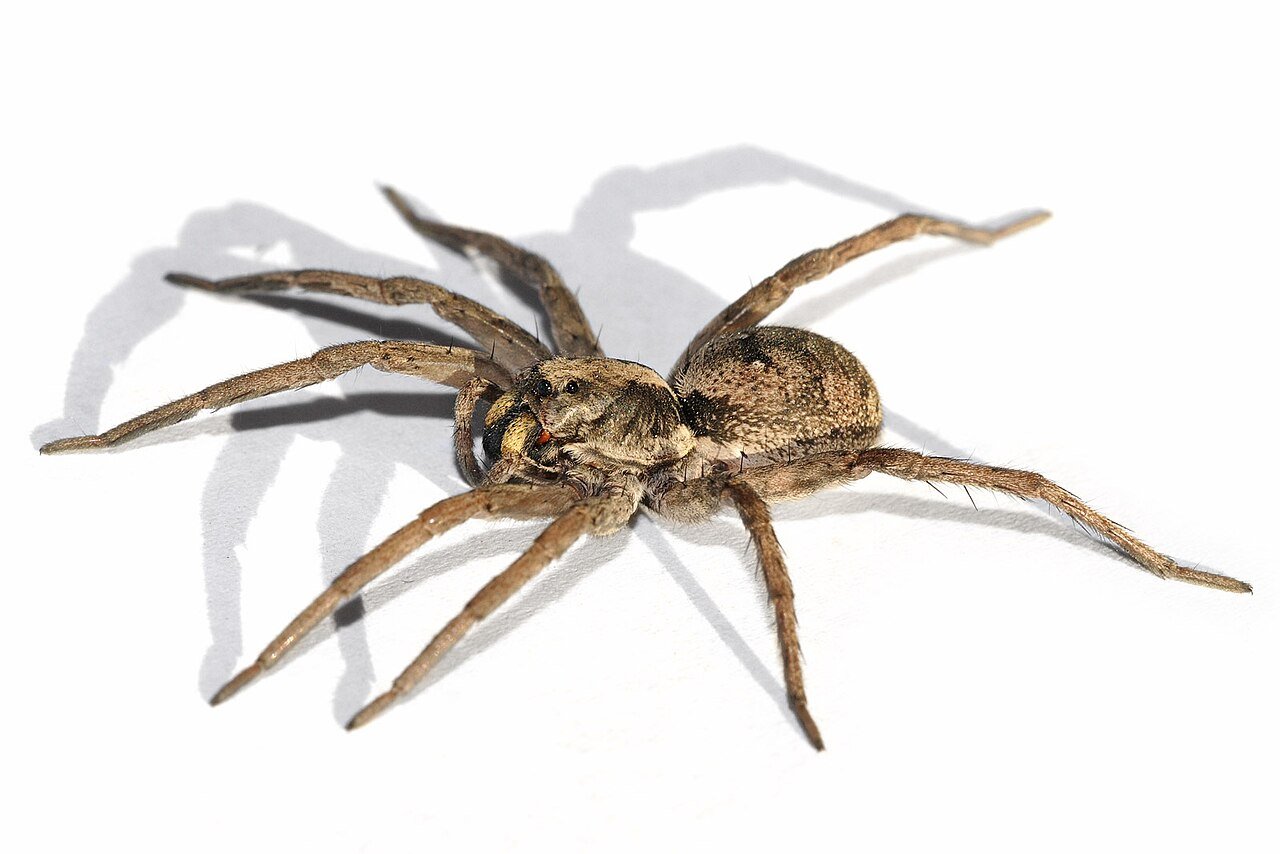
The larger, fast, hairy spider that turns up on a basement floor or sprints across a garage in October is a wolf spider. They hunt actively rather than building webs to catch prey, which is exactly why you see them moving. They are alarming because of size and speed, they will bite if genuinely trapped against skin, and they are not dangerous and not interested in people. They came in through a gap following something they were chasing.
The ones spinning orderly circular webs across a porch light or a window frame overnight in late summer are orb weavers — seasonal, harmless, and a fairly reliable sign that the exterior lighting is doing an excellent job of attracting flying insects. On streets with mature trees and older fixtures, they can be spectacular, and they are also why a lot of people call in August after walking face-first into one.
The Two Everyone Asks About
Black widows do occur in Ohio, and Hamilton has more of the conditions they favor than a subdivision does — undisturbed, protected, low spaces. Stacked firewood, the underside of a porch, a detached garage floor corner, a basement bulkhead, a window well that has not been cleaned out in a decade, and stored items in an outbuilding. The identification is specific: a glossy black spider with a distinctly globular abdomen and a red hourglass on the underside, in a tangled irregular web close to the ground. Gloves when handling stored materials in those places is sensible and covers most of the realistic risk.
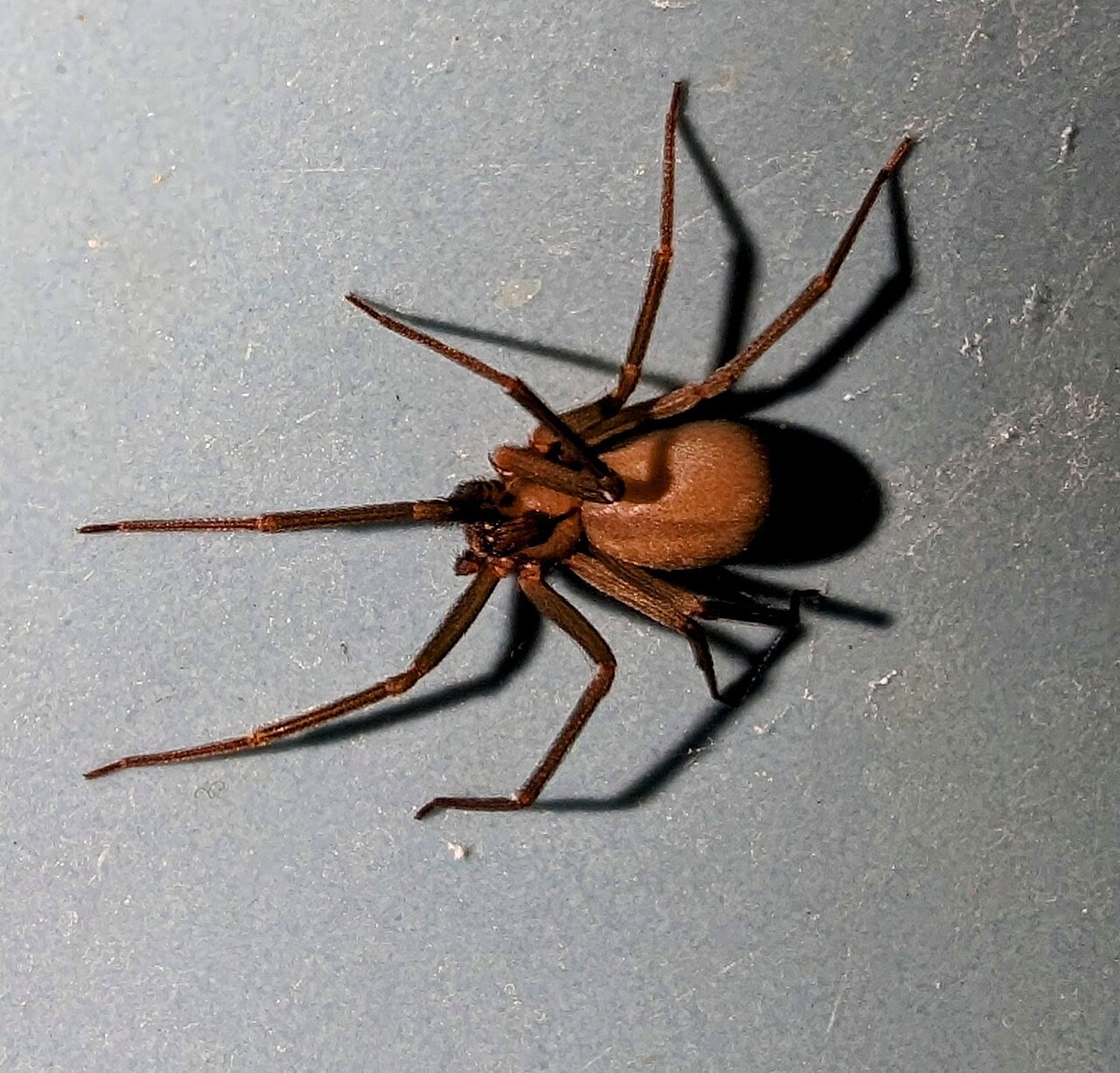
Brown recluse is the one people worry about most and encounter least. Ohio sits outside the established range for the species, and the overwhelming majority of suspected recluse spiders submitted for identification in this state turn out to be something else entirely — commonly a house spider, a grass spider, or a sac spider. A handful of isolated Ohio populations exist, but a spider in a Hamilton basement is far more likely to be almost anything else. We identify what you actually have rather than guess.
It is also worth saying that most reported spider bites are not spider bites. A great many turn out to be bacterial skin infections, and misattributing one to a recluse can delay appropriate treatment. If a lesion is worsening, that is a medical question rather than a pest question.
- Warm or amber exterior bulbs instead of bright white — the most effective single change available.
- Window wells cleaned out and covered — accumulated leaf litter is prime harborage.
- Basement moisture corrected — fewer insects means fewer spiders, with a season’s lag.
- Firewood stacked off the ground and away from the house, with gloves when handling it.
- Webs and egg sacs knocked down physically — residual treatment will not do this for you.
Window Wells and the Grade Line
Deep window wells are close to universal on Hamilton basements, and they are the most reliably productive spider habitat on the whole property. A well that has not been cleaned in a few years holds several inches of leaf litter, and that litter supports the entire food chain a spider needs — springtails, sowbugs, millipedes, and the small flies that breed in decaying organic matter. The spiders are simply where the food is, and the window into the basement is right there.
The correction is genuinely easy and it makes a visible difference within a season. Clear the wells out, install fitted covers, and check that the window frames themselves still seal, because on houses of this age the wood casing at the bottom corner of a basement sash is very often rotted enough to let anything walk straight through. Covers also stop the wells filling with water, which helps the basement generally.
The same logic applies at grade all the way around. Leaf litter and mulch banked against the foundation, ivy climbing the brick, and shrubs touching the wall all support insects at the exact elevation where the openings are, and they give spiders sheltered staging a few inches from every one of them. Pulling that material back off the wall does more than any perimeter spray applied over the top of it.
What Treatment Does and Does Not Do
Spiders are less susceptible to residual insecticides than most insects for a mechanical reason: they walk on the tips of their legs and hold most of their body clear of treated surfaces, so they pick up considerably less material than a crawling insect. Anyone promising to eliminate every spider from a stone-walled basement with a spray is overselling it badly.
What actually works is a combination. A well-placed exterior treatment reduces the insect population spiders feed on and hits specific harborage at entries, window wells, and the foundation line. Physical removal of webs and egg sacs takes out the next generation directly, and it needs repeating because it is maintenance rather than a one-time fix. Sealing gaps at grade — settled thresholds, basement window frames, bulkhead doors, and old pipe penetrations — keeps wandering males out in autumn.
And there is a threshold question worth asking honestly. Cellar spiders in the corners of an unfinished stone basement are ordinary in every house of this age in this city, and they are doing you a small favor. Treatment makes sense when spiders are appearing in living space, when there is a widow identification concern around a woodpile or outbuilding, or when exterior webbing has become genuinely unmanageable.
Across Butler County
Fairfield to the south has poured basements and a lighter version of this. Oxford northwest and Middletown northeast have comparable older stock.
General service is on the Hamilton pest control page.
Frequently asked questions
Why is my old basement so much worse than my last house?
Texture and humidity. A stacked stone wall offers a thousand web anchor points, deep shadowed recesses, and joist pockets, and it holds moisture against the soil behind it. A poured concrete wall offers almost none of that. The masonry itself is why the population is larger.
Why do spiders suddenly appear every September?
Mature males leave their webs in autumn and wander looking for females. A wandering spider that meets an old house with settled openings at grade ends up inside. It is a seasonal movement rather than an infestation, and it passes.
Do we have brown recluse in Hamilton?
Almost certainly not. Ohio sits outside the established range, and the large majority of suspected recluse spiders submitted for identification here turn out to be common house spiders, grass spiders, or sac spiders. We identify what you actually have rather than assume.
Are black widows really in Ohio?
Yes, uncommonly but genuinely, and Hamilton has more of the spaces they like — firewood stacks, under porches, detached garage corners, bulkheads, and neglected window wells. Look for a glossy black spider with a globular abdomen and a red hourglass underneath. Wear gloves handling stored materials.
What are the long-legged spiders in every corner?
Cellar spiders. Harmless, unable to meaningfully bite human skin, and useful because they eat other spiders and insects. In most old basements a broom is a better response than a treatment.
Will spraying get rid of them all?
No, and in a stone basement especially. Spiders walk on their leg tips and keep their bodies clear of treated surfaces, so they pick up much less residual than crawling insects. Treatment works mainly by reducing the insects they eat and by hitting specific harborage.
What actually reduces spiders the most here?
Two things: exterior lighting and basement moisture. Warm or amber bulbs with motion activation cut the flying-insect supply, and drying the basement out through downspouts, grade, and a working sump reduces the insects spiders feed on. The spider population follows the food down over a season.
I think I was bitten by a spider.
Most reported spider bites turn out not to be spider bites — a great many are bacterial skin infections. If a lesion is worsening, that is a medical question rather than a pest one, and misattributing it to a recluse can delay the right treatment.
Do window wells really matter that much?
They are usually the single most productive spider habitat on an old Hamilton property. A well holding a few inches of leaf litter supports springtails, sowbugs, millipedes, and small flies, and the spiders follow the food — with a basement window right there. Clearing the wells and fitting covers makes a visible difference within a season.