
On a house with a basement, spiders have somewhere to be that is not your living room. Most of Middletown does not have that. The postwar neighborhoods are largely slab-on-grade and shallow crawl, which means the attached garage is the buffer zone, and anything that gets past it is in the house rather than two floors below it. That single architectural fact explains why spider complaints here are so often about living space rather than a basement corner, and why the garage is where most of the useful work happens.
The Garage Is the Whole Battleground
An attached garage on a slab house does everything a basement would do for a spider and puts it one door away from the kitchen. It is dim, minimally heated, stores boxes and seldom-moved items, has an overhead door with imperfect seals, and usually contains at least one light that gets left on. That combination attracts insects and gives spiders both food and undisturbed harborage.
The high corners, the track and spring assembly of the overhead door, the underside of shelving, and the space behind stored boxes are where webs accumulate. Because the garage is not a room anyone inspects, populations get established without being noticed, and the first sign is usually spiders appearing inside the house near the connecting door.
That makes the garage the highest-value place to work. Sealing the overhead door corners with a fresh sweep and side seals, clearing webs and egg sacs from the high corners and door assembly, getting stored items off the floor and into sealed containers, and changing the light that stays on all do more for a slab house than anything applied to the exterior foundation.
The Autumn Wave
Spider calls cluster in September and October, and it has almost nothing to do with spiders seeking warmth. What actually happens is that mature males abandon their webs and wander looking for females, and a wandering spider that meets a slab house with an attached garage and settled thresholds ends up inside.
The larger, fast, hairy spider that turns up on a garage floor or sprints across a kitchen in October is a wolf spider. They hunt actively rather than building webs to catch prey, which is exactly why you see them moving. They are alarming because of size and speed, they will bite if genuinely trapped against skin, and they are not dangerous and not interested in people. On lots backing onto open ground or a field edge they are more common, because that is where they live the rest of the year.
The ones spinning orderly circular webs across a porch light, a window frame, or a garage door opening overnight in late summer are orb weavers — seasonal, harmless, and a reliable indicator that your exterior lighting is doing an excellent job of attracting flying insects. They are also why a lot of people call in August after walking into one on the way to the car.
The Two Everyone Asks About
Black widows do occur in Ohio, and it is worth being accurate rather than either alarming or dismissive. They are uncommon but genuinely present, and they favor undisturbed, protected, low spaces — stacked firewood, the underside of a deck or stoop, the back corner of a detached garage or shed, a crawl access, a window well that has not been cleaned in years, and stored patio furniture. The identification is specific: a glossy black spider with a distinctly globular abdomen and a red hourglass on the underside, in a tangled irregular web close to the ground.
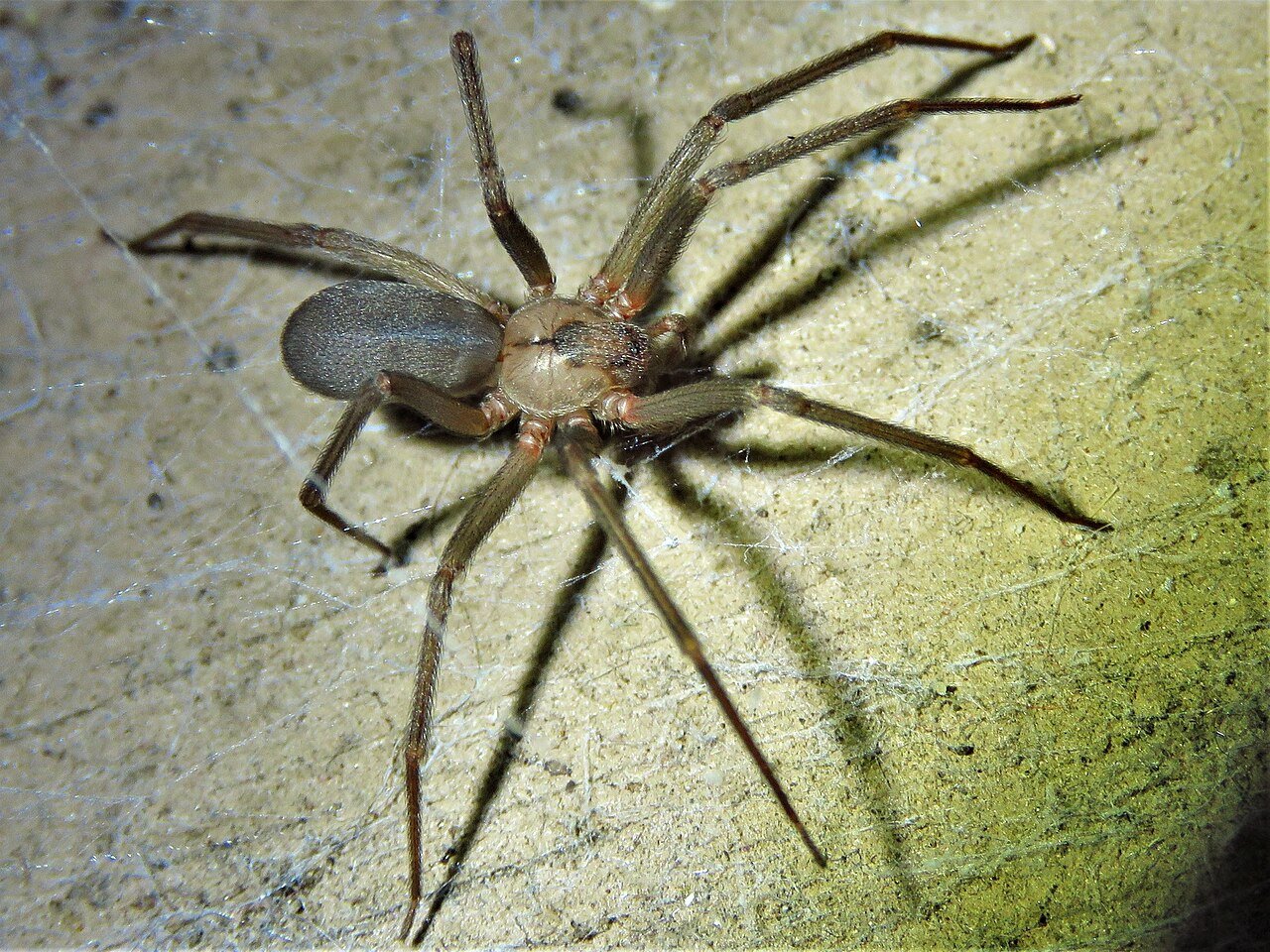
Brown recluse is the one people worry about most and encounter least. Ohio sits outside the established range for the species, and the overwhelming majority of suspected recluse spiders submitted for identification in this state turn out to be something else — commonly a house spider, a grass spider, or a sac spider. A handful of isolated Ohio populations exist, but a spider in a Middletown garage is far more likely to be almost anything else. We identify what you actually have rather than guess.
It is also worth saying that most reported spider bites are not spider bites. A great many turn out to be bacterial skin infections, and attributing one to a recluse can delay appropriate treatment. If a lesion is worsening, that is a medical question rather than a pest question. Gloves when handling firewood and long-stored boxes covers essentially all of the realistic risk.
- Fresh garage door sweep and side seals — the highest-value single fix on a slab house.
- Warm or amber exterior bulbs instead of bright white, on motion rather than dusk-to-dawn.
- Webs and egg sacs cleared from garage corners and the door track assembly.
- Stored items off the floor and into sealed containers rather than cardboard.
- Vegetation trimmed so nothing touches siding, and beds pulled back from the slab edge.
Crawl Spaces and the Shallow Foundation
Where a Middletown house has a shallow crawl rather than a slab, that space becomes the equivalent of a basement for spider purposes, and it is usually in worse condition than a basement would be. Crawls here are frequently dirt-floored or have a vapor barrier that was laid once and has been walked on, torn, and never re-lapped. They run humid most of the year, they are dark, and almost nobody goes into them.
That combination supports the whole food chain a spider needs. Springtails, sowbugs, millipedes, and small flies breed in damp soil and organic debris, and spiders follow the food. Because the crawl connects to the living space through plumbing and duct penetrations in the subfloor, whatever establishes down there has a direct route up.
The corrections are worth doing for the house generally, not only for spiders: get a continuous vapor barrier down and properly lapped, make sure the crawl vents are actually open and unobstructed, extend downspouts so water is not being delivered alongside the foundation, and seal the plumbing and duct penetrations in the subfloor. A drier crawl supports fewer insects, and the spider population follows within a season.
Spiders Are a Symptom
This is the part that changes how the work is done. Spiders are predators, and predator populations track prey populations. A house with a persistent spider problem almost always has a persistent supply of the insects spiders eat, and in these neighborhoods the most common supply line is exterior lighting. Bright white fixtures at the garage, front door, and patio pull in flying insects all night, and spiders simply set up where the food is.
Switching to warm-toned or amber bulbs, moving fixtures away from doors where practical, and using motion activation rather than dusk-to-dawn operation reduces insect attraction substantially, and spider numbers follow within weeks. It is the highest-value change most households can make and it costs less than a treatment does.
The second supply line is the landscape at the slab edge. Beds, ground cover, and shrubs touching the siding support insects right against the house and give spiders sheltered harborage inches from every ground-level opening. Pulling beds back and keeping vegetation off the walls removes both the food and the staging area at once.
Across Butler County
Monroe is immediately south, Franklin and Carlisle north across the county line, and Hamilton southwest where old stone basements change the picture entirely.
General service is on the Middletown pest control page.
Frequently asked questions
Why do spiders end up in my living room instead of a basement?
Because most Middletown houses do not have one. On a slab or shallow crawl house the attached garage is the buffer zone, and anything that gets past it is in the house rather than two floors below. That is why the garage is where most of the useful work happens.
Why do spiders suddenly appear every September?
Mature males leave their webs in autumn and wander looking for females. A wandering spider that meets a slab house with an attached garage and settled thresholds ends up inside. It is a seasonal movement rather than an infestation, and it passes.
What is the single best thing I can do?
Two things, and neither is a treatment. Replace the garage door sweep and side seals, and change bright white exterior bulbs to warm or amber on motion activation. The first closes the main entry; the second cuts the flying-insect food supply that draws spiders in.
Do we have brown recluse in Middletown?
Almost certainly not. Ohio sits outside the established range, and the large majority of suspected recluse spiders submitted for identification here turn out to be common house spiders, grass spiders, or sac spiders. We identify what you actually have rather than assume.
Are black widows really in Ohio?
Yes, uncommonly but genuinely. They favor undisturbed low spaces — firewood stacks, under decks and stoops, detached garage and shed corners, crawl access, and neglected window wells. Look for a glossy black spider with a globular abdomen and a red hourglass underneath, and wear gloves handling stored materials.
Will spraying get rid of all the spiders?
No, and anyone promising that is overselling. Spiders walk on their leg tips and hold their bodies clear of treated surfaces, so they pick up much less residual than crawling insects. Treatment works mainly by reducing the insects they eat and by hitting specific harborage points.
Do egg sacs need to be removed?
Yes, physically. Knocking down webs and egg sacs removes the next generation directly, which residual treatment will not do on its own. In an attached garage it is worth doing a couple of times a year rather than once.
I think I was bitten by a spider.
Most reported spider bites turn out not to be. A great many are bacterial skin infections, and attributing one to a recluse can delay the right treatment. If a lesion is worsening, that is a medical question rather than a pest one.
Does my crawl space matter?
A great deal. A dirt-floored or poorly sealed crawl runs humid year round and supports springtails, sowbugs, millipedes, and small flies — the food chain spiders follow — with a direct route up through subfloor penetrations. A continuous vapor barrier, open vents, and extended downspouts reduce the insects and the spiders follow within a season.