
Fairfield’s rodent problem is mostly a landscaping problem that nobody thinks of as one. These subdivisions were planted in the seventies and eighties, and forty years later the foundation shrubs are enormous, the beds have crept up the wall, the ground cover runs unbroken from the property line to the siding, and the ornamental grasses have not been cut back in years. That is continuous cover from the yard to the house, and a mouse crossing an open lawn is exposed while a mouse moving through mature landscaping is not. The autumn spike here follows that cover almost exactly.
Cover Is What Actually Moves Them
Mice are prey animals, and prey animals move where they cannot be seen. An open, mown lawn is genuinely hostile ground for a house mouse — hawks and owls hunt it, cats patrol it, and there is nowhere to hide. Dense ground cover, mature foundation plantings, ornamental grasses, ivy on a wall, and a woodpile against the garage are the opposite. They form a protected corridor running right up to the building.
That is why two identical houses on the same street can have completely different mouse experiences. The one with beds pulled back, shrubs trimmed off the siding, and a clear band of visible foundation gets far less pressure than the one where the junipers have grown into the wall. It is not luck and it is not housekeeping. It is whether there is a covered route to the door.
The correction is unglamorous and it works: trim foundation plantings so nothing touches the siding, pull beds back so a band of foundation is visible, cut ornamental grasses back in autumn rather than spring, move woodpiles away from the structure and off the ground, and keep ground cover from running unbroken to the wall. That alone reduces how many mice ever reach the building.
Where They Get In
Once they reach the building the entry list on this housing stock is short and predictable, which is good news because it means the job is finite. The attached garage door is first — specifically the bottom corners where the rubber sweep meets the jamb over a slab that is never quite level. A sweep that has hardened and curled after fifteen summers leaves a triangular gap at each corner, and the garage typically stores grass seed, birdseed, and pet food while sharing a door with the house.
Second is the utility penetration set: the air conditioning line set through the rim joist or slab edge, the dryer vent, the gas line, the electrical service entrance, hose bibs, and any plumbing coming through at grade. On houses of this era those were sealed with caulk or mortar that has been cracking for decades, or were never properly sealed at all. Mice chew through cured foam and caulk without difficulty; what stops them is copper mesh or hardware cloth packed into the void before anything is sealed over it.
Third is the crawl space, where the house has one. Crawl vents with rusted or missing screen, a crawl access door that no longer seats, and the gap where a duct or pipe passes through the band joist all provide entry into a space that connects to the living area through the subfloor. On split-levels and crawl houses that is the route people most often miss.
- Trim plantings off the siding and expose a band of foundation — the cheapest thing that works.
- Garage door corners — a hardened sweep over an uneven slab is the leading entry.
- Utility penetrations sealed decades ago with caulk that has since cracked.
- Crawl vents and access doors with failed screen or seals.
- Woodpiles and ornamental grasses against the house — covered staging areas.
Mice, Rats, and the Commercial Corridor
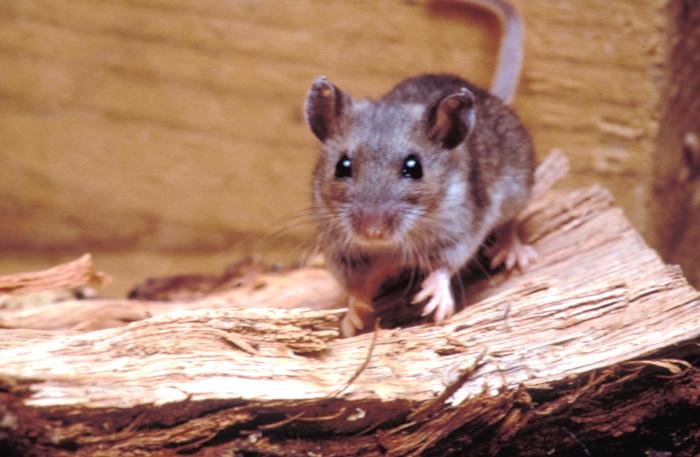
Almost everything we handle in Fairfield residential work is house mouse. Norway rats are a realistic possibility on properties backing onto or near the Route 4 commercial corridor, where unsecured dumpsters and food waste provide a sustained outdoor food source, and near creek corridors and construction sites where burrow systems get displaced.
The distinctions are practical. Mouse droppings are the size of a grain of rice; rat droppings are the size of an olive pit. Mice need about a quarter inch to enter; rats need closer to half an inch. Mice nest in wall voids, insulation, and stored boxes; rats burrow in soil and run established routes along foundations and fence lines. Burrow openings along a foundation, under a shed, or beside a fence are a rat conversation rather than a mouse one.
The work diverges immediately, so we identify which one you have before quoting anything. Mouse work is envelope sealing plus interior trapping. Rat work is burrow treatment, grade and sanitation correction, considerably heavier exclusion, and sometimes a conversation with a neighbor or a commercial property about a container that is feeding the population.
What the Work Involves
Exterior bait alone is a subscription rather than a solution. It reduces perimeter pressure and there is a role for it on properties near a persistent source, but if the entries stay open the house keeps receiving arrivals indefinitely. Exclusion is what closes it, and exclusion is physical rather than chemical.
The order matters: walk the full perimeter at grade, the garage, the crawl, and the roofline; seal every opening with material a mouse cannot chew; then remove whatever is already inside using traps rather than interior bait. That last choice is deliberate — a mouse that eats bait and dies inside a wall cavity or a crawl is an odor problem for two to three weeks, and in a finished house those cavities are not reachable without cutting drywall.
Then verification at roughly two weeks, because the honest measure of a rodent job is not the day-one catch but whether anything is still being caught a fortnight later. If it is, an entry was missed and we go back to the envelope rather than adding traps and hoping.
What We Do Not Handle
We handle rodents — nothing larger than rats and mice. On properties with mature landscaping, sheds, and decks, that boundary comes up regularly, because those features attract animals well beyond our scope. If what is under the deck is a groundhog, what is in the attic is a raccoon or an opossum, or what is in the chimney is a bat, that is wildlife control and we will say so plainly and point you toward someone who does that work properly.
Ruling it out early is worth doing. Heavy, slow, or dragging sounds concentrated around dusk and dawn are usually not mice, and six weeks spent on a mouse program for a raccoon is six weeks lost. A short conversation about what you are hearing and when generally sorts it before anybody schedules anything.
Across Butler County
Hamilton to the north has alleys and old masonry foundations and behaves quite differently. West Chester is east with newer construction and field edges, and Middletown is north.
General service is on the Fairfield pest control page.
Frequently asked questions
Why does my neighbor never get mice and I do every year?
Usually cover. Mice avoid open mown lawn because they are exposed on it, and move freely through dense foundation plantings, ground cover, ornamental grasses, and woodpiles. A house with beds pulled back and a visible band of foundation gets far less pressure than one where the junipers have grown into the siding.
What is the cheapest thing I can do?
Trim foundation plantings so nothing touches the siding and pull beds back to expose a band of foundation. Cut ornamental grasses in autumn rather than spring, and move woodpiles off the ground and away from the house. That reduces how many mice ever reach the building in the first place.
My house is from 1982. Where are they getting in?
A short list: the bottom corners of the attached garage door where the sweep has hardened, utility penetrations sealed decades ago with caulk that has cracked, and on crawl houses the crawl vents and access door. Slab and crawl houses of this era have fewer openings than old masonry ones — they just need closing properly.
Do I have rats or mice?
Droppings are the quickest tell — grain-of-rice sized means mice, olive-pit sized means rats. Rats also burrow in soil along foundations, sheds, and fence lines rather than nesting in walls. Rats are a realistic possibility near the Route 4 commercial corridor and creek corridors, and they are a different job.
Can you just put out bait?
Exterior bait has a role near a persistent source, but on its own it is a subscription. If the entries stay open the house keeps receiving arrivals. Inside we use traps rather than bait, because a mouse dying in a wall cavity or crawl is an odor problem you cannot reach for two to three weeks.
How small a gap do mice need?
About a quarter inch, roughly a pencil width, and juveniles need less. They find existing gaps and work the soft edges rather than chewing masonry, which is why sealing has to use copper mesh or hardware cloth packed in first rather than foam or caulk alone.
I hear something in the attic.
It could be mice, but heavy, slow, or dragging sounds around dusk and dawn usually are not. We handle rodents only — nothing larger than rats and mice — so if it turns out to be a raccoon, opossum, or bat we will tell you and point you toward wildlife control.
When should I schedule this?
Late summer into early September. Sealing before the first cold night is prevention and it is inexpensive. Doing it in November is cleanup, because whatever got in is already sheltered and breeding on roughly a three-week cycle.