
Every July, a Dayton gardener watches Japanese beetles skeletonize the roses, drives to the hardware store, and returns with the yellow-and-green bag trap that seems purpose-built for revenge. By August the bag is heavy, wriggling, revolting — and the roses are worse. This is not bad luck. Japanese beetle traps are the best-documented case in home pest control of a product that works exactly as designed and fails at its actual purpose: decades of university research shows the traps attract far more beetles than they catch, and gardens near traps consistently suffer more damage than gardens without them. The full story — the lure science, the famous capture-rate numbers, the narrow cases where traps genuinely help, and the honest alternatives for a Miami Valley July — is below.
How the Trap Works (Too Well)
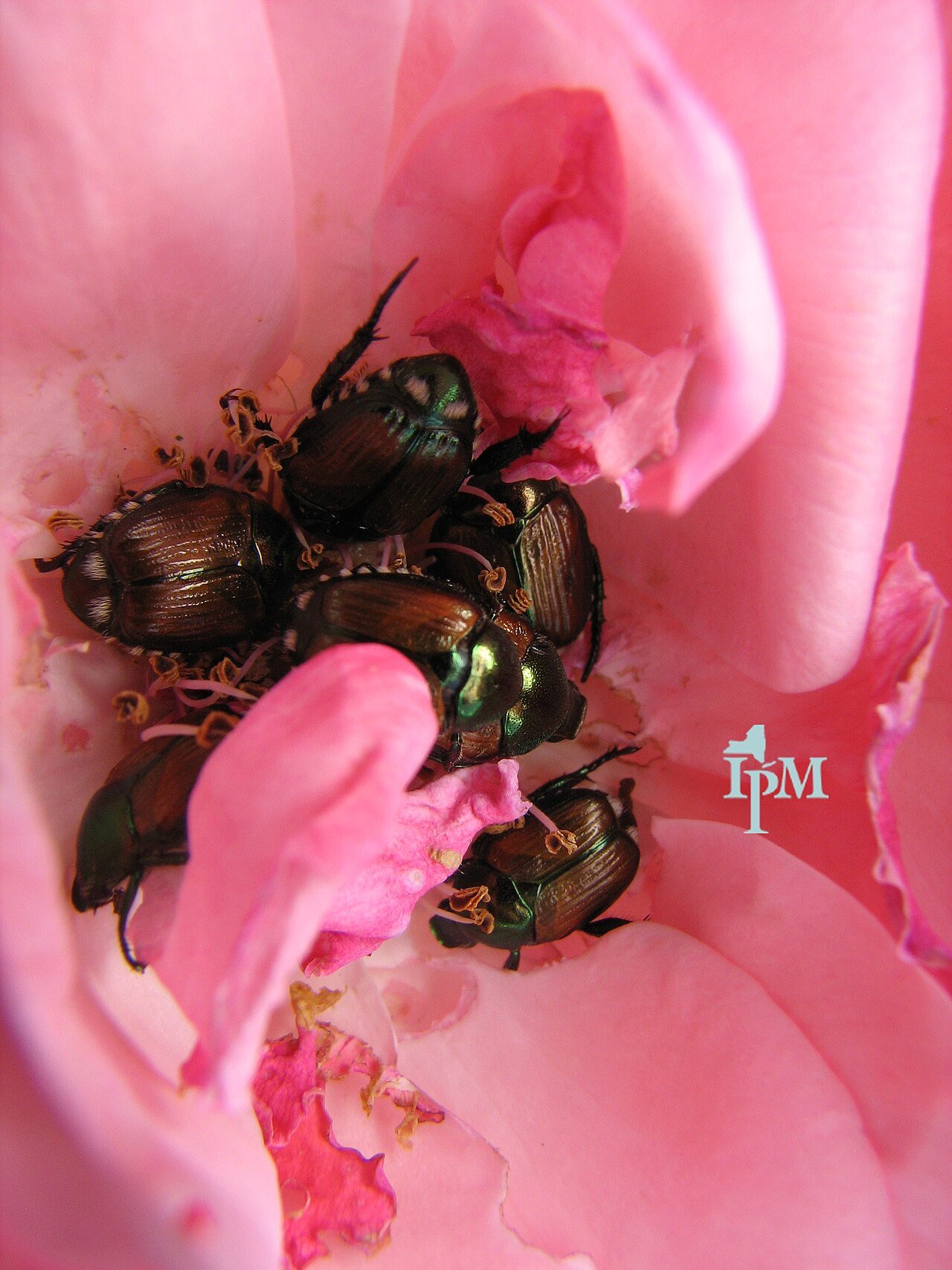
The bag hangs under a plastic vane charged with a double lure: the beetles’ own aggregation-sex pheromone plus a floral co-attractant — a combination so effective it pulls Japanese beetles from hundreds of yards, plausibly a quarter mile, far beyond your property line. Arriving beetles orient clumsily, hit the vane, and tumble into the bag… some of them. The number that made this product famous comes from USDA and university field research (Kentucky’s trials are the classics): traps catch well under half of the beetles they attract — commonly cited around 50–75% escaping capture — and the escapees don’t go home. They land on the nearest food and mate site, which is your rose bed, your linden, your grape arbor. The result, replicated repeatedly: plants near traps sustain significantly more feeding damage than plants in trap-free yards. You are not trapping your beetles; you are hosting a regional beetle festival and billing your own garden for catering.
A trap pulls in more beetles than it catches, which is why the full bag means a worse garden. For the house itself, see pest control in Dayton.
“But My Bag Is Full” — the Persuasive Illusion
The full bag is the product’s marketing department. Thousands of dead beetles feel like victory — but the bag only proves attraction, not protection, and the regional population is beyond denting: Japanese beetle densities across an Ohio summer run to millions per square mile, refreshed continuously by highly mobile adults that fly miles in their six-week season. Removing ten thousand from an open system that deep changes nothing about tomorrow’s arrivals — except that your yard now broadcasts the strongest come-hither signal on the block. It’s the same review-section trap as the fly bag traps: catch volume measures the lure, while the only metric that matters — damage to your plants — quietly worsens. The five-star review and the skeletonized roses are the same phenomenon, photographed from different angles.
The Narrow Cases Where Traps Genuinely Help
- Sacrificial distance trapping: the research-supported use — traps placed at the property’s far edge, 30+ yards downwind from anything you value, intercepting a share of the traffic your plantings would otherwise receive. On a small suburban lot, that distance usually doesn’t exist, which is the honest reason the product fails most buyers.
- Community-scale mass trapping: when a whole neighborhood traps in a coordinated grid, area-wide suppression becomes measurable — the strategy behind some municipal and orchard programs. One yard can’t run it alone; one yard just becomes the grid’s hotspot.
- Monitoring: a trap run for a day tells you when the annual flight starts and peaks — useful timing intelligence for the sprays and covers below, as long as the trap comes down after the census.
- New-infestation detection: the USDA’s own use — traps as surveillance at the species’ expanding range edges. Not an Ohio application; we’ve been thoroughly colonized since the mid-century.
What Actually Protects a Miami Valley Garden in July
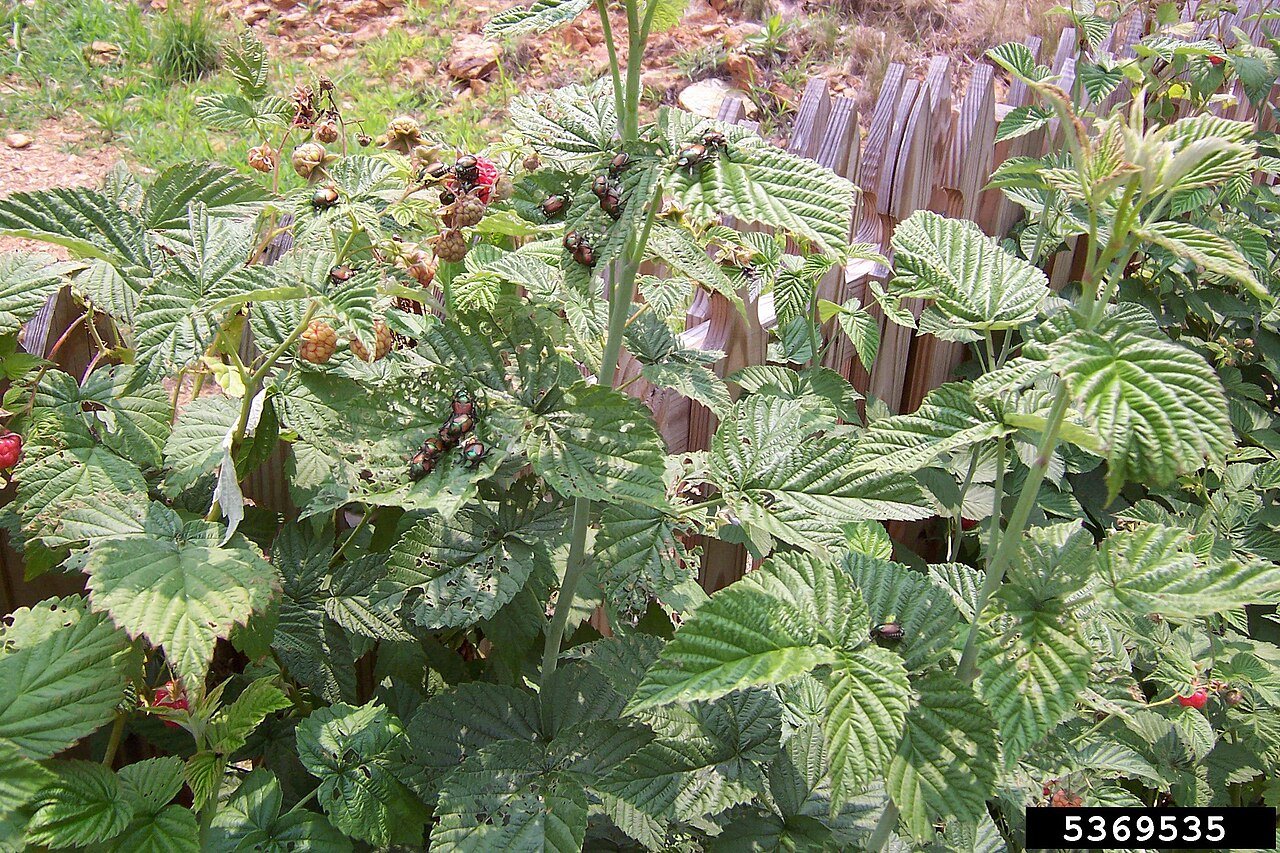
Hand-picking into soapy water — genuinely the most effective per-minute tactic on garden scale: beetles drop reflexively when disturbed, so a morning cup-of-soapy-water patrol under each rose truss removes the residents and their aggregation scent, which is the real win — beetles recruit to plants where beetles already feed, so daily removal makes your plants smell unpopular. Physical exclusion for the six-week flight: fine netting or row cover over roses, grapes, and prize beds during peak (mid-June to early August here), removed for pollination windows on food crops. Plant-level triage: beetles have a strong menu ranking — lindens, roses, grapes, raspberries, and cherries get hammered while many natives and conifers go untouched — so long-term landscaping choices quietly outperform every July product. Targeted insecticides, honestly framed: neem/azadirachtin gives modest deterrence on ornamentals; pyrethroid or carbaryl sprays protect high-value plants but cost pollinators (never spray open blooms); and systemic imidacloprid on non-flowering ornamentals like lindens works but carries the same pollinator caveat writ large. And the grub question: treating your lawn for the white grubs that are this beetle’s larval stage protects your turf from grub damage — worthwhile on its own terms — but does not meaningfully reduce next July’s adults on your roses, because the adults fly in from every lawn in the county. Sold as beetle prevention, grub control is the trap illusion in soil form; sold as turf protection, it’s legitimate. We price it as the latter.
The Bigger Lesson the Yellow Bag Teaches
The Japanese beetle trap belongs on the same shelf-of-fame as the roach fogger, the ultrasonic plug-in, and the misplaced patio fly bag: products whose feedback (bodies, ceremony, a full bag) measures something other than protection. The filter that beats all of them is one question — does this reduce damage to my stuff, measured at my stuff? — asked before purchase and audited after. It’s the question our whole honest-grading series runs on, and the one we apply to our own services: a treatment that can’t point to that metric doesn’t ride in the truck. For beetles specifically, the July answer is soapy water, netting, smart planting, and — where turf grubs are the actual complaint — properly timed lawn-side work. The yellow bag’s answer is a heavier bag.
Roses getting skeletonized — or lawn dying in patches that peel back like carpet? Tell us which; they’re different problems with different fixes, and we treat the real one. Serving Dayton and all of Montgomery, Greene, Miami, Clark, Warren, Butler, Preble, and Darke counties.
Know Your Enemy: the Beetle Behind the Bag
Popillia japonica earned its American infamy honestly. Arrived in New Jersey nursery stock around 1916, it found a continent with its favorite foods, ideal turf for its grubs, and none of the specialist predators and diseases that keep it a minor insect in Japan — the full invasive-species starter kit. A century later it’s permanent from the Atlantic to the Plains, with Ohio deep in the settled zone. The life cycle explains both the July surge and the futility of local eradication: adults emerge in mid-June, feed and mate for six weeks (skeletonizing leaves down to lace by eating between the veins — the diagnostic damage), and each female salts sixty-odd eggs into moist turf; the grubs feed on grass roots into fall, overwinter deep, feed again in spring, and pupate into next year’s emergence — every lawn in the county running the same conveyor. Two vulnerabilities matter to a homeowner: the adults’ reflexive drop-when-disturbed response (the entire physics behind the soapy-water cup), and the grubs’ late-summer shallow feeding window (the timing behind effective turf treatments). Neither vulnerability involves a yellow bag.
The Wet-Summer Signal: Reading Beetle Years in Advance
Beetle pressure is forecastable a season out, because egg and grub survival hinges on soil moisture: eggs desiccate in drought-baked turf, so a wet July-August (egg-laying season) reliably sets up a heavy flight the following June, while a bone-dry late summer thins next year’s emergence for free. Practical uses: after a soggy August, pre-order netting and book turf-grub work with confidence rather than reactively; irrigated lawns in drought years become the neighborhood’s premier nurseries (dialing back August watering during droughts is quiet, free suppression); and the same moisture logic explains why golf courses and irrigated subdivisions carry the heaviest local pressure. It’s the least-known lever in the whole Japanese beetle conversation — and unlike the trap, it costs nothing and can’t backfire.
Milky Spore and Nematodes: the Biological Shelf, Graded
The organic aisle’s two beetle offerings deserve honest grades too. Milky spore (a bacterial disease of the grubs) carries devoted folklore and disappointing modern data: Ohio-latitude trials show slow establishment, weather-dependent performance, and — the structural problem again — even a perfectly inoculated lawn imports its adults from every neighbor. Grade: C-minus as sold, and only as a years-long community project does the math improve. Beneficial nematodes (Heterorhabditis species against grubs) earn a solid B-minus in the right hands: genuinely effective on turf grubs when applied to warm, moist soil in late summer with fresh stock and watered in — and completely wasted when the jug sat on a hot shelf or the lawn ran dry. Both share the grub-control asterisk from above: they protect turf, not July roses. The pattern across every product on this page holds to the end — the closer a remedy’s feedback sits to actual plant protection, the humbler its marketing, and the better it works.
If you already own the trap, one salvage and one disposal note: salvage — run it for a single day in early June as a flight-season alarm clock, then bag the lure in sealed plastic (it keeps broadcasting from the trash can otherwise) and store the vane for next year’s census. Disposal of a season’s catch — double-bag it sealed; a decomposing bag of beetles is its own aroma event and, left open, a raccoon buffet. The trap’s best career, honestly, is as a one-day-a-year measuring instrument — a demotion the research has been recommending for forty years while the bags kept selling. Consider this page your permission slip to take it down.
(Ohio footnote: our summers also host lookalike scarabs — false Japanese beetles, rose chafers, June bugs — that draw friendly fire every year. The white side-tufts along the abdomen are the confirming Japanese beetle field mark; no tufts, different beetle, possibly no problem at all.)
Frequently Asked Questions
Do Japanese beetle traps work?
They work perfectly at attracting beetles and poorly at protecting anything: university research shows the pheromone-plus-floral lure pulls beetles from hundreds of yards while the trap captures well under half of arrivals — and gardens near traps consistently show MORE feeding damage than trap-free yards. The full bag measures the lure, not protection.
Why did my garden get worse after I put up a beetle trap?
The escapee problem: beetles drawn from a quarter-mile radius that miss the bag (the majority) land on the nearest food — your roses, grapes, and lindens. You imported the neighborhood’s beetles and captured a minority of them. This outcome is replicated in decades of field trials.
Is there any right way to use a Japanese beetle trap?
Three narrow ones: far-edge sacrificial placement 30+ yards downwind of valued plants (most suburban lots lack the distance), coordinated neighborhood-wide grids (measurable area suppression), and short-term monitoring to time the flight season. Solo, close, and season-long — the default use — is the documented failure mode.
What actually gets rid of Japanese beetles?
On garden scale: daily morning hand-picking into soapy water (removes beetles AND the aggregation scent that recruits more), fine netting over prize plants during the six-week flight, and planting choices that skip their favorites. Targeted sprays protect high-value plants at pollinator cost — never on open blooms.
Does grub control stop Japanese beetles?
It protects your lawn from grub damage — a legitimate goal — but not your roses from adults, which fly in from every lawn in the county regardless of yours. Grub treatment sold as beetle prevention is the trap illusion in soil form; sold as turf protection with proper timing, it’s honest work.
How long does Japanese beetle season last in Ohio?
About six weeks of adult flight, mid-June through early August, peaking in July. Netting and picking campaigns only need to survive that window; by mid-August the survivors are laying eggs in turf and the pressure collapses on its own.
Do the beetles in my trap attract more beetles?
Yes — trapped and feeding beetles broadcast the aggregation pheromone, and damaged leaves release attractive volatiles, so both a full bag and a chewed rose actively recruit. It’s why daily removal (picking) outperforms passive collection: you’re silencing the invitation, not just gathering guests.
What plants do Japanese beetles attack most?
The hit list: lindens, roses, grapes, raspberries, cherries and other stone fruit, birches, and hibiscus. Largely ignored: most conifers, boxwood, holly, lilac, and many natives. Long-term, the planting list protects a yard better than any July product ever sold.