
Lewisburg holds down northern Preble County where the old National Road — US-40 — crosses the farm grid, with I-70 running its interchange just north of the village and Harrison Township’s sections stretching out in every direction. That geography writes the pest file: a historic village core that grew up along one of America’s oldest highways, an interstate-corridor commercial edge with its own traffic-borne pressures, and open grain country on all sides delivering the rural calendar in full. Greater Dayton Pest & Rodent runs Lewisburg on the northern leg of our Preble route days — about twenty-five minutes out US-40 from our side of Dayton — with the complete service list and the same guarantee that anchors every page of this site.
Plenty of people in Lewisburg search for an exterminator rather than pest control. Same job, older word — and it is still the one most of our callers use.
The National Road village and the interstate edge
The village core’s older homes run the familiar old-stock lineup — stone-and-block foundations meeting the fall mouse push, porch wasps, cellar moisture feeding the basement guild — with a National Road twist: pike-era buildings and their successors sit close to the old right-of-way, and generations of regrading along Main Street have buried more than one foundation reveal, exactly the condition our termite inspections weight heavily in stock this age. The I-70 edge adds the corridor factor: interstate-adjacent businesses — fuel, food, and logistics serving the exit — process traveler and freight traffic that seeds the occasional bed bug introduction and keeps commercial rodent pressure constant at the dumpster-and-dock line; our commercial programs run the corridor accordingly, documentation included. And everywhere the village meets the sections, the rural calendar governs — harvest mice, cluster flies, and the lady beetle flights that soybean country amplifies.
The Lewisburg playbook
- September defense — barrier and exclusion before the combines and the beetle flights; the north county’s highest-value visit
- Old-stock exclusion — mortar, mesh, and steel on the pike-era foundations, with buried-reveal termite vigilance
- Corridor commercial service — scheduled programs with inspector-ready paperwork for the exit economy
- Rural campus scoping — house-plus-outbuildings assessment on every township address (county page logic)
- Transaction inspections — Category 12 WDI reports on village and farm real estate alike
A Lewisburg seasonal calendar
- March–May: village ant season opens; termite swarms follow warm rains — pike-era basements photograph every winged insect same-day; cluster flies exit the farmhouse attics
- June–August: wasps scale in barns and porch structures; carpenter bees work the outbuildings; the corridor businesses run their fly-and-rodent programs hardest
- September–October: the northern sections harvest and the field mice move; lady beetles and invaders mass on sunny siding; September’s scheduled visit answers the whole wave
- November–February: interior mouse season; sunny-day cluster flies at the windows; exclusion carpentry and pre-listing inspection season
Lewisburg questions we hear
We run a business at the exit. Can you match the corporate pest vendor’s paperwork?
Match and usually improve on it — our commercial reports document devices, findings, and corrective actions per visit in the format auditors and health inspectors actually read, and the difference is the service behind the paper: a local company on a weekly route beats a regional vendor’s rotating techs at noticing that this month’s dock evidence is new. Corridor businesses switch to us for the paperwork and stay for the phone number that answers; ask for a sample report with the quote.
The farmhouse attic has had cluster flies since my grandparents. Truly fixable?
Truly — with the honest shape the county page’s deep-dive explains: the multi-generation attic population is the accumulation of decades of unguarded Septembers, and no single winter treatment empties it, but the late-August exterior barrier plus sealed entries changes the arithmetic immediately — each defended fall shrinks the overwintering class, and by the second or third September the January windowsills go quiet. Multi-generation problems yield to multi-season discipline; we schedule it so nobody has to remember.
Preble coverage: county hub · Eaton · West Manchester · Eldorado · Verona · full service area.
Twin Creek country: the northern farm campus
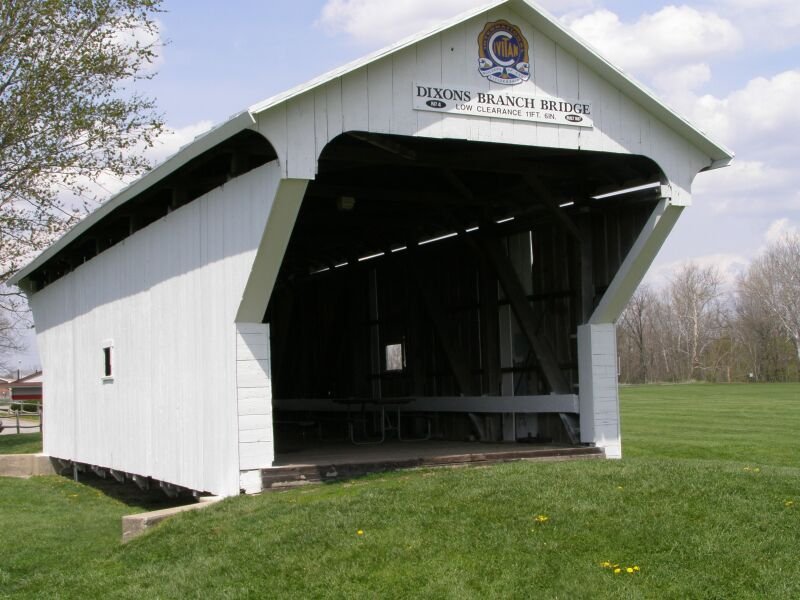
North of the village, Harrison and Twin townships run the classic Preble campus properties — farmhouse, bank barn, machine shed, grain storage — along the Twin Creek headwaters country, and the full rural protocol applies: the twelve-doors standard on the house, feed-room hardening as the highest-return exclusion on the property, the deer-mouse storage protocol for the equipment and campers that winter in the sheds, and wasp management at scale for the structures that grow colonies the suburbs never meet. The Dixon Branch bridge in the photo above makes the point better than another paragraph: north Preble has kept its timber standing for a century and a half by handling water and openings before they became failures, and our work up here is the same trade with a license number. Farm families who want the whole campus read honestly — what earns steel, what earns management, what earns a shrug — get exactly that in writing, with the quote free and the guarantee riding every structure we treat.
The bottom line for Lewisburg
A National Road village with an interstate edge and grain country on all sides gets three pest economies for the price of one address — and now gets a company that reads all three on a weekly northern route. Old-stock exclusion done like preservation, corridor commerce documented like the auditors want, the September wave met on schedule, and the whole county’s guarantee behind it: (937) 569-3330, free quotes, free photo identification, Saturdays by appointment. The pike brought Lewisburg its first traffic two centuries ago; consider us the newest regular service running it.
Does the interstate really change the pest picture, or is that marketing?
It is measurable, and modest — the honest version: interstate exits concentrate three flows that move pests. Freight and dumpster density raise the baseline rodent pressure at the commercial cluster (managed with station networks and dock exclusion, routine work); traveler turnover through lodging and fuel stops seeds occasional bed bug introductions that spread nowhere when caught early (the corridor’s businesses get our early-response pricing and protocols); and the exit’s light-and-food footprint runs a slightly hotter summer insect economy than a dark crossroads would. None of it touches the village blocks a half mile south in any way a resident would notice — the exit is a workplace pest story, not a neighborhood one, and we service it as exactly that. The village’s own pressures remain the old-stock and farm-edge classics every other section of this page covers.
Will your treatment clash with the co-op spraying the field next to me?
Gladly — and the coordination is usually just calendar courtesy: our structural work and the co-op’s field application run under different licenses on different targets, and the only real interactions are scheduling ones (we will not treat the farmhouse perimeter the same morning the fields beside it are being worked, out of simple product-stewardship manners). Tell us your agronomy calendar’s big dates when booking the September visit and the two programs will never meet awkwardly in the driveway. Lanes, respected; timber, dry; everyone’s label, followed.
Who actually turns up in Lewisburg: Greater Dayton Pest & Rodent is owned and operated by Bryan Camden, licensed by the Ohio Department of Agriculture — firm #115079, commercial applicator #170858, categories 10A, 10B and 12. When you call, you talk to the person who does the work. No call center, no rotating crews, and the same technician on every visit.
Frequently asked questions
Do you provide pest control in Lewisburg?
Yes — the northern Preble village rides the western rotation; full program on every street and township lane.
What pests are most common in Lewisburg?
Preble standards with a northern accent: harvest rodent surges, the historic core’s foundation mice, covered-bridge-country woodline wasps, farmstead economies, and September’s certain flights.
How much is pest control in Lewisburg?
County formula: most homes $39–$55/month quarterly; campuses walked; free: (937) 569-3330.
Why does the village get the full fall surge?
Acreage on every side — the displacement wave aims at every heated cluster in the belt; September sealing is the annual municipal answer.
Do you treat the farms around Lewisburg?
Campus model — systems quotes, harvest calendars, grain protocols, deer-mouse defaults; the northern lanes are standing route work.
How fast can you reach Lewisburg?
Weekly western rotation — days typically, no travel charges.
Do you serve Lewisburg businesses?
Yes — village storefronts and ag operations, matched programs, documentation included.
What about the older housing stock?
Masonry-appropriate exclusion and moisture-first basements — the era’s craft applied at village scale.
Is the Protection Plan right here?
Farm-adjacent majority, yes; interior blocks triaged honestly on the first call.
How do I start service in Lewisburg?
Instant quote, free photo ID, or (937) 569-3330 — free estimates, route days weekly.