
Every October, somewhere in the Miami Valley, a sunny afternoon follows a hard frost and a homeowner watches hundreds of “ladybugs” carpet the south wall of the house, stream into the window frames, and reappear indoors all winter, one confused beetle at a time. Those are not the ladybugs from the children’s books. They are multicolored Asian lady beetles (Harmonia axyridis) — called Asian beetles, Japanese lady beetles, or Chinese ladybugs depending on who in Ohio you ask — and they are a different insect with different behavior, a mild bite, a memorable smell, and a strong opinion about spending winter inside your walls. Here is how to tell them from our native ladybugs, what they can and cannot do to your household, and how to keep next October from being an invasion.
Asian lady beetle vs. native ladybug: the ID
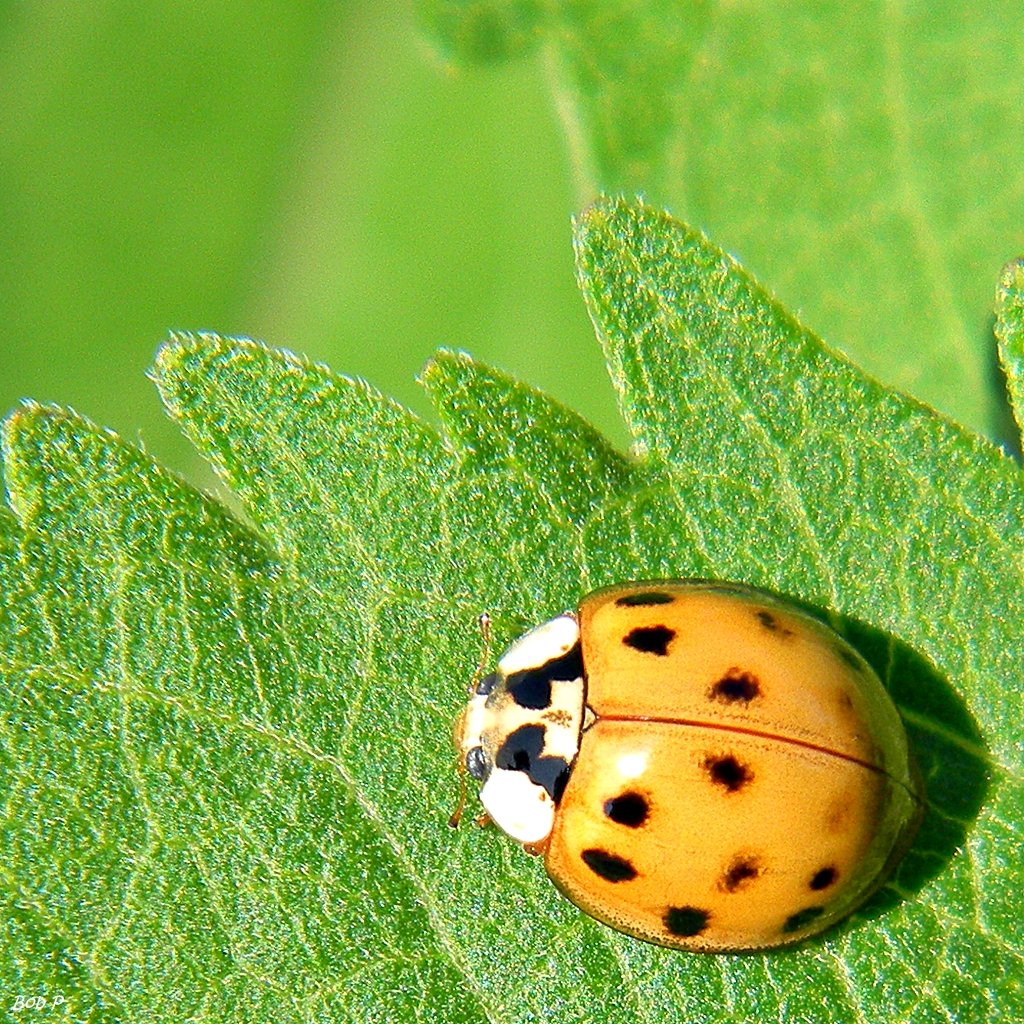
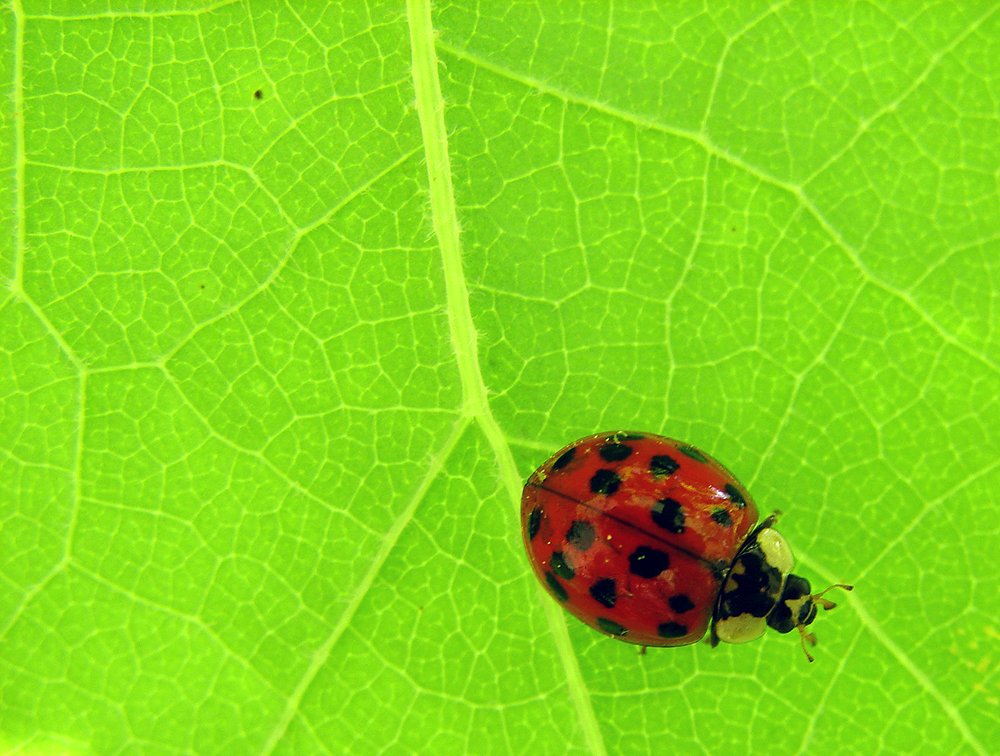
Native lady beetles (Ohio has several, including the increasingly scarce nine-spotted and the common pink-spotted) are small, deeply red, consistently spotted, and utterly uninterested in your house. The Asian lady beetle is bigger, highly variable — mustard yellow through orange to brick red, with anywhere from zero to twenty spots — and identifiable by one reliable field mark: the whitish plate behind the head (the pronotum) carries a bold black “M” (or “W”, depending which way the beetle is walking). If it is on your window in November, that alone nearly settles it: native species overwinter outdoors in leaf litter and bark; the Asian lady beetle is the only one that treats Ohio houses as a destination.
October is when they arrive by the hundreds, and sealing the house beforehand is far easier than vacuuming afterwards. See pest control in Dayton.
The behavioral tells are just as clear. Asian lady beetles aggregate — hundreds to thousands strong — on sun-warmed, light-colored, high-contrast building faces in October. They nip exposed skin (a genuine, startling little pinch — native ladybugs essentially never bite people). And when alarmed or crushed they “reflex bleed,” releasing a yellow-orange fluid that smells acrid and permanently stains paint, drapes, and carpet — the source of most of the actual damage they do.
Where they came from — and why Ohio farm country made it worse
Harmonia axyridis was introduced to North America repeatedly through the twentieth century as biological pest control — it is a spectacular aphid predator — and established explosively in the 1990s. Ohio’s soybean belt turned out to be ideal: when soybean aphid arrived in the early 2000s, boom years of aphids grew boom years of beetles, and the Miami Valley’s mix of crop ground, woodlots, and housing put millions of beetles within flying distance of walls every autumn. In their native range they overwinter en masse in pale cliff faces; in ours, the closest thing to a pale cliff face is a cream-colored colonial in Beavercreek with a sunny southwest exposure. The swarm on your siding is a navigation error 6,000 years of evolution insists on repeating.
Are Asian lady beetles harmful? The complete answer
To people: barely, but not zero. The bite is a surprise-pinch that rarely breaks skin and carries no venom or disease. The meaningful human issue is allergy — in homes with heavy winter infestations, beetle fragments and the reflex-bleed proteins join the indoor dust and can trigger rhinitis, watery eyes, and asthma flare-ups in sensitive people; several clinical studies have confirmed lady-beetle-specific allergies in high-exposure homes. If someone in the house has unexplained winter allergies and you sweep up beetles weekly, mention it to your allergist — and to us.
To pets: occasionally more than you would expect. Dogs that snap up crawling beetles get a bitter mouthful of reflex blood; in rare, well-documented cases, dogs that ingested large numbers ended up with beetles embedded against the roof of the mouth causing ulceration and drooling. It is uncommon, it is treatable, and it is one more argument against letting an indoor aggregation build up where a bored retriever can graze on it.
To the house: the damage is cosmetic but real — yellow reflex-blood stains on paint, wallpaper, drapes, and lampshades that do not come out, plus the die-off aroma of an over-wintering aggregation in a wall void. To Ohio’s ecosystem: this is the quiet cost. Harmonia outcompetes and directly eats the larvae of our native lady beetles, and several once-common natives have collapsed since its arrival. The children’s-book ladybug is now the one that needs the PR campaign.
Why your house, specifically
Aggregating beetles navigate by sight toward large, pale, sun-warmed vertical surfaces with strong contrast lines — and they re-aggregate where beetles have massed before, guided by aggregation pheromone residues that persist on the structure year to year. Which decodes every pattern we see on service calls: the cream or white house gets hit while the dark-brick neighbor does not; the southwest wall gets hit while the shaded north wall stays clean; the same window bay gets hit every single October regardless of what you sprayed in July. It also explains the two houses on every rural road that get absolutely buried: light-colored, isolated against crop ground, unobstructed sun. If that is your house, prevention is not optional — it is an annual calendar item.
The wall-void winter — what happens after they disappear in November
The October swarm is visible; the November move-in is not. Beetles work through gaps at window heads, soffit returns, siding ends, and utility penetrations into wall voids and attics, where they cluster by the hundreds in diapause — a semi-dormant state — waiting for spring. Every midwinter warm spell wakes a share of them, and warm interior light draws them the wrong way: out of the void, into the living room, buzzing at the ceiling fixture and dropping onto the dinner table. This is why homeowners report beetles “all winter long” from a swarm they saw once in October, and why interior sprays are pointless — the reservoir is in the structure, refilling the rooms one beetle at a time until April empties it outward.
What to do right now (and what never to do)
If they are indoors this minute: vacuum, with one trick. Slip a knee-high stocking into the vacuum wand, secure it with a rubber band, and the beetles collect in the stocking instead of dying (and reflex-bleeding, and stinking) inside your machine — knot it and dispose outside. Never crush them on painted surfaces or fabric; the stain outlasts the beetle by years. Skip the interior foggers entirely: they cannot reach the wall-void reservoir, they contaminate living space for no benefit, and dead beetles in voids feed the next problem — carpet beetle and larder beetle populations that scavenge them (our carpet beetle guide explains that chain reaction).
Sticky note for spring: when the survivors emerge in March and April, they emerge outward and leave. Do not book (or accept) an April “treatment” for departing beetles; the honest window for chemical prevention is late summer. Anyone selling you a spring lady-beetle spray is selling calendar filler.
Prevention that actually works: the two-layer play
Layer one is exclusion, done any time before September: seal window-head and trim gaps, close soffit and fascia joints, screen gable vents, caulk siding ends and penetrations on the sunny faces first. Every gap closed is permanent, chemical-free prevention — and it stacks with your stink bug and boxelder bug defense, because all of Ohio’s fall invaders use the same doors. Layer two is a professionally applied barrier treatment on the aggregation faces (typically south and west walls, rooflines, and window surrounds) in late August to mid-September — timed so the residual is at full strength when the first frost-and-sunny-afternoon sequence triggers flight. Homes on our fall-invader program get exactly this, and the before-and-after on a historically buried house is dramatic: the swarm tests the wall, fails, and moves on.
Asian lady beetle questions we hear
Are they good for my garden? Should I feel bad about controlling them?
In the yard, they genuinely are premier aphid control — leave the outdoor population to its work. Control is about the structure: keeping thousands of beetles out of your wall voids does nothing measurable to the landscape population and everything for your winter. Defend the building, not the flowerbed, and the ethics take care of themselves.
Why do they keep coming back to the same corner every year?
Aggregation pheromone residue — the chemical “we wintered here” sign painted on your siding. It fades slowly on its own; a thorough wash of the historic aggregation faces (before the barrier treatment goes on) helps take the sign down. This is also why the problem is so house-specific and so repeatable: the beetles are not finding you fresh each fall, they are reading last year’s reviews.
Ladybug or lady beetle or ladybird — which is right?
All of them; entomologists say lady beetle (they are beetles, not bugs), the British say ladybird, and everyone’s grandmother says ladybug. The one that matters on this page is the “M” on the pronotum — whatever you call the insect wearing it.
Related: Fall invaders in Ohio homes · Carpet beetles · Stink bugs · perimeter treatments.
What do Asian lady beetles eat — and can they infest food or fabric?
Outdoors, they are strict predators: aphids above all (a single larva can clear hundreds), plus scale insects, mites, and other soft-bodied prey — and in late fall they will rasp at damaged orchard fruit, which makes them a genuine nuisance for grape growers (beetles harvested with the crop can taint an entire pressing; vineyards take them very seriously). Indoors, the reassuring news: they eat essentially nothing. They do not feed on your pantry, fabric, wood, plants, or pets; overwintering beetles run on stored fat, which is why they gradually die off in the rooms all winter. The beetle on the windowsill is not eating your house — it is starving in it, slowly, while occasionally staining things. Every other “infestation” behavior people fear — laying eggs indoors, multiplying in the walls — does not happen; reproduction is an outdoor, aphid-fueled, summer activity.
The lifecycle, briefly — and why summer is silent
Eggs go on aphid-infested plants in spring; the larvae — spiky little orange-and-black alligators that alarm gardeners who have never seen one — gorge for weeks, pupate on leaves, and emerge as adults. Two to three generations run through an Ohio summer entirely outdoors, entirely beneficially, and entirely unnoticed by homeowners. The species only becomes a “pest” for the six weeks between first frost and Thanksgiving, and only at the structure. That narrow window is the whole strategy: one well-timed barrier, one round of sealing, and the year’s entire conflict with this insect is settled before it starts.
When a professional makes sense
Call us when your house is one of the historic aggregation targets (you know if it is), when the winter emergence indoors has become a daily broom-and-vacuum ritual, when someone in the home has the allergy pattern above, or when you simply want the sealing and the September barrier handled on a schedule you never have to think about. The work is quick, exterior, kid-and-pet-conscious, and guaranteed like everything else we do: for Protection Plan members, if the invasion beats the barrier, the re-treat is free. Greater Dayton Pest & Rodent — Ohio licensed — ODA Pesticide Business License #115079, based on Salem Ave, serving the whole Miami Valley: (937) 569-3330, free quotes, free photo ID of whatever is wearing spots on your siding.
A season on our routes: what the calls actually look like
The first calls come within days of the season’s first hard frost — almost always from the same neighborhoods, almost always light-colored homes on open exposures: the farmhouse edges of Bellbrook and Xenia, the newer builds facing soybean ground around Springboro and Huber Heights, the tall pale colonials of Centerville catching afternoon sun. By Thanksgiving the calls change character: no more swarms, now the slow indoor trickle — “they are coming out of the can lights,” “every sunny afternoon there are ten more on the kitchen window.” By February it is the die-off questions, and by April it is quiet for another year. We mention this rhythm because it is the whole diagnosis: if your beetle story matches the calendar above, you do not need an inspection to know what you have — you need a September on the books. We schedule fall-invader barriers from mid-August; the houses that book them stop appearing in the November call log, which is the only metric either of us should care about.
The bottom line
The multicolored Asian lady beetle is a superb field predator, a mediocre houseguest, and a completely solvable problem. Learn the “M,” leave the garden population to its aphids, vacuum with the stocking trick instead of crushing, and put your money where it works: sealed gaps and a late-summer barrier on the faces your house has already taught the beetles to love. Do that once, properly, and October goes back to being about cider and football instead of sweeping spotted beetles off the storm windows. When you want it done for you — guaranteed — we are minutes away.
How long can Asian lady beetles live without food?
Months — that is the entire overwintering strategy. An adult enters your wall void in October carrying enough stored fat to idle through winter in diapause and fly out in April without a single meal. The ones that die indoors mostly die of dehydration and misadventure (warm rooms burn their reserves faster than a cold void would), which is why the winter trickle is steady rather than sudden. Practical upshot: you cannot starve them out, wait them out by spring, or bait them — there is nothing they want from you except the wall itself. Exclusion and the September barrier remain the only levers that move the outcome.
Do they sting? Is the yellow fluid dangerous?
No sting — the pinch is mandibles, not a stinger, and the yellow fluid is defensive blood, not venom. It can irritate sensitive skin and it tastes bitter enough to teach most dogs a one-time lesson, but its real weapon is aimed at your decorating: it stains. Handle beetles with the vacuum stocking, not your fingers, and everyone’s afternoon goes better.
Still not sure whether you are looking at a native ladybug, an Asian lady beetle, or something else entirely wearing spots? Photograph it against a coin for scale and text it to (937) 569-3330 — free identification, usually within the hour during business hours, and an honest answer about whether your house needs anything at all this fall.
Will they damage the garden or fruit trees before frost?
Only opportunistically: sound fruit is safe from them, but split or bird-pecked grapes, apples, and berries draw feeding beetles in late September, and heavy years can make small-orchard cleanup genuinely sticky. Harvest damaged fruit promptly and the pull disappears. For everything else in the yard they remain a net positive right up until the moment they land on your siding.
The orange ladybug question, answered directly
The search that lands here most: the orange ladybug IS the Asian lady beetle — the native reds run scarlet, while the multicolored Asian runs the orange-to-tan spectrum (spots varying from zero to many), wears the white-cheeked “M” on its pronotum, and accounts for essentially every orange specimen an Ohio household meets. And the companion question: are orange ladybugs poisonous? No — to people and pets they’re harmless (the yellow reflex-blood stains and smells; the dog that eats several learns the boxelder lesson), though the Asian’s famous nip — a harmless exploratory pinch no native delivers — is real, and its fall aggregations are the whole page above. Orange = Asian = this file; red and unbothered = the native ally; both = photograph before verdicts, as ever.
Frequently asked questions
What is the difference between ladybugs and Asian lady beetles?
The fall house-invader is the multicolored Asian lady beetle: variable orange-to-red with an “M” marking behind the head, versus the native ladybug’s deep red and homebody outdoor habits. Natives never mass on your siding in October; the Asian species built its reputation doing exactly that.
Why are lady beetles swarming my house in fall?
Overwintering flights — warm light-colored walls on sunny late-October days trigger mass landings as beetles seek wall-void winter quarters, stink-bug-style. Ridge-and-woodlot adjacent houses take the heaviest waves, and aggregation scents mark successful buildings for repeat years.
Do Asian lady beetles bite?
A detectable pinch, yes — unlike almost every other fall invader, they will test-bite skin. Harmless but real, and along with the yellow staining reflex (defensive “blood” that marks walls and fabric) it separates them from the ladybug goodwill they borrow.
Are Asian lady beetles harmful to dogs?
Rarely and memorably — dogs that mouth clusters can end up with beetles wedged against the palate causing drooling and irritation; a vet or careful owner removes them. The defensive chemicals taste terrible, which is usually lesson enough.
How do I get rid of lady beetles inside?
The gentle-removal toolkit: vacuum with stocking pre-filter (crushing triggers the yellow stain), jar-and-card for singles, and lamp-over-soapy-water in bad rooms. No interior sprays — wall-void die-offs feed carpet beetles, the same chain our stink bug page documents.
How do I keep them out next fall?
The universal fall-invader program: seal by Labor Day (gaps, vents, screens, sweeps), amber exterior lighting through October, and the September barrier for houses with a history — lady beetles, stink bugs, and boxelders all fail the same audition when it runs.
Why do they come out in my house in January?
Warm-day wake-ups from wall-void dormancy — the same sleeper mechanics as stink bugs, with sunny south rooms collecting the emergences. They are winter stragglers, not a breeding population; indoor reproduction does not happen.
Do Asian lady beetles eat anything in my house?
Nothing — indoors they run on stored fat, seeking only shelter. Outdoors they are legitimately voracious aphid predators, which is both why they were introduced and why the springtime yard population is genuinely on your side.
What is the yellow stuff they leave on walls?
Reflex bleeding — defensive hemolymph released when stressed or crushed, staining light surfaces and carrying the signature odor. It is the reason every removal method on this page is a gentle one.
When should I call about lady beetles?
Siege-level fall invasions (wooded-adjacent houses can take thousands) warrant the September barrier-and-seal package; midwinter stragglers warrant the vacuum and patience. We will tell you honestly which category your photo shows: (937) 569-3330.