
Greenwich Village is one of those Dayton neighborhoods that people outside it have to be told about — a compact pocket of solid brick homes on quiet, tree-arched streets, the kind of place where houses change hands by word of mouth and the same families hold porches for decades. We photograph our service neighborhoods ourselves, and the shot below is exactly what the Village looks like: substantial mid-century brick, generous setbacks, and a tree canopy that has had seventy years to mature. This page is about what that specific combination means for pests, because it absolutely has a signature.
The word exterminator is the one most people in Greenwich Village, Dayton grew up with. It describes what we do; the license on the truck is what makes it different from a can from the hardware store.
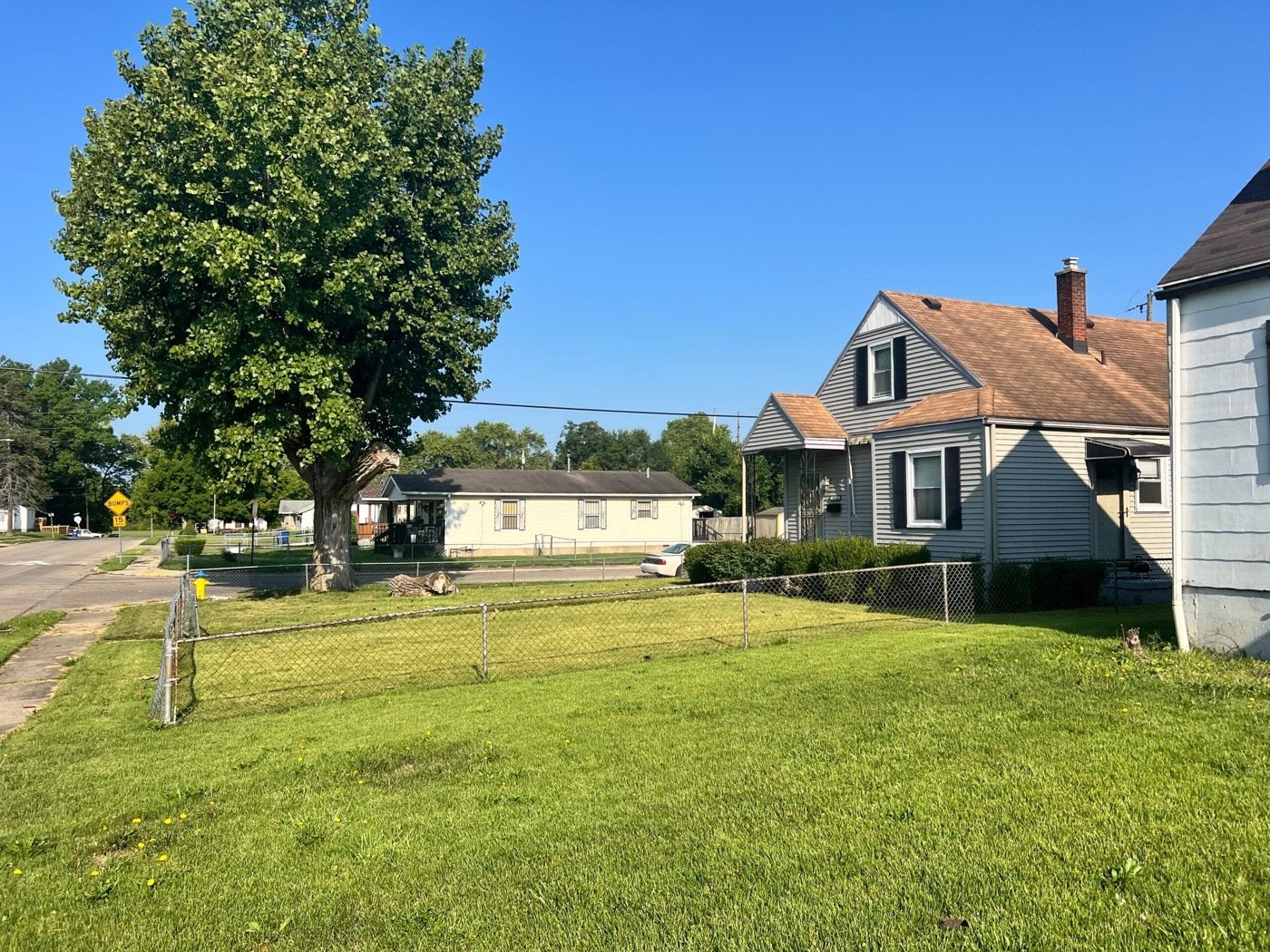
The mature-canopy effect
A seventy-year-old street tree is a beautiful thing and a busy one. Big canopies drop honeydew-producing aphids and scale insects onto everything below, and honeydew is the fuel that runs ant colonies — which is why homes under mature trees see more persistent ant trails than new subdivisions ever do. Canopies also mean carpenter ants: every large shade tree eventually carries a dead limb or an old pruning wound, and those cavities host parent colonies that send satellite colonies into nearby structures — typically through a branch touching the roof or a gap at the fascia. And shade means moisture: lawns that hold dew longer, mulch beds that stay damp, and the cool, humid conditions that millipedes, springtails, and ground beetles love.
None of this argues against the trees — they are the neighborhood. It argues for a pest strategy built around them: keep limbs trimmed off the roofline, treat the foundation perimeter where the moisture-loving insects stage, and take flying ants indoors seriously enough to get them identified.
Brick homes are tight — except where they are not
Brick veneer over frame is some of the most pest-resistant construction ever built, with three famous exceptions. First, weep holes — the deliberate gaps in the bottom courses of mortar that let the wall drain. They are supposed to be there, and mice, wasps, and ants know it; we screen them with stainless inserts that preserve drainage while closing the doorway. Second, the garage: an attached garage’s overhead door seal is the single most common rodent entry in this neighborhood, gapping at the corners as the rubber ages. Third, penetrations — the AC line-set, hose bibs, dryer vents, and cable runs drilled through the brick over the decades, each one an unsealed ring unless someone closed it properly.
Our first visit to a Greenwich Village home is a slow lap around the brick with a flashlight and a mirror. It is remarkable how often a “mystery” mouse or wasp problem resolves to one of those three.
The Village pest lineup
- Odorous house and pavement ants — the honeydew economy at work; persistent kitchen and driveway trails from spring through fall (ant control)
- Carpenter ants — big black ants indoors, especially near skylights and fascia, deserve a same-week look
- Mice — garage corners and utility penetrations; the fall push starts in late September (rodent control)
- Wasps and hornets — soffit returns, shutters, and weep holes; bald-faced hornets build in the big trees (wasp removal)
- Spiders — healthy canopy insect life keeps porch-light webs constant without perimeter treatment (spider control)
- Fall invaders — stink bugs and boxelder bugs on sunny brick faces every October (fall invader guide)
How we treat a Greenwich Village home
Every engagement starts with an inspection, not a spray. On a typical Village brick home that means the full exterior lap — weep holes, garage door corners, every utility penetration, the roofline where branches approach, the mulch line and downspout splash zones — plus the basement or crawl space, the garage interior, and wherever you have actually seen activity. We photograph what we find and show you, because a homeowner who can see the wasp traffic at a shutter or the rub marks at a garage corner makes better decisions than one being sold a contract on faith.
Treatment follows the findings. Ant work is bait-led indoors — slow-acting baits the workers carry back to the colony, which is why we ask you not to spray trails yourself before we arrive; repellent sprays scatter colonies and multiply satellite nests. The exterior gets a targeted perimeter application at the foundation, entry points, and trailing routes. Rodent work is exclusion-led: stainless screening in weep holes, sealed penetrations, corner seals at the garage, then interior trapping to clear the house. Wasp work happens at the nest, at the right time of day, with the right equipment — and in this neighborhood that often means extension work into serious tree height.
Then we guarantee it. If the ants are back in the kitchen a month later, the return visit costs nothing. Most Village homes that want year-round coverage end up on a quarterly exterior program timed to the neighborhood’s actual rhythm — spring ants, summer wasps and spiders, fall invaders and mice — and most quarterly customers never see a pest indoors at all.
What Village homeowners can do themselves
- Keep tree limbs pruned six feet off the roofline — the single best carpenter ant prevention there is
- Rake mulch back to leave a visible strip of foundation; mulch piled against brick hides moisture and highways
- Check the garage door seal each fall: with the door closed, daylight at the corners means mice fit
- Redirect downspouts that dump beside the foundation; damp soil there feeds everything from millipedes to termites
- Swap white porch bulbs for warm LED — measurably fewer flying insects, which means fewer spiders
- Store bird seed and pet food in steel or heavy plastic bins, never bags on the garage floor
The termite note for established neighborhoods
Neighborhoods built in the 40s, 50s, and 60s are now old enough that their termite history matters. Original construction predates modern soil pre-treatments, decades of landscaping have buried foundation lines, and additions — porches, sunrooms, attached garages — created the wood-to-soil transitions termites exploit. Winged swarmers indoors in spring, mud tubes on foundation walls, or a hollow-sounding baseboard all warrant a real look. We are licensed for both termite treatment and WDI inspections, and our inspections are free when you suspect activity.
A Greenwich Village seasonal calendar
Spring (March–May)
The honeydew economy restarts. Ant colonies that overwintered under slabs and in wall voids wake hungry, and the first warm rain produces swarm flights — winged ants (and sometimes termites, which is why identification matters) appearing at windows. Wasp queens emerge and scout eaves, shutters, and grill covers for nest sites; knocking down a golf-ball-sized starter nest in April prevents a football-sized problem in August. Moles resume tunneling as the soil thaws. This is the highest-value season for a perimeter treatment, because everything you suppress now compounds through the year.
Summer (June–August)
Peak everything. Ant trails run their strongest; wasp colonies hit maturity; spiders web every light fixture nightly; mosquitoes settle into the shade the canopy provides all afternoon. Under the big trees, evening yards can be unusable without treatment — our mosquito service targets the resting vegetation, and in a canopied neighborhood the difference is dramatic. Watch, too, for sawdust-like frass appearing below fascia boards or window heads: mid-summer is when carpenter ant satellite colonies inside structures become detectable.
Fall (September–November)
The two migrations. First the fall invaders: stink bugs, boxelder bugs, and multicolored Asian lady beetles massing on the sunny south and west brick faces through October, working their way behind shutters and into soffit gaps to overwinter. The fix is a barrier treatment applied to those faces in September, before massing begins — after they are inside the wall voids, options shrink. Second, the rodent push: as night temperatures drop into the 40s, every mouse within range tests your foundation. The homes that get sealed in September skip the whole season.
Winter (December–February)
Quiet outside, telling inside. Winter is when established mouse activity announces itself — droppings in the pan drawer, scratching in the ceiling after dark — and when overwintering invaders emerge confused into living rooms on sunny days. It is also the best season for exclusion work: activity is concentrated, entry points are freshly used, and trapping results are fast.
DIY or call us? An honest answer
Some Village problems are genuinely DIY-solvable, and we will say so: a single wasp nest at shoulder height, the occasional ground beetle wandering in under a door, a light pavement ant trail on the driveway. Where homeowners lose months and money is on colony insects treated with repellent sprays (odorous house ants split into new colonies when sprayed — the infamous budding response), on rodents treated with bait alone while the entry stays open, and on anything requiring ladder work over landscaping. Our rule: if the same problem has come back three times, the third fix should be a professional one. It is cheaper than the fourth, fifth, and sixth DIY rounds.
What to expect when you call
First contact is a conversation, not a pitch. Tell us what you are seeing — or better, text a photo to (937) 569-3330 and we will identify it free. If it needs a visit, we quote before we schedule, we schedule within the week (faster for bed bugs, wasps by the door, or mice in the kitchen), and the price we quote is the price you pay. The technician who comes is trained on this housing stock — brick veneer, plaster interiors, mature landscaping — and treats your home like the well-kept property it is: shoe covers inside, gates latched, product choices explained before anything is applied.
Every treatment is used per its EPA label, placed in cracks, voids, and exterior lines rather than broadcast across surfaces your family touches. Kids and pets are the first constraint on every plan we write, not an afterthought. And for Protection Plan members, if the problem returns between visits, the return trip is free, no fine print.
Greenwich Village questions we hear
Big black ants keep showing up near the ceiling. Should I worry?
Take it seriously, yes. Large black ants appearing high in a room — near skylights, ceiling fixtures, or the tops of window frames — are the classic sign of a carpenter ant satellite colony in the structure above, usually connected to a parent colony in a nearby tree. They are not eating the wood, but their galleries expand every season and their presence often flags a moisture problem worth finding anyway. This is a same-week call, and diagnosis starts with a free photo ID.
We never had pests for twenty years. Why now?
Because something changed — and in established neighborhoods it is usually one of four things: a tree matured or declined (new carpenter ant pressure), a neighbor’s renovation displaced an existing population, a seal aged past its service life (garage doors and door sweeps have one), or landscaping crept up the foundation. Part of our inspection is figuring out which, because treating the symptom without the cause is how companies sell you the same job every year.
Do we need a quarterly plan, or is that upselling?
Honest answer: it depends on your tolerance and your trees. A Village home under heavy canopy that wants zero indoor activity year-round genuinely benefits from quarterly exterior service — the pressure is constant, so the barrier should be. A homeowner comfortable calling when something appears can absolutely use us that way instead; one-time work carries the same guarantee. We will tell you which fits after we see the property, and we will not pretend a one-problem house needs a program.
Are the treatments safe under all these trees — birds, pollinators, gardens?
This matters to us. We do not treat tree canopies, flowering plants, or anywhere pollinators forage; applications go to structural cracks, foundation lines, and specific harborage. Vegetable gardens get a stand-off buffer. The neighborhood’s ecosystem is part of why it is beautiful — the goal is pest-free rooms, not a sterile yard.
The local difference
We are a Dayton company — office on Salem Ave, owner on the jobs, no national call center reading a script off your account. In a neighborhood where reputations travel across porches, that accountability is the product: free quotes, honest recommendations, guaranteed results, and a technician who has walked these exact streets often enough to have photographed them. If your Greenwich Village home has picked up ants, mice, wasps, or anything else with more legs than it should have, call (937) 569-3330 and we will handle it.
Nearby coverage: Dayton · South Park · DeWeese · Downtown Dayton · full service area list.
What affects the price of pest control here
We quote every job individually and for free, but it helps to know what moves the number. Size and construction matter less than people expect — most Village homes fall in a fairly narrow band. What actually drives cost: the pest itself (bed bug and termite work involve more labor and follow-up than ant or wasp work), how established the problem is (a first-week mouse issue is a smaller job than a season-old one with nesting in the wall insulation), access (ladder work over landscaping, tight crawl spaces), and whether the job includes exclusion carpentry — sealing, screening, and repairs that permanently close entry points rather than just knocking down the current population.
Two things we promise on pricing. First, the quote comes before the work, always — no technician-at-the-door surprises. Second, we will tell you when the smaller option is the right one. Plenty of Village calls end with a one-visit fix and a short list of free prevention steps, because earning a neighborhood’s trust is worth more than padding a single invoice.
One street at a time
Local SEO pages are usually written by people who have never seen the street. We took the photo at the top of this page ourselves, on a workday, because Greenwich Village is a place we actually service — same as South Park, DeWeese, and the rest of the neighborhoods on our routes. When you are ready, we are minutes away: (937) 569-3330, or use the quote form and we will call you back the same business day.
The bottom line for Village homeowners
Mature trees and brick construction give this neighborhood a pest profile that is predictable, seasonal, and completely manageable — ants running the honeydew economy, carpenter ants working the canopy, mice testing the garage every fall, wasps in the soffits, and invaders on the sunny brick each October. Predictable is good news: it means prevention works. Whether that is a one-time fix with our guarantee behind it or a quarterly barrier timed to the calendar above, the outcome is the same — a home where the trees stay and the pests do not. Free quotes, free photo identification, same-week scheduling: (937) 569-3330.
Licensed by the Ohio Department of Agriculture (Commercial Applicator #170858, categories 10A, 10B, and 12), insured, and locally owned — Greater Dayton Pest & Rodent, 733 Salem Ave, Dayton. Monday through Friday 8–6, Saturdays by appointment.
Frequently asked questions
Do you provide pest control in the Greenwich Village area?
Yes — the neighborhood’s tidy mid-century blocks sit minutes from base on daily routing; the dedicated page you are on documents patterns street by street.
What pests are most common in Greenwich Village?
Mid-century files: garage-corner mice at first frost, slab-seam pavement ants, mature-landscape odorous house ant networks, fall invaders on the sunny brick, and the occasional sewer-line American roach the era’s laterals still deliver.
How much is pest control here?
Standard formula — the neighborhood’s modest footprints price kindly: most homes $39–$55/month quarterly; one-time flat. Free: (937) 569-3330.
Why do the garages here collect mice every October?
Original doors, sixty winters on — corner gaps meet the frost push annually; the threshold retrofit plus steel-wool detailing is the neighborhood’s highest-value hour of exclusion.
What is the slab-ant pattern on these streets?
The era’s construction gives pavement ants their seams — driveway joints and garage-floor cracks to kitchen kick plates; bait-first protocol (never spray), then seam-sealing.
How fast can you reach the neighborhood?
Minutes — core-route speed: days at most, priority faster, no travel charges.
Do the brick facades get the fall invasion?
The sunny south walls audition stink bugs and boxelders annually — barrier-plus-seal before Labor Day carries the file, and the brick holds heat enough to matter.
What about the mature street trees and wasps?
The canopy supplies cavity-and-comb pressure — spring patrols, honest globe triage, and the sealing that keeps eave gaps closed.
Is the Protection Plan right for these blocks?
The mid-century stock’s accumulated doors favor it — quarterly maintenance beats the emergency cycle for most; honest triage on the first call regardless.
How do I start service in Greenwich Village?
Instant quote, free photo ID, or (937) 569-3330 — free estimates, first visits typically within days.