
The brick city’s ants work its two signature surfaces: the slab and the veneer. Huber Heights’ thousands of brick ranches sit on slab-on-grade pours whose expansion joints — garage seams, porch and patio junctions, driveway plates — are pavement ant real estate at municipal scale, and the brick veneer above adds the entry system every Huber file shares: weep holes at grade, mortar joints aging since the Eisenhower administration, and the cavity behind them running sheltered highways from soil to sill. The result is an ant profile heavy on two species — pavement ants below, odorous house ants running the foundation plantings — with the slab’s interior deliveries arriving through the one route homeowners never suspect: up through the expansion joints, under the wall plates, and out at the kitchen’s slab-level cabinet runs. Here’s the brick-and-slab playbook.
The Two-Surface Problem
- The slab-joint cities: pavement ant colonies occupy the expansion joints and pour seams — May’s sand piles at the garage seam and patio edge are the visible sign, and the colonies’ interior route runs through the joints themselves: under wall plates, up plumbing penetrations, and out at floor-level cabinet gaps. Slab-city trails appear “from nowhere” because the highway is under the house.
- The veneer’s contribution: weep holes and aged mortar gaps admit foraging traffic into the cavity — the same never-plug openings as the city’s wasp and termite files — and colonies nested against the foundation use the cavity as a weatherproof commute.
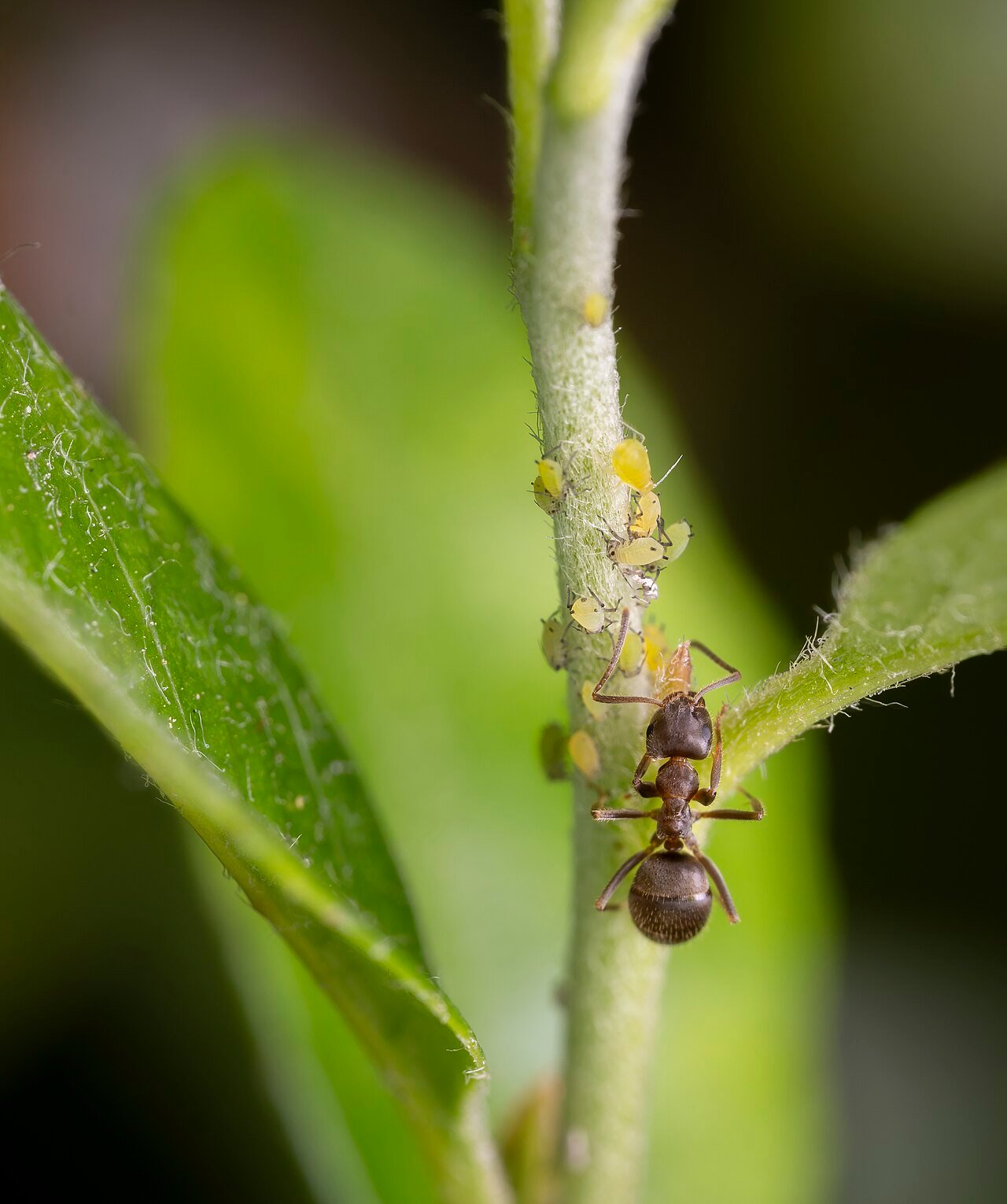
- The planting-strip networks: odorous house ants run the irrigated foundation beds on the regional standard — post-rain kitchen surges, aphid economies in the shade trees, and the budding-under-spray biology that makes baiting the only correct opening move (the budding problem).
- The patio culture factor: the fenced-yard outdoor living this town runs — patios, grills, dog bowls — stages food at slab level daily, exactly where the joint colonies forage. The wipe-down and bowl-lift disciplines earn double here.
Treating Through the Slab (and Behind the Brick)
The placement logic follows the architecture. Joint-line baiting puts gel and granular placements along the expansion seams, garage-slab edges, and patio junctions where the pavement colonies actually live — exterior placements the colony carries home, beating any amount of interior spraying at the cabinet line. The interior emergence points — floor-level cabinet gaps, plumbing escutcheons, the wall-plate line — get crevice placements and sealing, closing the “from nowhere” route at its exits. The veneer front runs the brick city’s standing rules: nothing plugged, treated bands at the weep-hole course, and cavity-aware placements where traffic maps into the wall — the same through-the-openings principle as every Huber file. The planting strips get the standard non-repellent program: baits beside the trails, perimeter banding, and the irrigation-and-mulch counsel in writing. What never happens: repellent sprays across kitchen floors (scatter, budding, and an erased trail map — the standing case), with the home-remedy grades at vinegar and borax and the pet-safe placements for the dog town’s households.
The Huber Heights Calendar and Bottom Line
May: the slab emergence — sand piles at every seam, the year’s visible opener. June–August: odorous house ant prime time in the beds, post-rain surges, and the patio-season staging that keeps joint colonies fed. September–October: peak baiting effectiveness and the sealing window — cabinet-line gaps, escutcheons, and thresholds closed before frost drives foraging inward. Winter trails mean slab-warmed indoor colonies and a prompter call. The bottom line runs the brick city’s theme one more time: identical architecture means an identical, repeatable playbook — the joint map, the veneer rules, the planting-strip program — executed street after street with the confidence repetition builds. One flat price, the method at ant control — and the brick city’s complete ledger, now seven services deep, at Huber Heights pest control.
Trails From Nowhere at the Cabinet Line?
The highway is under the slab — joint-line baiting, exit sealing, and the veneer rules, flat-priced and guaranteed across Huber Heights.
Frequently asked questions
Why do ants appear from nowhere at my Huber Heights cabinet line?
The highway runs under the house: pavement ant colonies in the slab’s expansion joints travel beneath wall plates and emerge at floor-level cabinet gaps and plumbing escutcheons. Exterior joint-line baiting plus exit sealing closes the route sprays never touch.
What are the sand piles at my garage seam every May?
The slab emergence — pavement ant colonies excavating the expansion joints at municipal scale across the brick city’s identical pours. Harmless outdoors; the treatment case opens when trails run interior.
Do ants use the brick weep holes too?
Yes — the veneer’s grade-level openings admit foraging traffic into the cavity commute, same as the city’s wasp and termite files. The standing rules apply: never plug (the wall must drain), treat the band at the course, place into the traffic.
Why did spraying the kitchen floor make the ants worse?
Repellent scatter warns colonies and splits the odorous house ant networks into multiple nests while erasing the trail map baiting needs. Non-repellent placements the workers carry home end colonies; floor sprays multiply them.
Does the patio and dog-bowl setup matter?
Directly — slab-level food staging feeds the joint colonies daily. Bowl lifts, prompt wipe-downs, and grill-area discipline debit the exact colonies whose highway runs beneath the patio.
Which ant baits work for the ants ignoring my ant baits?
Likely the grease-preferring minority — thief ants find sweet baits invisible, and species identification under magnification picks the chemistry before placement. Wrong-bait patience is the commonest DIY dead end.
When is ant treatment most effective in Huber Heights?
Any active trail treats well; September–October is peak — pre-winter colonies find bait fastest, and it’s the sealing window for cabinet-line gaps and thresholds. Winter trails mean slab-warmed indoor colonies and an earlier call.
What does ant control cost in Huber Heights?
One flat price: the joint map, veneer-rule placements, planting-strip program, and exit sealing — with the pet-safe standards this dog town expects and free re-treatment under the quarterly Protection Plan.
The Slab-City Advantage Nobody Mentions
For all the “from nowhere” drama, slab construction hands the treatment side a genuine gift: the routes are finite and mappable. A basement house offers ants a hundred entry theories; a Huber ranch offers a knowable set — the expansion joints, the plumbing penetrations, the wall-plate line, the veneer course — and a technician who works this housing weekly carries the map in muscle memory. That’s why brick-city ant jobs quote confidently and clear quickly: the first visit’s joint-and-exit survey covers the whole geometry in under an hour, placements go exactly where forty identical houses said they should, and the follow-up confirms a collapse that had nowhere to hide. Add the town’s detached construction — no party-wall recolonization, every yard its own campaign — and Huber Heights runs some of the cleanest ant outcomes in our service area. The architecture that builds the highway also draws the map; we just drive it.