
Ohio hosts roughly 500 native bee species plus the honey bee, and nearly every one of them is something a pest control company should talk you out of treating. That is not a marketing pose — it is the professional consensus, our license’s ethics, and this page’s organizing principle. Bees pollinate a third of what the Miami Valley eats and grows; their stings are rarer and more avoidable than almost anyone believes; and the situations that genuinely require intervention are a short, specific list this guide covers honestly. What Ohio families mostly need is what this page delivers: identification (which fat striped flyer is which), the sting truth (who can, who will, who physically cannot), the swarm protocol (the one dramatic bee event with a beautiful free solution), and the narrow scenarios where Greater Dayton Pest & Rodent actually gets involved. Free photo identification backs it all — (937) 569-3330 — and roughly half those bee photos end with us saying the best word in pest control: “beneficial.”
The cast: Ohio’s bees, from famous to overlooked
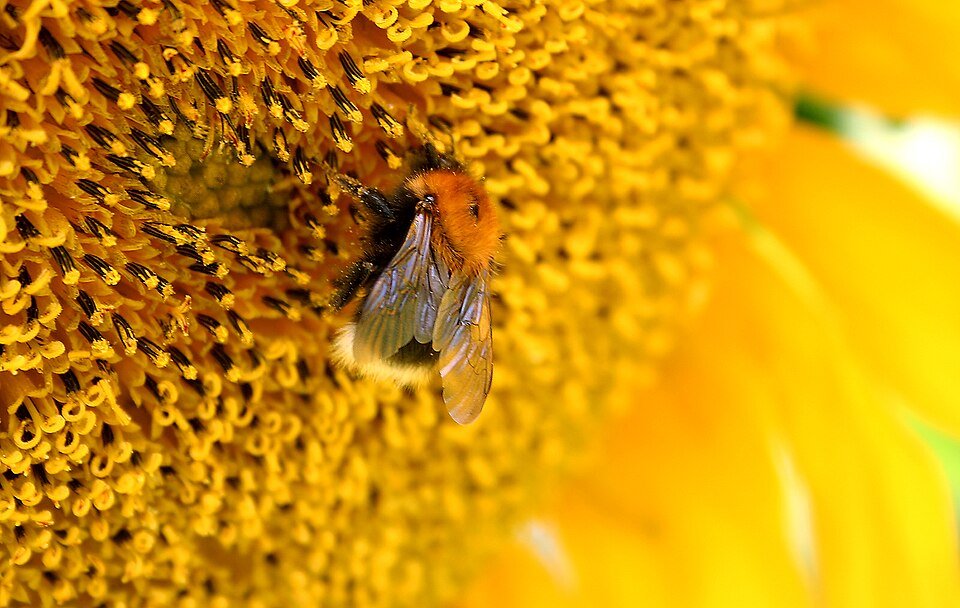
The honey bee — golden-brown, fuzzy-thoraxed, half an inch — is Ohio’s only perennial colony bee, wintering as a 10,000-plus superorganism in hives, hollow trees, and occasionally wall voids (the one habit that concerns this website, covered below). Bumble bees — the big, deep-buzzing teddy bears — run annual colonies of a few hundred in abandoned rodent burrows, compost margins, and under sheds; fuzzy from head to tail (compare the shiny-bellied carpenter bee, their constant case of mistaken identity), they are docile to the point of comedy away from the nest entrance. Carpenter bees get their own full page on this site — the deck-drilling exception with a service attached. Then the overlooked majority: mining bees, which emerge each April from volcano-dusted holes in thin lawns and terrify homeowners into calls that end in reassurance (solitary, sting-averse, gone in three weeks, actively aerating your soil); sweat bees, the tiny green-metallic jewels that land on summer skin for the salt and sting only when swatted mid-sip; leafcutter and mason bees, the orchard heroes renting hollow stems and the holes in your pollinator house; and squash bees, asleep in your zucchini blossoms every July morning. None of these maintain defended colonies worth fearing; all of them out-pollinate the honey bee per capita on native plants; and every single one is routinely misreported as “a wasp problem” by callers we are happy to correct. The wasp-versus-bee sorting rule that resolves most confusion: fuzzy and pollen-dusted means bee; smooth, bright, and narrow-waisted means the other page.
Honey bees should be moved rather than killed. For the ones that genuinely have to go, there is wasp and hornet removal in Dayton.
The sting ledger, honestly kept
Bee sting fear outruns bee sting fact by a comfortable margin, so here is the ledger. Cannot meaningfully sting: male bees of every species (no stinger — including the dive-bombing male carpenter bees of May), mining bees (stinger too weak to reliably pierce skin), and the vast majority of tiny solitaries. Can but essentially never do: bumble bees away from the nest, sweat bees unswatted, mason and leafcutter bees at any provocation short of being squeezed. Will, in defense of home: honey bees near the hive (barbed sting, single-use, alarm pheromone recruiting reinforcements — the reason hive removal is a suited professional’s job) and bumble bees within a few feet of a disturbed nest entrance. The overwhelming share of Ohio “bee stings” are actually yellowjacket stings — smooth-bodied wasps whose late-summer aggression, ground nests, and pop-can ambushes fit every sting story bees get blamed for. The practical safety rules cost nothing: do not swat (a brushed-off bee leaves; a swatted one defends), watch drink cans in August, locate nest entrances before mowing verges, and give any discovered colony entrance a respectful few feet. Allergy changes the calculus as it always does — epinephrine carriers get our priority scheduling on every stinging call, bee or otherwise — but for the general household, Ohio’s bees rank among the least dangerous wildlife sharing your lot.
The swarm: pest control’s happiest phone call
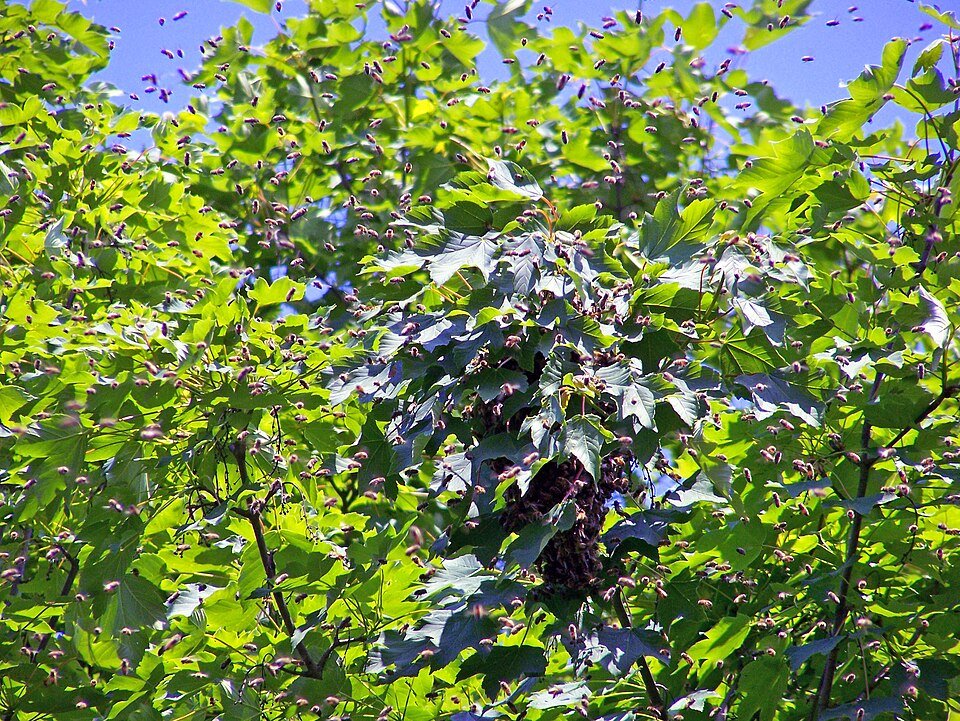
Once or twice each May and June, a Miami Valley family looks out at the maple and sees ten thousand bees hanging in a seething basketball-sized cluster, and the ensuing call is one we genuinely enjoy: this is a honey bee swarm, it is the least dangerous the species ever gets, and the solution is free. A swarm is a colony mid-move — the old hive raised a new queen, and half the workers left with the old one, gorged on honey (too full to sting easily, with no home to defend) while scouts hunt a permanent cavity. The cluster is a waypoint, typically gone within hours to two days on its own. The right response: keep respectful distance, skip the hose and the spray can (both convert a docile cluster into a defensive one), and call a beekeeper — local beekeeping associations across Montgomery, Greene, and Warren County maintain swarm lists of members who will collect the cluster promptly, expertly, and at no charge, because a captured swarm is a free colony. We keep those contacts current and make the connection for any caller: (937) 569-3330 gets you a beekeeper’s number faster than a search would, and our involvement usually ends there — the best outcome on this entire page. The one urgency worth adding: a swarm scouting your soffit gap or chimney is hours from becoming the wall-void situation below, and that is the moment prevention (a beekeeper today, exclusion this week) is cheapest by far.
Honey bees in the wall: the one bee situation that is genuinely ours
When scouts win and a swarm moves into a wall void, soffit, or chimney, the situation changes category — and it is the single most misunderstood job in Ohio stinging-insect work. The colony will build fast: within weeks, tens of pounds of comb, brood, and honey hang inside the cavity, and every response short of physical removal fails expensively. Spraying the entrance kills foragers and leaves the colony; sealing the entrance traps thousands of bees to chew toward interior light (the yellowjacket rule from our wasp page, at triple scale); and even a successfully poisoned colony leaves the real bomb — unattended comb. Without bees fanning it, honey ferments and melts through drywall in summer heat, staining ceilings and drawing a secondary parade of robber bees, wax moths, dermestid beetles (see our carpet beetle guide for who cleans up dead colonies), and rodents. The professional standard is a coordinated cutout: a beekeeper or bee-removal specialist opens the cavity, transfers comb and queen alive where feasible, and we handle what our license and trade cover — the exclusion engineering that seals the entry and the scouts’ alternates, void treatment against the aftermath parade, and coordination with a contractor on the closure. It is the one bee scenario with a real invoice attached, it is far cheaper caught in week one than month six, and it is the reason the free swarm call above is such a bargain: every wall colony was a collectible swarm two days earlier.
Ground bees in the lawn: the April panic that solves itself
Every April, thin-lawned yards across Kettering, Huber Heights, and every other suburb on our map erupt with small soil mounds and low-cruising bees, and the calls describe “a yellowjacket infestation.” It is mining bees — solitary natives whose females each dig a private nursery burrow, provision it with pollen, and finish in two to three weeks, after which the aggregation vanishes until next spring. No colony, no defense, no meaningful sting risk: children and mowers pass through active aggregations daily without incident, and university extensions uniformly counsel tolerance. Our honest playbook: enjoy them (they are among the year’s first pollinators and free lawn aeration), and if the bare-soil conditions that attract them bother you, fix the lawn, not the bees — overseed and irrigate in fall, and next April’s aggregation relocates to thinner ground. The distinction that matters is traffic pattern: dozens of small mounds with one bee each is mining bees and a non-event; a single entrance with steady two-way traffic and escalating defensiveness is a social colony — bumble bees (tolerate or relocate) or yellowjackets (our page, our job). Thirty seconds of observation or one photo sorts it, free.
Bee questions, answered at Ohio temperature
Bumble bees nested under my porch step and my kids use that door. Now what?
Options in order of preference: reroute foot traffic for the colony’s natural lifespan (annual — dead by first frost, never reused), since bumble bees defend only the immediate entrance and a few feet of clearance usually makes peace; relocation by a specialist for the genuine conflicts (some local beekeepers take bumble colonies); and treatment as the true last resort for unavoidable-traffic-plus-allergy situations — we will do it reluctantly, tell you exactly why, and seal the cavity afterward so next year’s queen picks elsewhere. What we will not do is treat a tolerable colony just because it is treatable; that is not this company.
Something fuzzy is hovering at my deck and scaring everyone. Bee or not?
May, wooden rail, hovering at face height, shiny black belly: male carpenter bee — stingless theater, wood at risk, page and service exist. Fuzzy all over, bumbling between flowers, ignoring you: bumble bee — enjoy it. Smooth, bright yellow, hovering at your pop can in August: yellowjacket — different page, real caution. The photo line settles it in minutes, and this exact triage is its most common assignment.
A beekeeper quoted a cutout price but you also mention treatment — who do I actually call for bees in the wall?
Both, in the right order, and we will coordinate it: the beekeeper/removal specialist owns the live-transfer and comb-out; we own exclusion, aftermath treatment, and the pest side of the closure; a contractor owns the wall if the cavity work needs one. One call to us starts the chain either way — the coordination is free, and skipping it is how walls get sealed full of honey.
Do your other treatments hurt my garden’s bees?
Protecting pollinators is baked into how we work: label law is written around it, and our habits go further — no treating open blooms, drift-conscious application, ground-nest treatments (yellowjacket, not bee) placed and timed to the target colony, and the lighting-and-exclusion-first philosophy that runs this whole site. The honest summary: a professional following the label is among the smaller risks Ohio bees face, and the free advice throughout these pages — tolerate the solitaries, call beekeepers for swarms, plant for pollinators — is us actively rooting for the other side of our own industry’s stereotype.
The Ohio bee calendar
- April: mining bee aggregations erupt and finish; overwintered bumble bee queens prospect burrows; the first carpenter bee patrols begin at the deck
- May–June: swarm season — the beekeeper-call window; bumble colonies establish; carpenter bee drilling peaks (their page’s best treatment window)
- July: squash bees in every zucchini blossom at dawn; sweat bees at the garden; wall-void honey bee colonies from missed May swarms hit detectable traffic
- August–September: bumble colonies peak then produce next year’s queens; the sting complaints spike — and are almost all yellowjackets wearing bees’ reputation
- October: annual colonies die with frost; new bumble queens burrow to overwinter; honey bee colonies cluster for winter — and a warm-day flurry at one soffit point is your last cheap warning of a wall colony
- November–March: quiet — the season for sealing last year’s cavities, planting next year’s forage, and mounting the mason-bee house that makes spring’s pollination personal
The closing argument for the fuzzy ones
Five hundred species, two genuine service scenarios (the carpenter bee’s drill and the honey bee’s wall), one free phone call that solves the most dramatic event in the calendar, and a sting ledger friendlier than the family dog’s — that is Ohio’s bee file, complete. The rest is attitude: a region that keeps its bees fed and its wall gaps sealed gets pollinated gardens, quiet Augusts, and pest control bills that stay spent on actual pests. We are a company that kills insects for a living, and this page exists to keep an entire beloved category off our invoice — because the license, the guarantee, and the reputation all point the same direction: treat what threatens, spare what serves, and always know which is hovering in front of you. When you cannot tell, the camera is faster than the swatter and infinitely better for everyone: (937) 569-3330, photos welcome, beekeepers on speed dial, and the word “beneficial” always ready.
Planting for the good ones: the Miami Valley pollinator shortlist
Since half this page argues for keeping bees around, it owes you the how, tuned to local conditions. The Miami Valley’s native heavy-hitters bloom in relay: spring’s wild geranium, golden alexanders, and redbud carry the mining bees and emerging queens; summer’s purple coneflower, wild bergamot, mountain mint (the single busiest pollinator plant we know), and native sunflowers feed the full cast; fall’s asters and goldenrod — wrongly blamed for allergies that belong to ragweed — fuel the new bumble queens who ARE next year’s colonies. All of them thrive in our clay-loam soils and humid summers with minimal fuss. Add structure and the yard becomes habitat: a strip of unmulched bare soil for the miners, hollow stems left standing through winter for the masons and leafcutters, a shallow pebble-water dish through August, and pesticide restraint on open blooms — which, per the section above, describes professional practice anyway. None of this conflicts with a pest-quiet house; every exclusion and habitat principle on this site targets the species that invade structures, not the ones working the coneflowers. A yard planted like this plus a house sealed like our pages prescribe is the whole Miami Valley ideal: everything buzzing exactly where it belongs.
One last identification: the hornet that is secretly a bee-mimic (and vice versa)
Two final look-alikes complete the guide, because both generate their share of misdirected calls. The European hornet — Ohio’s genuinely large brown-and-gold wasp, active even after dark — carries enough fuzz on its thorax that flashlight sightings get reported as “giant bees”; its size also feeds annual “murder hornet” scares, so let the record state plainly that the northern giant hornet has never been found in Ohio, and every candidate photo we have received has been a European hornet or a cicada killer. Going the other direction, hover flies — harmless, stingless flies in nearly perfect yellowjacket costume — hang motionless in the air over summer gardens and land on arms, panicking picnics twice per season; the giveaway is the eyes (huge and fly-like), the single pair of wings, and that signature helicopter hover no wasp performs. Both mimics reward the same habit every page in this series teaches: look twice, photograph once, and let the identification drive the response. Ohio’s airborne stripes run from vital pollinator to genuine hazard with every gradation between, and the difference is never the buzz — it is the details, and the details are always one free photo away: (937) 569-3330.
Frequently asked questions
What kinds of bees live in Ohio?
A 400-plus species roster: honey bees (managed colonies), bumble bees (ground and cavity nesters), carpenter bees (the wood drillers), plus the huge solitary majority — mining bees, mason bees, leafcutters, sweat bees — that most people never identify. Nearly all of it is beneficial and none of it wants trouble.
Do you exterminate honey bees?
Never — site doctrine: honey bee swarms and colonies get referred to local beekeepers, who usually relocate them free. Fuzzy, golden, visible comb: send the photo before anyone treats anything; misidentifying honey bees is the industry mistake we built the referral path to prevent.
What should I do about a honey bee swarm on my property?
Nothing but distance and a phone call — swarms are homeless colonies at their gentlest, typically moving on within days. A beekeeper collecting a swarm is fast, free, and genuinely fun to watch from a window.
Are bumble bees aggressive?
Away from the nest, comically not — they will share a flower with your hand. Nest defense (a disturbed ground cavity or birdhouse colony) earns respect but small numbers; give the entrance six feet and coexistence is automatic. Colonies die at frost like the wasps’.
What is drilling perfect holes in my deck?
Carpenter bees — the one bee file with a genuine property complaint. Half-inch round holes in bare softwood, sawdust below, hovering males that cannot sting: the full treat-then-seal program lives on our carpenter bee page.
What are the tiny bees hovering over my lawn in spring?
Mining bees — solitary, sting-averse, three-week tenants doing premium pollination of fruit trees. The scattered pencil holes need no treatment; the acquittal file (with the yellowjacket-hole distinction that matters) is on the ground bee page.
Are the bees in my wall honey bees or something else?
Traffic answers first: steady moderate fuzzy traffic could be honey bees (referral path, comb removal considerations); fast glossy traffic is yellowjackets wearing bee mistaken-identity. The distinction changes everything — photo to us before any action, always.
Do bees sting pets or kids more than wasps?
Far less — bees sting once at real cost to themselves and reserve it for genuine nest defense; the picnic and patio incidents that fill sting statistics are yellowjacket work. Teaching kids the fuzzy-versus-glossy distinction is legitimate safety education.
Why are there so many bees at my hummingbird feeder or pool?
Sugar and water runs — late-summer scarcity sends everyone foraging. Bee-guard feeder ports, a decoy shallow water dish with landing stones, and patience through the season beat any treatment — which we would decline for bees anyway.
Who do I call about bees in Dayton?
Us first for the ID — free from a photo — then the referral or the treatment as the species dictates: beekeepers for honey bees, our carpenter bee program for the drillers, the acquittal speech for the miners, and the wasp protocols for everything that turned out not to be a bee at all: (937) 569-3330.