
Every May, the calls start the same way: “There’s a huge bee hovering at my deck, there are perfectly round holes in the rail, and there’s sawdust on the ground.” That’s the eastern carpenter bee — the Miami Valley’s most destructive bee and one of its most misunderstood insects. The good news buried in the alarm: carpenter bees are among the most solvable pest problems we treat, their sting risk is wildly overrated, and the long-term fix is as much carpentry as chemistry. Greater Dayton Pest & Rodent provides carpenter bee treatment, gallery sealing, and prevention across Dayton and the Miami Valley — free quotes, Ohio-licensed application (ODA Pesticide Business License #115079), and the same re-treatment guarantee that backs every service on this site. This page is the complete owner’s manual: identification, biology, damage math, treatment, and the prevention step most companies skip.
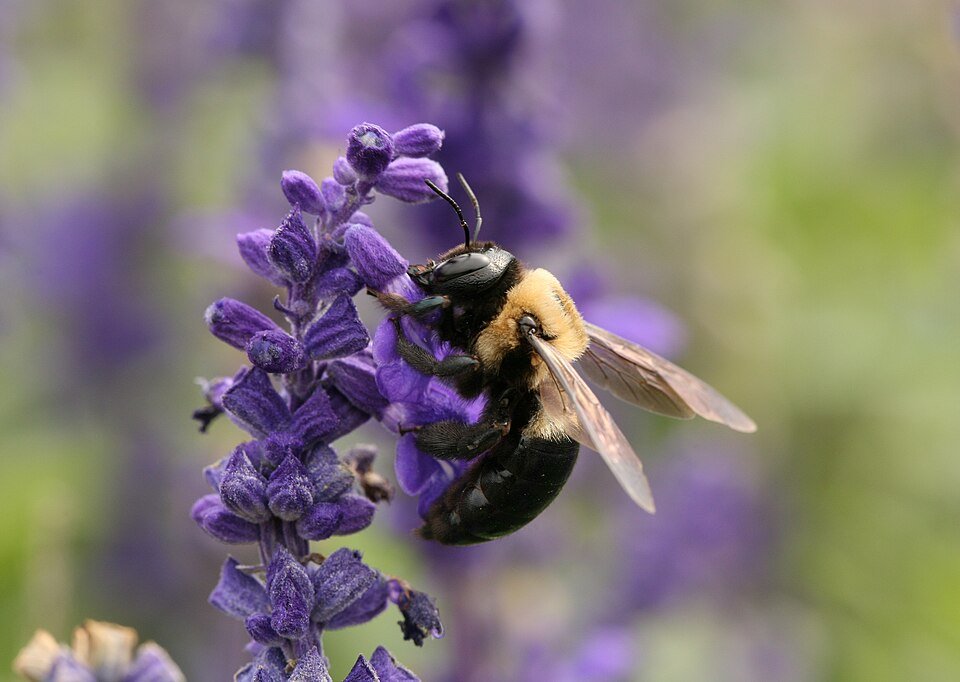
Carpenter bee vs. bumble bee: the 5-second identification
The two big bees of an Ohio spring are constantly confused, and telling them apart matters because one is drilling your fascia and the other is pollinating your garden from a hole in the ground. The tell is the abdomen: a carpenter bee’s abdomen is shiny, black, and nearly hairless — it gleams like patent leather in the sun — while a bumble bee’s abdomen is fuzzy with yellow-and-black banding from head to tail. Behavior seals the identification. Carpenter bees hover territorially at head height around wood structures — decks, fascia, porch ceilings, swing sets — and dart at anything that enters the airspace, including you. Bumble bees ignore you entirely and work flowers, commuting to a ground or cavity nest. Location finishes the job: a bee entering a perfectly round hole in wood is a carpenter bee, full stop; a stream of fuzzy bees disappearing into a hole in the ground or under a shed is a bumble bee colony (leave it alone if you can — they’re docile, valuable, and gone by fall). One more Ohio spring look-alike deserves a line: the big, loud cicada killer wasp of July digs in bare soil, not wood, and for all its terrifying size stings essentially nobody.
Carpenter bees are treated alongside the rest of the stinging insects on a property. See wasp and hornet removal in Dayton.
The hovering “attack” bee can’t sting you (probably)
The carpenter bee doing aggressive aerial patrols at your deck — hovering at eye level, dive-bombing anything that moves, chasing other bees in dogfights — is a male, and male carpenter bees have no stinger. None. The theatrical territorial display that keeps families off their own porches every May is pure bluff. Females can sting but almost never do; they’re busy inside the galleries and reserve the sting for being grabbed or trapped. In practice, carpenter bee sting incidents are rare enough that we treat the species as a structural pest, not a stinging hazard — the opposite of the yellowjacket calculus on our wasp and hornet page. If big hovering bees have annexed your deck, you can reclaim it today; the risk was never what it looked like. The wood, however, is a different story.
What’s actually happening inside the wood
The female bores a round entrance hole — almost exactly half an inch, so clean it looks drilled — straight into the wood for an inch or two, then turns ninety degrees and excavates a tunnel with the grain, six inches to a foot in a first-year gallery. Along it she builds a row of brood cells, each provisioned with a pollen ball and a single egg, sealed with chewed-wood partitions. Larvae develop through summer, emerge as adults in late August, feed briefly, and return to overwinter in the very galleries they hatched in — emerging the following April to mate and expand the family operation. Two facts in that life cycle drive all the damage math. First, galleries are reused and extended every year: what starts as a six-inch tunnel becomes, over four or five seasons, a branching network several feet long as daughters expand the ancestral home rather than drilling fresh holes. Second, carpenter bees don’t eat wood (they’re pollinators; the sawdust — technically frass — gets ejected, which is the pile on your deck boards). That means unlike termites there’s no hidden colony spreading through the structure — the damage is localized, inspectable, and stoppable, if someone actually stops it.
The real damage: five years of compound interest, plus woodpeckers
A first-year carpenter bee hole is cosmetic. The problem is arithmetic: untreated galleries get reused, extended, and multiplied each spring, and a deck rail or fascia run that hosted two bees in 2022 can carry a dozen galleries by 2026 — at which point rails wobble, fascia boards sag, and structural replacement enters the conversation. Then the amplifier arrives: woodpeckers. Downy and hairy woodpeckers can hear larvae developing inside the wood, and they jackhammer galleries open lengthwise to eat the brood — converting tidy half-inch holes into splintered trenches that ruin boards outright. Around the Miami Valley we see the woodpecker phase most on cedar play sets, barn beams, and the fascia of homes backing to woods in Bellbrook, Beavercreek, and the Washington Township edges. Moisture finds the opened galleries next, and rot finishes what the bees started. The cost curve is the whole argument for acting in year one or two: treatment plus sealing while damage is cosmetic costs a fraction of the board-replacement project waiting at year five.
Our carpenter bee treatment, step by step
Step one: the survey. We walk every wood element on the property — deck rails and undersides, fascia and soffits, porch ceilings, window trim, sheds, play sets, fence caps — marking active holes (fresh frass below, staining at the entrance, bees observed entering) versus old vacant galleries, because the two get different handling. Step two: gallery treatment. Each active hole gets an insecticidal dust applied directly into the gallery — dust is the right tool because it coats the tunnel walls and the turning chamber, reaching brood cells a liquid spray physically cannot, and because returning females track it deeper as they come and go. Timing matters: spring treatment catches nesting females; late-summer treatment catches the newly emerged generation before they overwinter. Step three: the waiting period. Holes stay open for several days to a week after dusting — sealing immediately traps emerging bees into chewing new exits, multiplying the damage. Step four: sealing. Treated galleries get plugged (dowel-and-wood-filler for structural neatness, or purpose-made plugs) and the surface is refinished where the owner wants it invisible. Sealing is not cosmetic — an open old gallery is a pre-drilled invitation to next spring’s females, who greatly prefer renovating to new construction. Step five: the prevention conversation — the section below, and the part that determines whether we see you every April or never again. Every step is covered by the re-treatment guarantee: if activity returns to a treated run this season, so do we, free.
Prevention: paint wins, and other honest answers
- Paint or solid-stain the target wood. Carpenter bees overwhelmingly refuse painted and solid-stained surfaces — bare, weathered, and thinly clear-coated softwood is what they drill. A painted fascia is near-immune; this is the single durable fix and we’ll say so even though it’s a paintbrush, not an invoice.
- Choose composite or PVC for the worst-hit runs. Deck rail retrofits in composite end the cycle permanently on the component that takes eighty percent of the drilling.
- Harden the favorites: cedar play sets, pine fascia, rough-sawn barn siding, and unpainted fence caps are the region’s top targets — prioritize them for finish or replacement rather than trying to armor everything.
- Skip the gimmicks: citrus sprays wear off in days, brown-paper-bag “decoy nests” test poorly, and the popular hanging traps catch impressive-looking handfuls while barely denting the local population. They’re harmless — they’re just not a plan.
- Seal old galleries every fall. Vacant tunnels are next year’s nurseries; a caulk gun in October is treatment avoided in May.
Carpenter bee questions we answer every spring
Are they pollinators? Should I feel bad about treating them?
They are genuinely valuable native pollinators, and we treat them accordingly: targeted gallery work on the structure, not broadcast spraying of foraging bees, plus prevention that redirects next year’s females to the dead trees and untreated wood the broader landscape offers. Protecting your fascia and respecting the species aren’t in conflict — that’s exactly what the paint conversation is.
Can’t I just spray the holes myself?
Aerosol into a half-inch hole coats the first two inches of a tunnel that turns ninety degrees and runs a foot — the brood cells never see it, the bees re-emerge, and by the time we’re called the gallery network has had another season. Add untreated-hole sealing (trapping bees to chew new exits) and the classic ladder-plus-angry-female combination, and DIY carpenter bee work fails more expensively than most. The professional visit is genuinely modest money here.
When is the best time to treat?
April–May (nesting season) and late August (emergence) are the high-value windows, with fall sealing as the follow-through. If you’re reading this in July, don’t wait for the calendar — active galleries treated mid-season still stop that season’s excavation and that fall’s overwintering.
The Miami Valley carpenter bee calendar
- April: overwintered adults emerge with the first sustained 70-degree days; males establish hover territories, females inspect last year’s galleries — the single best treatment window of the year
- May: peak drilling and provisioning; fresh frass piles appear under rails and fascia; our carpenter bee call volume peaks with Mother’s Day weekend regularity
- June–July: larvae develop inside sealed cells; adult activity quiets and owners mistakenly declare victory; woodpecker interest begins where broods are heavy
- Late August: the new generation emerges — a second burst of activity and the year’s second treatment window, catching next spring’s breeders before they overwinter
- September–October: adults return to galleries for winter; sealing season for treated and vacant holes; paint-and-stain projects done now protect next April
- November–March: everything sleeps in the wood; renovation and refinishing season — the only time sealing untreated holes carries no trapped-bee penalty (they’re dormant, and dusted plugs handle the rest)
Where carpenter bees hit hardest on our map
Carpenter bee pressure tracks bare softwood, and bare softwood tracks certain property types with mappable regularity. The wooded-lot decks and cedar play sets of Bellbrook and Sugarcreek Township lead our route; the barn beams and outbuilding siding of rural Greene County and the Lebanon countryside run second; the older cedar-trimmed housing of Oakwood and Kettering’s mid-century runs third; and every deck-heavy subdivision from Beavercreek to Springboro contributes its rails. Pressure is regional — the bees patrol the whole neighborhood’s wood inventory — which is why the prevention half of this page matters as much as the treatment half: on a street of bare-cedar decks, the painted one simply gets skipped. If your street sounds like any of the above, the free walk-around quote covers every wood element on the property, and combined scheduling with neighbors (the fence-line conversation that saved Huber Heights money on weep guards works here too) trims everyone’s price.
What carpenter bee work costs
Straightforward jobs — a deck rail run or fascia section with a handful of active galleries — sit comfortably in the lower-middle of the residential pest price range: survey, dusting, and the return sealing visit, quoted as one number. Larger inventories (barns, whole-house fascia, multi-structure rural properties) price by scope after the walk-around, and heavy woodpecker-damage situations get an honest split scope: our treatment-and-seal work plus a carpentry referral for the boards past saving, with photos documenting which is which. Every quote is free, every treated gallery is guaranteed for the season, and the paint recommendation comes standing — because a company confident in its treatment can afford to tell you how to never need it again: (937) 569-3330, photos of your holes and hovering patrol welcome by text.
We have both carpenter bees and big black ants near the same deck. Related?
Indirectly — both exploit wood, but differently: bees drill sound bare wood to nest; carpenter ants excavate wood that moisture already softened. Seeing both means your deck offers bare surfaces and a moisture problem — worth one inspection that reads for both, which is exactly what our survey does. Frass tells the tale: bee frass is coarse pure sawdust below round holes; ant frass is finer and peppered with insect fragments, pushed from irregular slits.
Carpenter bees and the sale of a house
A cluster of round holes in the fascia has an outsized effect on home sales, because buyers and inspectors can’t tell five cosmetic holes from five years of galleries — and in a market where our Category 12 WDI inspections already put us inside real-estate transactions weekly, carpenter bee evidence is one of the most common “what is this?” calls we get from agents. The practical guidance for sellers: treat and seal before listing (patched, painted wood photographs clean and inspects clean), keep the treatment documentation with your disclosures, and if woodpecker damage opened any boards, replace them rather than filling — a filled trench reads as concealment to a sharp inspector, while a receipt and a new board read as maintenance. For buyers: carpenter bee evidence on an inspection report is a negotiation point, not an alarm — the damage is localized and quotable, unlike the open-ended dread a termite finding carries — and we’ll put a real number on it before your inspection contingency expires, usually within a day of the call. Agents across our service area use us for exactly this triage; it pairs naturally with the WDI work, and it’s one more reason the inspection side of this business and the treatment side make each other better.
The bottom line on the big black bee
Of everything we treat, the carpenter bee offers the best ratio of alarm to actual menace: a stingless male doing theater, a female whose damage compounds politely at half an inch per year, and a permanent fix that costs a can of paint. Treat the active galleries properly, seal them at the right moment, finish the wood, and this is a pest you solve once — which is the kind of honest arithmetic this whole site runs on. The bees will be back at somebody’s bare cedar next April; with an afternoon’s work, it won’t be yours.
One last identification courtesy, since May brings them all at once: big fuzzy bee at flowers, ignoring you — bumble bee, leave it be. Big shiny-bellied bee hovering at the deck, all bluster — male carpenter bee, stingless, treat the wood not the bee. Enormous wasp dragging a cicada across the lawn in July — cicada killer, dramatic and harmless. Steady insect traffic into a wall or ground hole that gets angry when approached — that’s the yellowjacket page, and a genuinely different conversation. When in doubt, thirty seconds of video from a respectful distance answers it — text it over and we’ll name your visitor, free, usually before your coffee cools.
Frequently asked questions
How do you get rid of carpenter bees?
Per-gallery treatment of the active holes, timed so returning bees carry the product into the tunnels, followed — after the season — by plugging and sealing the galleries and treating or painting the exposed wood that invited them. Treat, then seal, in that order; sealing first traps live bees to drill new exits.
Do carpenter bees really damage wood?
Slowly and cumulatively: each female drills a half-inch gallery that she and her descendants extend and reuse year over year, and woodpeckers multiply the damage hunting the larvae. One season is cosmetic; five untreated seasons on the same fascia board is a replacement job.
Do carpenter bees sting?
Males — the ones that dive-bomb you — cannot sting at all; females can but essentially never do unless handled. The intimidation is theater. The wood damage is the real file.
What attracts carpenter bees to my house?
Bare, weathered, unpainted softwood: deck rails, fascia, pergolas, cedar and pine trim. Painted and sealed surfaces are dramatically less attractive — paint is the single best carpenter bee prevention product ever made.
How do I tell carpenter bees from bumble bees?
Shiny, hairless black abdomen = carpenter bee; fuzzy striped abdomen = bumble bee. Bumble bees nest in the ground and are pollinators we leave alone; carpenter bees drill perfectly round half-inch holes in your trim.
Do the hardware-store carpenter bee traps work?
As a supplement, modestly — they catch some prospecting bees in spring. As a strategy, no: traps do not treat existing galleries, and existing galleries are the recruitment engine. Trap if you like; treat and seal to actually win.
When is the best time to treat carpenter bees?
Spring, when the overwintered bees emerge and drill (April–June activity peak), with gallery sealing in late summer or fall after the season ends. Off-cycle treatments work; the spring window is just the highest-leverage moment.
Will carpenter bees come back next year?
To untreated galleries, reliably — offspring overwinter in the tunnels and reuse them. Treated-and-sealed galleries plus painted surfaces break the cycle, which is why our program includes the follow-up seal rather than leaving holes open.
Can I just spray the holes myself?
You can treat accessible galleries with the right dust and timing — our approach is on the page above — but most carpenter bee work is ladder work on fascia and rooflines, and the treat-then-seal sequencing trips up most DIY attempts. Misplaced foam is the classic mistake.
Are carpenter bees pollinators — should I feel bad?
They are genuine pollinators, which is why our program targets the galleries in your structure rather than the species in your yard. Bees working your flowers are welcome; bees drilling your fascia get evicted. Both things are true at once.
What do woodpecker holes near the bee holes mean?
Woodpeckers hear larvae in the galleries and excavate for them — converting neat half-inch holes into torn-out troughs. Woodpecker damage alongside bee holes is the sign the infestation has aged and the repair bill has started compounding.
How much does carpenter bee treatment cost?
Priced by gallery count and access (ground-level rail vs. two-story fascia), with the return seal visit included. Describe or photograph the holes when you call and we will quote it on the phone, free: (937) 569-3330.