
Somewhere on your property right now there is probably a wasp nest, and the odds are excellent that you’ve never seen it. That’s not a scare line — it’s the starting fact of wasp nest identification. Most nests in a southwest Ohio yard live and die in a single season without their landlords ever noticing: a quarter-sized comb behind a shutter, a papery bulb in the lilac, a colony working quietly out of an old vole burrow until a lawnmower finds it the hard way. The nests you do notice are the ones this page is for, because the single most valuable pest-control skill a homeowner can have is reading a nest from a safe distance: whose it is, how big the operation inside has gotten, whether it’s dangerous where it sits, and whether the right response is a $9 can, a phone call, or — more often than anyone expects — nothing at all. This is the complete field guide: every nest type built in the Miami Valley, keyed by architecture, location, and season, with the risk file and the playbook for each.
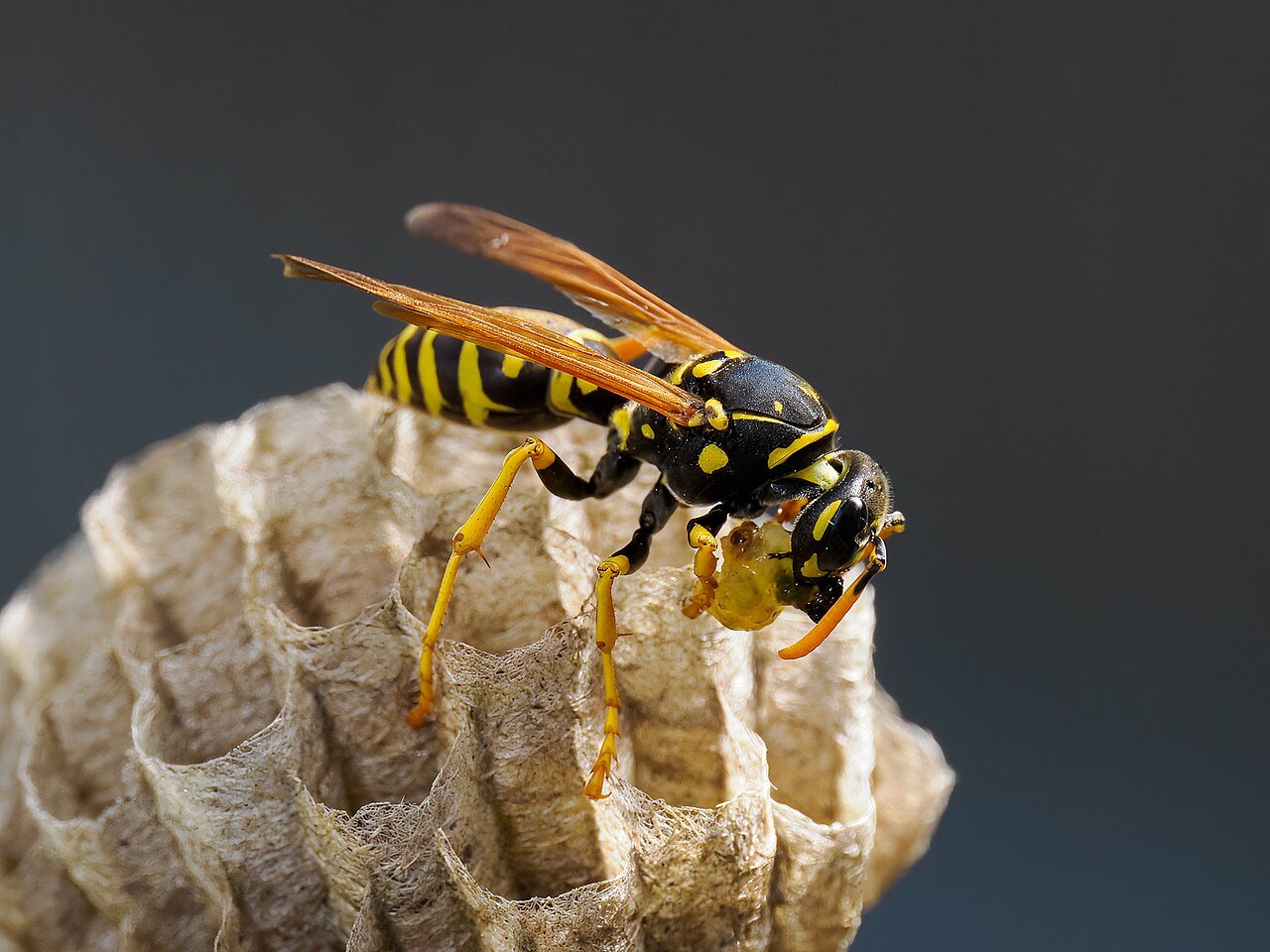
The one rule that sorts every nest: open or enclosed?
Before any species detail, learn the master key, because it does ninety percent of the work. Open architecture — a comb whose hexagonal cells you can see, hanging naked from a single stalk — belongs to paper wasps. Open builders run small colonies, a few dozen at peak, defend only the comb itself, and constitute the one genuinely DIY-manageable file in wasp control. Enclosed architecture — anything wrapped in gray paper envelope, and anything hidden inside a hole, void, or cavity where you can’t see a nest at all — belongs to the yellowjacket family, hornets included. Enclosed builders run big colonies, hundreds to thousands, defend a radius rather than a spot, and are professional work at every size. Everything else on this page is refinement; that one glance — can I see cells, or can’t I? — is the decision that keeps people out of emergency rooms. It works because the envelope isn’t decoration: wrapping the nest is what lets a colony regulate temperature well enough to grow into the thousands, so the architecture literally announces the army size.
Once you know which nest you have, the only decision left is whether to leave it or take it down. If it is coming down, that is wasp and hornet removal in Dayton.
Nest type one: the open umbrella comb (paper wasps)
What it looks like: an upside-down umbrella of gray paper cells, from quarter-sized (one queen, May) to a wide hand-span (peak, August), always hanging by a short stalk from something horizontal. The comb is bare — you can watch larvae wiggling in cells if you care to. Where: under eaves and soffits, porch ceilings, deck railings, behind shutters, inside grill lids and mailboxes, under patio furniture — anywhere with a roof and a windbreak. Season: founded April–May by a single visible queen; growth through summer; abandoned at frost, never reused. Risk file: lowest on the page. Paper wasps sting to defend the comb at close range and mostly can’t be bothered otherwise. The danger cases are proximity cases — a comb over a doorway, at head height on a railing, or in a grill someone’s about to light. The playbook: this is the DIY file, with the full protocol on our main wasp guide: dusk, jet-stream aerosol from fifteen feet, morning knockdown, scrape the stalk scar. In May, you don’t even need the can — a quarter-sized founding comb dies with one broom-flick while the queen’s out. And a comb on the back fence, away from traffic? Its workforce is clearing caterpillars off your garden for free; the correct treatment is frequently none.
Nest type two: the hanging gray globe (bald-faced hornets)
What it looks like: the icon — a teardrop or football of swirled gray paper, entrance hole near the bottom, growing from softball to basketball-plus across a summer. The swirls are literal work logs: each band is a different wood source, chewed and re-spat as paper. Where: tree branches eight to forty feet up, and — the ones people find late — under deep eaves, on gable ends, behind dense shrubs at face height. Season: visible by late June, conspicuous by August, dead at hard frost. Risk file: the widest defense radius in the yard. Bald-faced hornets escort perceived threats away from a bubble that can extend a dozen feet or more, they remember repeat disturbances, and a mature globe holds 400–700 defenders with no per-sting limit. Vibration is their tripwire — the classic incident isn’t someone touching the nest, it’s someone running a mower, trimmer, or pressure washer underneath it. The playbook: never DIY, at any size, in any location — this is the file the never-list was written for. High and remote, the free option is legitimate: frost demolishes the whole operation by November and the nest is never reused. Anywhere near human traffic, it’s our visit. And empty winter globes are safe to cut down and even keep — they’re genuinely beautiful objects once the tenants are gone.
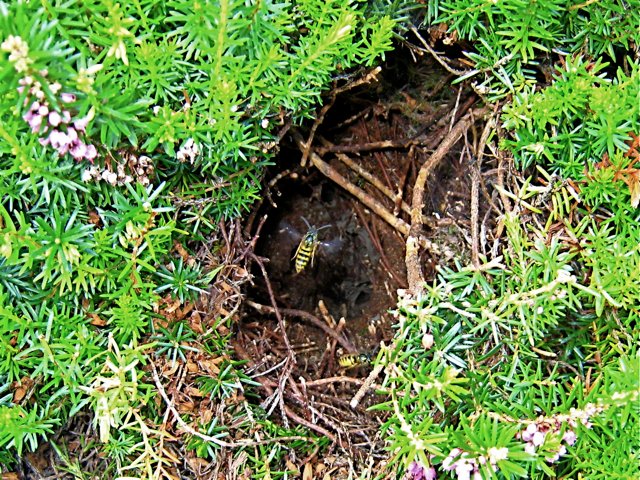
Nest type three: the hole in the ground (yellowjackets)
What it looks like: nothing — that’s the trap. The colony builds its paper city underground, usually in an abandoned rodent burrow, and the only surface evidence is a nickel-to-quarter-sized hole with air traffic: a steady stream of compact yellow-and-black wasps, one landing as another departs, all day. By late summer a busy entrance handles a wasp every second or two — unmistakable once you know to watch for it. Where: lawn edges, flower beds, under landscape timbers and stones, the seam where grass meets woods, occasionally compost bins. Season: quiet and tiny until July; peak traffic August–September — precisely mowing season, which is why the lawnmower is the number-one discovery mechanism and the number-one multi-sting event in Ohio. Risk file: severe. Ground colonies run one to four thousand by September, respond to ground vibration from yards away, and pursue. The playbook: professional, and the two forbidden moves deserve their standing repetition — don’t spray the hole (kills doormen, enrages the city) and don’t plug it (they excavate a new exit, sometimes indoors if the nest sits against a foundation). Mark the entrance location from a distance, flag it so the household mows around it, and call. One dust application at the entrance, carried inward by the workers themselves, ends the whole colony in a day or two.
Nest type four: the invisible nest with a doorway (wall and void colonies)
What it looks like: wasp traffic in and out of a structural gap — under siding laps, at soffit corners, around window trim, into weep holes, under porch steps — with the nest itself completely hidden in the wall void, ceiling bay, or attic edge behind. Yellowjackets are the usual tenants; European hornets take the larger cavities, and announce themselves by size and by working your porch light after dark. Late in the season you may hear it: a dry papery rustle in the wall on quiet evenings, and a warm spot on the drywall over a big colony. Risk file: everything the ground nest has, plus a building. The catastrophic DIY move — sealing the entrance — is even worse here, because the trapped colony’s new exit is frequently through an interior wall, and a few thousand yellowjackets discovering your living room is the single worst afternoon in amateur pest control. Void colonies also occasionally chew through season-weakened drywall on their own. The playbook: professional, promptly, and July beats September — every week of delay adds hundreds of defenders. After the colony’s dead, the entrance gets sealed (order of operations is everything) and large legacy nests in accessible voids are worth removing, since abandoned brood and prey stores can draw dermestid beetles and a secondary infestation.
Nest type five: mud, not paper (the harmless masons)
What it looks like: organ-pipe tubes, neat clay pots, or rough mud blobs plastered on brick, under porch ceilings, in garage corners and barn rafters. These are mud daubers and potter wasps — solitary masons, one female per project, no colony, no defense instinct, and a sting file so empty that entomologists handle them bare-handed. Round exit holes drilled in the tubes mean the tenants have already grown up and left. The playbook: scrape at leisure with a putty knife; a squirt of water softens old mud. The only real significance of heavy mud-dauber construction is informational — they provision their tubes with paralyzed spiders, so a porch full of organ pipes is a free survey saying your spider population is healthy. Treat the food supply and the masons relocate on their own.
Nest type six: the perfect circles in the lawn (solitary diggers)
What it looks like: individual pencil-to-nickel holes in bare, sandy, well-drained ground, each with a little thrown-soil apron — and in July, the giant version: cicada killer burrows the diameter of a quarter with a U-shaped dirt kick-out. One wasp per hole. No traffic stream. The tell versus a yellowjacket ground nest is pure arithmetic: a dozen scattered holes with one occupant each versus one hole with a continuous two-way rush hour. Solitary diggers — cicada killers, digger wasps, sand wasps — hold no colony and defend nothing; males patrol and bluff, females ignore you completely. The playbook: none required. The full acquittal, including the dog question and the six-week eviction timeline, lives in the cicada killer guide. Dense aggregations in a lawn are a soil-moisture message, not a wasp problem: thicken the turf and water the bare patch, and next July they dig elsewhere.
Reading a nest’s age and size from the outside
Two questions decide urgency, and both are readable at range. How old? The calendar tells you: any nest in May is a founding queen and a handful of cells — trivially cheap to solve. The same nest in August is a city. This is why our standing advice is a five-minute porch-and-eaves walk on Memorial Day weekend; it’s the highest-leverage inspection of the year. How big inside? For globes, exterior size maps directly to population — softball, low hundreds; basketball, high hundreds. For hidden nests, count the entrance rate: a wasp every four or five seconds is a young colony; multiple wasps per second is a mature one; and traffic that’s visibly heavier than two weeks ago is the growth curve telling you to stop waiting. Photograph the entrance from a safe distance on two different days — the comparison is the diagnosis, and it’s exactly what we’ll ask to see when you call.
The decision table, complete
- Open comb, palm-sized or less, reachable, not over a doorway: DIY at dusk, or broom-flick in May. The one green-light file.
- Open comb, bigger, higher, or over traffic: quick professional stop — flat-priced, undramatic.
- Gray globe, anywhere: professional, or free-by-frost if it’s high and remote. Never DIY.
- Hole in the ground with rush-hour traffic: flag it, mow around it, call. Never spray, never plug.
- Traffic into the structure: call promptly — July beats September by hundreds of defenders. Never seal first.
- Mud tubes: putty knife, any time, zero risk.
- Scattered solo burrows: nothing. Fix the bare soil in September if you want them gone next year.
Nest identification questions we hear every week
There’s a small papery bulb on my eave with one wasp on it. Is that a hornet nest starting?
In May, an enclosed bulb the size of a golf ball with a single large tenant is indeed a founding queen — bald-faced or aerial yellowjacket — building her starter envelope. This is the one moment the globe file is cheap: one insect, no defenders. It’s still not a bare-hands job (founding queens sting), but a dusk aerosol treatment of a golf ball is a different universe from an August basketball. If you see cells instead of a wrapper, it’s a paper wasp start — even easier.
Wasps are going under my siding but I also see them in the kitchen. Connected?
Almost certainly — workers from a void colony follow light when the nest presses against an interior gap, emerging around window trim, ceiling fixtures, and outlets. Indoor stragglers from a wall entrance are the classic mid-stage void-colony sign and move the job from “this month” to “this week.” Kill the indoor individuals with a swatter or vacuum, don’t caulk anything yet, and call.
I found a nest in my attic in January. Emergency?
No — you found a corpse. Winter nests are empty: the colony died at frost and the queens overwinter elsewhere, under bark and in leaf litter. Remove it in a bag (a respirator’s not overkill; old nests hold frass and beetle debris), and note the entrance gap it used — sealing that in February prevents next year’s tenant, since cavities that hosted once tend to host again.
Can I just leave every nest until frost?
Location decides. High globe over the back woods — absolutely, and you’ll save the service fee. Anything over doors, decks, play areas, or in the structure — no, because August traffic and August tempers peak precisely when the household is outside most. The frost option is real but it’s a November solution to what is usually an August problem.
The eight-county nest census
Our service map runs every file at different frequencies: Oakwood, Kettering, and Dayton’s mature-tree streets lead on European hornet cavities and high bald-faced globes; Beavercreek, Springboro, and the newer Greene and Warren suburbs skew paper-wasp-on-vinyl and ground nests at the sod line; Miami and Preble counties’ barns and outbuildings are paper wasp and mud dauber country, with fencerow globes for variety. The reading skills transfer everywhere — architecture, location, traffic — and so does the phone number: (937) 569-3330. Text us a photo from a safe distance and we’ll identify it free, tell you honestly which file it’s in, and quote the visit only if it needs one. Half our nest photos get the answer “leave it alone, here’s why” — which is exactly how identification should work.
The bottom line
Every wasp nest in an Ohio yard answers three questions from thirty feet: open or enclosed, where does it sit, and how heavy is the traffic. Open and small is the DIY file; enclosed — globe, ground, or void — is the professional file at any size; mud and solo burrows are the leave-it-alone file. Read the architecture before the insect, let the calendar set the urgency, and remember that the most dangerous nest on the property is reliably the one nobody has spotted yet — which is the whole argument for the Memorial Day walk-around, and for sending us the photo before the mower finds the answer for you.
One more identification tool deserves mention because it costs nothing: the two-day photo pair. Nearly every nest question that reaches us — species, size, urgency, price — is answerable from two phone photos taken from the same safe spot forty-eight hours apart. The first shows us the architecture; the second shows us the trend. A comb that added a ring of cells, a globe that gained an inch, an entrance whose traffic doubled — that pair tells the whole story, and it’s better diagnostic data than most in-person glances. Make it a habit and you’ll never be surprised by a nest again.
Frequently asked questions
How do I identify what kind of wasp nest I have?
One glance does most of it: visible hexagonal cells on an open comb = paper wasps (small colony, low risk); anything wrapped in gray paper or hidden in a hole or wall = the yellowjacket family (big colony, real risk). Location and traffic volume refine it from there — the full key is on this page.
What does a paper wasp nest look like?
An upside-down umbrella of exposed cells hanging by a single stalk under eaves, rails, and porch ceilings — quarter-sized in May, hand-span by August, never enclosed. If you can see the cells, you are in the lowest-risk file on the roster.
What is the big gray papery ball in my tree?
A bald-faced hornet globe — football-to-basketball, swirled gray paper, entrance hole near the bottom, holding 400–700 defenders by late summer with the widest defense radius in the yard. Never DIY at any size; high and remote ones can simply wait for frost’s free demolition.
I see wasps going into a hole in the ground. What is it?
A yellowjacket colony in an old rodent burrow — the most dangerous nest type per incident, because mower vibration triggers mass defense. Flag it, mow around it, never spray or plug the hole, and have it dusted: workers carry the dust in and the colony collapses in a day or two.
What are the mud tubes on my brick — a wasp nest?
Mud daubers — solitary masons with no colony, no defense instinct, and an essentially empty sting file. Round exit holes mean the tenants already left. Scrape at leisure; their only significance is that heavy mud-dauber building advertises a healthy spider population.
How can I tell how many wasps are in a nest?
Read the outside: globe diameter maps to population (softball = low hundreds, basketball = high hundreds); for hidden nests count the entrance rate — a wasp every few seconds is young, multiple per second is mature, and traffic visibly heavier than two weeks ago is the growth curve telling you to act.
Is it safe to knock down a small wasp nest?
A quarter-sized May start with one queen: yes — a broom-flick while she is out, done. A palm-sized summer comb: dusk aerosol protocol. Anything bigger, higher than flat-footed reach, over a doorway, or enclosed: no — that is the professional file, and the reasons fill the rest of this page.
What wasp nests appear inside walls?
Yellowjackets mostly (soffit gaps, siding laps, weep holes), European hornets in larger cavities — visible only as traffic in and out of a structural gap, sometimes audible as papery rustling on quiet evenings. Never seal the hole; the treat-wait-then-seal order is the entire safety protocol.
When are wasp nests biggest and most dangerous?
August through early October — peak population meets peak defensiveness meets peak human yard time. The same nests were golf balls in May, which is why the Memorial Day porch walk is the highest-leverage inspection on the calendar.
What should I do with an empty wasp nest in winter?
Anything you like — frost kills every colony and nests are never reused. Cut down globes (they are genuinely beautiful objects), scrape combs, note the attachment points and cavity entrances for sealing, and bag old void nests before carpet beetles find the leftovers.
Are there wasp nests that should just be left alone?
Plenty: back-fence paper wasp combs away from traffic (free caterpillar control), high remote globes (frost handles them), every mud dauber tube, and all solitary digger burrows including cicada killers. The collision zones get treated; the rest of the yard’s wasps are mostly staff.
Who can identify my wasp nest from a photo?
We can, free — text the clearest safe-distance shot to (937) 569-3330 and you get the species, the risk file, and the honest verdict (including “leave it alone”, which is half our answers) usually the same day.