
The pantry’s other dynasty announces itself two ways: a small moth — half-inch, two-toned, coppery-banded wings — flying its slow zigzag across the kitchen at dusk, or the discovery the beetle page promised this one would handle: webbing in the flour — the silky clumping, the fine strands lacing the cereal, the granola bar with a tenant. Both point at the Indian meal moth (Plodia interpunctella), America’s most common stored-food pest and the pantry wing’s flying franchise — and both resolve through the source-hunt method that wing already runs, with the moth-specific upgrades this page adds: the webbing-and-wanderer evidence read (the caterpillars leave the food to pupate, which is why they turn up on the ceiling — the finding that confuses every household), the pheromone-trap advantage this species uniquely offers (the traps work dramatically here — with the placement-and-expectation rules that keep them honest), the freezer-quarantine doctrine restated for the moth’s import routes (birdseed and pet food lead again), and the ceiling-corner-and-lid-thread deep clean that ends reinfestation cycles the surface wipe misses. Greater Dayton Pest & Rodent, pantry verdicts by photo, free: (937) 569-3330.
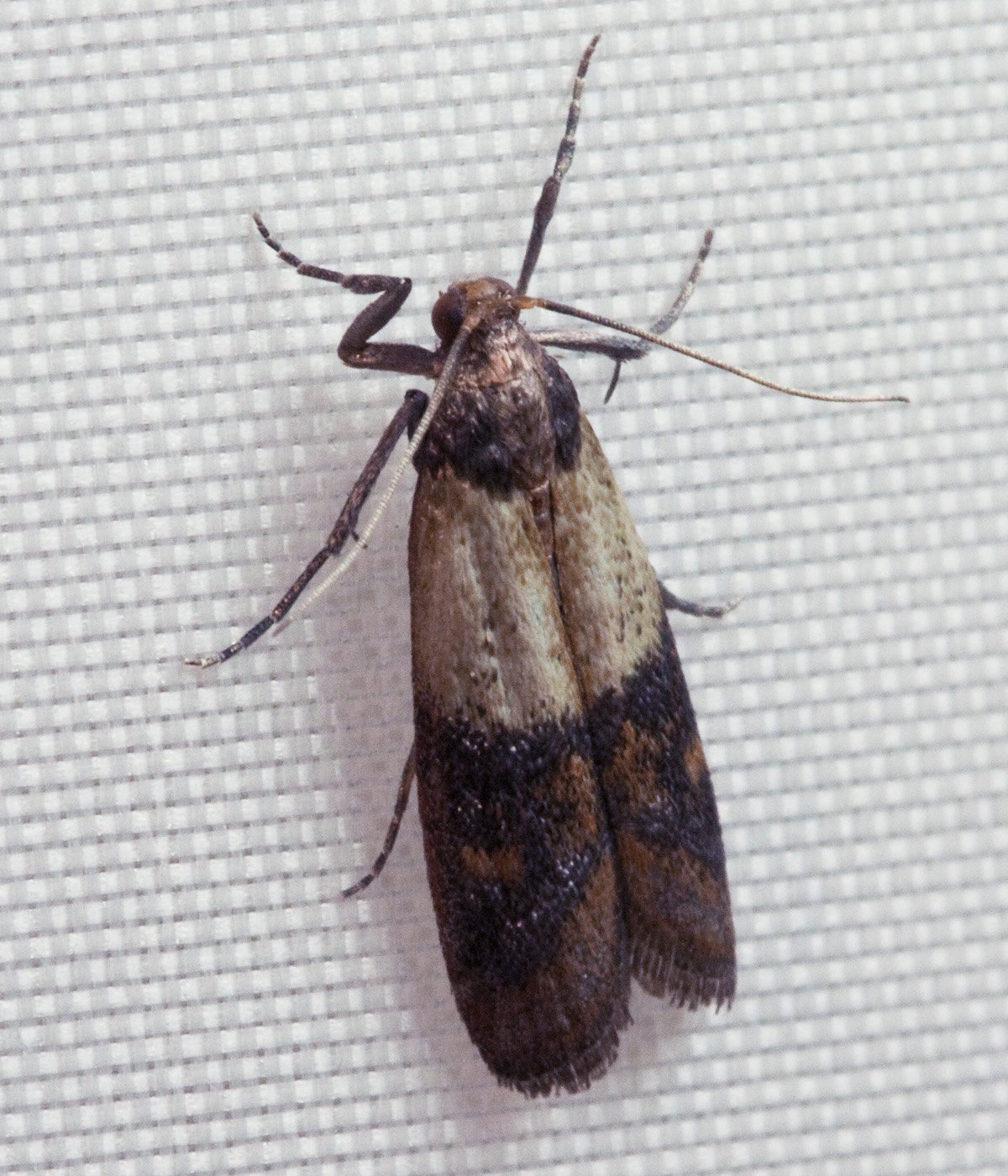
Know the dynasty: moth, larva, and the ceiling-walk that confuses everyone
The ID stack runs three stages, each with its tell. The adult: a 5/8-inch moth with the split-color wings no look-alike wears — pale gray-cream inner half, coppery-bronze outer half, a two-tone visible even mid-flight — flying weak dusk zigzags near the kitchen and resting days on walls and ceilings nearby (adults don’t eat AT ALL — no mouthparts to speak of; their week of life is entirely reproductive logistics, which is why swatting adults never ends anything: the receipt-not-factory doctrine, moth edition). The larva: the actual pest — a half-inch cream-to-pinkish caterpillar with a dark head, living IN the food and spinning as it feeds: the webbing that distinguishes moth work from every beetle’s (the beetle page’s sorting rule, now from the other side — silk says moth, always), clumping grain into the matted wads the discovery-scoop finds. The wanderer: the stage that generates this page’s most alarmed calls — mature larvae LEAVE the food to pupate, climbing walls and crossing ceilings to spin cocoons in the crack lines, cabinet-top corners, and the gap where ceiling meets wall; a caterpillar on the kitchen ceiling, or the small tough cocoons in the cabinet’s door-hinge corners, is the infestation’s graduation march — normal, diagnostic, and the reason the deep-clean section targets geography no food-tossing reaches. Egg to adult runs four-to-seven weeks warm; several generations a year indoors; and the population’s founding, as with the beetles, almost always shipped in — the source hunt’s first stop is the bag, not the building.
The caterpillar on the ceiling came from a bag in the cupboard, and the bag is what has to go. Clearing the rest is pest control in Dayton.
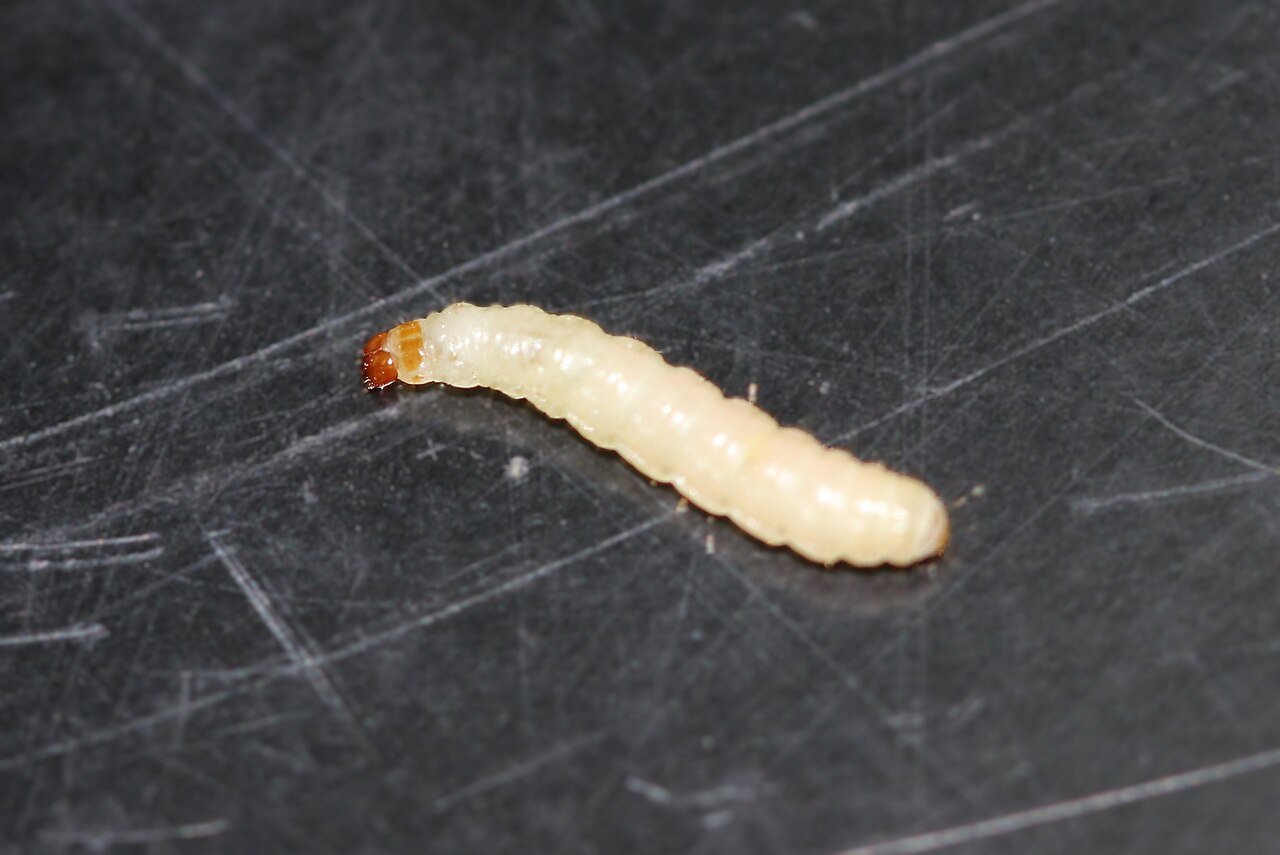
The hunt, moth edition (and the two-front purge)
The beetle page’s source hunt runs here with the moth’s amendments. Front one, the food: empty the pantry completely and read for silk — webbing, clumped wads, larvae in the folds, and the fine strands at bag-tops that pre-date visible tenants; the suspect list re-ranks moth-style with coarse grains, birdseed and dried pet food at the top (the meal moth’s founding routes run heavily through the birdseed bag in the garage — check it even though it’s not in the pantry; a garage colony supplies kitchen flyers indefinitely), then cereals, meal, nuts, dried fruit, chocolate, and the spice-rack’s coarser jars. Infested and suspect stock exits sealed, same-hour; the freezer salvages the precious (four days, the quarantine doctrine’s kill-step). Front two, the architecture — the moth’s addition, and the reinfestation-cycle breaker: the wanderers’ cocoons survive every food purge, so the deep clean goes where they graduated — the ceiling-wall seam, cabinet-top edges and corners, the underside of shelf lips, the hinge recesses, and the lid threads of every jar (larvae pupate under jar-lid rims constantly — run the lids through hot wash), vacuumed with the crevice tool and wiped; the shelf-liner paper, classic cocoon real estate, gets replaced rather than cleaned. Skip front two and the cycle re-seeds from architecture in six weeks — the “we threw everything out and they came back” case our line hears weekly, solved by a crevice tool the first time through.
The pheromone advantage (the trap that actually earns its box)
The meal moth offers what the pantry beetles mostly don’t: pheromone traps that work dramatically — the retail sticky tents loaded with female sex pheromone pull males with a reliability that makes them the pantry wing’s best monitoring instrument, subject to three honesty rules. Rule one — they’re monitors, not eliminators: traps catch males only; the mated females keep laying regardless, so a trap-only campaign runs the attendance-not-crashes fallacy in reverse — use the catch-count as the verification metric for the two-front purge (counts falling to zero over six weeks = won; plateaued = a missed source, usually the garage birdseed or a cocoon zone). Rule two — placement modesty: one or two traps near the pantry; a trap-per-cabinet festival can draw males from the neighborhood (the fence-line trap logic at kitchen scale) and reads as worse-than-reality. Rule three — species scope: the standard lures pull meal moths and their close kin; a trap ignoring visible moths means a different species — and the household’s OTHER moth question routes to the clothes-moth file, where the wardrobe’s smaller, plainer, light-shy moth runs an entirely separate racket this page’s sibling covers. Two moths, two rooms, two pages — and the pheromone trap, correctly briefed, refereeing the kitchen half with the best signal-per-dollar in the wing.
Pantry moth questions, answered
I keep killing moths but they keep coming. What am I missing?
The adults are the receipt — a new flyer every few days means a producing source: run both fronts (the garage birdseed and the cocoon architecture are the classic misses), set the trap line as the meter, and expect the six-week decay as pupae age out. Swatting stays satisfying and stays irrelevant; the species budgeted for your swatter generations ago.
We ate cereal that turned out to have webbing. How bad?
The beetle page’s verdict transfers whole: unappetizing, not unsafe — no toxins, no disease, incidental protein at worst (allergy-prone individuals note the caveat). The box goes out, the hunt begins, and breakfast recovers faster than the story stops being told.
Do bay leaves in the flour actually repel them?
The folk shelf’s gentlest entry, graded gently: bay, like the cedar-and-lavender wardrobe folklore, shows weak short-range repellency in some tests and no protection in any honest one — a bay leaf in a sealed jar is redundant (the jar did it), and in an open bag it’s a garnish. The glass did the work the leaf gets thanked for; the doctrine stays gasket-first.
When does a moth problem justify calling you?
The honest tiers: the standard kitchen case is a this-page case — two fronts, traps as meter, six weeks. The calls that pay: commercial and food-service settings (where meal moths are an audit item and the program’s monitoring-and-documentation runs standard), the whole-structure mystery (persistent catches with clean fronts — occasionally a wall-void seed cache from a past mouse tenancy feeds a colony no pantry purge touches; the borescope find our techs log a few times a year), and the multi-unit building where the source is a neighbor’s pantry. The photo line grades the ambiguous webbing-versus-beetle finds same-day, as ever.
The verdict in silk
The pantry’s flying dynasty, fully filed: a two-toned flyer that eats nothing, a spinning larva that eats everything, a graduation march to the ceiling corners that confuses every household once, and a management program — two fronts, one freezer, glass everywhere, traps as referee — that ends the cycle in six weeks and the reinfestations forever. The webbing said moth; the crevice tool said finished; and the pantry wing’s two dynasties — beetle and moth — now share one doctrine, one quarantine, and one shelf of honest glass between them and the next imported founding. For the audit trails, the wall-void mysteries and the webbing photos: (937) 569-3330, Greater Dayton Pest & Rodent, Dayton and all eight counties — where the flour stays silk-free and the ceiling keeps only paint.
The six-week campaign calendar
- Day 1: the two-front purge — pantry emptied and silk-read, infested stock out sealed, precious stock to the freezer; the crevice-tool architecture pass (ceiling seams, cabinet tops, hinge recesses, lid threads, shelf paper replaced).
- Day 1–2: the wider-map check — garage birdseed, pet food, the decorative corn and seed-art the beetle page flagged; one or two pheromone traps placed as the meter.
- Week 1: restock in glass and gasket only; the freezer-quarantine habit installed for all future vulnerable purchases; expect continued flyers — the pupae in uncleaned micro-refugia age out on their own schedule.
- Weeks 2–4: trap counts declining = campaign working; any larva sighting mapped (its direction points at a missed source); the second crevice pass if graduation traffic continues.
- Weeks 5–6: counts at zero = verified; traps refreshed once and left as standing early-warning (a lure lasts months and catches the next founding at import, weeks before webbing would).
- Forever: the freezer on arrival, the glass on the shelf, the annual spice-rack honesty review — the pantry wing’s complete constitution, two dynasties covered, one habit set.
Six weeks, two fronts, one meter — the dynasty’s complete eviction, calendared. The silk was the signature; the crevice tool was the sentence; and the standing trap keeps the docket clear.
The meal moth’s biography (the supply chain’s most successful passenger)
The species’ back-story explains both its ubiquity and its management. Named for its 1856 description feeding on cornmeal (“Indian meal” in the era’s vocabulary), Plodia interpunctella rode the industrialization of food storage to global dominance: a generalist whose larvae process everything from grain to chocolate to chili flakes, a pupal stage that tolerates shipping, and a founding strategy — eggs laid at processing and packaging — that distributes the species through the supply chain itself, mill to warehouse to shelf to pantry. The consequence the household file inherits: infestation is an arrival event, not a housekeeping verdict — the packages seed themselves, the cleanest kitchen in the county receives the same imports as the messiest, and the differences that matter are entirely post-arrival: the freezer that ends the eggs, the glass that contains the misses, and the six-week campaign that closes the occasional establishment. The commercial world runs the same doctrine at scale — the food industry’s meal-moth management (pheromone-grid monitoring, mated-female disruption, heat sanitation of structures) is a standing discipline whose residential translation is exactly this page — and the species’ other career deserves its footnote: as one of biology’s model organisms for studying insect immunity and granulosis viruses, the pantry’s dynasty has paid some genuine scientific rent on its long tenancy. None of which softens the webbing verdict — but the household that understands the passenger stops blaming the port, and the quarantine-and-glass constitution stops being effort and starts being policy: the supply chain ships them; the freezer ends them; the pantry, at last, adjudicates.
A eight-county pantry report
The local file, from the intake notes: meal-moth calls run year-round with the post-holiday peak the calendar predicts — the baking-season flour stock-up plus the gift-basket economy seeds January’s discoveries, and the bulk-buying households’ twenty-pound bags write the biggest case files (the warehouse-club scenario, moth edition); the birdseed route leads the founding stories in every county — the garage bag feeding both the feeder and the kitchen’s flyers, solved by the steel-can upgrade the rodent wing already prescribed for the same bag; the farm-and-rural addresses add the granary-adjacent pressure and the occasional barn-to-house commute; and the estate-cleanout imports — inherited pantries and decades-old spice racks — supply the historic districts’ chapter. Across the map, the resolution statistics run the wing’s most cheerful: the two-front campaign closes the overwhelming majority of files without a truck, the standing trap catches the re-imports at the door, and the pantry pages’ combined doctrine — freezer, glass, rotation, and now the crevice tool — has quietly become the library’s most-cited household constitution. The silk keeps signing; the freezer keeps ending; and the eight counties’ flour, jar by jar, keeps getting harder to colonize.
The moth fork, stated once for both pages
Since the two moth files ship together, the fork that routes every household moth question, stated where the kitchen search lands: two-toned copper-and-cream, flying dusk zigzags near the kitchen, webbing in food = this page — the meal moth, the pantry campaign, the pheromone meter. Small, plain gold-to-buff, light-shy and scuttling more than flying, found in closets and under furniture, damage in wool = the clothes moth file — the wardrobe’s entirely separate campaign, next door in the library. Big, patterned, at the porch light = outdoor wildlife, no file at all (the giant silk moths and sphinx moths of Ohio summers are the garden bench’s celebrity visitors — photograph, admire, release from the screen door). The fork’s stakes are the usual: pantry protocol deployed against a closet species (or vice versa) wastes its weeks on the wrong architecture, and the porch-light beauty sprayed as a “moth problem” is the library’s saddest misfile. Wings and venue, ten seconds, three verdicts — and the two campaign pages standing ready behind the two that need one.
Silk in the flour, wanderers on the ceiling, a two-toned flyer with no mouth and one week to live — the dynasty read completely, evicted on calendar, and locked out by glass and cold at the door it always used. The pantry wing closes its flying chapter the way it closed its crawling one: source hunted, architecture crevice-cleaned, freezer standing guard, and the household’s flour restored to the only tenants it ever needed — none. Six weeks to quiet, one standing trap to keep it, and the webbing’s signature retired from the shelf for good.
And for the reader mid-discovery, scoop still in hand: bag it, bin it, breathe — the webbing was the whole bad news, the campaign starts tonight at the freezer, and by the six-week mark this page will read as history. The moths budgeted for your surprise; they never budgeted for the crevice tool, the trap line, or a household that reads before it reacts — which, as of this paragraph, yours is.
Webbing means moth; silk means source; glass means never again. The pantry’s three-line law, now fully legislated across both dynasty files — and enforced, jar by gasketed jar, at the only border that ever mattered: the shelf’s edge, where the supply chain’s passengers meet a household that finally checks the manifest.
Case sealed — in glass, where the pantry files all their best endings. The wardrobe’s moth is next door when you’re ready.
Two dynasties down, one doctrine standing: hunt, freeze, glass, verify — the pantry, permanently adjudicated.
The flour rests; the freezer watches; the library turns the page.
Frequently asked questions
What are the little moths in my kitchen?
Indian meal moths — the pantry moth of record: half-inch fliers with two-tone (tan and coppery) wings, zigzagging at dusk near cabinets. The moths are the visible end; the infestation is their larvae in your stored food.
How did pantry moths get into my house?
In the groceries — eggs or larvae ride in on grain products, birdseed, pet food, nuts, and dried fruit from infested packaging upstream. Nearly every case is an importation; the store shelf, not your housekeeping, wrote the origin story.
How do I get rid of pantry moths for good?
The purge-and-seal protocol: empty the pantry completely, inspect every grain-adjacent package (webbing, clumping, larvae), discard the infested, freeze the questionable (four days), vacuum the shelf cracks (larvae pupate in corners and screw holes), wash surfaces, and restock into airtight glass or heavy plastic. Skipping the crack-vacuuming is the classic relapse.
What does pantry moth webbing look like?
Silky matting and clumped granules inside packages — flour that ropes together, webbed corners in cereal bags, sticky threads on cracker sleeves. Webbing plus small caterpillars confirms the diagnosis instantly.
Why do pantry moths keep coming back?
Three leaks: a missed source package (the forgotten birdseed bag is legendary), larvae pupating in shelf cracks and can rims outside any package, or re-importation on new groceries. The full-empty protocol plus pheromone monitor traps closes all three.
Do pantry moth traps work?
Pheromone traps catch males and serve brilliantly as MONITORS — a busy trap says the source persists; a quiet one confirms victory. As standalone control they fail (females keep laying); trap plus purge is the working combination.
Are pantry moths harmful if we ate the food?
Harmless — accidentally consumed larvae or webbing is unappetizing, not dangerous; no disease, no toxin. Discard for quality, not safety, and skip the panic.
What foods do pantry moths infest?
The grain-and-seed aisle: flour, cereal, rice, pasta, cornmeal, nuts, dried fruit, chocolate, spices, birdseed, and dry pet food — the last two being the most-missed sources in every relapse case we work. Unopened cardboard and thin plastic stop nothing; larvae chew through.
How long does a pantry moth infestation take to clear?
Run the protocol fully and flying adults fade over two to three weeks as the last pupae emerge into a food-free kitchen. Monitor traps tell the truth: quiet by week four, or the hunt resumes for the missed bag.
When do pantry moths warrant professional help?
Recurring infestations after two honest purges (a hidden source — wall-void seed caches from mice are a real finding), multi-room moth traffic, or commercial kitchens under inspection pressure: (937) 569-3330 — we find the bag people cannot.