
If your mosquito problem changed character sometime in the last fifteen years — if the bites moved from dusk to daylight, from the yard’s edges to the patio’s middle, from occasional to relentless-at-the-ankles — you’ve met the Asian tiger mosquito, and this page is its complete Ohio file. Aedes albopictus — black-and-white striped, container-bred, day-biting, and among the most successful invasive insects on Earth — has spent three decades converting the American backyard mosquito experience from an evening nuisance into an all-day siege, and the Miami Valley sits well inside its established range. The good news arrives with the bad and outweighs it: the tiger is the most household-controllable mosquito there is — it breeds within a few hundred feet of where it bites, in containers you own, holding water you can dump — which means the species that bites hardest is also the one whose war is winnable from your own driveway. The file: the stripe-and-daylight ID, the invasion story (used tires, famously), the container biology that puts the nursery in your saucers and gutters, the honest disease picture for Ohio, the Tuesday-night dump routine that beats any fogger ever built, and where the professional program earns its place against this specific enemy. Greater Dayton Pest & Rodent: (937) 569-3330.
The ID and the schedule: why your bites moved to noon
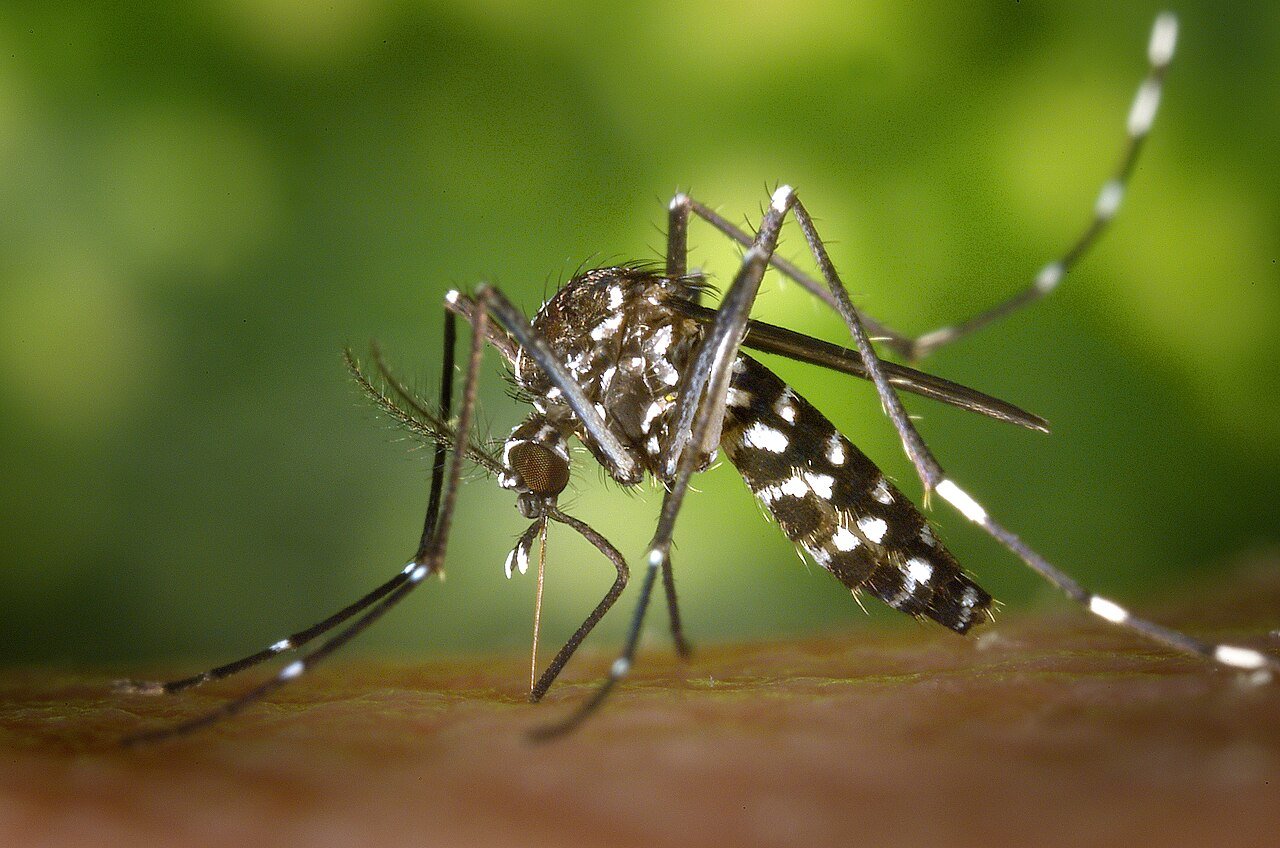
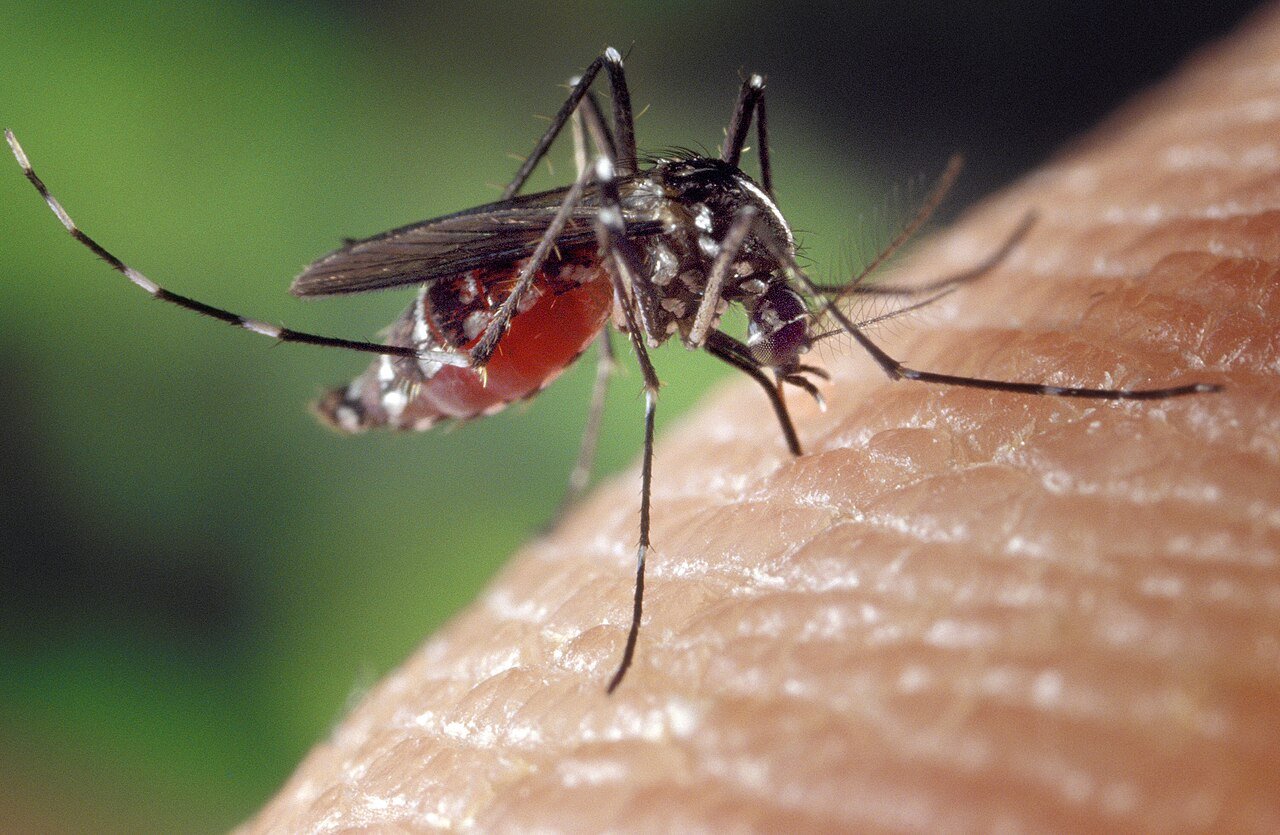
The tiger announces itself in pattern and timing. Pattern: a small (quarter-inch), jet-black mosquito with a single silver-white stripe down the center of the thorax — the racing stripe that names it — plus bold white bands on the legs and abdomen: high-contrast enough to identify mid-swat, and distinct from the region’s brown-toned natives. Timing: tigers are daytime biters — peak activity in morning and late afternoon, active straight through fair-weather midday — a schedule inversion from the dusk-shift native Culex that rewrote the backyard rulebook: the gardener bitten at 10 AM, the cookout besieged at 2, the kids’ ankles welted from an afternoon sprinkler session. Technique: low, quiet, ankle-and-calf specialists (the CO₂ plume near the ground is their hunting lane), persistent re-approachers after swats, and short-range fliers — the tiger rarely travels more than 200 yards from its natal container in its life, the single most strategically important fact in this file. The confusion cases: the native gallinipper giants after floods (huge, brown, the crane-fly page’s one genuinely large true mosquito), the similarly-striped-but-rarer yellow fever mosquito (not established this far north), and the biting midges whose invisible dusk work runs the opposite schedule. Striped, small, daylight, ankles: tiger, and the rest of this page is the response.
The invasion story: tires, drought-proof eggs, and thirty years to your patio
The tiger’s conquest is invasion ecology’s tidiest case study. Native to Southeast Asia, it crossed the Pacific in the mid-1980s aboard the used-tire trade — a tire holds exactly the shaded rim-water the species evolved for, ships by the million, and drains never — with the first US establishment documented in Houston tire yards in 1985 and the range running the eastern half of the country within two decades. Two adaptations powered the sprint: drought-proof eggs — laid at the waterline of containers rather than on water, surviving dry months (and shipping dry, in tires and lucky bamboo alike) to hatch when refilled, which makes every neglected bucket a time capsule; and cold-hardy diapause — the northern populations evolved overwintering eggs that shrug off Ohio winters, the trait that separated the tiger from its tropical cousins and put it on your patio permanently. Ohio’s timeline followed the national one — established in the southern counties by the 2000s, general across the Miami Valley since — and the local surveillance record (the county health districts’ trap networks monitor exactly this species) confirms what the ankle welts already reported: the tiger is a resident, not a visitor, and the management question is suppression, not prevention. The invasion’s lesson repeats this library’s oldest theme at continental scale: the species didn’t conquer America’s wetlands — it conquered America’s containers, and it holds exactly as much territory as the standing water we collectively forget to dump.
The container census: where your tigers are actually born
Because the tiger’s 200-yard commute makes every infestation local, the response begins with the census our yard program runs on arrival — and any household can run Sunday morning: the classic seven — plant-saucer water (the number-one urban nursery: the terra-cotta saucer under the porch fern breeds hundreds weekly), clogged gutters (the elevated swamp nobody sees — and the reason gutter cleaning is mosquito control), birdbaths unrefreshed (dump twice weekly and they’re an asset; neglect them and they’re a factory), tarps and covers (every fold holds a nursery — the boat cover and firewood tarp lead the category), toys and buckets (the tipped truck bed, the sandbox lid, the frisbee behind the shed), tires (the founding habitat, still the champion — one tire equals thousands of tigers per season), and corrugated downspout extensions (the ribbed black tubing holds water in every corrugation and has personally staffed half the Miami Valley’s patio sieges). The overlooked tier: trash-can lids inverted, bromeliad and hosta leaf-wells in lush years, the grill’s drip pan, tree holes (legitimate natural habitat — fillable with sand), and the neighbor question this species forces honestly: a 200-yard radius crosses property lines, and the block whose worst container yard opts out stays bitten — the community-scale truth behind every “I dumped everything and they’re still here” call, and the reason our assessments map the radius, not just the parcel. The census’s arithmetic is the campaign’s entire morale: a female lays 100-plus eggs per container cycle; every dumped saucer is a hundred tigers unborn; and the species that owns your afternoon can be evicted with a watering can’s worth of effort, weekly, forever.
The disease file, Ohio edition (honest, not breathless)
The tiger’s global résumé includes vectoring dengue, chikungunya and Zika — headline diseases whose outbreaks track this species worldwide — so the Ohio calibration matters and lands reassuringly: local transmission of the tiger’s headline diseases has not established in Ohio — the outbreak chains require infected travelers plus dense tiger populations plus tropical transmission windows, a combination the state’s surveillance has never seen sustained, and the region’s actual mosquito-borne concern remains West Nile virus, carried predominantly by the native dusk-flying Culex rather than the tiger (the tiger is a competent-but-secondary local player in that file). The honest forward note mirrors the tick page’s trend-line discipline: warming seasons extend the transmission mathematics, travel-linked cases arrive annually, and the county health districts trap-and-test precisely because the calculus can shift — but today’s Miami Valley tiger bite is an itch, not an exposure, and the household’s protective energies sort accordingly: the bite-care file for the welts, the repellent stack (DEET, picaridin — the tiger respects both; apply low, where it hunts) for the outdoor hours, and the container war — which protects the whole block’s public-health margin along with its patios — as the response that actually compounds. Panic stays unearned; the Tuesday dump stays undefeated.
The campaign: Tuesday’s dump, the dunk, and the honest role of the truck
The anti-tiger playbook, ranked by return: The weekly dump — the champion, unchallenged: every container emptied, scrubbed (eggs glue to walls at the waterline — the rinse matters), inverted or removed, on a standing weekly rhythm (the egg-to-adult cycle runs 7–10 summer days; weekly beats the clock). Assign it a day; Tuesday works; the whole yard takes ten minutes. The fix-or-fill tier — gutters cleaned and pitched, downspout corrugations swapped for smooth, tarps tented, tires gone (the county’s tire-disposal amnesty days exist for exactly this), tree holes sanded, the rain barrel screened (a screened barrel is conservation; an open one is a factory). The dunk tier — BTI in what must hold water: the rain barrel, the pond’s still margin, the drainage basin that won’t drain — larvae-specific, wildlife-safe, and the correct chemistry in the one place chemistry belongs. The truck’s honest role — our seasonal program against this species runs the census professionally (we find the containers households miss — the gutter tier especially), treats the shaded resting vegetation where day-hunting tigers wait between meals (the barrier application’s one legitimate target, timed and placed rather than fogged), and coordinates the block-scale cases where the 200-yard radius crosses fences. What stays theater: the propane traps (they catch tigers modestly and change patios rarely), the ultrasonic apps, the citronella perimeter — and the panic fogging whose collateral this library’s predator wing has already invoiced. The tiger’s war is won in containers, weekly, at walking pace — the most local victory in the entire mosquito file, and the only one that stays won.
Tiger mosquito questions, answered
I dumped everything and I’m still bitten daily. What did I miss?
Run the missed-container hit list in order: the gutters (climb or camera — the elevated tier is the classic miss), the corrugated downspout extensions, the tarp folds, the neighbor’s radius (the 200-yard truth — the block conversation, or our block-scale assessment), and the shaded resting vegetation where the standing adult population waits out the two weeks it takes the container war to bite. Adults live weeks; the census plus patience plus one resting-zone treatment closes the gap between “dumped everything” and “quiet patio.”
Why do they always find my ankles specifically?
Hunting-lane biology: tigers work the ground-level CO₂ and heat plume, approach low and from behind, and land below the knee where swatting fails and socks end. The counter-stack: repellent applied where they hunt (ankles and calves — the tick page’s application map covers both parasites), the patio fan’s downdraft (tigers are weak fliers — the box-fan doctrine’s third endorsement), and long socks for the garden hour that always costs the most.
Do the county spray trucks handle this species?
Only partially by design: municipal adulticiding runs at dusk for the West Nile-bearing Culex, when day-flying tigers are already bedded in vegetation the truck fog barely reaches — a scheduling mismatch, not a failure. Tiger suppression is structurally a yard-and-block program: your containers, your resting margins, your Tuesday. The trucks and the households split the mosquito file by species, and the tiger’s half is the private sector’s — which, given how winnable it is, is the better half to own.
When does professional treatment genuinely pay against tigers?
Three cases, honestly: the heavy-pressure yard whose census needs professional eyes (gutter tier, block radius, the containers experience finds in minutes); the entertaining household that wants the season managed rather than DIY’d (the seasonal program’s scheduled visits, resting-zone treatments and dunk maintenance — with the plan’s guarantee behind it); and the event calendar (the graduation party, the backyard wedding — a timed treatment ten days out is the difference the photos show). For everyone else: the Tuesday dump, the fan, the socks — and our honest phone-line blessing on all three.
The winnable war
The Asian tiger mosquito closes this batch of the library as its most satisfying opponent: an invader that crossed an ocean in tires, rewrote the backyard’s schedule, and yet — alone among the region’s biters — lives entirely within reach of a watering can and a weekly habit. Learn the stripe, run the Sunday census, dump on Tuesdays, dunk what must stand, screen the barrel, talk to the block, and give the resting margins to the program when the season or the stakes warrant. The species holds exactly as much territory as we leave it in saucers — and a Miami Valley household armed with this page holds the rest. For the census walks, the block-scale cases, the event timelines and the photo that confirms the racing stripe: (937) 569-3330, Greater Dayton Pest & Rodent, Dayton and all eight counties — where the daylight biter meets the daylight audit, and the patio’s afternoon comes back for the price of ten minutes a week.
The eight-county tiger map
Local pressure geography, container-written as always: the older urban neighborhoods lead — Dayton’s dense historic blocks and the courthouse-square towns combine mature shade (the tiger’s resting habitat), aging gutters, and container-rich lots into the valley’s heaviest daytime pressure; the garden suburbs run the saucer-and-birdbath economy (the loveliest patios breed their own besiegers — the Oakwood irony our routes know well); the rural properties contribute the tire piles, stock-tank margins and tarp-covered equipment of the farm campuses — where one barn-side tire stack can staff a township; and the new subdivisions start cleanest and converge fastest (five years of landscaping, downspout extensions and forgotten toys close the gap). The through-line completes the batch the way it opened: the pest map is the habit map, the habit map is auditable, and the household that runs its audits — containers, caulk lines, moisture numbers, radius walks — owns its address in a way no truck alone ever delivers. Two hundred pages of library now say the same thing in two hundred voices; the tiger just says it striped, in daylight, at the ankles: the evidence was always yours to read, and the victory was always yours to schedule.
The Sunday census, printable
- Ground tier: plant saucers (dump + scrub the waterline), buckets, toys, wheelbarrows, the sandbox lid, the frisbee behind the shed — invert everything invertible.
- Cover tier: tarps re-tented, boat and grill covers drained, firewood wrap checked fold by fold.
- Fixture tier: birdbath refreshed (twice weekly = asset), rain barrel screened, pond margin dunked, gutter check monthly (the elevated swamp), corrugated extensions swapped smooth.
- Legacy tier: tires GONE (county amnesty days), tree holes sanded, the trash-can lid flipped.
- Radius tier: the 200-yard honesty — the block’s worst yard sets the block’s floor; the friendly conversation (or the block-scale assessment) beats a summer of private effort.
- Standing weekly: ten minutes, one day, every container — the cycle runs 7–10 days and the calendar is the insecticide.
Census walked, Tuesday kept, ankles reclaimed: the tiger’s file closes the batch — and the library’s newest wing — on the most democratic victory in pest control: no truck required, no chemistry beyond a dunk, just the weekly ten minutes that decide whose patio the afternoon belongs to. It belongs to you. Keep the appointment.
One stripe, one ocean crossed in a tire, one species that bet everything on human forgetfulness — and one weekly walk with a watering can that calls the bet, every Tuesday, forever. The daylight biter picked the wrong habit to depend on; the patio picked the right page to finish on; and the afternoon, at long last, reverts to its rightful owners — iced tea optional, socks recommended, victory scheduled.
Striped, scheduled, and thoroughly out-audited: the tiger’s territory ends where the Sunday census begins — and it begins this Sunday.
The saucers await; the stripe never wins a fair audit. Walk the yard.
Ten minutes, one watering can, every Tuesday: undefeated.
Frequently asked questions
What is the Asian tiger mosquito?
The striped daytime ambusher — black with bold white bands and a signature white stripe down the back — that arrived in the U.S. in used tires in the 1980s and now dominates Ohio’s container-breeding niche. Aggressive, ankle-biting, and — crucially — almost always born within a few hundred feet of where it bites you.
Why do tiger mosquitoes bite during the day?
Species schedule — unlike the dusk-flying natives, tigers hunt through daylight with morning and late-afternoon peaks, which is why daytime garden and patio bites are practically a species ID. Dusk-only defenses miss them entirely.
Where do Asian tiger mosquitoes breed?
Containers, exclusively and tiny ones: bottle caps, plant saucers, gutters, toys, tarp folds, birdbaths — never ponds or streams. A bottle cap of water is a viable nursery, which makes the weekly tip-and-toss the single most effective control in existence for this species.
How far do tiger mosquitoes fly from where they hatch?
A few hundred feet lifetime — the tightest range of any local mosquito. The tiger biting your ankles was born on your property or a neighbor’s, converting source-hunting from civic virtue to direct self-defense; our yard audits find the container more often than not.
Do Asian tiger mosquitoes carry disease?
Capable vectors (dengue, chikungunya, Zika in lab and tropical settings) with minimal Ohio transmission to date — local risk remains West Nile via the native Culex. The tiger’s Ohio crime is quality-of-life: relentless daytime biting that makes yards unusable.
Why are tiger mosquitoes so hard to control with spraying?
Daytime activity plus scattered micro-breeding — dusk barrier missions miss their schedule, and no spray reaches a thousand bottle caps. Effective control inverts: source elimination first (the audit), barrier treatment of their daytime resting vegetation second, repellent and fans third.
What repellent works against tiger mosquitoes?
The standards hold: DEET and picaridin jam their targeting, permethrin-treated clothing adds a layer, and the box fan defeats their weak flight completely — they are ambushers, not pursuers, and moving air ends the ambush.
Why is my yard full of them when my neighbor’s isn’t?
Container inventory — somewhere within a few hundred feet, water stands in something small: the clogged gutter, the tarp over the woodpile, the kids’ dump truck. The audit walk (ours or yours with our checklist) almost always finds it; the asymmetry between yards IS the diagnostic.
When is Asian tiger mosquito season in Ohio?
Late May through first frost, peaking July–September — eggs overwinter in dry containers and hatch when spring rains refill them, which adds the elegant pre-season control: empty and scrub containers in April before the first filling.
How do you treat for tiger mosquitoes professionally?
The inverted program: the container audit (finding nurseries the homeowner walk misses), Bti dunks for the undumpable water, barrier treatment on shaded daytime resting vegetation, and the season schedule that holds it — the species rewards precision over volume: (937) 569-3330.