
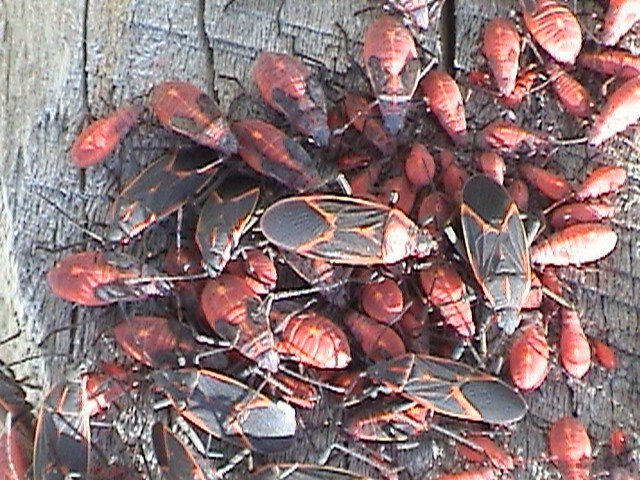
Every October, certain Miami Valley houses — and it is always certain houses, the same ones annually, while the neighbors watch unafflicted — disappear under a red-and-black tide: hundreds to thousands of half-inch bugs in charcoal gray piped with red racing stripes, massed on the sunny south wall like a convention that lost its venue. Boxelder bugs are the fall-invader family’s most visible member and its most house-loyal, and the whole phenomenon runs on two facts this page unpacks completely: the tree — the boxelder maple whose seeds are the species’ almost-exclusive diet, and whose presence within a few hundred yards writes the entire local forecast — and the wall — the sun-warmed, gap-rich southwest exposure that certain architecture offers as overwintering real estate, and that aggregation scent-marking re-books year after year. Everything a besieged household needs is here: the ID (and the red-nymph summer prelude people miss), the honest damage assessment (they harm essentially nothing — the offense is census and staining, and the staining is real), why YOUR house (the tree-plus-wall audit), the September playbook that decides the winter (the same seal-and-barrier doctrine as the stink bug file, at higher volume), the soap-bucket knockdown that outperforms every spray indoors, and the tree question — when removing a boxelder maple is honestly worth it, and when it’s an overreaction to a wall problem. Greater Dayton Pest & Rodent: (937) 569-3330.
Know the delegate: ID, diet, and the summer prelude
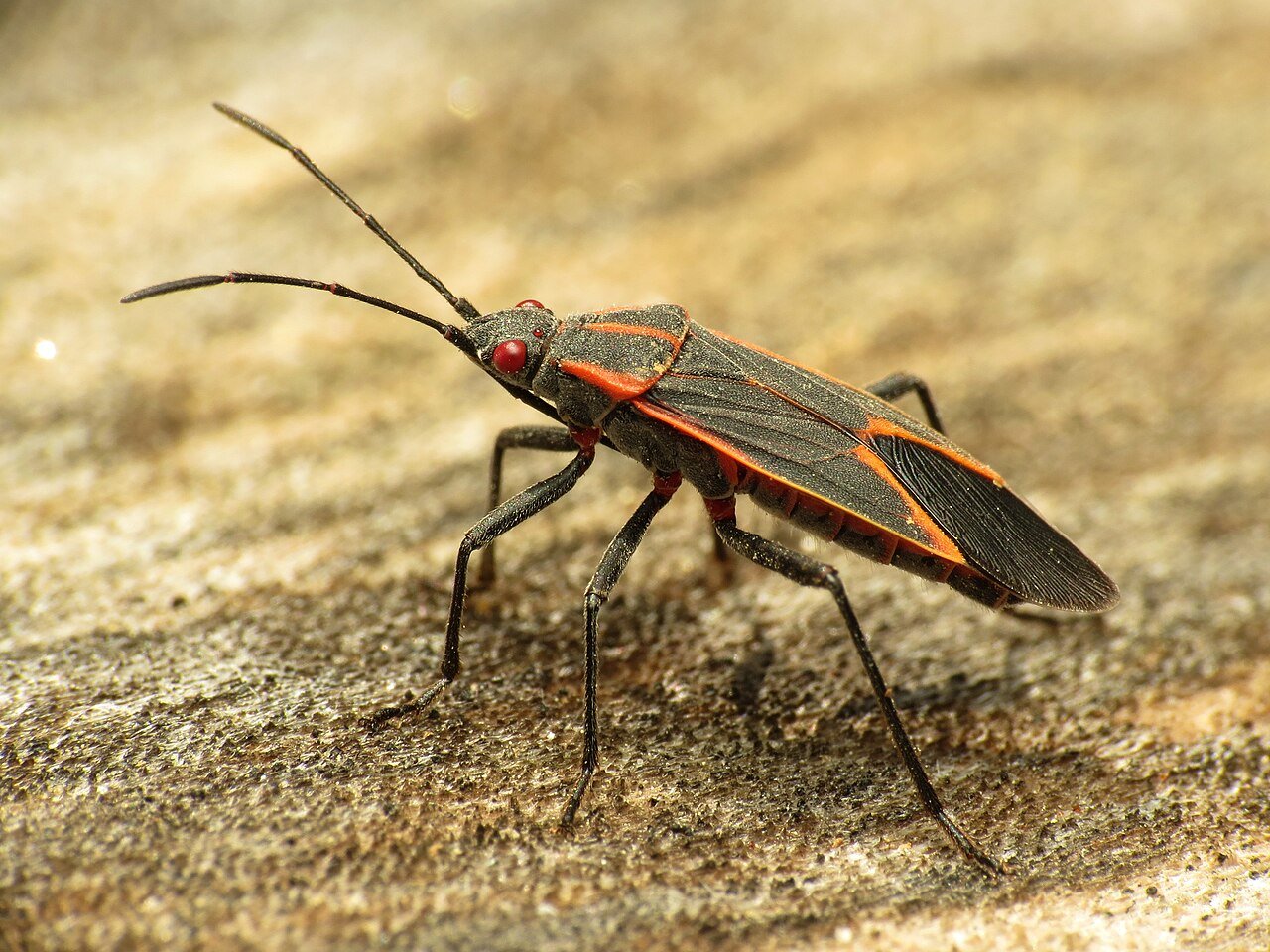
The eastern boxelder bug (Boisea trivittata — the scientific-name searches land here too) is a true bug of the straw-mouthed clan: half an inch of flattened charcoal-black adult with three red lines on the pronotum and red wing-edge piping — unmistakable in the aggregate, and the aggregate is how they present. The diet explains the loyalty: boxelder bugs feed almost exclusively on the seeds of the boxelder maple (Acer negundo — the scraggly, fast-growing, ubiquitous floodplain maple of every Ohio creek line and fencerow), with side orders from silver maple and ash; specifically the seed-bearing female trees, a detail that matters below. The summer prelude most households overlook: the bright scarlet nymphs — wingless red dots massing on the host tree’s trunk and the ground beneath through July and August — are the same population in its nursery phase; a seething red patch at a boxelder’s base in high summer is September’s wall crowd, pre-announced. The mouthparts are seed-piercing straws: they cannot bite people or pets (the no-jaws rule, second verse), they don’t sting, carry nothing, and breed strictly outdoors on the host trees — the indoor winter population is inert cargo, same as its stink bug colleagues. Their two honest offenses: volume (the aggregations photograph like biblical events) and staining — crushed or alarmed boxelders release a red-orange defensive fluid that marks curtains, walls and upholstery, which single-handedly writes the management rule governing everything below: never crush indoors, vacuum always.
Why your house: the tree-plus-wall audit
The annual unfairness — your wall, not the neighbor’s — decomposes into an audit any household can run in twenty minutes. Factor one, the tree: walk a two-hundred-yard radius (the bugs fly further, but pressure concentrates near food) looking for boxelder maples — scraggly multi-trunked maples with compound three-to-five-leaflet leaves (often mistaken for ash, or at seedling stage for poison ivy) — and specifically for seed-laden female trees: the drooping tan seed-cluster “helicopters” that persist into winter are the population’s entire pantry. No female boxelder in range = light pressure years only; a big seed-heavy female on the fence line = the standing forecast. (Silver maples and ashes extend the map modestly.) Factor two, the wall: aggregation sites select for sun-warmed southwest exposure, light-colored siding, and crevice-rich construction — the same real-estate listing the stink bug page published, which is why the two species so often share a wall; add the scent-marking that recruits each year’s crowd to proven sites, and “the same house every year” stops being mystery and becomes address quality. The audit’s output is the strategy: tree-adjacent house with a champion wall = run the full September playbook below and consider the tree conversation; treeless house with occasional drift = the caulk pass alone usually suffices; and either way, the pressure is now a forecast instead of an ambush — which, per this library’s standing economics, is most of the victory.
The September playbook (and the winter that follows it)
Boxelder defense is calendar warfare, and September is the whole campaign. The seal pass — the fall-invader caulk line at its highest-stakes address: south and west walls’ siding gaps, window frames, utility penetrations, soffit seams and vent screens, done before the first cool-after-warm week sends the aggregation looking for entries; every gap closed in September is a hundred bugs not overwintering in the wall void. The barrier layer — where history says pressure will be heavy, a professional exterior treatment on the aggregation walls in early-to-mid September intercepts the landing crowds at the siding; it’s the same one honest chemical window as the stink bug file, it rides the fall anchor visit, and its effect is measured in the difference between dozens and thousands indoors come January. The knockdown tool for the massed walls — the finding that surprises everyone: plain soapy water kills boxelder bugs on contact (a few tablespoons of dish soap per gallon, sprayed directly on the wall aggregations — the soap collapses their breathing surface), making the pump sprayer the season’s best five-dollar instrument: no residue, no restrictions, endlessly repeatable as new delegations land. The winter protocol indoors — for the survivors that made the wall voids and emerge on sunny January afternoons: the vacuum (stocking-in-hose trick from the cluster fly file), the cup-and-release for singles, and never the swat (the staining rule) nor the indoor spray (inert wintering insects emerging on their own schedule — the fogger verdict stands eternal). The bugs indoors die or exit by spring, breed nowhere inside, and the January sightings are last September’s scorecard — filed as next September’s to-do list.
The tree question, answered like a ledger
The nuclear option always comes up by November, so the honest accounting: removing a female boxelder maple genuinely works — eliminate the seed pantry within the pressure radius and the local population collapses within a season or two; it’s the one boxelder intervention with permanent effect, and for a seed-heavy female overhanging the afflicted wall, it’s a legitimate line item (boxelders are, candidly, few arborists’ favorite tree: fast-growing, weak-wooded, storm-shedding — the removal often pays twice). The ledger’s other side: the tree may not be yours (the fence-line and creek-bank sources that drive most cases are the neighbor’s or the township’s — a conversation, not a chainsaw), the species is a floodplain native doing honest riparian work where it grows wild (bank-holding, early-season pollen — the bee page’s constituency notes it), replacements take decades to shade what came down — and critically, the wall factors persist: a champion aggregation wall keeps drawing the area’s remaining pressure post-removal, so the seal-and-barrier playbook stays the foundation either way. The decision tree we walk callers through: your tree + female + heavy seed + adjacent wall = removal worth pricing alongside the playbook; anyone else’s tree, or light seed years, or drift-level pressure = playbook alone, and spend the chainsaw budget on caulk and soap. (A middle path exists on paper — growth-regulator seed suppression for high-value trees — niche, annual, and arborist territory; we mention it for completeness and prescribe it roughly never.)
Boxelder questions, answered
They’re all over my tomatoes and strawberries too. Garden threat?
Minor and occasional: heavy populations sometimes probe soft fruit for moisture in late summer, dimpling a strawberry or two — measurable damage stays rare, and the garden bench’s proportionality rule applies: hose them off, harvest promptly, and save the response budget for the September wall campaign that actually decides anything.
Do they breed inside the house over winter?
No — indoor boxelders are non-feeding, non-breeding winter cargo, same physiology as their stink bug wall-mates: the eggs go on host trees in spring, the nymphs feed on seeds outdoors, and the January window-walker is a dormancy interruption, not a nursery report. Vacuum, release, repeat until spring empties the walls on its own schedule.
My dog ate several. Vet visit?
No — the defensive fluid is bitter enough that most dogs stop at one (the drooling face of regret is the standard presentation), and the bugs are nontoxic beyond the flavor lesson. The red stain on the dog’s chin launders out; the lesson usually holds.
Soap really kills them but sprays are wrong? Explain the logic.
Placement and timing, as always: soap on the exterior wall aggregation is contact-killing exactly the insects present, zero residue, repeatable — the right tool at the right address. Interior sprays treat rooms the bugs are merely passing through on dormancy errands (no colony, no nest, nothing residual chemistry can intercept), and broadcast exterior sprays outside the September window miss the flight entirely. The barrier treatment’s one honest window — pre-flight, on the landing walls — is the exception that proves the placement rule. Soap for the crowd you can see, caulk for the gaps they want, barrier for the wall they’ve booked, vacuum for the stragglers: every tool at its address, nothing anywhere else.
The convention, adjourned
The boxelder bug closes the fall-invader file as its most manageable member: a seed-eating, straw-mouthed, house-loyal aggregator whose entire annual siege runs on one tree species and one wall exposure — both auditable, both addressable, and neither requiring a single indoor treatment ever. Run the radius audit, work the September playbook, keep the soap sprayer loaded and the stocking-vac standing by, and give the tree question the ledger it deserves rather than the November rage it usually gets. For the barrier scheduling, the heavy-pressure consults, and the photo that sorts boxelder from the look-alikes that matter more: (937) 569-3330, Greater Dayton Pest & Rodent, Dayton and all eight counties — where the red-striped convention meets a sealed venue, and the sunny south wall goes back to being just a wall.
The aggregation science (why thousands, why there, why every year)
The October wall’s mechanics reward a closer look, because boxelder aggregation is a small masterpiece of collective behavior. The bugs’ fall assembly runs on stacked signals: thermal scouting — individuals sample the landscape’s warm microclimates on the first post-frost sunny days, and south-southwest masonry and siding hold heat like nothing else on offer; aggregation pheromones — early arrivals scent-mark productive sites, converting individual discoveries into crowd bookings (the mechanism behind the maddening house-loyalty: the mark outlasts the season, and next year’s scouts read last year’s reviews); and the huddle economics — massed overwintering shares warmth and dilutes predation, the same arithmetic that packs the lady beetles into the same walls. The crowd’s daily rhythm is legible from the kitchen window: mornings on the sunlit wall charging like solar panels, afternoons probing crevices as the sun swings, dispersal to shelter at dusk — and the whole assembly reruns daily until either the seal-and-soap campaign or the first hard freeze adjourns it. The science also delivers the campaign’s timing logic: the seal must precede the scouts (hence September), the soap works best on the morning charge (massed, sluggish, exposed), and the pheromone legacy means a champion wall stays booked until a season or two of failed entries teaches the population otherwise — persistence, in both directions, being the whole game. Know the mechanism, and the biblical-looking tide resolves into a predictable, exploitable routine: which has been this library’s entire method, one species at a time, for a hundred and ninety pages.
The eight-county boxelder map
Local pressure geography, which the host tree writes: the creek and river corridors lead — boxelder maples are floodplain natives, so the Great Miami, Stillwater and Little Miami margins and every tributary fencerow stock the source populations, and the river-adjacent neighborhoods of Troy, Miamisburg and Franklin run the heaviest wall pressure in the valley; the farm belt’s fencerow boxelders put the October crowd on Preble and Miami county farmhouses annually (the same south-facing brick that hosts the stink bug file’s heaviest chapters); the older suburbs’ volunteer boxelders — the fence-line saplings nobody planted that became forty-footers — drive the classic same-house-every-year cases the radius audit solves; and the new-build subdivisions mostly wait — their pressure arrives as the creek-buffer plantings mature, usually within the decade. Wherever the map places your wall, the file now in hand runs the same: audit the radius, seal by September, soap the morning charge, vacuum the January stragglers, and let the ledger — not the November fury — decide the tree. The convention will reconvene next fall regardless; whether it gets past the siding is, from this page forward, entirely a scheduling question. Book September.
The look-alike gate (the one check worth a pause)
One identification gate closes the file responsibly: the boxelder’s red-on-dark scheme has a look-alike whose stakes run higher — the eastern kissing bug question that our dedicated page handles (rare in Ohio, medically discussed, and the reason “red-and-black bug in my bedroom” deserves thirty seconds of comparison rather than reflex identification). The gate’s quick tells: boxelders wear their red as three pronotum stripes plus wing piping on a flat-backed half-inch body and appear in numbers on sunny exteriors; kissing bugs run larger, cone-headed, with red-orange bands along the abdomen’s flared edges, and appear (vanishingly rarely here) as singles near sleeping areas. Massed on the south wall in October: boxelder, full confidence, proceed with the soap. A lone cone-headed stranger indoors at night: the photo line, before anything else — which is precisely the habit this entire library exists to install, and a fitting final drill for its hundred-ninetieth page: pattern first, confidence calibrated to stakes, and the camera always faster than the assumption. The wall crowd is the easy call; the singles get the thirty seconds; and the household that runs both checks correctly has graduated the library’s whole curriculum.
One tree, one wall, one September — the whole red-striped siege reduced to a radius audit, a caulk gun, and a five-dollar soap sprayer deployed at the morning charge. The convention has met at the same venue for years because nobody ever checked the booking; consider it checked, the calendar marked, and the sunny south wall — for the first October in memory — scheduled for nothing but sunlight.
Red stripes, straw mouths, seed diets and scent-marked reunions: the most dramatic-looking siege in the fall file, and the most completely solvable — two pages from the library’s current wing remain, and the phorid flies are next through the door.
Soap loaded, radius walked, September circled in red: adjourned.
And if the wall is already red as you read this: soap today, caulk this weekend, calendar next August — the siege ends on whichever schedule you start.
Frequently asked questions
What are the red and black bugs all over my house?
Boxelder bugs — half-inch dark bugs with red-orange racing stripes, massing on sun-warmed south and west walls in fall. They are overwintering shelter-seekers in the stink bug mold: harmless indoors, annoying in volume, and entirely seasonal.
Why does my house get boxelder bugs every fall?
A female boxelder (or silver maple) tree within a couple hundred yards plus warm light-colored walls — the seed-bearing trees feed the summer population, and your siding is the winter hotel audition. Same houses, every year, on tree-and-sun logic.
Do boxelder bugs damage the house or bite?
Neither — no biting, no breeding indoors, no eating anything you own; the sole demerits are stain potential when crushed (a red-orange mark on light fabric) and the sheer visual mass on a warm October wall.
How do I get rid of boxelder bugs on the outside walls?
The soap-water spray knocks down the massed bugs on contact (a bucket-and-garden-sprayer job, repeatable), while the durable fixes are stink-bug-identical: seal the gaps by Labor Day and consider the September exterior barrier for repeat-audition houses.
How do I get rid of boxelder bugs inside?
The stink bug toolkit transfers wholesale: jar-and-card or vacuum with a stocking pre-filter, no swatting on light fabrics, no interior sprays for wall-void sleepers. Winter wanderers are stragglers, not a breeding population; they self-limit by spring.
Should I cut down my boxelder tree?
Almost never worth it for bugs alone — females can fly blocks, so removal helps only when the tree is literally overhead, and the sealing program achieves more for less. If the tree is coming down anyway for other reasons, the bug reduction is a bonus.
Do boxelder bugs come back every year?
The flight does — tree-adjacent, sun-walled houses re-audition annually, and success compounds via scent traces like their stink bug colleagues. A sealed envelope plus a timed barrier converts the annual invasion into scattered stragglers within two seasons.
What eats boxelder bugs — any natural control?
Very little — their warning colors advertise foul taste, so birds mostly pass. Control is exclusion and timing, not predation; the good news is they neither breed indoors nor damage anything while waiting out winter.
Are boxelder bugs the same as stink bugs?
Different families, identical strategy — both are fall shelter-seekers that overwinter in walls and bumble out on warm days, and both answer to the same defense: August sealing, September barrier, gentle indoor removal. Our stink bug page’s whole program applies.
When should I call about boxelder bugs?
For the September package on repeat-siege houses — barrier plus sealing audit, ideally booked before the flight — or whenever the fall mass on the wall exceeds your soap-sprayer patience: (937) 569-3330.