Two questions arrive together every July, usually after a close encounter at the pond dock or the garden gate: do dragonflies bite, and — from the household that just met three inches of alien poise on the tomato cage — do praying mantises bite? The paired answer, up front: neither insect will ever bite you unprovoked, neither carries venom, neither stings (the dragonfly’s “stinger” folklore — the “devil’s darning needle” that supposedly sews lips shut — is pure Victorian nursery invention), and both, held forcibly in a closed hand, can deliver a defensive nip that startles more than it hurts. That two-sentence verdict could end the page — except that these two are the yard’s apex insect predators, the standing rebuttal to half the pest-control industry’s broadcast instincts, and the subjects of enough folklore, stocking-program marketing and genuine wonder to earn the full file: the dragonfly’s flight-and-appetite résumé (the best mosquito control no one can buy), the mantis’s ambush biology and the native-versus-Chinese-mantis question the garden centers never mention, the honest grading of “beneficial insect” purchases, and the yard design that recruits both predators free. Greater Dayton Pest & Rodent, photo line standing by for whatever landed on the tomato cage: (937) 569-3330.
The dragonfly file: the bite question and the résumé behind it
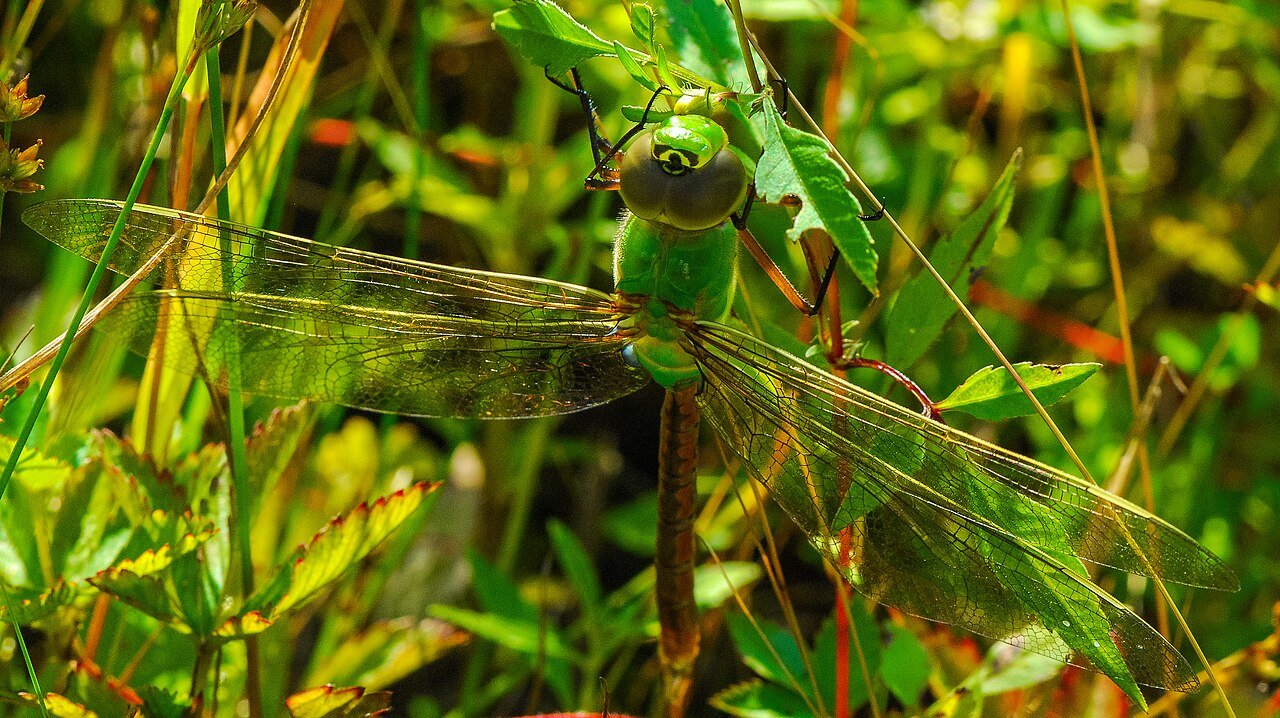
The full bite answer first: dragonflies are pursuit predators with genuinely strong mandibles — the order name Odonata means “toothed ones” — and a large darner grabbed and held against its will can pinch hard enough to feel, occasionally enough to break skin on the largest species. Free-flying dragonflies direct exactly none of this at humans: no territorial strikes, no defensive swoops, no interest — a dragonfly that buzzes close is hunting the insects your body heat and CO₂ attracted, effectively running personal air cover (hold still and watch: the close pass that startled you was an interception, and the mosquito it took was headed for your arm). The folklore file empties just as fast: no stinger exists anywhere in the order — the “darning needle” tail is the male’s claspers or the female’s ovipositor, lip-sewing was a fable to keep children quiet, and the residual unease the myth planted deserves replacing with the actual résumé, which is better than folklore anyway: dragonflies are the most successful aerial predators ever measured — capture rates above 90 percent in controlled studies (lions manage a quarter of that), powered by independently-driven wings that hover, reverse and out-accelerate everything they hunt, guided by near-360-degree compound vision and a neural targeting system that predicts prey trajectories rather than chasing them. The menu is the household’s entire airborne complaint list: mosquitoes and midges by the hundreds per day per dragonfly, plus the fly guild at every size — and the nymphs spend their one-to-several underwater years eating mosquito larvae professionally before graduating to the air war. The crane fly page called them the real mosquito hawks; this page files the supporting evidence.
The mantis file: the bite, the gaze, and the question of which mantis
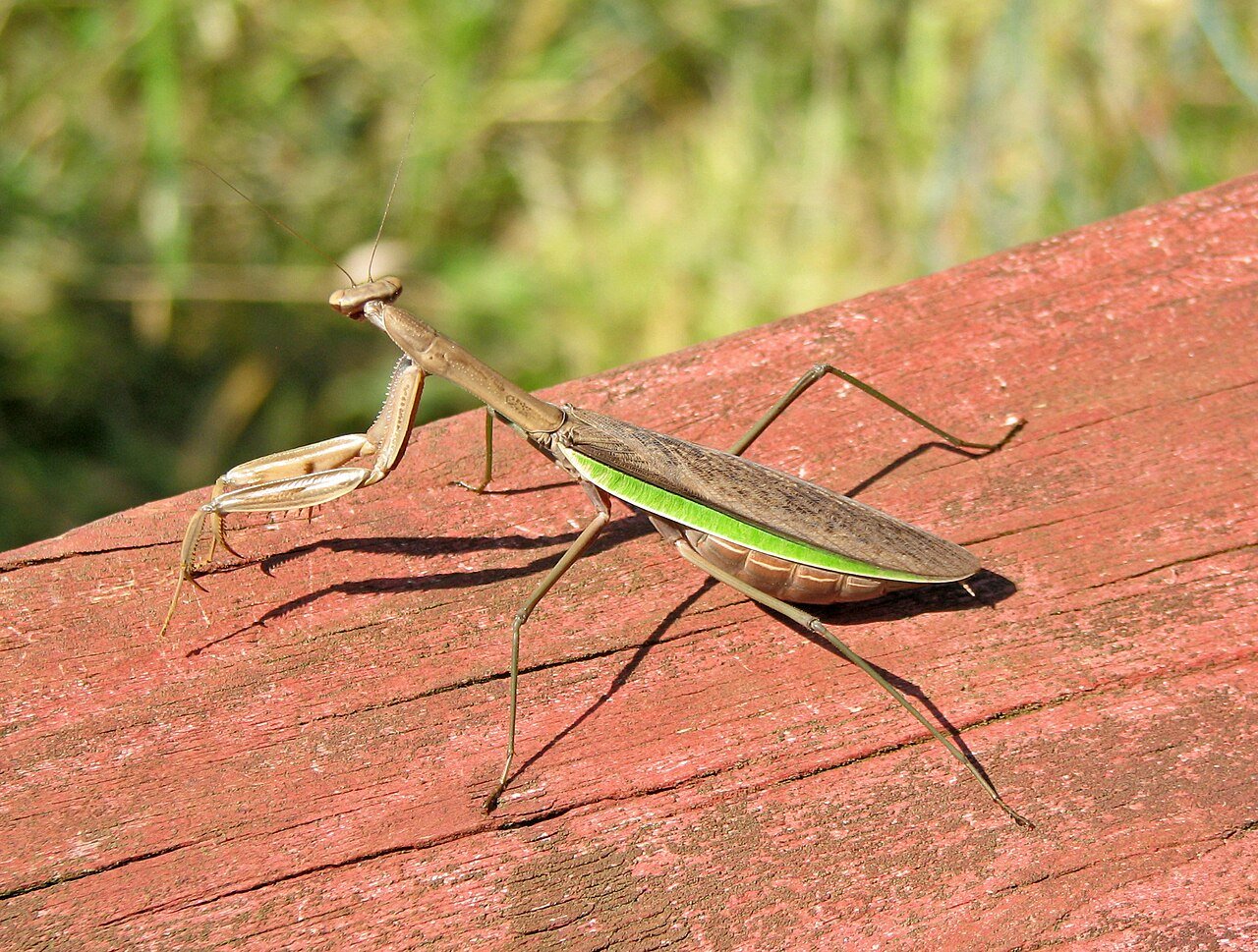
The mantis bite answer parallels the dragonfly’s with one amusing footnote: a praying mantis grabbed barehanded will deploy the raptorial forelegs — the spiked grabbers — and can scratch or pinch enough to surprise; the mouth itself rarely reaches skin, there is no venom (the “poisonous mantis” folklore is empty), and a mantis walking calmly up an offered hand — which they do, with the deliberation of a chess master — is one of the yard’s better close encounters. What makes the encounter uncanny is real: mantises are the only insects with a documented ability to track you with their head — the flexible neck and forward-facing compound eyes that make prey-distance stereopsis possible (mantises are the one insect group proven to see in 3D) also produce the over-the-shoulder gaze that convinces every gardener the animal is sizing them up. It is — as scenery. The local cast note the garden centers skip: Ohio’s conspicuous mantises are mostly the Chinese mantis (the tan four-inch giant of late summer, introduced a century ago via nursery trade and egg-case sales) and the European mantis, with the native Carolina mantis — smaller, grayer, dappled — holding on beneath them. The introduced giants are effective generalists with a documented dark side: a four-inch Chinese mantis takes not just pests but pollinators, butterflies, each other, and — the finding that made the rounds — the occasional hummingbird at feeders (rare, real, and the reason feeder placement away from dense cover is a fair courtesy). Which sets up the purchasing question below with unusual honesty: the mantis on your tomato cage is welcome resident wildlife; the mantis egg case on the garden-center shelf is a more complicated purchase than its packaging admits.
The “buy beneficial insects” aisle, graded
Both of this page’s subjects headline the beneficial-insect commerce, so the honest grades. Mantis egg cases (oothecae): the classic garden-center impulse — and the weakest buy on the shelf: the cases sold are overwhelmingly Chinese mantis, each hatching hundreds of nymphs that immediately disperse and eat one another (mantis cannibalism is not a quirk; it’s the developmental plan), leaving a handful of survivors who hunt as indiscriminately as any generalist — pest, pollinator and sibling alike. Controlled studies of mantis releases for pest control find essentially no measurable crop protection. Verdict: as a children’s biology project, wonderful (the hatch is unforgettable); as pest control, theater — and at the margin it subsidizes the introduced species over the native Carolina. “Dragonfly stocking”: mostly sold as nymphs for ponds — legitimate for actual pond owners as part of a balanced water feature (where they’ll eat mosquito larvae ferociously), meaningless for yards without water: adult dragonflies range where they please, and no purchase holds them. Ladybugs and lacewings: adjacent aisle, same grading pattern — wild-harvested ladybug bags disperse within a day (and carry parasites); lacewing eggs actually grade out decently for aphid work. The through-line this library keeps finding: predators are recruited by habitat, not purchased by the bag — which converts the whole aisle’s budget into next section’s design notes, where the same dollars buy permanent residents instead of dispersing tourists.
Recruiting the air force: habitat that hires predators free
The design notes that convert the beneficial-insect budget into standing residents: for dragonflies, the answer is water done right — they breed only in it, and a yard water feature built to their spec (two-plus feet deep in part, sunny, with emergent vertical stems for nymph climb-out and perch sticks for adult hunting stations, and — critically — no fish, which eat the nymphs, or a fish-free shallow shelf at minimum) recruits a resident squadron within a season or two; the pond that breeds dragonflies runs mosquito-negative on net, the arithmetic the mosquito program endorses and BTI dunks bridge in the establishment years. No pond? The perch alone still pays: tall stakes or bare branch tips at garden edges give ranging dragonflies hunting stations, and hunted airspace is calmer airspace. For mantises, the answer is structure and restraint: unmown margin strips, shrubby edges and perennial stem-litter left standing through winter (the egg cases overwinter on exactly the stems fall cleanup removes — the single biggest mantis-population lever a yard controls), plus the broadcast-spray restraint this library preaches everywhere: the generalist predators are always the collateral of perimeter fogging, which is why our own applications run crack-crevice-and-targeted rather than lawn-wide. And for both: the warm-LED porch light that stops sabotaging the night shift, and the tolerance that lets the top of the food web stand — the same yard that hosts the orb weavers, the daubers and the native bees hosts these two at the apex, and pays for the whole staff with habitat instead of invoices.
Predator questions, answered
A dragonfly keeps landing on me at the pool. Why me?
You’re the best perch on a flat deck — tall, warm, and surrounded by the insect cloud your presence raises. It’s a hunting station choice, and something of a compliment: hold still and you’re briefly part of the most sophisticated interception system nature runs. No bite has ever followed from letting it stay.
Is the mantis eating the bees at my flowers?
Occasionally, honestly — a mantis stationed on a bloom takes what visits, pollinators included. Singles are ecosystem noise; a Chinese mantis camped daily on the hummingbird feeder or the prize pollinator patch can simply be relocated a few yards to the vegetable rows (they re-station agreeably), which redirects the appetite to the pest side of the ledger. Management by gentle relocation: the entire mantis-control industry, in one sentence.
Are mantises endangered or illegal to kill? My grandmother was emphatic.
The folk law is folklore — no US mantis has ever carried protected status, and the “$50 fine” of playground legend appears in no statute. Grandmother’s instinct was still right: killing one is pointless — the animal is harmless, beneficial-leaning, and the introduced-species nuance argues for relocation over execution in every scenario a yard produces. Some laws are better as customs anyway.
Do either of them control enough pests to skip treatments?
At the yard scale, they’re meaningful pressure, not a program: the resident squadron suppresses the ambient fly-and-mosquito load and the mantises patrol the margins, but neither touches the structural files, the indoor conveyors or a genuine outbreak. The honest frame: the predators are the reason the baseline stays low; the program is for what breaks through — and a company that fogs the predators to sell the program has billed you twice for one problem. Habitat below, targeted response above: the stack this library has been assembling all along.
The apex file, closed
Two insects, one shared verdict, and the library’s cheerfullest chapter: the yard’s most fearsome-looking residents are its most valuable staff — a 300-million-year-old interception system that out-hunts every mammal ever timed, and a tomato-cage sentinel that watches you back in genuine 3D, neither with any professional interest in human skin. Retire the darning-needle fable, grade the egg-case aisle honestly, plant the perches, leave the winter stems, and let the top of the food web do what the bottom of the spray shelf never could. For everything the apex predators don’t cover — and for the photo of whatever’s watching you from the cage right now: (937) 569-3330, Greater Dayton Pest & Rodent, Dayton and all eight counties, proud colleagues of the air force we’ve never once had to invoice.
The migration nobody watches (and the September show everyone could)
One more dragonfly file deserving daylight: Ohio sits on a genuine dragonfly flyway. The common green darner — this page’s photo subject — runs a multi-generation annual migration rivaling the monarch’s: southbound swarms ride September cold fronts down the Great Miami and Stillwater corridors (the same river geography that organizes half this library’s pest maps organizes the predators too), overwinter generations breed along the Gulf, and their offspring return north in spring — a relay documented by radio-tagging studies that found individual darners covering nine hundred miles. The September show is watchable from any eight-county ridge or riverbank on the right front: dozens-to-hundreds of darners streaming south at treetop height, hawking insects as they go, often trailed by the kestrels and nighthawks that migrate on the same buffet. Citizen platforms log the flights annually, and the household that catches one converts permanently — it is difficult to fear an order you’ve watched commute a continent. The practical footnote rides along: migration pulses briefly spike local dragonfly numbers in exactly the weeks the fall invader season opens — a fortunate scheduling accident that puts maximum air cover over the year’s peak insect traffic, one more free service from the staff this page has spent its length appreciating. Watch for the front, look up in September, and count the squadron; the yard’s air force has been running this route since before the river had its name.
A field guide to the squadron: Ohio’s dragonflies at a glance
For the pond-side identifier, the local headliners: the common green darner — the big one, green thorax and blue-striped abdomen, the migrator, first arrival of spring and the September flyway’s star; the twelve-spotted skimmer — the flashy pond patroller with alternating black-and-white wing spots, summer’s most photographed; the widow skimmer — black-banded wings dusted white, garden-pond royalty; the blue dashers and pondhawks — the small blue crowd working every retention basin in the eight counties; the saddlebags — dark wing-patches visible at range, gliding specialists that hunt over lawns far from water; and the damselflies — the delicate cousins (wings folded at rest where dragonflies hold theirs flat): the ebony jewelwing’s black-winged flutter along shaded creeks is the region’s most elegant insect sighting, and the bluet swarms over every dock are the pond’s smallest patrol. All of them: harmless, voracious, and index species — a pond with a rich odonate roster is certifying its own water quality, which is why the state’s stream-health surveys count them professionally. The household version of the survey takes one June afternoon and a lemonade; the certification, either way, comes free with the residents.
The eight-county squadron map
Where the apex predators concentrate locally, for the recruiting-minded: the pond-and-basin suburbs — every retention pond in Mason, Beavercreek and Springboro runs a resident skimmer squadron whose adjacent households enjoy measurably calmer patios (the basin the developer dug for stormwater doubles as the neighborhood’s air base); the river corridors host the darner flyway and the jewelwing creeks; the farm-pond belt of Preble and Miami counties stations the deepest rosters (stock ponds without heavy fish pressure are darner factories, and the mantis population runs richest along the same unmown fencerows); and the garden districts everywhere host the tomato-cage sentinels wherever fall cleanup spares the stems. The recruiting map is the pest map inverted — the wet margins this library manages for mosquitoes and tabanids are simultaneously the predator nursery, which is precisely why our yard programs treat margins with a scalpel instead of a fog: the goal was never sterile airspace; it was airspace where the interceptors outnumber the biters. Eight counties, one food web, and the top of it working nights and weekends, unpaid: the best staffing arrangement in this entire library, and the only one that improves when ignored.
Ninety-five percent capture rates, three-dimensional vision, a nine-hundred-mile commute, and not one bite worth the name between them: the apex file closes with the yard’s two most dramatic silhouettes fully credentialed and permanently off the suspect list. The darning needle sews nothing; the sentinel prays for grasshoppers, not forgiveness; and the September flyway is booking free seats now — look up on the next cold front, and count your air force going by.
Toothed, taloned, and entirely on your side: some files close themselves.
The library’s air wing, dismissed with full honors.
Perches up, stems standing, pond fish-free: report for duty is theirs to file.
Frequently asked questions
Do dragonflies bite humans?
A handled dragonfly can deliver a harmless pinch — the big ones barely break skin — and a free-flying one never bites people at all. No venom, no sting (despite the “devil’s darning needle” folklore), no disease: the file is empty.
Do dragonflies sting?
Cannot — no stinger exists; the long abdomen is anatomy, not weaponry, and females lay eggs in water, not skin. Every “dragonfly sting” story is a misidentified wasp or a pinch from rough handling.
Why do dragonflies fly at me or land on me?
You flush prey — walking stirs mosquitoes and gnats, and dragonflies work the wake. A landing is a hunting perch decision and something close to a compliment; the escort down the trail is an airborne mosquito patrol.
Are dragonflies good to have in the yard?
Among the best insects on the property — adults take mosquitoes, gnats, and flies on the wing at hundreds a day, and aquatic nymphs eat mosquito larvae for months before that. A dragonfly-rich yard is running free air support.
What attracts dragonflies to a yard?
Water within commuting range, sunny perches (tall stakes, bare twigs), and an unpoisoned insect base — broadcast lawn insecticides starve them out. Ponds with fish and plants breed the next generation.
What are dragonfly nymphs?
The aquatic first act — months to years underwater as ambush predators, with mosquito larvae as a staple. The B+ grade dragonflies earn in our mosquito predator rankings is largely nymph work.
What is the difference between dragonflies and damselflies?
Wings at rest: dragonflies hold theirs flat like a biplane; damselflies fold them along the body. Both run the same harmless, mosquito-eating program at different sizes.
Do dragonflies eat wasps or bees?
Occasionally — big species take whatever flies, honey bees included — but the bulk diet is midges, mosquitoes, and flies. No yard’s wasp problem was ever solved or caused by dragonflies.
Why are so many dragonflies swarming my yard?
A feeding aggregation over a hatch — flying ants, midges, or mosquito emergences pull dozens of dragonflies into visible feeding frenzies for a day or two. It is a signal worth reading: something hatched nearby, and the air force noticed.
Should any dragonfly situation involve pest control?
Only as the beneficiary — we never treat dragonflies, and their abundance is a diagnostic we actively use (swarms flag hatches; absence flags over-spraying). The one call they justify: whatever they are swarming over, if it is emerging from your gutters, that is our floodwater-mosquito file: (937) 569-3330.