Nothing else in the Ohio bite catalog announces itself like a horse fly: a bite you feel as it happens — sharp, slicing, out of all proportion to expectations — from an insect the size of a thumbnail that circled twice, landed silently, and committed fully. The pain has an engineering explanation this page delivers in full: horse flies and their smaller cousins the deer flies don’t pierce like mosquitoes — they cut, with scissor-blade mouthparts that slash a small wound and lap the pooling blood, a Bronze Age approach to phlebotomy that trades stealth for speed and hurts precisely because it’s supposed to be over before you react. The rest of the file: why they target you at the pool and the lake (movement, warmth, dark colors and CO— they hunt by eye, which changes every defense), the bite-care protocol and the swelling that alarms people on day two, why repellents that work on mosquitoes half-work here at best, the traps that genuinely dent local populations (the blue-bucket science is real and delightfully weird), what a farm or horse property can actually do, and the honest boundary: these are landscape insects, and this is the rare page where the pest company’s main product is knowledge rather than a truck. Greater Dayton Pest & Rodent, photo IDs free: (937) 569-3330.
Meet the family: horse flies, deer flies, and the clegs of search-bar legend
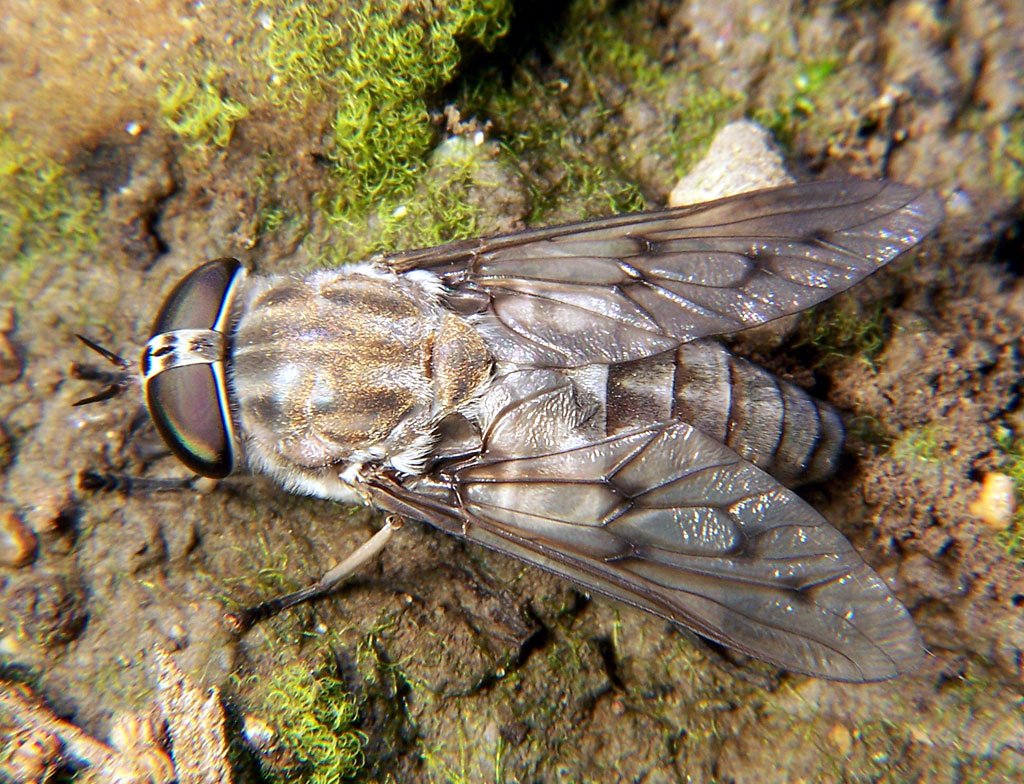
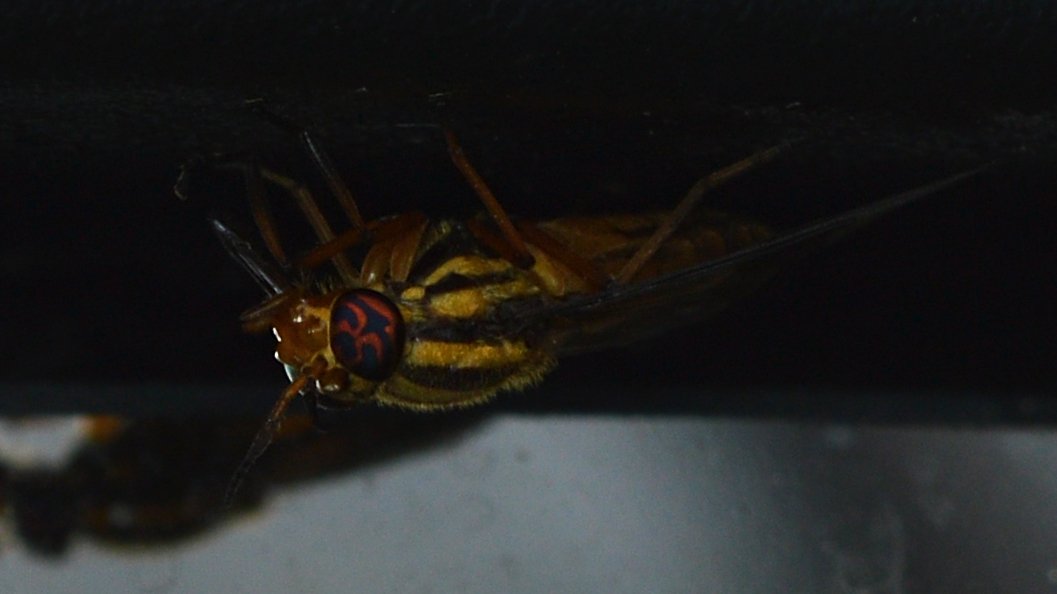
The Tabanidae are the heavyweight division of biting flies — Ohio hosts dozens of species in two household names. Horse flies (Tabanus): half-inch to well past an inch, gray-to-black, stout as a fingertip, with the family’s signature — enormous, often iridescent-banded eyes that wrap the head (the males’ meet in the middle; the females’, the only sex that bites, stay separated — the one field mark that answers “will this one bite me” from a photo). The giants — the inch-plus “B-52s” of farm-pond legend — are the region’s largest biting insects, and their approach is unmistakable: a heavy, persistent, circling buzz that follows swimmers and mowers with genuine determination. Deer flies (Chrysops): the smaller cousins — house-fly-sized, yellow-and-black with dark-patterned wings held delta-style — and behaviorally the more maddening: they orbit the head specifically (drawn to the highest moving point — the black-fly hat rule’s evil twin), strike at the hairline and neck, and hunt in relays that make June trail-walking a percussion exercise. “Cleg fly” — the search term that rides along — is simply British for the same family; the UK’s cleg-bite panic content washes into American search results annually, and the biology, bites and care below translate one-to-one. All of them: strictly daylight hunters (dawn through dusk, peaking on hot, still, humid afternoons), strictly summer (late May through early September here), and strictly female — the males sip nectar and bother no one, a distinction this library’s stingless-male file has made familiar.
The bite: engineering, aftermath, and honest care
The mechanism explains both the pain and the aftermath. The female’s mouthparts are paired cutting blades — the entomology texts use the word “scissors” without apology — that slash through skin to open a small free-bleeding wound, plus an anticoagulant saliva that keeps it flowing while she laps (not sucks) her meal: the reason horse fly bites bleed visibly where mosquito bites don’t, the reason they hurt immediately (no anesthetic in the saliva — stealth was never the strategy), and the reason the aftermath runs bigger: a cut plus saliva proteins produces welts that commonly swell impressively — a hot, raised, sometimes hand-width response by day two that sends people to search bars convinced of infection. The honest care file: wash it properly (this is a cut, not a puncture — soap, water, and the cleaning attention you’d give any open wound; infection risk, while low, is the bite’s one real medical dimension); cold compress for the first hours; the standard itch-and-welt protocol (antihistamines and hydrocortisone genuinely help here) once the throb becomes itch; and the escalation lines — expanding redness or warmth after day two, red streaking, fever (the infection tier: medical visit), or the systemic-allergy signs (hives beyond the site, facial swelling, breathing trouble — rare with tabanids but documented: the anaphylaxis protocol verbatim). Ohio’s disease-transmission picture stays mercifully clean — tabanids here are pain, not pathogens, for humans (livestock carry a different ledger, below). The welt outlasts a mosquito’s by days; the memory, by seasons; and both were the design working exactly as evolved.
Defense: what works against an insect that hunts by sight
Tabanid defense differs from mosquito doctrine at the root, because these are visual hunters: they key on movement, silhouette, warmth, dark colors and CO₂ at range — which reorders the toolkit. What genuinely helps: light-colored clothing (the single most effective wardrobe change — tabanids preferentially strike dark, moving shapes; the dark-shirt mower is the yard’s chosen target), long sleeves and the hat (deer flies’ head-orbit makes any brim armor — and the old trail trick of a taller lure works: they strike the highest point), permethrin-treated clothing (the tick-page strategy pays a second dividend — treated hats and shirts genuinely reduce landings-to-bites), and timing (they’re weakest in early morning, wind, and shade — the pool hour moved to 9 AM beats any spray). What half-works: DEET and picaridin — honestly rated, tabanids are the repellent family’s weakest opponents: skin repellents deter landing modestly but a determined female pushes through in ways mosquitoes don’t; wear it (it stacks), trust it alone never. What’s theater: citronella anything, ultrasonic anything, and the dryer-sheet folklore. The weird science that works: tabanids orient to large dark objects and — the finding behind every university extension’s favorite build — to blue specifically: the “trolling deer fly trap” (a blue cup coated in sticky Tanglefoot worn on a slow-moving hat — comic, documented, effective) and the pasture-scale versions (the black-ball “horse pal” traps and blue-panel sticky traps) genuinely cut local populations when run through a season, because tabanids are strong fliers but faithful to breeding territory. For the pool deck and patio: a large dark inflatable ball hung sticky-coated at the yard’s far corner is the residential translation — the decoy takes the strikes the swimmers would have.
Why they’re at YOUR pool (the habitat honesty section)
Tabanid pressure maps to breeding habitat, and the map explains the summer’s unfairness: females lay on vegetation over wet organic margins — pond and stream edges, marsh fringes, wet meadows, even chronically soggy ditches — and the larvae (predatory, aquatic-to-semiaquatic, and years-long in the big species: the inch-long horse fly circling your mower spent two to three years as a mud-dwelling larva first) develop in that saturated zone. Adults then range up to a mile-plus hunting — strong-flying, visually-guided, and drawn precisely to the sunny open spaces where warm-blooded targets congregate: the pool deck (heat, motion, water glare, wet dark swimsuits — a tabanid’s entire target profile in one backyard), the mowing route (the tractor’s heat-and-motion signature is famous bait), the pasture, the lakeside beach. The honesty this section owes: a household cannot eliminate the source — the breeding margins are the region’s ponds, creeks and wetlands, unowned, untreatable and correctly protected (larviciding wetlands for horse flies is neither legal, feasible, nor sane); what a property CAN do is drainage housekeeping at its own margins (the chronically wet ditch or failed pond edge on your own acreage is the one exception where fixing the hydrology counts), the decoy-and-trap layer above, the shade-and-schedule adjustments, and screening — tabanids rarely follow indoors or into screened porches (bright-light hunters lose interest at the shade line: the screened porch is total sanctuary, and the season’s best real-estate argument for one). It’s the midge-and-black-fly boundary redrawn one size larger: manage the encounter, not the landscape.
The farm file: where tabanid control is real economics
For the horse and livestock properties on our rural routes, tabanids graduate from nuisance to line item: heavy fly pressure measurably cuts weight gain and milk yield, drives fence-line injuries from tormented stock, and transmits the livestock diseases (equine infectious anemia’s mechanical transmission chief among them) that make control a herd-health matter. The honest program, ranked: trap arrays — the black-ball and blue-panel traps at pasture edges, run seasonally, are the documented backbone (each intercepting thousands of females per season); animal-side defense — veterinary permethrin pour-ons and sprays, fly masks and sheets for horses (the mask is the single kindest fifteen dollars in the barn), and shade access during the afternoon peak (stock given shade take dramatically fewer strikes); premises housekeeping — the wet-margin drainage where owned, and manure-and-mud management that helps the whole biting-fly guild if not the tabanids specifically; and the boundary honesty — area-wide adulticiding for tabanids underperforms everywhere it’s tried (strong fliers, constant immigration, daylight activity away from resting sites) and any operator selling pasture fogging as a horse fly solution is selling the fogger fallacy at acreage scale. Our role on the farm accounts: the trap-array consult, the seasonal timing, and the integrated program where tabanids share the invoice with the stable flies and house flies that premises management genuinely does control.
Horse fly questions, answered
Why does it keep coming back after I swat at it?
Persistence is the species’ entire hunting model: a female needs a full blood meal to produce eggs, she’s committed to the target she’s selected, and near-miss swats read as target movement — which attracts. The counterintuitive move that works: stop, stand still in shade for thirty seconds (motion is the beacon; shade is the off-switch), then relocate. The fly breaks off targets that stop behaving like targets. Or land the swat — tabanids are big, committed, and genuinely swattable, the one biting fly where the swatter earns its keep.
The bite left a bruise and swelled for days. Is that normal?
Textbook, unfortunately — the cut-and-anticoagulant mechanism bruises and swells beyond any mosquito comparison, and robust local reactions running days are the family signature, not an infection. The watch-list stays the same: expanding redness AFTER day two, streaking, fever, or systemic signs get medical eyes; everything else gets cold, antihistamines, elevation and patience. Mark the bite’s edge with a pen if you’re unsure — shrinking is healing, growing is the doctor question, and the pen line answers it objectively.
Do horse flies bite through clothes?
The big species can push through thin knits — one more argument for the loose light-colored layer over the dark fitted one (loose fabric defeats the blade geometry; dark fitted invites it). Permethrin treatment converts any layer into active defense, and denim stops the whole family cold. The swimsuit, alas, remains the season’s worst armor at its most-targeted venue — hence the decoy ball, the morning schedule, and the screened porch’s undefeated record.
Is there any point calling a pest company about horse flies?
Honestly: for a suburban yard, usually not for treatment — and we say so on the phone, which is precisely why this page exists. The calls that DO pay: the farm trap-array program, the “is this a horse fly or something that warrants more” photo (deer fly versus black fly versus the stable flies premises work genuinely controls), and the property-margin drainage consult where your own acreage is breeding them. The knowledge is the product here; the trap plans are free with any rural service visit; and the screened porch remains the best quote in the file.
The daylight cutter, filed
The horse fly closes the biting-fly wing as its most honest member: no stealth, no subtlety, no disease here — just a big, visual, committed daylight hunter whose bite hurts because it was engineered to be fast rather than sneaky, and whose defenses are correspondingly physical: light colors, brims, permethrin, shade, screens, decoys, and the blue-cup science that proves entomology has a sense of humor. Wash the cuts, pen-mark the swellings, move the pool hour, mask the horses — and give the landscape its due: the wet margins that breed the misery also breed the dragonflies that eat it, and the trade, most summers, runs closer to even than the welts suggest. For the farm arrays, the margin consults and the photo verdicts: (937) 569-3330, Greater Dayton Pest & Rodent, Dayton and all eight counties — where the honest answer sometimes wears a brim instead of driving a truck.
The eight-county tabanid map and calendar
Local pressure, mapped: the river and pond corridors lead — the Great Miami and Stillwater margins, the farm-pond belt of Preble and Miami counties, and every subdivision backing a retention wetland inherit the mile-radius hunting range of their wet margins; the horse country of southern Warren and the rural townships runs the livestock file at full economics; the trail systems serve the deer flies’ head-orbit specialty to every June hiker (the brimmed hat is trail equipment here, full stop); and the pool suburbs meet the giants on exactly the hot, still July afternoons the species prefers. The calendar is short and sharp: first deer flies with June’s warmth, horse fly peak through July into August’s first weeks, and a fast September fade as temperatures drop — a ten-week season, roughly, for the whole family’s annual argument. Which yields the file’s closing arithmetic: ten weeks, a wardrobe adjustment, a nine-o’clock pool hour, a fifteen-dollar fly mask and a screened porch — against the region’s most painful bite and least treatable source. The landscape sets the terms; the household that knows them wins anyway, every summer, by lunchtime.
The blue-cup build (because someone will ask)
The trolling deer fly trap deserves its instructions, both because it works and because it’s the most entertaining piece of applied entomology this library will ever publish. Materials: one bright blue plastic cup (16-ounce, the classic), Tanglefoot or any sticky trap coating, and a hat you don’t love. Build: coat the cup’s exterior, fix it upside-down atop the hat (zip tie through the crown, or a dab of adhesive), and wear it while mowing, walking or gardening at normal pace. Mechanism: deer flies orbit the highest point of a moving target and strike preferentially at blue-dark contrast — the cup out-competes your head for every strike, and the coating converts strikes to captures; university extension trials have logged dozens of flies per hour per hat in peak season, and generations of grounds crews have confirmed the finding while looking magnificent. Scale it stationary for the deck: the same blue-and-sticky logic on a post-mounted ball or panel at the yard’s far corner runs the decoy program without the fashion statement. It is, in miniature, everything this library keeps teaching — know the animal’s targeting system, and the counter-measure gets cheap, specific and slightly ridiculous — and it sends the season off properly: the region’s most feared bite, defeated per-encounter by a party cup, worn proudly, at the pool, in July. Science does not require dignity; it requires results, and the cup delivers both minus one.
Frequently asked questions
Why do horse fly bites hurt so much?
Anatomy — horse flies cut with scissor-like blades and lap the pool, rather than piercing neatly like mosquitoes. The slash triggers real pain instantly, bleeds visibly, and welts larger — the price of being bitten by shears instead of a needle.
What do horse fly bites look like?
Raised red welts, often with a visible central cut, swelling broader than mosquito work, occasional bruising — on exposed skin, delivered in daylight, frequently at water or after mowing. Itching follows the pain by hours and can last days.
How do I treat a horse fly bite?
Wash it (the cut is a real wound), cold compress, antihistamine for the itch, and resist scratching — secondary infection is this bite’s main complication. Escalating redness, heat, or streaking earns medical attention like any infected cut.
Why do horse flies chase people?
Heat, motion, dark colors, and CO₂ — they hunt by sight better than any mosquito and commit hard once locked on. Swimmers and mowers are the classic targets: wet skin flashes light, engines pump heat, and both read as large moving mammals.
Do horse flies carry disease to humans?
In Ohio, functionally no — the misery is mechanical, not microbial. Livestock take the economic damage (blood loss and stress in pastured animals); humans take the welt and the indignation.
How do I keep horse flies away from my yard and pool?
Reduce the draw: manage standing water margins and tall wet vegetation where larvae develop, run fans on patios (strong flyers, weak against wind), wear light colors, and deploy trap technology — the black-ball “horse fly trap” genuinely works by impersonating livestock.
Do horse fly traps really work?
The inflatable-dark-ball sticky traps and H-traps have real evidence behind them — horse flies stalk large dark warm shapes, and the decoy out-advertises you. Placement between breeding water and your patio does the most good.
Why are horse flies worse near water?
Larvae develop in wet soil, pond margins, and stream edges — and adults patrol water for drinking mammals. Waterfront properties inherit the pressure; the fan-and-trap toolkit plus margin management is their honest program.
What repellent works on horse flies?
DEET and picaridin underperform against them compared to mosquitoes — sight hunters care less about scent jamming. Permethrin-treated clothing, light colors, and moving air outperform skin products; long sleeves beat everything.
When do horse fly bites mean calling pest control?
Property-level pressure — a pond edge or wet margin breeding season after season — is treatable at the habitat level, and patio misery has fan-and-trap fixes we can spec: (937) 569-3330. Individual bites, alas, are summer’s tax on swimmers.