
Tiny red bugs arrive in two completely different stories, and the search bar can’t tell which one you’re living. Story one: hundreds of moving red pinpoints on the sunny windowsill, the white siding, the concrete porch — alarming by sheer census, touching no one. Story two: nothing seen at all, but a day after the yard work or the creek-side hike, a constellation of ferociously itchy welts at the sock line and waistband. The first story is clover mites — harmless lawn grazers on a spring wander, whose only crime is dying in crowds and smearing red when wiped. The second is chiggers — larval mites you’ll never see doing damage you’ll scratch for a week. Same “tiny red bug” search, opposite problems, opposite fixes — and a supporting cast (velvet mites, red spider mites, the occasional red-tinted impostor that matters more) that this page sorts completely: identification by story, the concrete-and-windowsill protocol for the mites, the sock-line defense for the chiggers, and the honest line where either earns a professional visit. Greater Dayton Pest & Rodent, photo verdicts free as ever: (937) 569-3330.
Story one: clover mites, the windowsill multitude
The moving red dust on your sill is Bryobia praetiosa — the clover mite — smaller than a pinhead, oval, brick-to-rust red, with a field mark visible in any decent phone macro: a front pair of legs nearly twice body length, held forward like antennae. The biology explains the whole invasion pattern. Clover mites are plant-feeders (lawn grasses, clover, weedy greens — sap only; they cannot bite animals, having mouthparts built exclusively for piercing plant cells), they reproduce without males (every mite is a self-sufficient female cloning the horde), and they are creatures of the cool edges of the growing season — population explosions come in April–May and again September–October, not high summer. The invasion mechanics: populations build in the lush turf nearest the foundation — especially heavily fertilized lawns, and especially the south- and west-facing walls where spring sun warms the masonry — and when a hot spell or population peak triggers the wander, they climb. Warm siding, sills, and porch slabs collect thousands; some fraction finds window-frame gaps and appears indoors, where every single one is dying of dehydration on arrival — clover mites cannot feed, breed or survive inside. Indoors they are a cleanup, never an infestation. The one genuine nuisance: crushed mites smear rust-red (that’s pigment, not blood — they haven’t bitten anyone) on paint, curtains and grout — so the cleanup protocol matters, and it’s two tools long: vacuum them up (crevice tool, gently, bag emptied outside) and wipe surfaces with a damp soapy sponge, blotting not scrubbing. No spray on the sill will ever be the answer; the population is in the lawn, and the lawn conversation is below.
Story two: chiggers, the invisible welt-writers
Now the red bug nobody sees. Chiggers are the larval stage of harvest mites — at a fiftieth of an inch, effectively invisible on skin — that quest from grass and leaf litter exactly the way ticks do, ride clothing upward, and settle where fabric compresses against skin: sock lines, waistbands, the backs of knees, belt lines. The feeding is widely misunderstood and worth correcting because the folk remedy is built on the misunderstanding: chiggers do not burrow into skin and do not drink blood — the larva injects digestive enzymes that liquefy a microscopic column of skin cells (the body walls this column into a feeding tube called a stylostome), feeds for a day or two if undisturbed, then drops off to become a harmless soil-dwelling adult. The maddening itch — peaking 24–48 hours after exposure, outlasting a week — is your immune response to the enzyme tube, which remains after the mite is long gone. Hence the verdict on the infamous nail-polish remedy: it aims to suffocate an animal that has already left; it treats a vacancy. What actually helps: a hot soapy shower within an hour of exposure (dislodges larvae still wandering or feeding — genuinely effective), then the standard itch war — cold compresses, antihistamines, hydrocortisone, and the discipline against scratching that our bite-relief guide details, since secondary infection from gouged welts is the only real medical risk chiggers carry in Ohio (they transmit no disease here). The exposure map writes the prevention: tall grass, brambly edges, creek banks and leaf litter in the warm months — the same DEET-or-picaridin-plus-permethrin stack, socks-over-cuffs, and post-adventure shower that defeats ticks defeats chiggers wholesale, one stack for both parasites.
The supporting cast: the other red dots
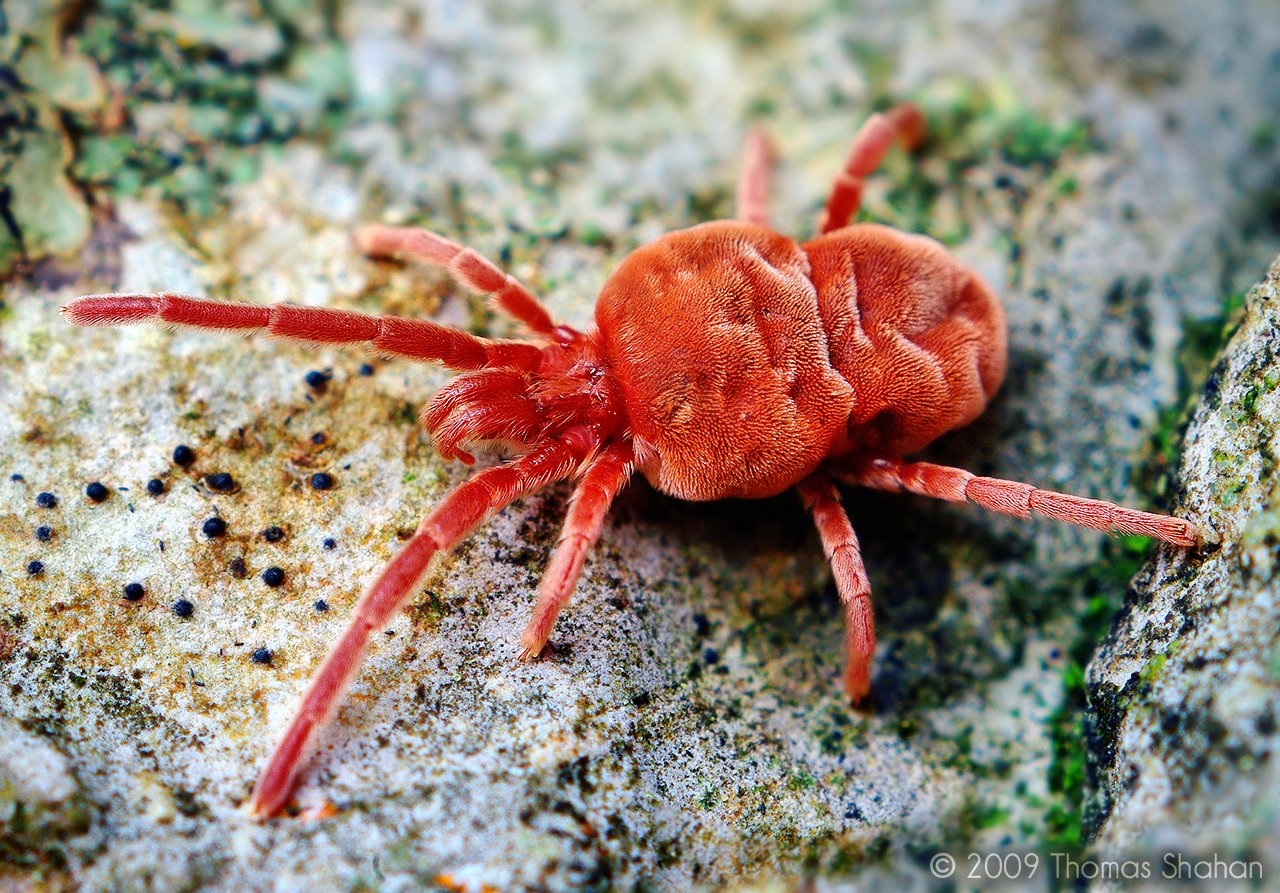
Four more red-bug stories cross our photo line, quick verdicts each. Red velvet mites: the giants of the category — an eighth-inch-plus, plush as their name, wandering garden soil and patios solo after rains; predators and decomposer-allies, completely harmless, no action ever; they’re the “tiny red bug” people photograph admiringly. Spider mites: the houseplant-and-garden red — pinpoint mites webbing the undersides of stressed plant leaves, stippling foliage yellow; a horticulture problem (blast with water, insecticidal soap, humidity up) rather than a structural one. Concrete mites: the sidewalk sprinters of high summer — fast-moving red dots on sun-baked patios and playground equipment, actually predatory mites hunting smaller arthropods; harmless, seasonal, and the answer to “the hot slab is covered in red things that AREN’T slow like clover mites.” And the impostor that matters: a reddish, flattened, apple-seed-sized crawler near a BED is not in this family at all — run the bed bug inspection tonight rather than filing it under mites; the cost of that particular misfile compounds weekly. Size, speed, setting: velvet = big and solo, spider = on plants, concrete = fast on hot slabs, clover = slow multitudes on sills, chigger = never seen at all, bed bug = the one that ends the taxonomy game and starts a protocol.
The clover mite program: fixing the lawn-to-sill pipeline
For households where the spring multitude returns every year — and in the fertilized-lawn suburbs of Beavercreek, Centerville and Springboro it reliably does — the fix is architectural, and it’s the same moat doctrine running through this library. The grass gap: clover mites won’t cross bare, dry ground in numbers — an 18-to-24-inch vegetation-free band of gravel, stone or coarse mulch against the foundation (exactly the moat the tick page builds at the wood line, relocated to the wall) cuts invasions dramatically and permanently; it also pays dividends against ants, voles and foundation moisture, making it the rare landscaping choice with four pest constituencies. The seal pass: the mites enter through the same window-frame gaps, weep-hole margins and sill cracks everything else uses — the caulk-and-screen audit closes the door for pennies. The fertility conversation: lush over-fertilized turf against the wall is mite biomass; easing the foundation strip’s feeding schedule quietly starves the population. The chemical layer, honestly placed: where invasions stay heavy despite the moat, a targeted spring perimeter treatment — exterior foundation band and the turf edge, timed to the April wander — knocks the migration down effectively; it’s part of our standard perimeter program, and it’s aimed at the pipeline, not the windowsill, because by the sill the story was already over. What we’ll talk you out of: fogging interiors (they’re dying inside anyway), spraying sills weekly (smear plus residue, zero population effect), and lawn-wide broadcast treatments for a foundation-strip problem.
The chigger program: yard management for the invisible
Chigger defense at the property scale follows the habitat: they concentrate in moist, shaded, unmowed vegetation — the tall fescue clumps, the bramble margin, the creek bank, the orchard’s long grass — and they’re nearly absent from sunny, mowed, dry turf. So the yard fixes are mowing the transition zones, opening sun lines into chronically shaded corners, clearing the leaf-litter beds where the farm-edge populations stage, and elevating the woodpile — the same passes the tick moat already scheduled, which is the recurring good news of this page: every dollar of tick landscaping is a chigger dollar too. The targeted-treatment tier exists here as well — acaricide application to confirmed chigger zones (verified the old-school way: a black cardboard square stood in suspect grass for a few minutes collects questing larvae as visible red specks on the upper edge — the “chigger card,” still the best diagnostic in the business) — and it’s honest work for play-area margins, camp properties and the yards backing onto meadow. For everything else, the stack wins: repellent, clothing, shower, and a mowed line between the wild and the picnic blanket.
Tiny red bug questions, answered
The red bugs on my sill smeared pink when I wiped them. Was that blood? Have they been biting us?
Pigment, not blood — clover mites are sap-feeders physically incapable of biting animals, and the rust smear is their own body color. Nobody in your house has been bitten by anything on that windowsill. Vacuum first, damp-blot second, and the stains lift from most surfaces; on flat paint, touch-up beats scrubbing.
I get “chigger bites” every summer but my spouse never does. Why?
Real phenomenon, two mechanisms: immune response varies enormously (some people’s histamine reaction to the stylostome is dramatic, others’ nearly silent — the mites may be biting you both), and behavior maps exposure (the gardener kneeling in the bed collects what the lawn-chair observer doesn’t). The defense stack works regardless of which spouse you are; the itchy one just has more reason to run it.
Do clover mites damage the lawn?
At ordinary densities, no — the feeding stipple is invisible in a healthy lawn. Historic outbreak densities can silver a stressed foundation strip in a dry spring, which mostly reads as another argument for the gravel moat: the strip they’d damage is the strip you’re better off not growing.
Are any of these red bugs dangerous to pets?
Clover, velvet, concrete and spider mites: no — ignore, or enjoy (velvet mites are genuinely charming under a phone macro). Chiggers: they’ll bite dogs as happily as people (check the belly and leg folds after field romps; your vet’s standard flea-tick preventives largely cover them). The red dot that matters for pets isn’t on this page at all — it’s the tick, and the tick page’s pet section is the one to bookmark.
Two stories, both ending well
The windowsill multitude and the sock-line constellation turn out to be the friendliest chapter in the red-bug book: one is harmless and self-terminating, the other invisible but fully defeatable with a shower and a repellent stack, and neither belongs to the small list of things that should genuinely worry a Miami Valley household. Calibrate by story, fix by pipeline — the moat and the seal for the mites, the stack and the mow-line for the chiggers — and send the ties to the line that reads red dots for a living: (937) 569-3330, Greater Dayton Pest & Rodent, where the spring perimeter program handles the multitude and the yard assessment maps the invisible, across Dayton and all eight counties. May all your red bugs be velvet.
The calendar of red
Season stamps every red-bug story, and the local calendar sorts most photos before the macro focuses. March–May: clover mite prime time — the south-wall multitudes peak on the first stretch of 70-degree days, sills collect their crowds, and our spring perimeter routes time the foundation-band treatments to exactly this wander; velvet mites make their post-rain patio appearances alongside. June–August: chigger season proper — every creek-bank adventure and unmowed margin carries the sock-line risk; concrete mites sprint the hot slabs; spider mites stipple the stressed tomatoes; and clover mites all but vanish (aestivating through heat as eggs in dry protected crevices, a fact that reliably confuses households expecting a summer sequel). September–October: the clover mites’ second act as cool weather wakes the fall generation — smaller than spring’s, same playbook — while chigger pressure fades with the first cool nights. November–February: the red-bug file closes entirely; any winter “tiny red bug indoors” photo deserves a harder look, because the seasonal cast is offstage and the impostors (a well-fed bed bug runs reddish; a carpet beetle larva can read rusty) hold winter residency. Two months of multitude, three of invisible itch, and seven of quiet: as pest calendars in this library go, the red one is nearly a vacation — provided you know which story you’re in, which was the entire price of admission.
The macro-photo minute (how to send a red dot we can actually read)
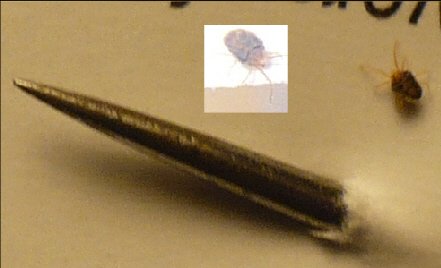
Since this entire family of cases turns on photos of near-invisible subjects, a technician’s guide to the thirty-second macro that gets you an instant verdict instead of a “can’t tell”: get scale into the frame — a coin, a pen tip, a fingertip beside the subject turns “small red thing” into data (the sewing-needle photo on this page is the genre’s masterpiece); shoot the group, then the individual — the crowd pattern (multitude on a sill vs. loner on soil) carries as much ID weight as the specimen; note the where and when in the message — “south windowsill, sunny afternoon, hundreds” is clover mites before the photo loads, and “welts only, nothing visible, creek hike yesterday” is chiggers with zero photos at all; use the flashlight — oblique light off a second phone reveals leg count and texture that overhead light flattens; and resist the wipe until after the shoot — the smeared specimen answers fewer questions than the walking one. Our line runs on exactly these photos, the verdict is free, and the habit generalizes: every mystery in this library, from droppings to nymphs, resolves faster through a phone camera used deliberately. Thirty seconds of photography, professionally aimed: still the cheapest pest control ever invented, and this page’s red dots are its easiest subjects.
The one-paragraph field guide, for the fridge
Slow red multitude on a sunny sill or wall, spring or fall: clover mites — vacuum, damp-blot, build the gravel moat, call about the spring perimeter band if it’s annual. Ferocious sock-line welts a day after outdoor time, nothing ever seen: chiggers — hot soapy shower fast, itch care, the tick stack next time, mow the margins. Big plush red loner after rain: velvet mite — admire it. Fast red dots on hot concrete: concrete mites — ignore them. Stippled webby houseplant: spider mites — water blast and soap. Reddish apple-seed near a bed: stop reading this page and run the bed bug inspection. Everything else red, tiny and ambiguous: coin, macro, message — (937) 569-3330. Total emergency count across the entire red-bug family: zero. Total cost of getting every one of them right: one read, now complete.
Two stories, five species, one moat, zero emergencies — the red-dot file closes as gently as it opened, and the windowsill goes back to being just a windowsill, wiped clean and sealed at the seams.
On to the winged termites of spring — the red dots’ opposite number in every way that costs money.
Frequently asked questions
What are the tiny red bugs on my porch and windowsills?
Clover mites, almost certainly — pinhead-sized red mites with distinctive long front legs, massing on sunny walls, sills, and patios in spring and fall. Plant-feeders, harmless to people and pets, with one critical handling rule: do not smash them.
Why can’t I smash clover mites?
The red stain — crushed clover mites leave a persistent red-brown mark on sills, curtains, and paint that outlasts the season. Vacuum or wipe with a soapy sponge instead; the no-smash rule is the whole management protocol’s first line.
Do clover mites bite humans?
Cannot — plant-sap feeders with mouthparts unfit for skin. Red mites plus bites points elsewhere: chiggers (outdoor grass exposure, waistband welts) or bird/rodent mites (a different page and a real, findable source).
Why are clover mites all over my house walls?
Sun-warmed masonry adjacent to lush, well-fertilized lawns — their food. Populations bloom in cool spring and fall weather, climb the warm south face, and slip through sill gaps by the hundred. The lawn-to-wall interface is the entire story.
How do I get rid of tiny red clover mites?
The barrier band: an 18-to-24-inch vegetation-free gravel or bare strip along the foundation stops the migration cold (they rarely cross exposed ground), plus sill-gap caulking and soapy wipe-downs of the massing zones. Insecticide bands work but the moat outlasts them.
What are the bright red velvety bugs in the garden in spring?
Velvet mites — larger, plush, slow, and beneficial (they eat insect eggs and larvae). Distinguish from clover mites by size and venue: velvet mites wander soil alone; clover mites mass on walls by the hundred. The velvet ones need nothing from you.
Are tiny red bugs in the house dangerous?
Clover mites, no — stain-only. The caution flag flies for red mites found on BEDS with bites in evidence: bird and rodent mites migrate from nests and do bite; that combination warrants the inspection, not the shrug.
What are chiggers then — the red bugs that bite?
Chigger larvae are nearly invisible (you feel them, you rarely see them) — the visible red crawlers on walls are not chiggers. Fierce waistband-and-sock-line welts after tall-grass exposure is the chigger file; permethrin-treated clothing and prompt showers are its defense.
Why do clover mites come back every spring and fall?
Egg banks in wall cracks and the lawn interface — the populations cycle with cool weather regardless of last season’s wipe-downs. The gravel moat and caulked sills are the compounding fixes; everything else is seasonal maintenance.
When do tiny red bugs justify professional help?
Mass invasions breaching into living spaces despite the moat (we run the exterior band treatment), or any red-mite-plus-bites scenario needing the bird/rodent-mite source hunt: (937) 569-3330 — and windowsill photos welcome; the ID takes seconds.