Somewhere above your yard right now — a maple branch, the eave’s shadow line, a hollow in the old oak — something is building, and by August it will be the most intimidating object in the neighborhood: a gray paper football with air traffic. “Hornet” questions arrive on our line with more adrenaline than any other insect subject, so this page delivers the calibration first: Ohio has exactly one true hornet, one famous impostor that runs most of the drama, and zero of the “murder hornets” the internet promised you. What we actually have is manageable, predictable, and — handled with the right timing and respect — entirely solvable. The full tour: the bald-faced hornet and its basketball nests, the European hornet that headbutts your porch light at 10 PM, the ground “hornets” that are really yellowjackets in a burrow, how to read a nest’s risk honestly (location beats size, every time), the season calendar that makes removal cheap or expensive, why DIY hornet work fails differently than other DIY (these defend in squads), and the winter fact that solves half of all cases for free. Greater Dayton Pest & Rodent, licensed stinging insect work across eight counties, photo triage always free: (937) 569-3330.
The bald-faced hornet: the impostor that owns the brand
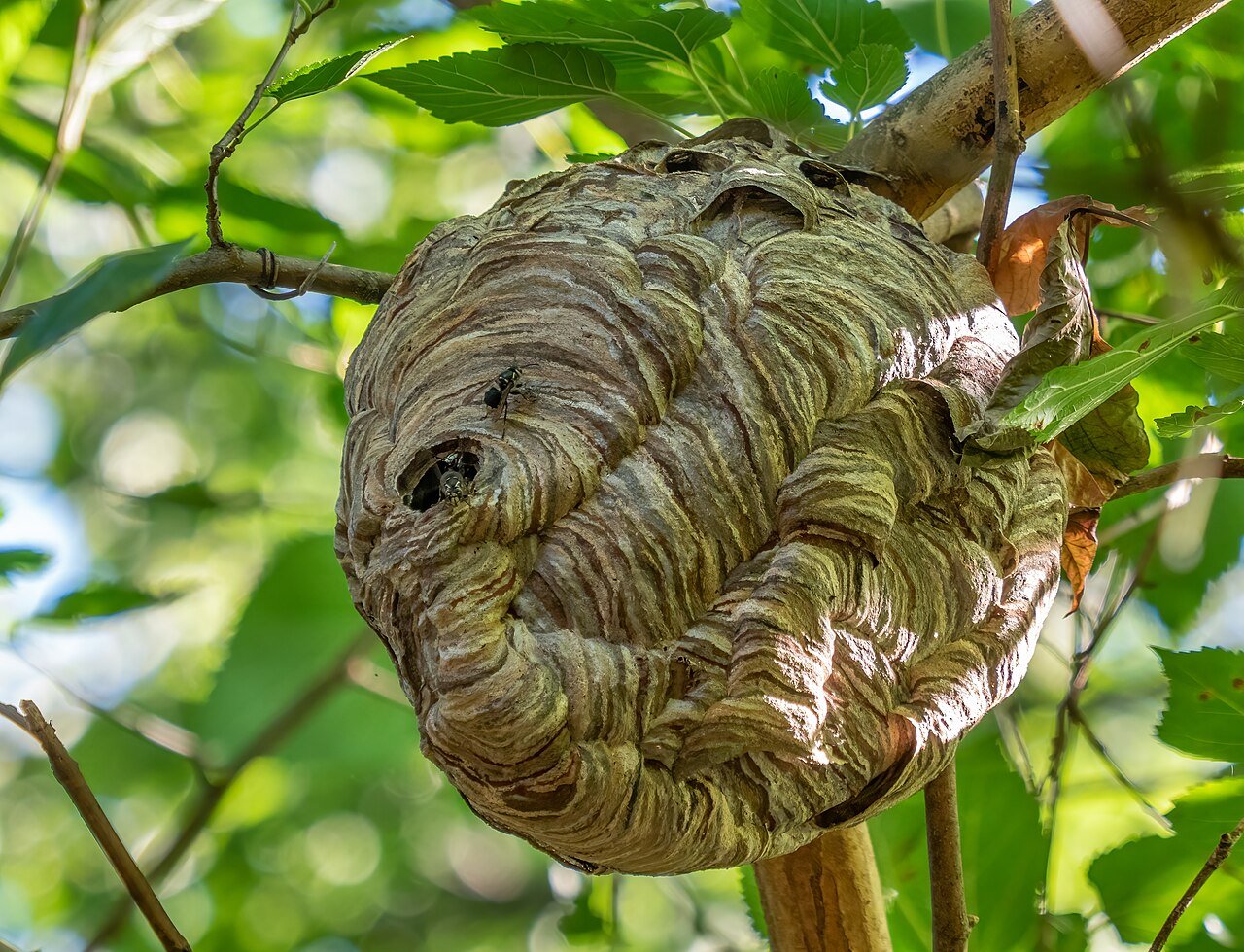
The black-and-white insect patrolling that gray paper football is Ohio’s most famous “hornet” — and taxonomically it’s not one: the bald-faced hornet is an oversized aerial yellowjacket wearing hornet branding, which matters not for pedantry but because it behaves like a yellowjacket with a bigger budget. The résumé: half-inch-plus workers in ivory-on-black livery, colonies founded each April by a single overwintered queen, growing through summer to 400–700 workers by late August inside the signature nest — the layered gray-paper teardrop that starts golf-ball size in May (hidden in foliage, invisible) and emerges from the leaves in August as the football-to-basketball landmark that generates our call volume. Two behavioral facts set the safety math: they are vigorous nest defenders with a documented alarm system — disturb the envelope and defenders arrive in seconds, each capable of multiple stings, with alarm pheromone recruiting the shift; and famously, they can spray venom at the eyes of perceived threats at close range — a party fact that becomes practical advice: no faces near nests, ever. Away from the nest, though, a foraging bald-faced is nearly indifferent to people — it’s hunting flies and caterpillars (they’re significant predators of pest insects, one reason remote nests earn a stay of execution below). The entire risk profile lives within a few yards of the envelope; the calibration question is never “how big is the nest” but “how close is it to human traffic” — next section’s whole subject.
The European hornet: the one true hornet (and the porch-light headbutter)
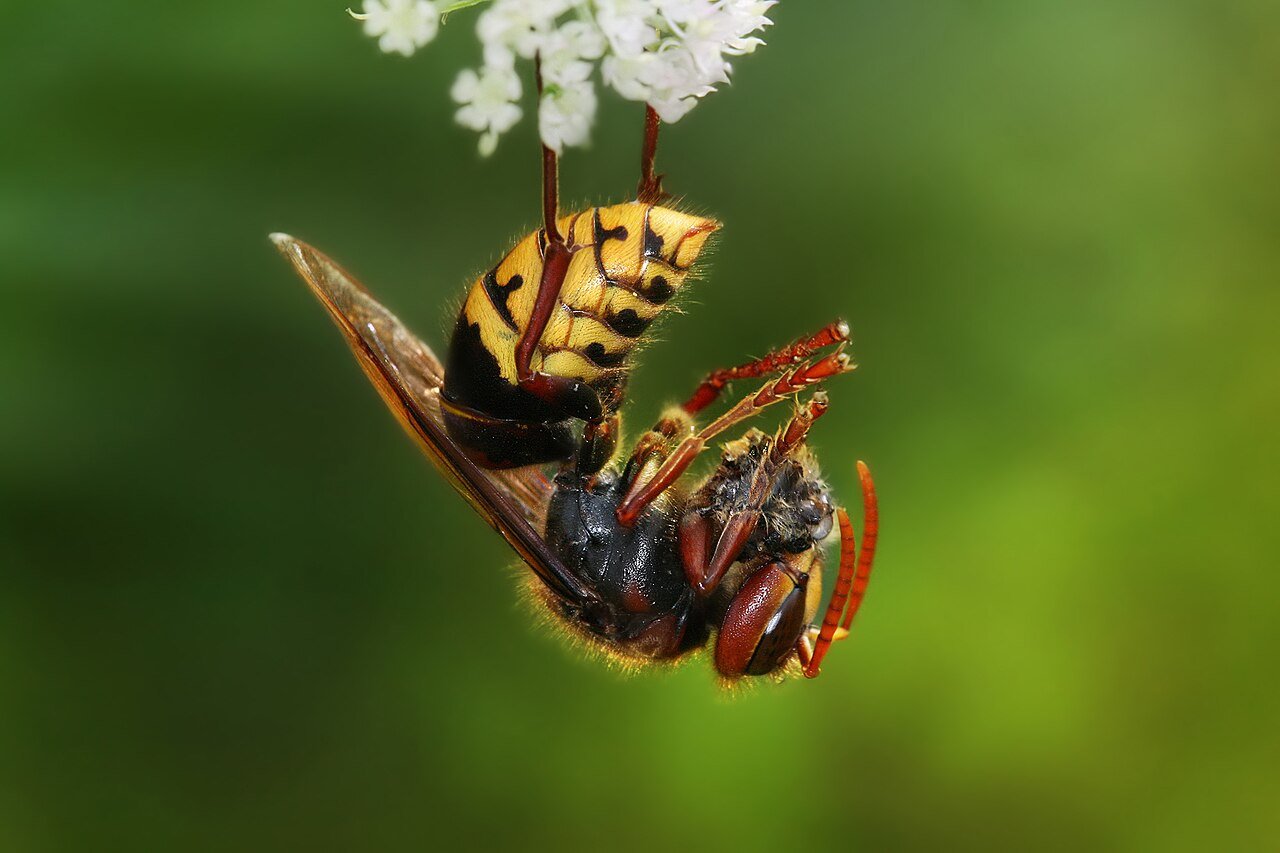
Ohio’s only genuine hornet is the European hornet — an inch-plus of brown-and-amber wasp that looks engineered to alarm and mostly isn’t: introduced to North America in the 1800s, it nests in cavities (hollow trees, barn walls, attics, the occasional historic-home wall void), runs colonies of a few hundred, and carries two habits that generate its entire reputation. First, it flies at night — the only big wasp here that does — which produces the signature encounter: a heavy insect thudding against the porch light or window screen at 10 PM, an experience people describe on our line in genuinely shaken tones. (It’s navigation error, not attack; the warm-LED bulb swap from our porch-light series ends it.) Second, it girdles twigs — stripping bark from lilacs and young trees for nest pulp and sap, occasionally enough to matter to a prized shrub. Away from the nest it’s notably placid for its size; at the nest — especially a wall-void colony with traffic through a gap in your siding — it defends like it means it, and the sting is proportionate to the insect. The management fork: tree-hollow colonies well away from the house are wildlife (they eat flies, moths and yellowjackets, and the colony dies at frost anyway); structural colonies are professional work, and specifically the never-plug-the-hole rule from our wasp playbook applies at maximum strength — seal a European hornet entrance with the colony alive inside and several hundred large, night-active wasps will find the indoor route, a service call we genuinely never want to make twice.
“Ground hornets,” “murder hornets” and the rest of the roster, sorted
Clearing the vocabulary the calls arrive in: “ground hornets” are yellowjackets nesting in old rodent burrows — the late-summer lawnmower ambush specialists, fully covered (with the mound-vs-molehill diagnostics) in our ground-nesting guide; everything on this page about defense radius applies, compressed to ankle height. “Cicada killer hornets” are the giant solitary wasps of July sidewalks — alarming, essentially harmless, and getting their own full page in this series. “Murder hornets” (northern giant hornets): not in Ohio, never established east of the Pacific Northwest’s brief incursion, since declared eradicated there — every Ohio “murder hornet” photo our line has ever received has been a European hornet or cicada killer, and we’re happy to keep extending the streak. Red “hornets” are usually paper wasps (the open-comb umbrella builders — different insect, different calculus, see the main wasp guide). The taxonomy tour matters because the response tiers differ wildly: paper wasp umbrella = frequently DIY-able; aerial bald-faced football = risk-tiered below; ground yellowjackets = the highest sting-count generator in the yard; European hornet wall void = professional, always. One word, four playbooks — the photo settles which one you’re in.
Reading a nest honestly: the location-over-size doctrine
Here’s the triage our office runs on every hornet call, and it starts by discarding the variable people lead with. Nest size mostly measures the calendar (every colony is big by September); risk lives in geometry — the overlap between the colony’s defended radius and your household’s daily traffic. The tiers: Leave-it tier — nests 15-plus feet up in trees, at the property’s far corners, or in the woodlot: outside the defense-trigger range of normal human activity, actively beneficial (a mature bald-faced colony removes thousands of flies and caterpillars weekly), and self-terminating at frost. Our honest advice on these, delivered weekly in August: mark it, mind it, mow around it, let winter do the job free. Monitor tier — nests over infrequently used spaces: the shed gable, the back fence line, the tree over the unused side yard; no action unless use patterns change, re-check monthly. Act tier — the defended radius overlaps daily life: nests at door and window lines, over decks, patios and play sets, along walkways, inside the garage, at mailbox height in shrubs (the classic kid-magnet), any ground colony in the lawn proper, and every structural void with interior potential. These get scheduled removal — and one more multiplier moves a nest up a tier instantly: a sting allergy in the household, which converts every “monitor” to an “act” and gets priority routing on our board at no surcharge, standing policy. Geometry, traffic, allergy — three questions, honest tier, no drama.
The season calendar: when removal is cheap, hard, or free
Hornet economics run on the colony’s annual cycle, and timing the response to the cycle is most of the strategy. April–May: overwintered queens found nests solo — the golf-ball stage, when a “nest” is one insect and paper the size of a plum; removals now are trivial and prevent the season (this is exactly what the pre-festival eave patrols in our county doctrine hunt for). June–July: colonies at dozens-to-low-hundreds; nests still often hidden in foliage; standard removals, routine pricing, the sweet spot once a nest is discovered. August–early September: peak population, peak defensiveness (colonies are provisioning next year’s queens — evolution’s maximum-stakes window), and peak discovery (leaf thinning + size makes every nest suddenly visible) — the surge our September-anchor calendar staffs for; removals are fully doable, with protocols and protective gear earning their keep. Late September–October: colonies decline as new queens depart to overwinter under bark and siding; aggression gets erratic on the way down. First hard frost: every worker, male and old queen dies — the colony is over, permanently; old nests are never reused. Which yields this library’s favorite free solution: a nest discovered in October that nobody needs to approach can simply be outwaited — take it down (or leave it as the winter’s strangest lawn ornament) after two hard frosts, zero chemicals, zero risk, zero invoice. We tell every October caller exactly that, and the ones with act-tier geometry get scheduled anyway, and everyone gets the truth — which is the entire business model, one more time.
Why hornet DIY fails differently (and when it’s genuinely fine)
This library grades DIY honestly everywhere, so here’s the hornet-specific grade and the reasons behind it. The squad problem: unlike a paper wasp umbrella (a dozen defenders, visible comb, predictable response), a mature bald-faced or yellowjacket colony fields hundreds of defenders with alarm-pheromone recruitment — the first jet of spray converts a quiet nest into a mobilized one, and retail cans empty faster than colonies do. The envelope problem: hornet nests are layered paper fortresses; spray wets the outside while the colony’s core — and the brood comb — sits insulated within, which is why the internet is full of “sprayed it three nights running” stories. The geometry problem: act-tier nests are by definition close to your house — meaning the panicked-defender cloud and your kitchen door share airspace, and ladder work plus defensive insects is the specific combination that fills emergency rooms in August. And the void problem, once more with feeling: never seal, foam, or caulk any active entrance — wall-void colonies redirect indoors, reliably, and the resulting service call costs multiples of the removal that should have happened first. The genuinely-fine list: the May golf-ball with a visible single queen (dusk, spray labeled for wasps, from distance, done); frost-killed autumn nests (a stick and a trash bag); and prevention itself — the eave inspections, the sealed gap audit that denies void access, the trash-lid discipline that starves late-summer scavenging. Everything between the golf ball and the frost is professional territory, priced honestly: our wasp pricing runs by nest type, height and access, published like everything else — and act-tier work is exactly what the equipment, the suits and the licensing exist for.
Hornet questions, answered
A huge nest appeared in my tree overnight. How did I miss it all summer?
You didn’t miss much — you watched it in disguise. The colony built inside the leaf canopy from May onward; August’s growth spurt plus early leaf-thinning unveiled it. The good news rides along: if it went unnoticed at ten feet all summer without incident, its defended radius and your routine evidently don’t overlap — which usually reads leave-it tier. Photo to the line and we’ll tier it with you.
Do hornets attack unprovoked?
Foragers, essentially never — the bald-faced working your goldenrod and the European hornet at the porch light are commuting, not hunting you. Defense triggers are nest-proximity events: vibration (mowers, trimmers, ladders), impact, and blocking the flight line. Nearly every “unprovoked” sting story resolves, on gentle questioning, into an unknown nest within a few yards — which is why sudden aggression in a specific yard zone is our cue to find the nest, not doubt the caller.
What kills hornets instantly if one gets in the house?
A cup and cardboard, honestly — a solo indoor hornet (usually a European at the lights, or a confused fall queen) is a lost navigator with no nest to defend and minimal sting motivation; trap against the window, release outside, done. Reserve the spray for what it’s for; reserve the concern for repeated indoor appearances, which suggest a structural colony and a call.
Are hornets good for anything?
Considerably: a mature colony is a predation machine — flies, caterpillars, beetle larvae, and (European hornets especially) other yellowjackets by the thousand across a season, plus incidental pollination. It’s why the leave-it tier exists and why we mean it: the remote nest earning its keep at the woodlot edge is doing unpaid pest control for the same yard that’s worried about it. Respect the radius, collect the service.
The calm version of hornet season
Every August, the same play runs across our eight counties: the football emerges from the leaves, the household breath catches, and the response gets decided either by adrenaline or by triage. Choose triage — species, geometry, calendar — and hornet season shrinks to its true size: one genuinely dangerous configuration (defended radius over daily traffic, or any structural void), a set of scheduled, licensed, honestly priced removals for exactly those, and a standing free answer for everything else, up to and including “wait for frost and use a stick.” Greater Dayton Pest & Rodent runs stinging-insect work with pre-event patrols, allergy-priority routing, published pricing and the never-plug doctrine, Dayton through all eight counties — and the photo line remains the best first move on anything with wings and attitude: (937) 569-3330.
The sting file: first aid and the allergy line
Completing the safety picture, because hornet stings run hotter than bee stings and multiply. The ordinary case: sharp pain, welt, hours of throb — cold compress, an oral antihistamine, elevation for hands and feet, and the itch-management from our bite-relief guide; hornets don’t leave stingers behind (that’s honeybees), so there’s nothing to scrape out. Multiple stings from a nest event: expect impressive local swelling; hydrate, antihistamine, and a physician check for children, elders, or double-digit sting counts even without allergy history. The emergency tier, worth memorizing verbatim: hives away from the sting site, swelling of lips or throat, difficulty breathing, dizziness or faintness within minutes-to-an-hour = anaphylaxis = epinephrine if prescribed and 911, immediately — not Benadryl-and-wait, not a drive to urgent care with the windows down. Households with known venom allergy: the EpiPen lives where the yard work starts, everyone in the house knows its location, and — our standing offer one more time — your nest calls get priority routing at standard pricing, because that policy costs us minutes and buys somebody’s summer back. Respect for these insects, it turns out, is mostly logistics: the radius, the calendar, the tweezers-free first aid, and one phone number that answers with a plan instead of a scare. That’s the whole page, and the whole approach.
And when the first hard frost finally lands in November, take a moment for the strangest free show in Ohio pest control: every hornet colony in all eight counties ends the same week, the paper footballs go silent for good, and the whole dramatic season resolves — as it always does — into an empty gray lantern swinging in a bare tree, home to nothing, threat to no one, and yours for the price of a stick. Some problems really do solve themselves; the skill is knowing which ones, and now you do.
Hornet vs. wasp: the difference, condensed
The recurring vocabulary question, settled in one paragraph: every hornet IS a wasp — “hornet” names the largest social wasps, so the real household distinction runs by behavior class, not name. Paper wasps: open umbrella combs, small colonies, mild defense. Yellowjackets (bald-faced included): enclosed nests, big colonies, the serious defense radius — and “worse than wasps” in exactly that sense. True hornets (the European): biggest individuals, cavity nests, night flights, moderate temperament. Rank the risk by colony size and nest location per the triage above — never by which name the insect wears.
Yellow jackets are the other half of this story and the more common late-summer caller. Yellow jackets in Ohio covers the ground-nesting species, why they turn up at cookouts in August, and what not to do about a nest in a wall.
Frequently asked questions
What kinds of hornets live in Ohio?
One true hornet and one impostor: the European hornet (Vespa crabro) — inch-plus, chestnut-and-gold, cavity-nesting, Ohio’s only actual hornet — and the bald-faced hornet, the black-and-ivory builder of gray globes that is taxonomically an aerial yellowjacket wearing the name.
Are murder hornets in Ohio?
No — the northern giant hornet never reached Ohio and was eradicated from its one Washington State foothold. Every local “murder hornet” report we have investigated has been a European hornet or a cicada killer; the photo review remains free and genuinely welcome.
What is the huge wasp hitting my window at night?
A European hornet — the only night-flying wasp on the roster, drawn to your porch light’s insect buffet. Diagnostic by itself: nothing else that size flies after dark in Ohio. The nest is a cavity nearby, usually a hollow tree rather than your house.
How dangerous is a European hornet sting?
Painful beyond its weight class — a deep spreading burn with real swelling — but rare: away from the nest this species is among the calmest large insects in the yard. Standard sting rules apply: local pain is normal; symptoms beyond the site are the 911 line.
Where do European hornets nest?
Cavities: hollow trees, barn walls, wall voids, occasionally attics — colonies of a few hundred, modest by yellowjacket standards. Traffic streaming into a tree hollow or structural gap plus night activity at lights is the signature.
Should a European hornet nest be removed?
In your structure: yes, professionally — cavity work complicates everything and amateur attempts inherit the void-colony risks. In a property-line tree hollow: often not — they are night-shift insect hunters (they eat yellowjackets, among others) and the colony dies at frost regardless.
What about the gray basketball nest — is that a hornet?
Bald-faced hornet — the impostor, with the widest defense radius in the yard and a firm never-DIY rule at any size. High and remote globes can wait for frost’s free demolition; anything near traffic is our visit.
Do hornets attack people unprovoked?
No species here does — incidents track nest disturbance, almost always vibration (mowers, trimmers, ladders) near an unnoticed colony. The prevention is spotting nests before machinery does, which is the entire case for the Memorial Day walk-around.
Do Ohio hornets die in winter?
Every colony, at hard frost — nests are never reused; only mated queens overwinter, in bark and litter, founding fresh colonies each spring. Winter is the free removal season for anything positioned where you could wait.
Who removes hornet nests near Dayton?
We do, all eight counties, with the ID-first discipline this page teaches: photo triage free, honest wait-for-frost advice where it applies, and priority routing for collision-zone and allergy-household calls: (937) 569-3330.