Late August is when the phone starts ringing in West Chester, and it rings about the same three things every year: a paper wasp nest under a soffit return, a football-sized bald-faced hornet nest in a landscape tree, or yellowjackets going in and out of a gap in the siding. The township’s housing stock is unusually good at hosting all three — tall two-story elevations, complex rooflines with a lot of protected corners, deep decks, and open ground nearby. The timing is not coincidence, and understanding why it happens in August changes what you should do about it.
Why the Problem Arrives All at Once
A social wasp colony starts in spring with a single overwintered queen. She builds a small nest, raises the first workers herself, and through early summer the colony is genuinely tiny and almost never noticed. Growth is exponential from there, and by the middle of August a yellowjacket colony can hold thousands of workers where in June it held a few dozen. Nothing changed about your property. The colony simply reached the steep part of its curve.
Late summer also changes wasp behavior in a way people feel directly. Through most of the season workers are hunting protein to feed developing larvae, and they are largely indifferent to humans. As the colony shifts toward producing next year’s queens, the larvae that were rewarding foragers with sugary secretions stop doing so, and the workers switch to seeking carbohydrates aggressively. That is why yellowjackets suddenly appear at your patio table, your trash cans, and your kids’ drinks in September when they were nowhere in June.
The colony dies with the first hard frosts. Only fertilized queens survive, dispersing to overwinter under bark, in leaf litter, and in structural voids. That is genuinely useful to know, because it means an exposed aerial nest in October is a rapidly emptying problem, while a nest in a wall void in June is a problem that has all summer to grow.
The Three You Are Most Likely to Have
Paper wasps build the open, umbrella-shaped comb you can see straight up into, hanging from a short stalk. On these houses they favor soffit returns, the underside of deck rails and stair stringers, gable vents, porch ceilings, playset canopies, and the inside of a grill that has not been opened in three weeks. Colonies stay relatively small, and paper wasps are the least aggressive of the three unless you are within a foot or two of the nest.
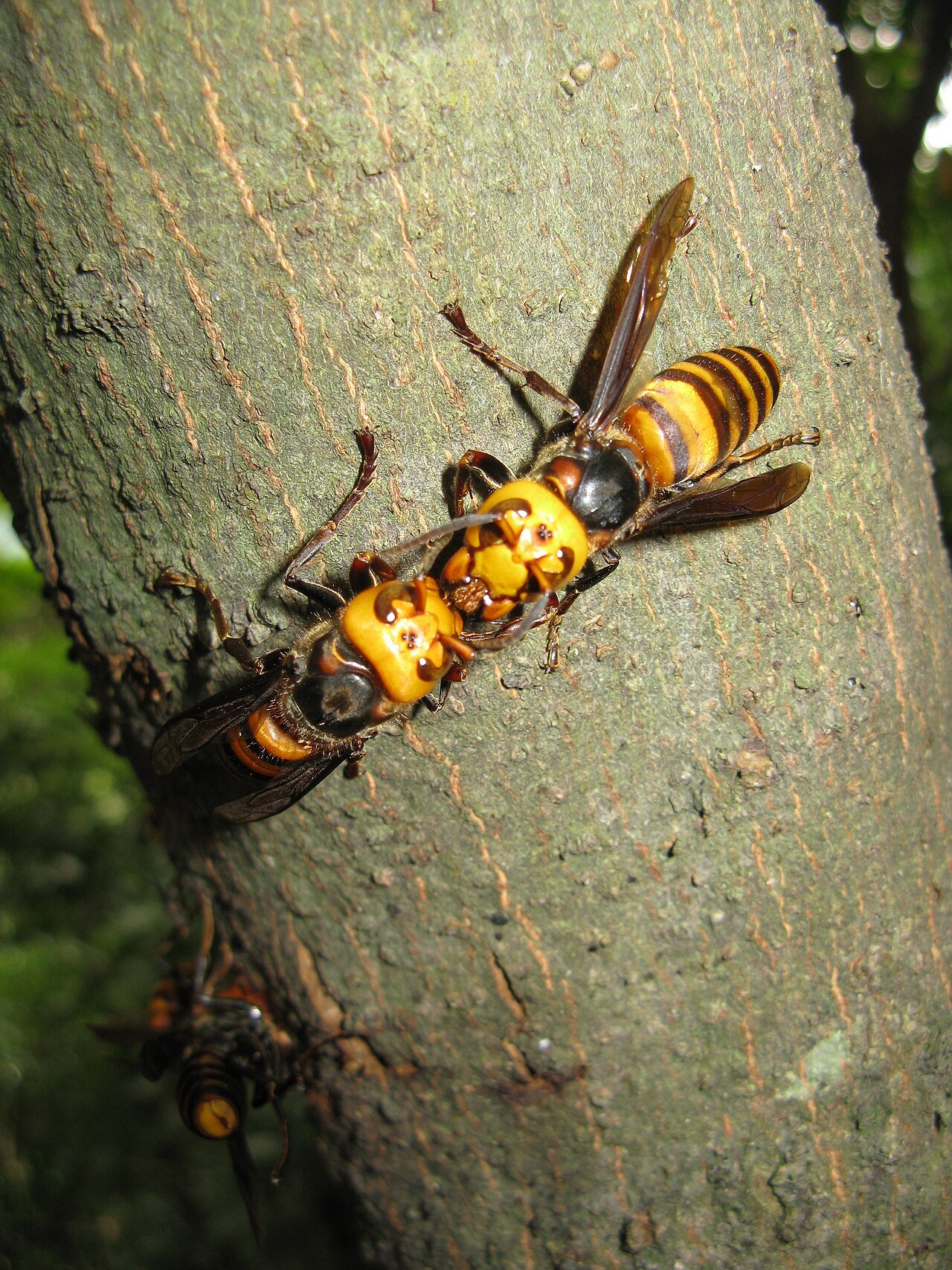
Bald-faced hornets build the large gray enclosed football that people photograph and post. They are technically a yellowjacket rather than a true hornet, they defend an area well beyond the nest itself, and they are the species most likely to send someone to urgent care after a lawn mower or a hedge trimmer passes too close. On this township’s lots they show up in ornamental trees, in dense shrubs along a property line, and tucked under high eaves on two-story elevations.
Yellowjackets are the ones that cause real trouble, because they nest out of sight. Sometimes that is an abandoned rodent burrow in the lawn or a mulch bed, which turns into a serious problem when it is discovered by a mower. Often it is a void inside the structure — behind siding, in a soffit, in the rim joist cavity, or behind a brick veneer. A steady stream of wasps entering one specific gap in the siding is a wall nest, and it should be treated as a structural problem rather than a yard problem.
- Open umbrella comb under a soffit, rail, or grill lid — paper wasps.
- Large gray enclosed football in a tree or under a high eave — bald-faced hornets.
- Traffic in and out of one gap in siding or soffit — yellowjackets in a void.
- Wasps emerging from a hole in the lawn — ground-nesting yellowjackets, a mowing hazard.
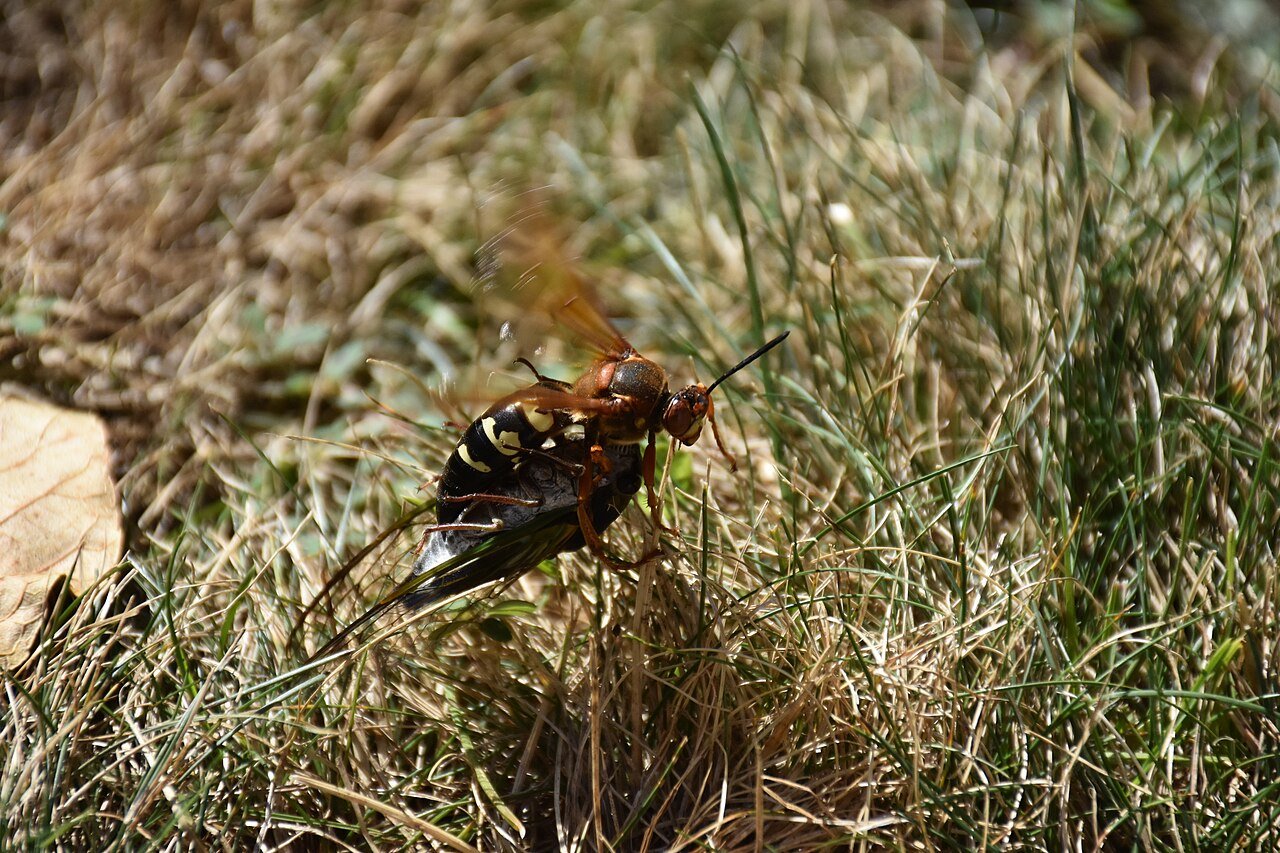
- Single large wasp burrowing in new turf — cicada killer, and essentially harmless.
The Mistake That Puts Wasps Inside the House
When homeowners find yellowjackets using a gap in the siding, the intuitive response is to seal the gap. It is completely logical and it is the worst available option. A wall void colony has one familiar exit and a nest that may hold thousands of insects. Close it and they do not leave — they look for another way out, and the next available route is very often inward, through the interior wall surface, a light fixture, an outlet box, or a ceiling seam.
That turns an exterior nuisance into wasps in a bedroom, which is both dangerous and considerably more expensive to resolve. The correct sequence is always treat first, confirm the colony is dead, and seal afterward. Sealing is the last step, not the first, and it does matter — an untreated void that stays open is attractive to next year’s queens looking for the same kind of protected space.
The related mistake is the ladder. A very large share of wasp injuries happen to people who are on a ladder when they get stung, and the sting is rarely the actual injury. Two stories up on an extension ladder with a can of wasp spray, on a soffit return you cannot see into, with a colony that defends a radius rather than a point, is not a good place to discover you are more allergic than you thought.
What Removal Actually Involves
For an exposed aerial nest, the work is direct: treat the nest at the right time of day, when the largest share of the colony is home, then physically remove the nest so it does not become an attractant or a mess. For a void nest, the treatment goes into the void through the entry point and the colony is monitored until traffic stops completely, which usually takes a few days. Only then does the opening get sealed.
For ground nests, the entrance gets treated directly and the area marked so nobody mows it in the meantime. Ground yellowjacket nests are frequently much larger than the entrance suggests, and on lots backing onto open ground here they can be substantial.
The honest exception is cicada killers, which appear every July in new or thin turf and terrify people who have never seen one. They are enormous, they hover conspicuously over lawns, and they are effectively harmless — solitary, non-defensive, and uninterested in people. Males cannot sting at all. Unless they are undermining hardscape, the correct treatment is usually none, and we will tell you that rather than sell you a service.
Across the Lakota Corridor
Liberty Township shares the same roofline profile and the same August timing. Fairfield to the west has more mature tree cover, and Mason is east across the county line.
General service in the township is on the West Chester pest control page.
Frequently asked questions
Why do wasps suddenly appear everywhere in August?
The colony started in spring with one queen and grows exponentially, so it hits its largest size in late summer. At the same time the workers switch from hunting protein to seeking carbohydrates, which is why they suddenly show up at patio tables and trash cans. The property did not change; the colony did.
Should I seal the hole where wasps are going into my siding?
No — that is the one thing not to do. A wall void colony that loses its familiar exit looks for another way out, and the next route is often inward through a light fixture, outlet, or ceiling seam. Treat first, confirm the colony is dead, then seal.
Can I just spray the nest myself?
For a small paper wasp nest you can reach standing on the ground, often yes. For anything on a ladder, anything enclosed, or anything in a wall or the ground, it is a genuinely bad idea. Most serious wasp injuries happen to people who were on a ladder when they got stung.
What is the giant wasp digging in my lawn?
Almost certainly a cicada killer. They appear in July in new or thin turf, they are enormous and alarming, and they are essentially harmless — solitary, non-defensive, and males cannot sting at all. Unless they are undermining a patio or walk, no treatment is needed and we will say so.
Is it worth removing a nest in October?
Usually not, if it is an exposed aerial nest. The colony dies with the first hard frosts and the nest is not reused. A void nest inside the structure is different, because the space stays attractive to next year’s queens and is worth treating and sealing properly.
How do I tell hornets from yellowjackets?
Bald-faced hornets build the large gray enclosed football and are technically a yellowjacket. Common yellowjackets nest out of sight in voids or in the ground. If you can see a big gray papery ball, it is bald-faced hornets; if you see steady traffic into a gap with no visible nest, it is yellowjackets.
How long before the wasps are gone after treatment?
An exposed nest is effectively finished the same day and gets physically removed. A void nest takes a few days for returning foragers to stop, which is why we confirm traffic has ended before sealing the opening.
They keep building in the same spot every year. Why?
Because it is genuinely good real estate — protected, shaded, and sheltered from rain. Soffit returns, deck rail undersides, and gable vents get reused season after season by different queens. Treating and then physically sealing or screening those specific spots is what breaks the pattern.