
Almost every house in Oakwood is old enough to have a termite history, and almost every buyer is paying enough to care exactly what that history says. This is the metro’s highest-stakes WDI market: century homes trading at premium prices, buyers’ attorneys reading disclosure files closely, and original woodwork that is precisely what the buyer is paying for. The inspection that serves it is $99 flat on the lender-ready NPMA-33, next business day, PDF the day we inspect — and written with the precision this housing stock demands.
What Inspections Actually Find in Oakwood
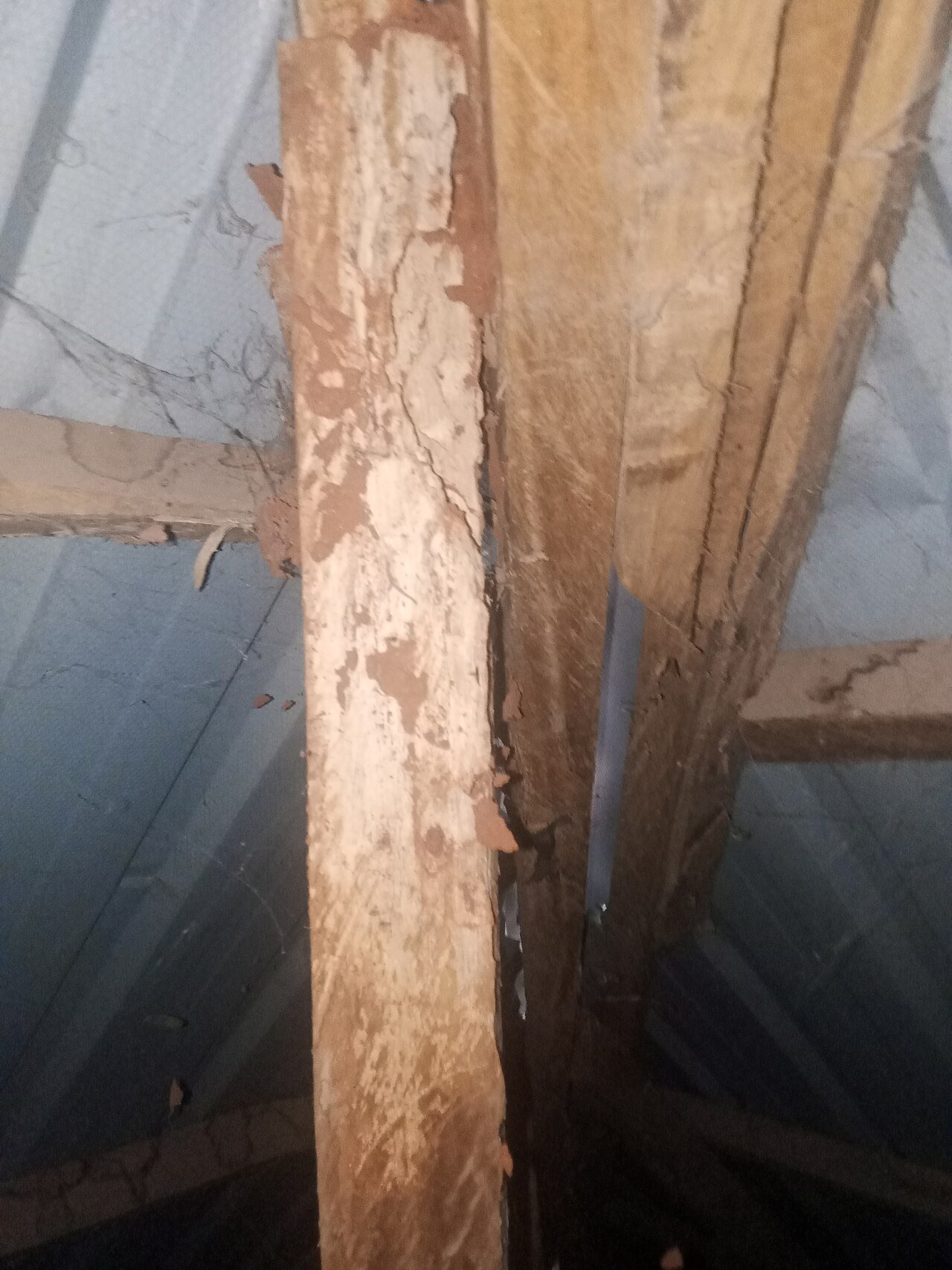
Expect evidence; the question is its age. An Oakwood four-square or Tudor has stood for a hundred years, and in that century it has almost certainly been treated at least once — the drill holes in the basement slab or foundation blocks are the receipts, usually from a treatment done decades ago by a company that no longer exists. Add dry galleries in a long-replaced sill, shelter-tube shadows behind the basement stairs, and repairs layered across four generations of ownership, and you have a normal Oakwood report: dense with history, empty of activity. Our Oakwood work reads that record fluently — because the alternative, an inspector who writes “evidence of termites” without dating it, can cost somebody tens of thousands of dollars of unnecessary panic.
Drill-Hole Literacy
Those rows of filled holes in the basement floor deserve their own paragraph, because they alarm more Oakwood buyers than any live termite ever has. They are treatment evidence, not damage — the footprint of a soil-applied termiticide job, and usually the best news on the report: this house was protected, professionally, on purpose. The NPMA-33 we write says so in words a lender and a buyer’s attorney can both act on.

Built for the Transaction Timeline
- $99 flat — conventional, jumbo, VA, and FHA-accepted NPMA-33
- Next business day across Oakwood’s twenty blocks
- Same-day PDF to agent, buyer, lender, title — and the buyer’s attorney when one is reading the file
- Pay now or at closing on the settlement statement
- Pre-listing reports for sellers who’d rather present a dated, explained history than negotiate a surprise
For Agents Selling the Woodwork
Oakwood listings lead with chestnut trim and quarter-sawn floors, which makes the termite conversation uniquely delicate: the buyer is falling in love with exactly the material termites eat. The answer isn’t reassurance — it’s documentation. A $99 report that dates every piece of evidence and states plainly that nothing is active lets the woodwork stay a selling point. Sellers order it pre-listing; buyers’ agents order it in the contingency; either way it books in one minute at the realtor link, with the full rundown on the realtor page.
Schantz Park to Far Hills
The inspection reads differently across Oakwood’s few square miles. Schantz Park’s signature homes — big frames, deep basements, original everything — produce the densest histories in the metro, and their buyers are the most likely to bring an attorney to the paperwork. The streets stepping down toward Far Hills and the Dayton line run slightly younger stock with the same century pressures at gentler intensity. And the apartment and condo conversions scattered near the corridor add multi-unit files where the WDI covers common structure as much as any single unit. Small city, full range — and the report’s precision has to hold at every address, because in Oakwood somebody is always reading closely.
That close reading is a feature, not a burden. A market that scrutinizes reports rewards the vendor who writes them carefully — and punishes vagueness with renegotiations that never needed to happen.
When an Attorney Reads the File
High-value Oakwood transactions often route the disclosure package through a buyer’s attorney, and a WDI written for that audience behaves differently: every finding located specifically, every date stated or honestly bounded, every conducive condition separated from evidence, the verdict stated in the operative first lines rather than buried in boilerplate. We write to that standard on every file — a $99 report in a million-dollar folder should read like it belongs there — and we take the attorney’s call when one comes, because a five-minute clarification beats a week of letter-writing.
For agents, the practical takeaway: name the attorney as a report recipient at booking and the file arrives complete on day one. Nothing calms a closely-read transaction like documents that anticipated the reading.
The Report as Part of the House’s Papers
Oakwood houses accumulate documentation the way they accumulate owners — abstracts, renovation permits, the occasional architect’s drawing in a basement flat file — and the WDI belongs in that archive. A century home’s termite history is genuinely part of its provenance: which sills were replaced and when, which treatment left the drill holes, what the 2026 inspection found and didn’t. Each dated NPMA-33 added at each sale extends the record, and the next buyer’s attorney reads a house with papers very differently from a house with stories.
We write reports for that shelf life — specific locations, bounded dates, plain verdicts — because in this city they get read twice: once at this closing, and once a decade from now when the house changes hands again and its file speaks for it.
Buying closer to the city? We also schedule termite inspections in Dayton, Ohio — same $99 NPMA-33 report, same next-business-day turnaround for realtors, from our office at 733 Salem Ave.
Frequently Asked Questions
How much is a termite inspection in Oakwood?
$99 flat — the lender-ready NPMA-33, next business day, PDF the day we inspect, pay at booking or on the settlement statement.
Will you find termite evidence in a century-old Oakwood home?
Almost certainly — a hundred-year-old house has nearly always hosted and been treated for termites at some point. The report’s job is dating that history and separating it from live activity. Dense-with-history, empty-of-activity is the normal Oakwood report.
What are the rows of filled holes in the basement floor?
Treatment evidence, not damage: the footprint of a professional soil-termiticide application, usually decades old. They’re typically the best news on the report — proof the house was protected on purpose — and our NPMA-33 says so explicitly.
Does old termite damage hurt the sale of a high-value home?
Documented, dated, inactive history closes routinely at every price point. What hurts high-value sales is vagueness — “evidence of termites” with no date or verdict invites renegotiation. Precision is the protection.
Should Oakwood sellers get a pre-listing inspection?
It’s the metro’s strongest case for one: premium buyers, attorney-read disclosure files, and guaranteed historical evidence. A current $99 report that explains the history before anyone asks converts the biggest unknown into a closing footnote.
Is the inspection required for a jumbo or conventional loan?
Ordered case-by-case — typically on appraisal notes — while VA purchases in Ohio require it outright. The NPMA-33 satisfies every loan type.
What happens if you do find something active?
A written verdict with location and extent, a treatment plan quoted only when warranted — designed around preserving original material — and re-inspection on the same file after the work.
How do agents book?
greaterdaytonpest.com/realtor — one minute, bookmarkable, built for phones.