
Liberty Township is one of the newest built environments in Butler County, and that creates a specific blind spot around termites. Four Bridges, Wetherington, the estate lots off Millikin Road, and the subdivisions filling in along Cincinnati–Dayton Road went up mostly between 1998 and last year. The prevailing assumption in a neighborhood like that is that termites are somebody else’s problem — an old-house problem, a Hamilton problem. The eastern subterranean termite does not evaluate build dates. It evaluates soil moisture and wood contact, and a golf-course lot with irrigation and deep landscape beds supplies both generously.
A Barrier With an Expiration Nobody Tracks
Virtually every house built in this township since the late 1990s received a pre-construction soil treatment. A licensed applicator treated the soil before the slab or footing went in, the builder filed it, and the current homeowner — often the second or third owner by now — has never heard the phrase. That barrier is the most consequential termite fact about Liberty Township, and almost nobody is tracking where it stands.
Soil treatments deplete over time. Depending on the material used, the soil chemistry, and how much the grade has been disturbed since construction, the protective band under and around a foundation gradually loses effectiveness across a span of years rather than decades. A 1999 house in Wetherington is running on a barrier that has been thinning for a quarter century. A 2015 house is somewhere in the middle of that curve. And every pool installation, irrigation trench, paver patio, retaining wall, and landscape regrade in between has cut physically through some portion of it.
None of that is a reason to panic, and it is emphatically not a reason to treat a house with no evidence of termites. It is a reason to stop assuming that a newer home is a protected home, and to look carefully at the specific places where evidence would appear first on this kind of construction.
Where It Shows Up on an Estate Lot
The large homes here share details that termites use. Brick and stone veneer is not a solid wall — it is a skin with an air gap behind it and weep holes at the base meant to drain and ventilate that gap. Twenty years of mulch renewal, decorative stone, and raised bed borders buries those weep holes, and the air gap stops drying out. What remains is a protected vertical route from soil to sill plate, running entirely behind masonry where no one can see it.
Walkout basements are the second opening, and they are everywhere on the rolling ground toward Dutchman’s Creek. A walkout puts finished living space at grade on one elevation, which means drywall covers the band joist exactly where evidence tends to appear first. Add a deck ledger bolted through that same wall, support posts set on or near soil, and a screened porch built over the whole arrangement, and there is a structural path from ground to frame that cannot be visually inspected without dismantling something.
Third is everything added after the builder left. Sunrooms, four-season rooms, poured patios, outdoor kitchens, and pool decks rarely receive their own soil treatment, and a slab poured tight against an existing foundation creates an expansion joint running straight down to soil. On homes in this age bracket that joint is the single most productive place we find mud tubes anywhere in Butler County.
- Buried weep holes at the base of brick or stone veneer, covered by raised beds and decorative stone.
- Deck ledgers and post bases where the frame meets soil on walkout elevations.
- Slab expansion joints at patios, sunrooms, outdoor kitchens, and pool decks added after the original build.
- Downspouts discharging at a corner rather than extending away, keeping one section of footing permanently damp.
- Irrigation heads aimed at the foundation — an automated daily moisture supply exactly where it does the most harm.
Swarm Season on a Golf-Course Lot
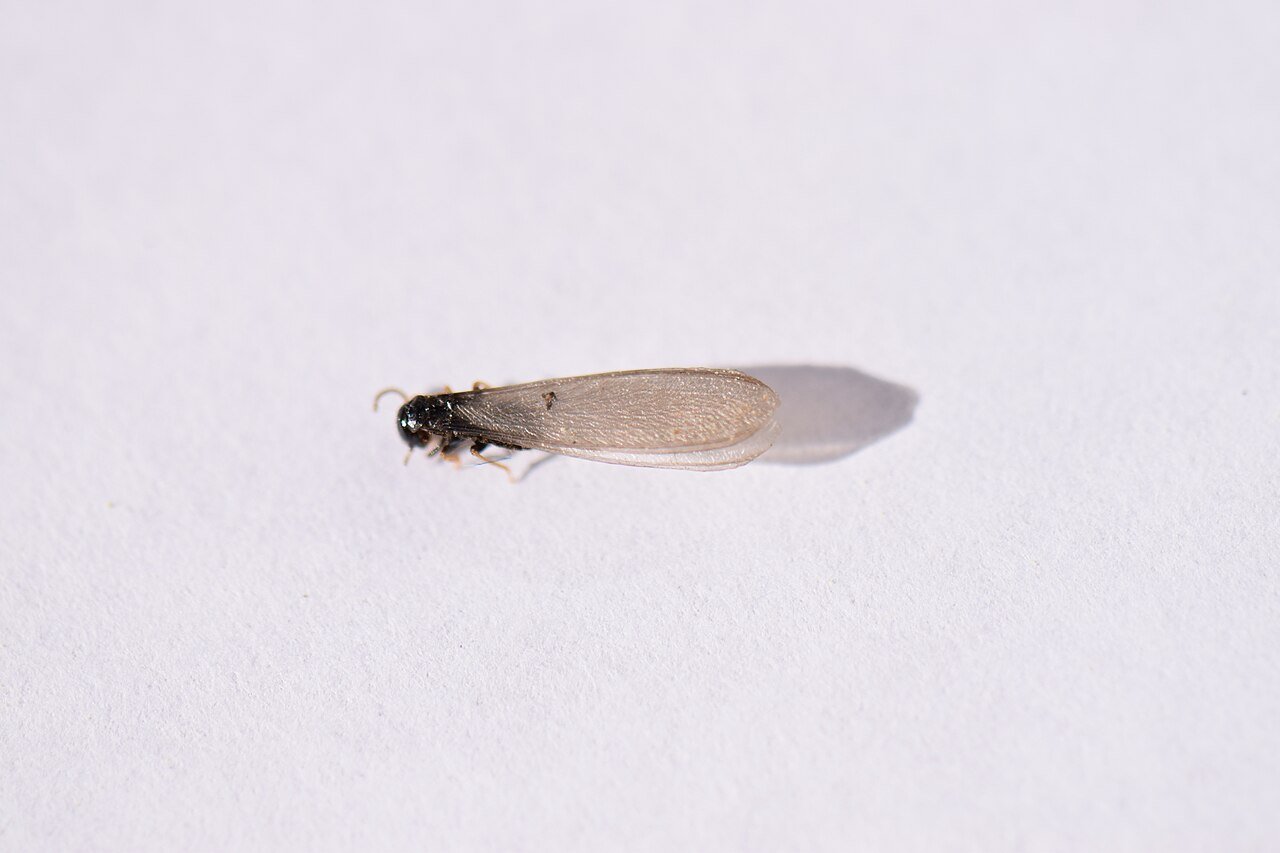
The visible event is the swarm. On a warm, still afternoon in March, April, or May — frequently the day after rain — a mature colony releases winged reproductives, and they emerge inside the structure as readily as outside it. Homeowners find them at a basement window well, along a sliding door track, or as a small pile of shed wings on a sill. The wings are the diagnostic detail: termite swarmers drop them, and four equal-length wings in a heap is not something any other insect in Ohio leaves behind.
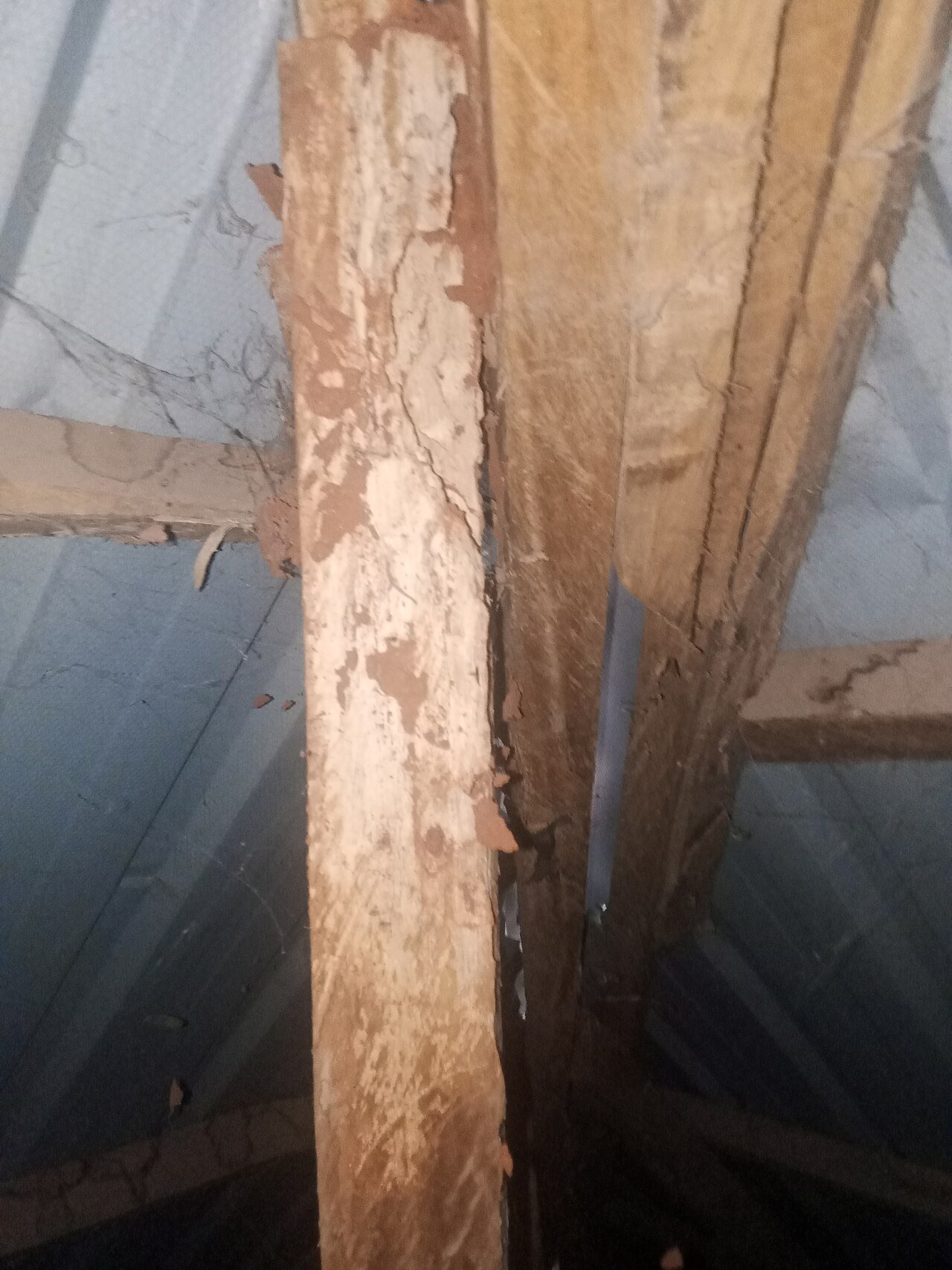
The common mistake at that moment is relief. The swarmers die within hours indoors, the pile gets vacuumed, and the household concludes it was a strange one-off. It was not. Swarmers emerging inside a structure indicate a colony established in or under that structure long enough to mature, which generally takes three to five years. The swarm is not the start of the problem. It is the announcement of one that has been running quietly underneath the house for years.
The rest of the calendar is invisible. Foraging continues year-round in this climate because soil below the frost line stays workable, and a colony feeding on a band joist in February is doing the same damage it does in July. Seasonality controls when you notice termites in Liberty Township. It has no bearing on when they eat.
What Treatment Actually Involves Here
A termite job on a house this size is fundamentally a perimeter job. The standard approach establishes a continuous treated zone in the soil around the entire foundation — trenched where there is soil to trench, drilled and injected where a patio, walk, driveway, or pool deck abuts the wall, and carried through expansion joints wherever they occur. On a typical Liberty Township home with a three- or four-car garage, a walkout, a patio, and hardscape, that is genuinely substantial linear footage, and any quote that has not accounted for the hardscape is a quote from somebody who has not walked the house.
Where layout or extensive hardscape makes a full perimeter treatment impractical, a monitored bait system is the alternative: stations installed in the soil around the structure, inspected on a schedule, with active stations carrying material back to the colony. Bait works by eliminating the colony rather than excluding it, which makes it slower to resolve but far easier to install cleanly on a heavily paved lot.
The honest framing either way: treatment is warranted when there is evidence, and evidence means live activity, mud tubes, damaged wood, or swarmers originating from the structure. A house with none of those does not need a termite treatment, and we will say so plainly. If you are buying, what you want is a WDI inspection and the NPMA-33 report, not a preemptive chemical application.
The Wooded Edge Factor
Liberty Township has more wooded lot edges than the subdivisions south of it, particularly along the Dutchman’s Creek corridor and on the estate lots where builders kept mature tree lines as privacy screening. That matters because it puts a natural cellulose supply — stumps, buried construction debris, root systems, fallen limbs, landscape timbers — within easy foraging distance of the foundation.
Subterranean termite colonies forage outward through soil in search of wood, and a colony established in a stump forty feet from the house is not a problem until it encounters something better. Removing stumps and buried lumber during landscaping, keeping firewood off the ground and away from the wall, and replacing landscape timbers in direct soil contact with material that is not a food source all reduce the number of colonies operating near the structure in the first place.
The Lakota Corridor
West Chester to the south is the same construction era and the same profile — subdivisions cross the line mid-street. Monroe is north, and Mason sits east across the Warren County line.
General pest work in the township is on the Liberty Township pest control page.
Frequently asked questions
My house was built in 2008. Can it really have termites?
Yes. The pre-construction soil treatment your builder installed was never permanent, and fifteen-plus years of landscaping, irrigation, pool and patio work has cut through parts of it. Newer construction in Liberty Township gets termites regularly. The age of the house mostly changes where we look first, not whether we look.
I found a pile of wings on a windowsill. What does that mean?
Almost certainly a termite swarm — four equal-length shed wings in a pile is the signature. It indicates a mature colony established in or under the structure, since colonies take roughly three to five years to produce swarmers. Vacuuming them up does not end anything, and that is the moment to have it looked at.
Are mulch beds against the foundation a problem?
They are a conducive condition rather than an infestation on their own. The particular risk on brick and stone veneer is burying the weep holes at the base of the wall, which stops the air gap behind the masonry from drying and creates a hidden route from soil to framing. Pulling beds back below the weep line is usually a weekend job.
Do you treat preventively if there is no evidence?
No. If there is no live activity, no mud tubes, no damaged wood, and no swarmers from the structure, we tell you the house is clear and you keep your money. Preemptive treatment on a clean house is not something we sell.
Liquid treatment or bait stations?
Liquid establishes a continuous treated zone in the soil around the foundation and is the usual choice where there is soil to trench. Bait suits heavily hardscaped lots where drilling through patios, pool decks, and walks would be extensive, and it works by eliminating the colony rather than excluding it. The layout of the property generally decides it.
Does the tree line at the back of my lot make it worse?
It can. Stumps, buried construction lumber, root systems, and landscape timbers in soil contact all support colonies within foraging distance of the house. Removing that material during landscaping and keeping firewood off the ground reduces how many colonies are operating near the structure.
I am buying here. Do I need treatment or an inspection?
An inspection. A lender or purchase contract wants a WDI report on the NPMA-33 form documenting what was found, and that is $99 flat. Treatment only enters the conversation if the report actually finds something.
How long does a treatment take on a house this size?
Most Liberty Township perimeter treatments are a single day. Large footprints with a four-car garage, a walkout, and significant patio, pool deck, or walkway abutting the foundation take longer, because hardscape has to be drilled and injected rather than trenched.