
Liberty Township sits on an edge, and mice live on edges. To the north and east there is still working farmland being converted a phase at a time; along Dutchman’s Creek and the retained tree lines on the estate lots there is permanent cover; and threaded between every subdivision are the stormwater basins and mowed drainage ways that field mice treat as highway. When night temperatures drop in October, that entire population starts looking for somewhere warm, and the nearest warm thing is a very large house with a great many penetrations in it.
Why It Happens in a Two-Week Window
Mouse calls here are not spread across the year. They arrive in a hard spike from roughly mid-October into early November, and again during the first sustained January cold snap. Nothing about the house changed in that window. An outdoor population that spent the summer perfectly content in the fields and creek margins received a temperature signal and began systematically testing building envelopes for a way in.
A house mouse needs about a quarter inch — the width of a pencil. A juvenile needs less. They are not chewing through your foundation and they are not making holes in masonry. They locate a gap that already exists and, if it is fractionally too small, work its soft edges until it is not. On construction this new, those gaps are essentially never in the walls. They are at the penetrations, which is a far more specific and far more fixable problem than most homeowners expect.
The scheduling consequence is straightforward: August and early September are the right months for this work, and October is the wrong one. Sealing a house before the first cold night is prevention and it is inexpensive. Doing it in November is cleanup, because whatever came in is already sheltered in a wall cavity or soffit return and already breeding on a roughly three-week cycle.

Estate Lots Add a Second Front
The larger properties here — the acre-plus lots off Millikin, the estate sections in Four Bridges and Wetherington — frequently come with outbuildings, and outbuildings change the problem. A detached garage, a pool house, a barn kept from the original farm, or a substantial garden shed is almost always less tightly sealed than the house, and it very often stores exactly what mice want: birdseed, grass seed, fertilizer, pet food, and stacked cardboard.
What that creates is a resident population living comfortably a hundred feet from the house year-round, rather than a transient one arriving from the fields each autumn. Come October, they are not crossing half a mile of open ground. They are moving across the yard. Households with outbuildings tend to have earlier and heavier mouse activity for exactly this reason, and treating the house without addressing the outbuilding produces a cycle that repeats every single year.
The fix is not complicated. Hard sealed containers for anything edible, the outbuilding door sweeps maintained the same as the house, and monitoring inside the outbuilding rather than only around the residence. It is unglamorous and it removes the staging area entirely.
- Garage door corners — worn sweeps over an uneven slab, the leading entry point on this housing stock.
- Line-set and utility penetrations at the rim joist, foamed by the builder but never screened.
- Soffit returns and gable-to-roof junctions on the complex rooflines these houses favor.
- Outbuildings and barns holding seed and pet food — a resident population next door to the house.
- Creek corridor and basin edges within a hundred yards — the source population that makes it recur every year.
Where They Get In on a Newer House
The most common entry point is the garage door, and specifically the bottom corners where the rubber sweep meets the jamb over a slab that is never perfectly level. A worn, curled, or hardened sweep leaves a small triangular opening at each corner that is more than enough, and the garage is heated-adjacent space containing food storage and a door into the house that gets propped open during groceries.
Second is the utility penetration set, identical on every house here: the air conditioning line set through the rim joist, dryer vent, gas line, electrical service entrance, hose bibs, and the radon or sump discharge. Builders foam these to satisfy an energy inspection, and cured foam is not a rodent barrier — mice chew through it without difficulty. What stops them is copper mesh or hardware cloth packed tightly into the void first, then sealed over.
Third is the roofline, badly underrated on houses with this much roof area. Where a gable meets a lower roof, where a soffit returns at an outside corner, and where the gutter apron leaves a gap behind the fascia board, there is often a direct route into the attic. Mice climb brick, stone, and lap siding without any trouble at all. An attic problem in a house with a tight, sealed basement almost always came from above rather than below.
What Actually Ends It
Bait stations set outside and left alone are a subscription, not a solution. Exterior bait reduces perimeter pressure and it has a place, but if the entry points stay open the house keeps receiving arrivals indefinitely and you keep paying to intercept them. Exclusion is what closes the problem, and exclusion is physical rather than chemical.
The order matters: find the entries by walking the full perimeter at grade, the garage, the roofline, and the accessible attic and rim joist; seal them with material a mouse cannot chew; then remove the population already inside using traps rather than interior bait. That last choice is deliberate. A mouse that eats bait and dies inside an insulated wall cavity or a soffit return is a significant odor problem in a finished house for two to three weeks, and in homes this size those cavities are effectively unreachable without cutting drywall.
Then verification. The honest measure of a rodent job is not the day-one catch; it is whether anything is still being caught at day fourteen. A follow-up visit answers that question, and if activity continues, it means an entry was missed and we return to the building envelope rather than simply adding more traps and hoping.
Mice, Rats, and What We Do Not Handle
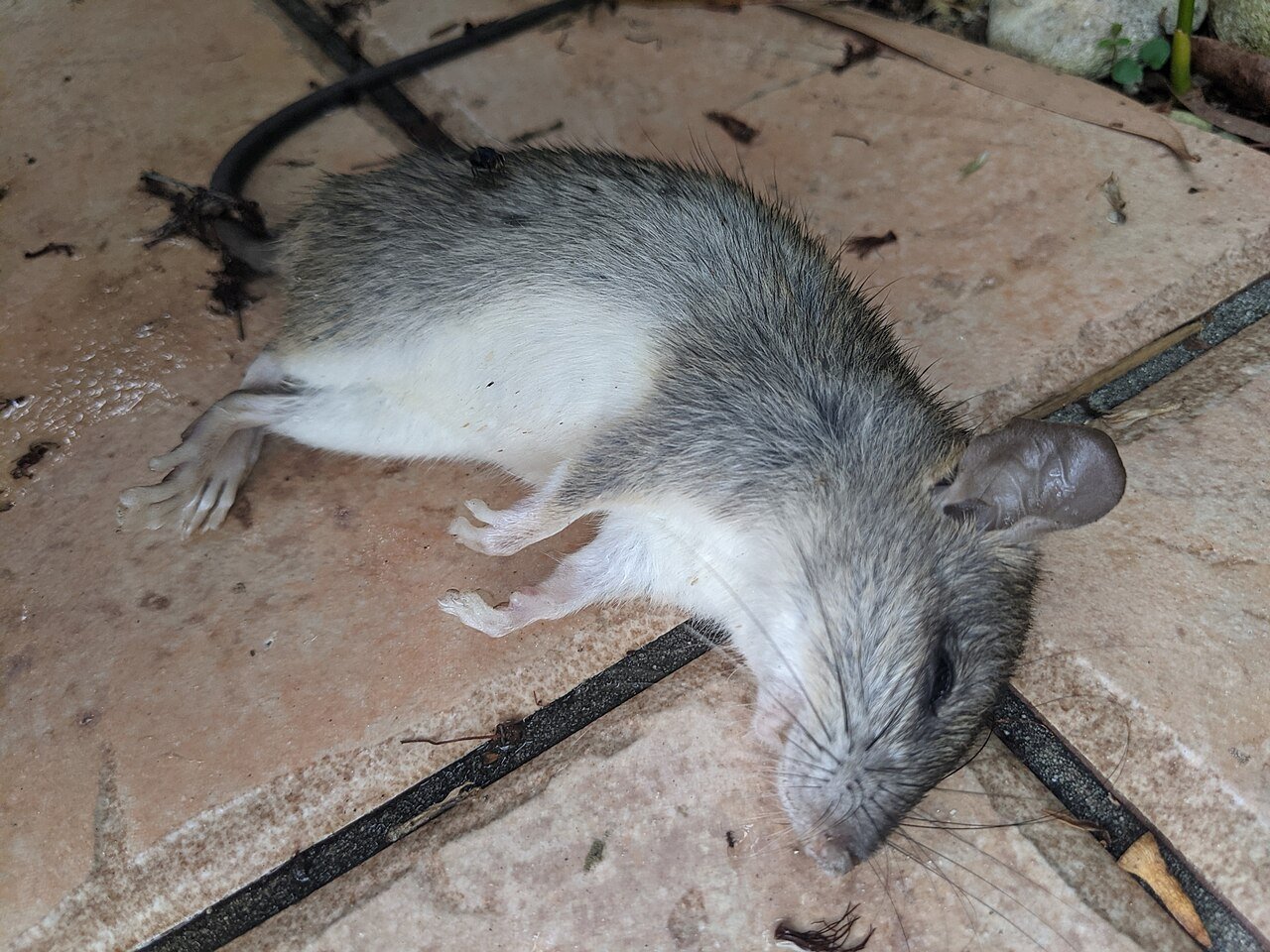
Almost everything in Liberty Township is house mouse. Norway rats do occur, usually tied to construction disturbance that displaces an existing burrow system, a compromised sewer lateral, or a steady outdoor food source. Rats are a genuinely different job — larger entries, burrow systems running along foundations and under slabs and outbuildings, and a much heavier emphasis on sanitation and grade correction. If it is rats, we will say so plainly, because the two problems do not respond to the same work.
On scope, we are direct: we handle rodents, nothing larger than rats and mice. If what is in the attic turns out to be a raccoon, a groundhog under the shed, an opossum, or a bat in the chimney chase, that is wildlife control, and we will tell you so and point you toward someone who does it properly rather than taking the job and improvising. On wooded estate lots this is genuinely worth ruling out early, because heavy, slow, dragging sounds concentrated at dusk are usually telling a different story than mice are.
The Lakota Corridor
West Chester to the south shares the same construction era and seasonal timing. Monroe is north where the farmland conversion is most active, and Mason is east across the county line.
General service in the township is on the Liberty Township pest control page.
Frequently asked questions
Why do mice show up every October?
Because night temperatures drop and an outdoor population begins testing building envelopes for heated space. The mice were in the fields, creek corridor, and drainage basins all summer. October is simply when they come looking for somewhere warmer.
My house is fifteen years old. How are mice getting in?
Age has little to do with it. On newer construction the openings are at penetrations rather than in walls — garage door corners, the air conditioning line set at the rim joist, dryer and radon vents, and soffit returns. Builders foam those, and mice chew cured foam without much difficulty.
We have a barn and a pool house. Does that matter?
A great deal. Outbuildings are almost always less tightly sealed than the house and usually store birdseed, grass seed, fertilizer, or pet food. That supports a resident population a hundred feet away year-round rather than a transient one arriving in autumn. Treating the house alone means repeating this every year.
Can you just put out bait?
We can, but alone it is a subscription rather than a fix. If entry points stay open the house keeps receiving new mice. Exclusion ends it, and inside a finished house we strongly prefer traps so a dead mouse does not decompose in a wall cavity for three weeks.
How small a gap do mice need?
About a quarter inch, roughly the width of a pencil, and juveniles need less. They find existing gaps and work the soft edges rather than chewing masonry, which is why sealing has to use copper mesh or hardware cloth rather than foam or caulk alone.
I hear scratching in the attic. Is that mice?
It might be, particularly with soffit returns giving access from above. But heavy, slow, or dragging sounds usually are not. We handle rodents only — nothing larger than rats and mice — so if it turns out to be wildlife we will tell you and point you to someone who does that work.
How long until it stops?
Most of the interior population comes out in the first week to ten days once exclusion is complete and traps are set. The real test is the follow-up around two weeks in. If anything is still being caught, an entry was missed and we go back to the envelope.
When should I schedule this?
Late summer into early September. Sealing before the first cold night is prevention and it is cheap. November is cleanup, because by then whatever got in is established, sheltered, and breeding on a three-week cycle.