
The small-fly library’s final resident is its most consequential: the phorid fly — the humpbacked “scuttle fly” that looks like a fruit fly at a glance and behaves like nothing else in the kitchen’s airspace. The distinction matters more than any other in the tiny-fly canon, because while the fruit fly announces a banana and the drain fly announces a biofilm, a persistent phorid population announces decay at depth — the broken drain line under the slab, the void where something died, the grease seam beneath the commercial kitchen — and it is the one small fly whose stubborn presence should genuinely lower the threshold for professional eyes. The complete file: the two-second ID (the hump, and the sprint that names them), the biology that makes them decay’s most versatile specialists (their résumé runs from coffin depths to ant decapitation — genuinely), the household source-hunt in escalating order, the slab-leak scenario that makes this page’s phone number earn its place, the commercial-kitchen stakes where phorids are an inspection item with teeth, and the honest boundary between the case you solve with a scrub brush and the case that needs a camera down the line. Greater Dayton Pest & Rodent, small-fly verdicts free as ever: (937) 569-3330.
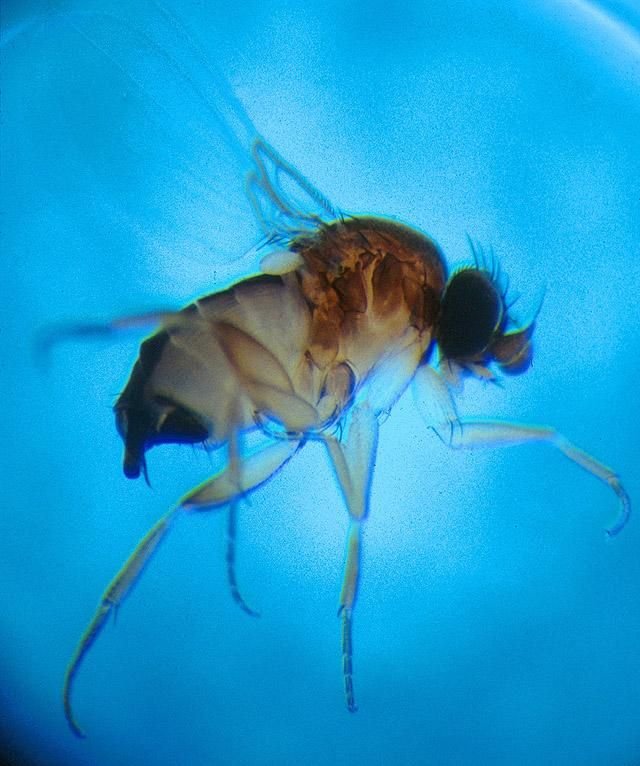
The two-second ID: hump and sprint
Phorids share the fruit fly’s size class (a sixteenth to an eighth inch, tan-to-dark), and two field marks separate them instantly. The hump: a phorid’s thorax arches high over a small tucked head — the “humpbacked fly” silhouette, readable in any side-on phone macro, versus the fruit fly’s level-backed, red-eyed profile. The sprint: the behavioral tell that works at distance — disturbed phorids run, in fast erratic zigzags across counters, windows and walls, taking flight only reluctantly (the “scuttle fly” name is earned; entomologists identify them across a room by gait alone), where fruit flies lift off instantly and orbit. Supporting cast notes: no red eyes, an irregular jerky flight when they do fly, and a venue preference for surfaces near their source rather than the fruit bowl’s airspace. The sorting stakes, one more time in this library’s favorite format: fruit-fly-shaped and orbiting the bananas = fermentation, the easy case; fuzzy and moth-like on the bathroom wall = drain film, the tape-test case; delicate and drifting near the plants = fungus gnats, the overwatering case; humpbacked and sprinting = this page, and the question is no longer “what ferments” but “what decays, and where” — a genuinely different investigation, with a genuinely wider answer space.
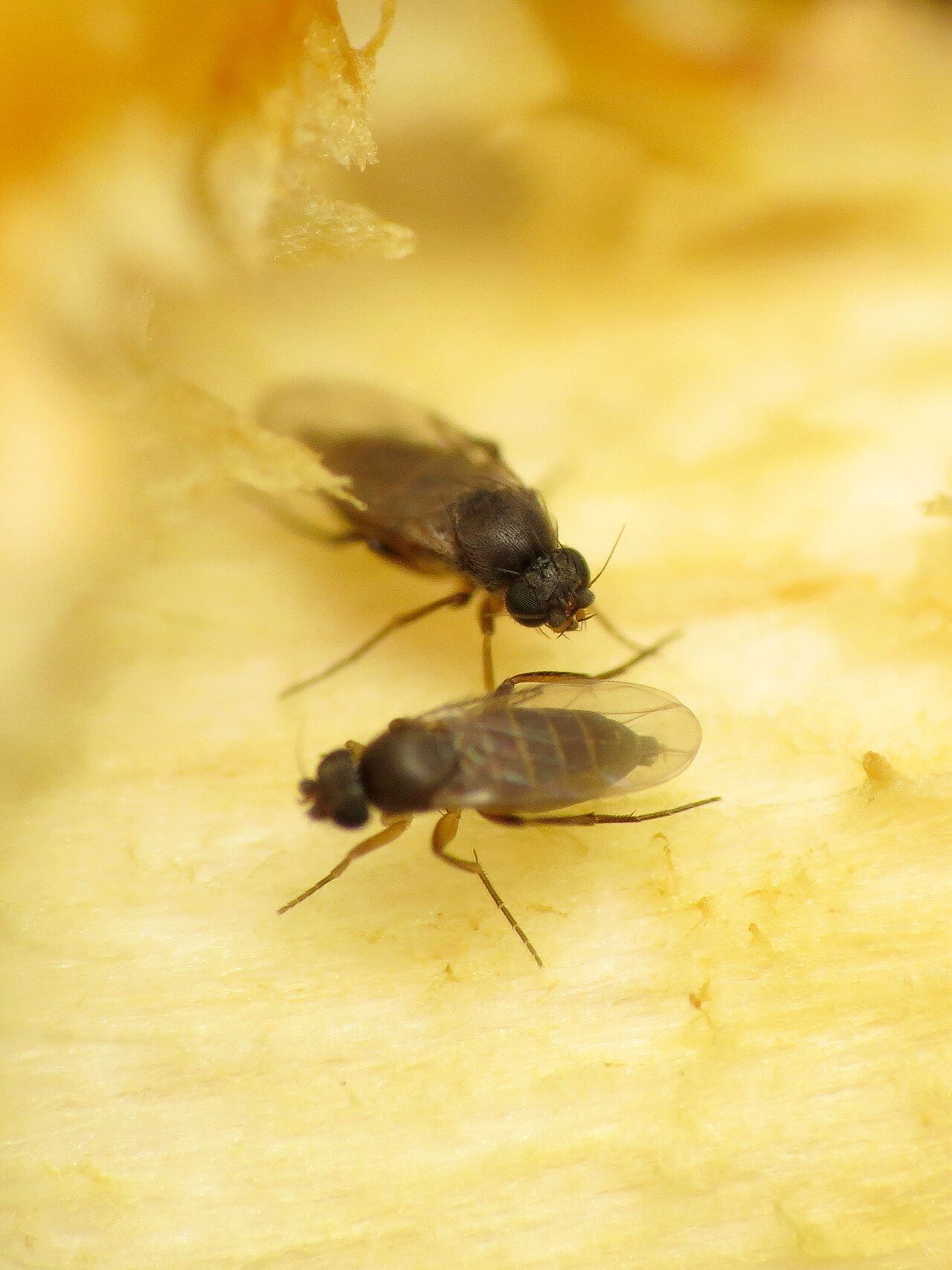
The résumé: decay’s most versatile family
The Phoridae are among the most biologically diverse fly families on Earth — thousands of species running life histories from the merely unglamorous to the genuinely astonishing, and three entries explain both their fame and their diagnostic value. The decay generalists — the household’s Megaselia species breed in almost any moist decaying organic matter: rotting produce, drain-line sludge, garbage residue, dead insects in light fixtures, potted-plant rot, and carrion of every scale — a breadth that makes “find the source” a wider hunt than any other small fly demands. The coffin fly — the family’s forensic celebrity: phorids’ talent for reaching buried and sealed decay is so developed that one species earned that common name by colonizing interred caskets, and the family features accordingly in forensic entomology’s depth-and-timing calculations — the fact this page deploys not for gothic color but for its practical translation: phorids reach decay that other flies cannot, through soil, slab cracks and sealed voids, which is precisely why their persistence flags hidden sources. The ant decapitators — the family’s biocontrol celebrities, already met in this library’s fire-ant file: parasitoid phorids whose larvae develop inside fire-ant heads, imported as the South’s biological counterweight — a reminder that this family works every niche decay and parasitism offer. The household relevance distills to one sentence: a phorid is never lost — it is always near something, and the something is the entire investigation.
The source hunt, in escalating order
Run the phorid hunt from cheap to deep, and let persistence — not panic — escalate it. Tier one, the surface sources (most cases end here): the trash-can rim doctrine at full strength (the can’s under-bag sludge is prime phorid substrate), the recycling’s residue, the disposal’s splash guard underside, the produce drawer’s liquefying member, the compost pail, the drain margins (phorids share the drain fly’s biofilm taste — run the same brush-and-gel protocol), the overwatered plant’s rotting roots, and the dead-mouse-in-the-void possibility the blow-fly forensics section mapped — phorids run the same carrion calls at smaller scale. Tier two, the pattern read: if the tier-one purge plus two weeks doesn’t collapse the population, map the emergence — phorids concentrate near their source, so persistent activity at one floor drain, one wall section, one bathroom points the investigation; the tape-test from the drain file works on suspect drains, and a strip of monitors localizes wall-void candidates. Tier three, the deep sources — the scenario this page exists to flag: persistent phorids with no findable surface source, concentrated near floor level, are the classic signature of a broken sanitary line under the slab or in a wall — the cracked lateral, the failed wax ring’s chronic seep, the disconnected drain line wetting soil beneath the foundation, where the buried organic-saturated soil breeds phorids that rise through hairline cracks for months. That scenario is plumbing-camera territory, and it’s the small-fly library’s one genuinely expensive early warning: households that chase the flies for a season while the leak works are the cases that end in slab repair; households that read the signature early end in a drain-camera appointment and a fix measured in feet, not floors. The fly is cheap; the message can be anything but — and knowing which tier you’re in is this page’s entire fee.
The commercial file: where phorids carry citations
In food service and institutional settings, phorids graduate from messenger to compliance item, and the stakes deserve their paragraph. Health inspectors read phorid activity correctly — as evidence of organic accumulation at depth: the grease-saturated seam under the cookline, the floor-drain complex’s biofilm economy, the mop-sink corner, the soda-fountain drip line’s syrup stratum, and the sub-slab breaks that busy kitchens’ thermal cycling and grease loads produce at rates residential plumbing never sees. The commercial playbook our restaurant program runs: scheduled bio-gel and foam treatment of every drain (the same circumference-coating logic as the drain-fly file, at commercial dosing), the quarterly deep-clean of the equipment seams phorids map for us (technicians read the fly concentrations as a free grease audit — the insects mark every failure point before the flashlight does), monitor traps logged for the inspector’s file, and the escalation protocol when activity persists: the camera down the suspect line before the health department’s visit rather than after. Healthcare settings run a stricter version still — the medical literature documents phorids’ occasional and unwelcome talent for reaching wounds and sterile environments, which is why hospital contracts treat any phorid sighting as an immediate facilities investigation. For the Miami Valley’s kitchens, the translation is economics: the phorid population that costs a residential household a weekend of source-hunting costs a restaurant a re-inspection — and the standing program that prevents it costs a line item. The fly is the same; the invoice scales with the stakes.
Phorid questions, answered
How do I know it’s phorids and not fruit flies before calling anyone?
The two-second kit: watch the escape (sprint = phorid, instant liftoff = fruit fly), check the profile (hump versus level back, no red eyes), and note the venue (surfaces near floors and drains versus the fruit bowl’s orbit). The vinegar-trap test adds a third data point — fruit flies pack a cider trap overnight; phorids mostly ignore it (wrong attractant — they want decay, not ferment). Sprint plus hump plus indifferent to vinegar = this page’s protocol, starting at tier one.
We fixed the trash-can situation and they dropped 90% but a few persist at one drain. Verdict?
A split source — the common real case: the can was the volume driver, the drain’s biofilm the residual nursery. Run the brush-and-gel protocol on the flagged drain, re-census in two weeks, and expect zero; a drain that survives a proper mechanical cleaning is the tier-three flag — something below it stays wet, and the camera question opens. The trend line, as always, is the verdict: falling fast = source found; plateaued low = source remaining.
Can phorids hurt anyone — the wound thing sounds alarming?
Household risk is effectively nil: the medical cases are institutional rarities involving immobilized patients and standing wound care, not kitchens and bathrooms. The residential concern is the mechanical one all decay-flies carry — they commute from filth to surfaces — and the fix is the source hunt, not anxiety. File phorids where this library files every messenger: read the message, skip the fear.
The flies appeared right after we had plumbing work done. Coincidence?
Worth suspicion — disturbed lines, imperfect reconnections and construction-debris-blocked drains are classic phorid origins, and a population blooming weeks after slab or sewer work earns the direct question to the contractor plus, unresolved, the camera. The timing is data; contractors’ warranties are shorter than phorid patience; and the early conversation beats the later excavation by exactly the margin this page has been pricing throughout.
The messenger’s last word
The phorid closes the small-fly library as its most serious correspondent: same size as the fruit-bowl crowd, entirely different letterhead. Sort it by hump and sprint, hunt it from the trash rim down, respect the two-week trend line, and honor the one escalation this family uniquely earns — the persistent floor-level population whose message is written in plumbing. Most cases end at tier one with a scrubbed can and a brushed drain; the rare deep case ends best exactly as early as someone reads it right. For the pattern reads, the commercial programs, the camera referrals and the photo that settles hump-versus-level in one frame: (937) 569-3330, Greater Dayton Pest & Rodent, Dayton and all eight counties — where the smallest flies get taken exactly as seriously as their messages deserve, and no more seriously than that.
The small-fly library, complete: the four-fly master key
With the phorid filed, the tiny-fly canon closes, and the whole wing compresses into the master key worth pinning: Orbiting the fruit, level-backed, red-eyed, packs a vinegar trap overnight: fruit fly — find the ferment, two weeks to quiet. Fuzzy and moth-shaped, parked on the bathroom wall: drain fly — tape test, brush, gel. Delicate and drifting at the houseplants and windows: fungus gnat — dry the soil, BTI the stubborn pots. Humpbacked and sprinting near floors and drains: phorid — this page’s escalating hunt, with the tier-three flag honored. Four flies, four sources, four fixes — and one shared doctrine that has now closed five consecutive fly files: the visible insect is a receipt, the source is the purchase, and the spray can is the wrong aisle in every single case. The master key plus a phone camera outperforms the entire “flying insect killer” shelf at a total cost of attention — which has been the small-fly wing’s entire tuition, and the library’s, from its first page: identify, locate, fix, verify. The kitchen’s airspace is readable; now the whole household can read it.
A forensic footnote: the family that testifies
The coffin fly’s cameo earlier deserves its respectful expansion, because the phorid family’s courtroom career illuminates exactly the trait the household hunt exploits. Forensic entomologists build post-mortem timelines from insect succession — which species arrive when — and phorids own a specific chapter: the deep-and-sealed scenarios where the fast-flying blow flies can’t reach. Phorids’ documented ability to burrow through feet of soil, slip sealed containers and colonize environments other flies never access makes their presence in a forensic sample a depth-and-concealment testimony no other insect gives — the same talent that, redirected at your address, sends them up through a slab’s hairline crack from a broken lateral’s wet soil, months before any odor or moisture stain reports the problem by other means. One family, one skill, two applications: in the laboratory it dates concealment; in your kitchen it flags it — and in both venues the tiny humpbacked witness is exactly as reliable as the investigator who bothers to read it. This library’s hundred-ninety-page thesis, sworn once more, in miniature, by its smallest deponent: the evidence is always already present; the skill was always the reading.
The eight-county phorid map
Local pattern notes to close the file: the commercial kitchens generate the volume — the restaurant rows of the courthouse squares and the Dayton dining districts run standing phorid-management programs because grease-and-drain economics never sleep; the older residential slab-and-basement stock supplies the tier-three stories — mid-century plumbing reaching the age where laterals crack and wax rings fail, with the phorid bloom as first witness (our camera-referral file maps almost perfectly onto pre-1970 slab construction); the rural properties add the septic dimension — a failing leach line breeds phorids across a yard, and the flies routinely beat the odor to the discovery; and every zip code contributes the tier-one cases the trash-rim doctrine closes by the weekend. The family’s message discipline holds across the whole map: phorids appear where decay accumulates beyond casual reach, they persist exactly as long as the source does, and they leave the moment it’s gone — the most honest reporting relationship in the small-fly canon, concluded, as every good file is, by someone finally reading the report. The wing closes; the master key stands; and the kitchen’s smallest mysteries are, from this page forward, a solved genre.
The two-week protocol, condensed for the fridge
- Day 1: confirm the hump-and-sprint ID (photo to the line if torn); scrub the trash can proper, rinse the recycling, clear the produce drawer, check the disposal guard.
- Day 1–2: brush-and-gel every drain that sees organic load; water the unused traps; pull the saddest houseplant for root inspection.
- Days 3–14: hold the sanitation line and watch the trend — falling counts confirm a tier-one source; note where survivors concentrate.
- Day 14, if persistent: map the concentration zone, tape-test the flagged drains, and open the tier-three question — especially floor-level concentration in slab construction or post-plumbing-work timing.
- The escalation: persistent + localized + no surface source = drain camera conversation, this month not this year. The flies are cheap; the leak never is.
- Always: vinegar traps to sort fruit flies out of the census, the vacuum for the visible, and never the fogger — the small-fly canon’s one unanimous verdict, five files running.
Hunt run, trend read, message honored: the humpbacked correspondent files its last dispatch, and the small-fly wing archives complete — four species, four sources, one method, zero aerosols. The library’s tiniest chapter ends exactly the way its largest ones did: with the evidence read, the source closed, and the household fluent in one more of the building’s native languages.
Frequently asked questions
What are phorid flies and why do they matter?
Small humpbacked flies that RUN across surfaces in bursts before flying — and the most diagnostically important small fly in the house, because established indoor populations breed in decaying organic matter that frequently means a plumbing breach, a dead animal in a void, or a drain-line failure.
How do I tell phorid flies from fruit flies?
Posture and gait: phorids carry a humpbacked profile and sprint erratically across counters and walls (the “scuttle fly” habit); fruit flies are rounder, red-eyed, and hover near produce. The vinegar trap sorts them too — fruit flies dive in, phorids mostly ignore it.
Why are phorid flies a plumbing red flag?
Because their breeding requirement — wet decaying organic matter in quantity — is most often supplied by broken drain lines under slabs, failed wax rings, or sewage seepage in crawlspaces. A persistent phorid population with clean kitchen habits is a plumbing investigation wearing wings.
Where do phorid flies breed in a house?
The grim inventory: under-slab drain breaks, the soil beneath leaking toilets, garbage disposals’ neglected splash zones, dead rodents in voids, mausoleum-grade organic accumulations in rarely-cleaned drains, and overwatered planter beds against foundations.
How do I find the phorid fly source?
Concentration mapping: note which rooms hold the most flies and where they rest, tape-test the drains, check toilet bases for movement or seepage, and sniff-test floor registers. Persistent no-source cases justify professional investigation — sometimes including a plumber’s camera; finding these is genuinely our specialty.
Do phorid flies bite or carry disease?
No bites — but their breeding-site resume (sewage, carrion) makes them serious mechanical contaminators, and healthcare settings treat them as a genuine hygiene emergency. In homes: no panic, real diligence.
Why do phorid flies keep coming back after I clean?
Because the visible cleaning never reached the source — a sub-slab breach or void carcass resupplies indefinitely. Phorids are the small fly where “keep cleaning harder” most reliably fails and source investigation most reliably pays.
Can phorid flies come from a dead animal in the wall?
Classically — a rodent dying in a void produces a bloom of phorids (and blow flies) two to seven days later, concentrated near that wall. The bloom is actually useful: it localizes the carcass for removal better than smell alone.
What kills phorid flies?
Nothing durable except source removal — space sprays knock down adults that the breeding site replaces daily. Fix the plumbing, remove the carcass, or scrub the accumulation, and the adults age out within a week on their own.
When should I call a professional about phorid flies?
Early — this is the one small fly where the call is cheap insurance: persistent phorids with no findable source have preceded slab-leak discoveries, crawlspace sewage seeps, and wall carcasses all over our service area. The investigation visit pays for itself in avoided water damage: (937) 569-3330.