
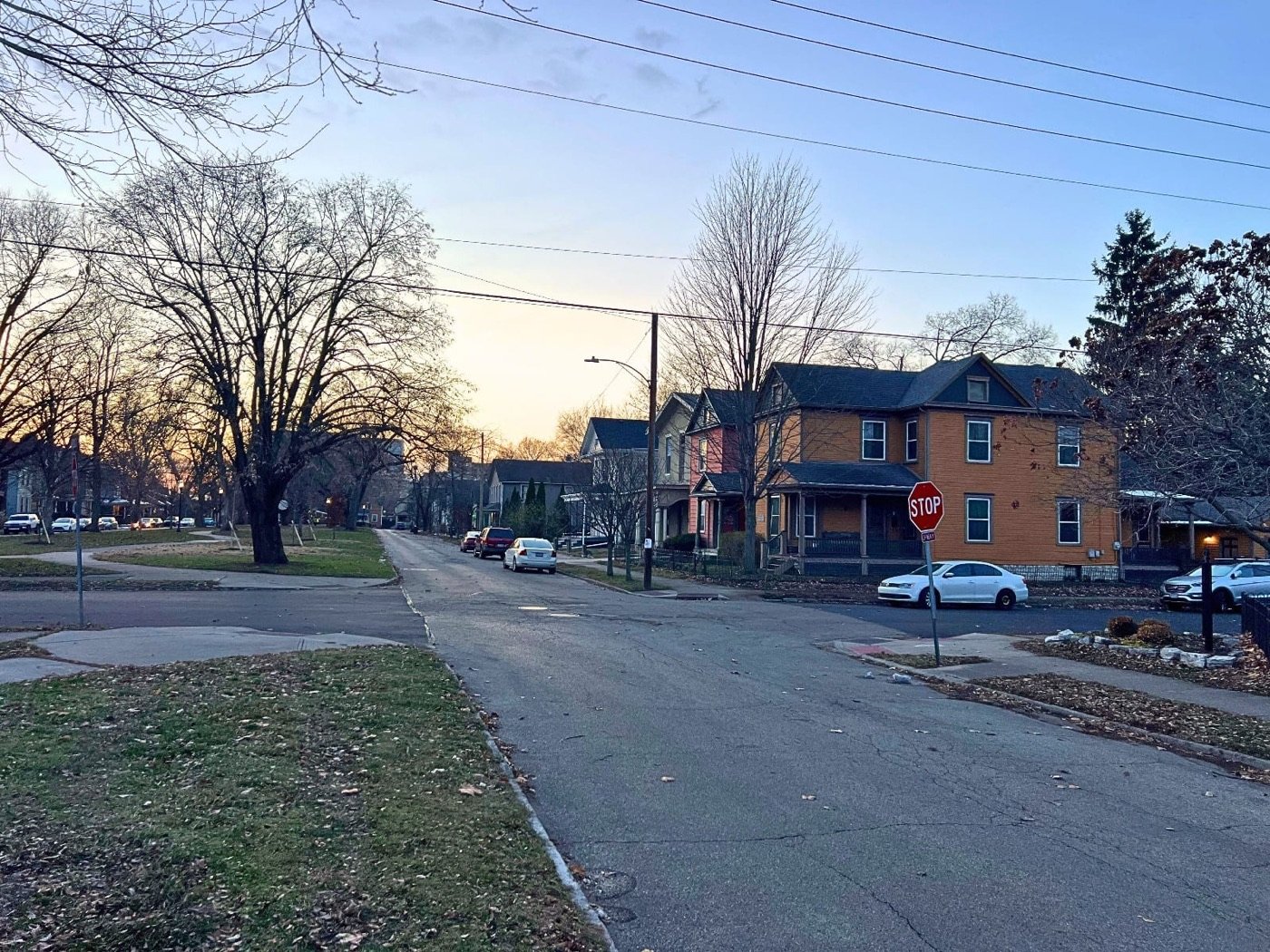
South Park is not like the rest of Dayton, and pest control here should not be either. The historic district south of downtown — the blocks between Warren Street and Wayne Avenue, in the shadow of Miami Valley Hospital and a short walk from the University of Dayton and the Brown Street corridor — is one of the largest intact collections of Victorian-era housing in Ohio. Steep gables, brick foundations, deep front porches, and street after street of homes built in the 1880s and 1890s. We service South Park constantly, and this page covers exactly what we find there and how we treat it.
Why 130-year-old houses have a different pest profile
A South Park home was framed before building codes, before sill sealers, and before anyone imagined a pest control industry. That history is what makes the neighborhood beautiful, and it is also what makes it porous. Stone and brick foundations laid in lime mortar develop gaps as the mortar softens with age. Balloon framing — the old technique where wall studs run unbroken from foundation to attic — creates open vertical chases that let a mouse enter at the sill and turn up in a second-floor wall without ever being visible. Original wood sills sit close to grade, cellar doors and coal-chute conversions rarely seal tight, and a century of utility retrofits (gas, electric, cable, mini-splits) has left generations of penetrations through the masonry.
None of this means a historic home has to live with pests. It means the inspection matters far more than the spray. When we work a South Park house we spend most of our first visit at the foundation line and in the basement, mapping actual entry points — then we seal, trap, and treat in that order.
The pests we deal with most in South Park
Mice
The number one call. Old foundations plus dense block-by-block housing means mice move along fence lines, porches, and shared alleys until they find the one gap that lets them in — and in this neighborhood there is always a gap. Our approach is exclusion-first: copper mesh and sealant in mortar gaps, hardware cloth over vents and chute openings, door sweeps on cellar entries, then interior trapping to clear the population already inside. Poison alone in a balloon-framed house is a mistake — mice die in wall chases and you live with the odor for weeks. See our full rodent control service.
Ants — pavement, odorous house, and carpenter
Brick sidewalks and stone foundations are pavement ant heaven; you will see their little soil volcanoes between pavers all summer. Odorous house ants trail into kitchens along plumbing. And the mature street trees that give South Park its canopy also support carpenter ants, which move from dead limbs into porch columns, sill plates, and any wood kept damp by a failing gutter. Carpenter ants in a 140-year-old sill deserve immediate attention — the galleries expand year over year. Our ant control page covers the treatment differences.
Cockroaches and bed bugs in the rental mix
South Park’s housing stock includes a healthy share of rentals, doubles, and student housing serving the UD and hospital corridors. Turnover moves pests. German cockroaches arrive in moving boxes and secondhand appliances; bed bugs arrive in furniture and luggage. In doubles and converted multifamily buildings, treating one unit while the neighboring unit goes untreated fails — roaches simply shift through shared wall voids and return. We treat attached housing as one structure, and we offer landlords scheduled programs that catch introductions early, with the documentation to show tenants the problem is being handled professionally. Details on our roach and bed bug pages.
Wasps, spiders, and basement insects
Deep Victorian porches and ornate cornices are prime real estate for paper wasps; slate and standing-seam roof lines hide yellowjacket entries. Unfinished limestone basements stay cool and damp — exactly what camel crickets, sowbugs, centipedes, and the spiders that hunt them want. A dehumidifier plus a perimeter treatment and exterior sealing knocks the basement ecosystem down dramatically.
Termites and the historic district
This one matters more in South Park than almost anywhere else we work. Original growth lumber is dense and termite-resistant compared to modern framing, but a century of moisture history changes the math: porch posts that meet soil, sill plates behind grade-level flower beds, framing above damp cellars, and additions tied into the original structure with newer wood. Subterranean termites work from the soil up, and in a historic home the damage they do is not replaceable at the lumber yard — that trim profile has not been milled since 1895. We are licensed for both termite treatment (Ohio 10B) and WDI inspections (Category 12), and if you are buying or selling in the district, a real inspection — not a drive-by — protects everyone in the transaction.
Treating historic homes without damaging them
We treat a lot of old houses, and our rule is simple: reversible first, discreet always. Copper mesh and removable sealants in masonry gaps rather than aggressive drilling through historic brick. Bait placements and dusts injected into existing voids rather than new holes in plaster. Exterior treatments applied to the foundation line, not sprayed across painted woodwork. If a treatment plan for a South Park home would make a preservationist wince, it is the wrong plan.
A South Park seasonal calendar
- March–May: ant swarms emerge from foundations and tree bases; termite swarmers appear on warm days after rain — save any winged insect you find inside and call us for a free ID
- June–August: wasp nests peak on porches and cornices; basement insects thrive in humid cellars; bed bug moves spike with summer leases
- September–October: the fall mouse push — the two-month window when every gap in a stone foundation gets tested nightly as temperatures drop
- November–February: interior rodent activity peaks; overwintering wasp queens and cluster flies appear in upper floors on warm days
Why neighbors call us
Our office sits at 733 Salem Ave — we are a Dayton company, not a franchise routing you through a national call center. Quotes are free, pricing is quoted before work begins, and every treatment is guaranteed as quoted — and our Protection Plan adds the full re-treatment guarantee: on our Protection Plan, if covered pests come back between visits, so do we, at no charge. We know the difference between a 1970s ranch and an 1890s Victorian, and we treat them differently.
Whether you are in a restored showpiece on Park Drive, a double you rent out near the hospital, or a fixer you just closed on, we can tell you exactly what you are dealing with — usually from a photo. Text one to (937) 569-3330 for a free identification.
Also serving the surrounding neighborhoods — see our Dayton pest control page, our downtown Dayton coverage, and the full service area list.
South Park pest control questions we hear
Can you get rid of mice permanently in a house this old?
Yes — with the right definition of permanent. No one can promise a 130-year-old foundation will never admit another mouse, but exclusion work plus a maintenance interval keeps homes at zero activity year after year. The homes that struggle are the ones treated with bait alone, forever, while the entry points stay open.
Is treatment safe for kids, pets, and gardens?
Everything we apply is used per label, targeted at cracks, voids, and exterior foundation lines rather than broadcast across living spaces. Tamper-resistant stations protect bait placements. We will walk you through every product before we use it.
Do you handle the whole double, or just my side?
We strongly recommend treating attached structures as one building — and we make it easy by coordinating with the other side or the owner. It is the single biggest factor in whether roach and bed bug work succeeds in this neighborhood.
Free quotes, same-week scheduling, and honest answers about what your house actually needs. That has been the deal since day one, everywhere in Dayton — and in South Park, it comes with a genuine respect for the houses themselves.
The alley economy: how pests move through a dense district
South Park’s density is part of its charm and part of its pest logic. Alleys thread the blocks, carriage houses and garages line them, trash lives in them, and fence lines connect every yard to every other yard. For rodents this is highway infrastructure: a population fed by one block’s loose trash pressures every foundation along the alley, and a single neglected property — an overgrown lot, a vacant house mid-renovation, a chronically open dumpster — radiates activity in a hundred-yard circle around it. This is why we think in blocks here, not just houses. When we work a South Park property we note the alley conditions in the service report, and when several neighbors are feeling the same pressure we will happily quote the block together — coordinated exclusion on connected houses succeeds where one sealed house between two open ones just redirects traffic.
Renovation waves matter too. Every gut-rehab — and the district always has a few running — displaces whatever lived in the walls and disturbs ground that has not moved in a century. If the house two doors down just got demoed to the studs and you suddenly have mice for the first time in years, those facts are related. A short-term monitoring setup through a neighbor’s construction season is cheap insurance we set up all the time.
The damp-basement playbook, step by step
Because the limestone cellar is the engine of so many South Park problems, here is the actual sequence that fixes one. First, water management: gutters cleaned and downspouts extended six feet from the foundation — half the damp basements we see are being watered by their own roof. Second, humidity: a properly sized dehumidifier holding the space under 50 percent, drained to the floor drain so nobody has to remember a bucket. Third, storage discipline: cardboard off the floor and out of the cellar entirely (it is both food and housing for insects), replaced with sealed plastic totes on shelving. Fourth, exclusion: the cellar door weatherstripped, the window wells screened, the utility penetrations sealed. Fifth — and only fifth — treatment: a perimeter application and targeted dusting of the voids, which now works because the habitat no longer replaces what the treatment removes. Homeowners who do steps one through three themselves cut their basement pest population dramatically before we ever open a product; we tell every client this, because the ones who hear it stop needing us for the basement.
Porch season, protected
South Park lives on its porches from May to October — and so do its paper wasps. Victorian porch architecture is practically designed for them: beadboard ceilings with gaps at every board end, ornate brackets and spindlework full of protected crevices, hollow columns, and rail assemblies nobody has opened since restoration. A porch nest by July means a summer of flinching at your own front door. The schedule that works: a spring inspection and treatment of the ceiling gaps and bracket work before queens establish (April), a mid-season patrol (June), and prompt nest response after that — small nests are five-minute work, established colonies in a hollow column are not. We treat porch structures with materials chosen for painted historic woodwork, applied into the gaps rather than across the finishes, and we will point out the three board gaps that a bead of caulk would close forever while we are up there.
For the district’s landlords and flippers
A big share of our South Park work comes from owners who hold doubles and small multifamily buildings here, and from renovators bringing houses back. For landlords: our scheduled programs cover common areas and units on a cadence, turn-over inspections catch bed bugs and roaches between tenants (the cheapest possible moment to catch them), and every visit generates documentation — which matters in a college-adjacent rental market where “who brought the bed bugs” disputes end up mediated by paperwork. For renovators: pre-purchase WDI inspections before you close on a century-old shell (the seller’s disclosure will not mention what the sill looks like under the porch), a treatment plan sequenced with your construction schedule, and exclusion work done while the walls are open — sealing a balloon-framed house from the inside during a gut rehab is a once-in-a-century opportunity, and we have specced it with contractors across the district.
What a South Park first visit looks like
Budget an unhurried hour. Outside: the full foundation lap with a light and mirror — mortar joints behind the shrubs, the porch skirt, the cellar entrance, every utility penetration, the alley-side conditions. Inside: the cellar first (it is the truth-teller in these houses), then the kitchen plumbing runs, the attic if access allows, and wherever you have seen activity. You get photos of everything we find, an explanation in plain English of how the house is being entered and why, and a written quote before anything is scheduled. If part of the fix is a five-dollar tube of caulk and a downspout extension, that goes in the plan as your homework instead of our invoice. Historic-district homeowners have been sold enough things; we would rather earn the block one honest job at a time.
The district’s bottom line
An 1890s house is not a pest problem — it is a house that predates the idea of pest-proofing, waiting for someone to retrofit it thoughtfully. The lime-mortar gaps can be sealed reversibly. The balloon-frame chases can be interrupted. The cellar can be made dry and boring. The porch can belong to you instead of the wasps, the double can be treated as the single structure it secretly is, and the sill the termites want can be monitored like the irreplaceable lumber it is made of. That retrofit is a craft, it is our favorite kind of work, and it is available one free quote away: (937) 569-3330, Monday through Friday 8–6, Saturdays by appointment. Greater Dayton Pest & Rodent — licensed (OH #170858), insured, local, and glad South Park exists.
Do you handle the carriage houses and garages too?
Yes, and they deserve inclusion in any serious plan. Alley structures are the district’s pest reservoirs — unheated, storage-filled, alley-adjacent, and visited weekly at best. A sealed main house next to an open carriage house is half a job. We treat and seal them together, and for owners restoring a carriage house into living or studio space, the same walls-open exclusion opportunity applies as in the main house: do it during the renovation, and it is done for fifty years.
Our house was “treated” by the previous owner. Does that carry over?
Sometimes — and it is worth finding out. Ask the seller for records: a termite treatment may carry a transferable warranty, and bait-station systems around the foundation need a company actively servicing them to mean anything. If you closed without records, a baseline inspection sorts out what is protecting the house versus what is just hardware in the ground. We read other companies’ installations all the time and will tell you plainly what you inherited.
Frequently asked questions
Do you provide pest control in South Park?
Yes — the historic district’s Victorian blocks are minutes from base and get the preservation-grade routing their architecture deserves.
What pests are most common in South Park?
Victorian-stock files: foundation mice through century mortar (the leader), American roaches off the old laterals, moisture guilds in stone basements, cavity wasps in the ornate eaves, and carpenter ant flags wherever original gutters have leaked.
How much is pest control in South Park?
Standard formula — the district’s footprints price honestly: most homes $39–$55/month quarterly; one-time flat. Free: (937) 569-3330.
Can you work on Victorian houses without damaging them?
That is the district craft — masonry-appropriate exclusion (copper mesh, mortar-compatible patching), slate-and-trim-safe roofline work, reversible everything; the preservation protocols our Oakwood route runs, applied to South Park’s stock.
Why do the stone foundations here leak mice?
A century of mortar joints, coal-chute scars, and settling — a dozen doors per house by now; the masonry-grade sealing program closes them without harming what makes the district worth living in.
What about the ornate eaves and wasps?
Victorian trim is cavity-rich real estate — spring comb patrols and honest globe triage carry the file, with ladder work quoted plainly.
How fast can you reach South Park?
Minutes — core-route speed, days at most, priority faster, no travel charges.
Do the old basements need the moisture program?
Mostly yes — stone foundations run humid, feeding the cricket-and-centipede guild; dehumidifier-first doctrine plus seepage triage, and the bugs leave with the water.
Is termite monitoring important for the district?
Emphatically — age, stone, and generations of landscaping stack conducive conditions, and no-drilling bait systems suit finished Victorian basements precisely. Free annual inspections regardless.
How do I start service in South Park?
Instant quote, free photo ID, or (937) 569-3330 — free estimates, preservation-minded protocols, first visits typically within days.