Older houses give wasps more places to build than new ones do, and Hamilton is full of older houses. Deep porch ceilings, decorative cornice work, box gutters, gable vents with failing screen, brick chimneys with open flue tiles, detached garages, and the ornamental brackets and returns on a Victorian all offer exactly the protected, shaded, rain-sheltered space a queen is looking for in April. By the second week of August the colony she started is at full size, and that is when the calls arrive.
Why Everything Happens in August
A social wasp colony begins in spring with a single overwintered queen. She builds a small nest, raises the first workers herself, and through early summer the colony is genuinely tiny and goes unnoticed. Growth from there is exponential, and by mid-August a yellowjacket colony that held a few dozen workers in June may hold several thousand. Nothing about the house changed. The colony reached the steep part of its curve.
Late summer also changes their behavior in a way people feel. For most of the season workers hunt protein to feed larvae, and those larvae reward foragers with a sugary secretion. As the colony shifts toward producing next year’s queens, that reward stops and the workers switch to seeking carbohydrates aggressively. That is why yellowjackets appear at porch tables, trash cans, and outdoor gatherings in late August after being invisible in June.
The colony dies with the first hard frosts, and only fertilized queens survive to overwinter under bark, in leaf litter, and in structural voids. That last detail matters on old houses: a cornice cavity or an unsealed soffit that hosted a colony this year is prime overwintering and re-nesting real estate next year, which is why the same house often has the same problem in the same place season after season.
What Old Architecture Provides
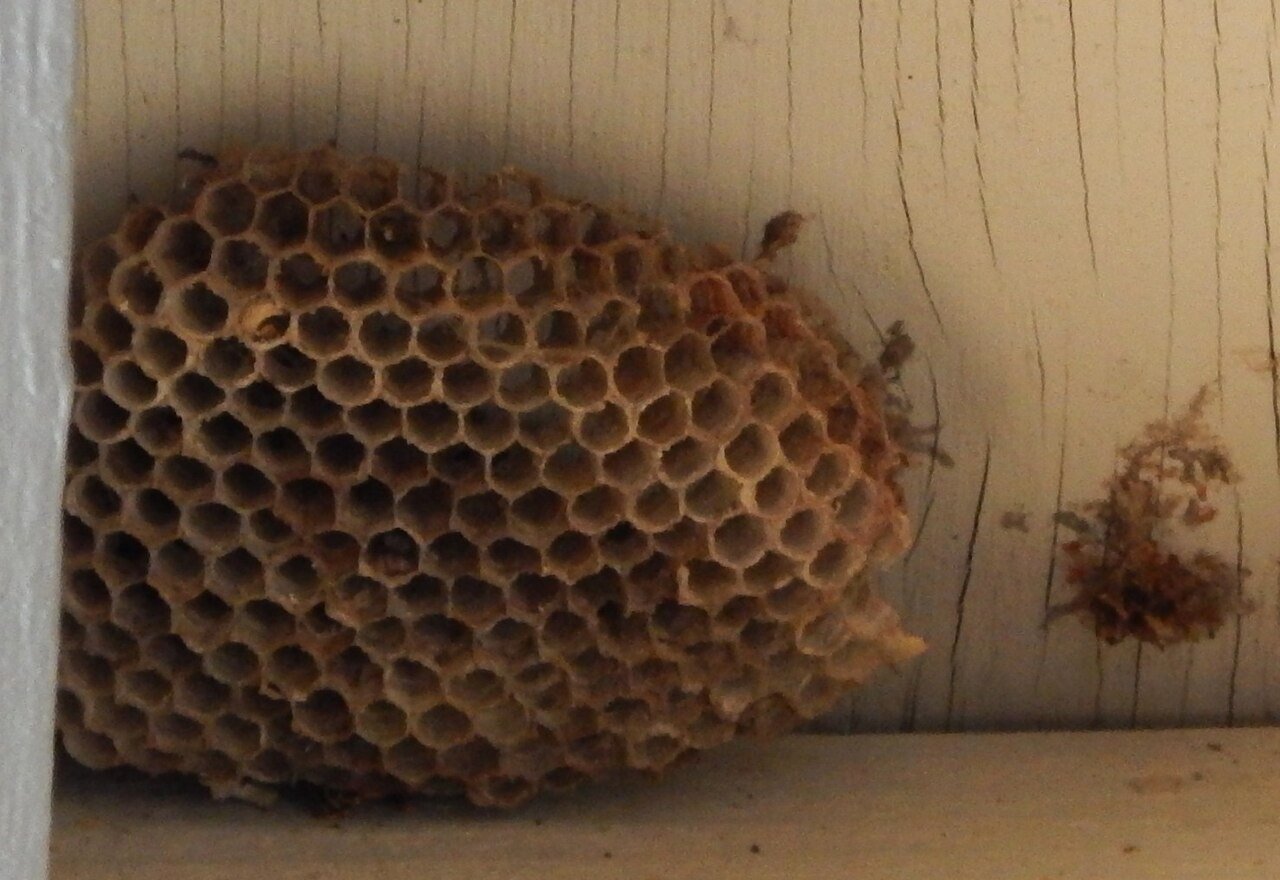
Paper wasps build the open, umbrella-shaped comb you can look straight up into. On these houses they favor porch ceilings, the underside of decorative brackets and cornice returns, gable vents, the inside of a detached garage, basement bulkhead doors left ajar, and the recesses of ornamental millwork. Colonies stay comparatively small, and paper wasps are the least aggressive of the three unless you are within a foot or two.
Bald-faced hornets build the large gray enclosed football. They are technically a yellowjacket, they defend an area well beyond the nest itself, and they are the species most likely to send someone to urgent care after a hedge trimmer or a ladder gets too close. On Hamilton lots they turn up in mature street trees, in overgrown boundary hedges, and tucked under the high eaves of a two-and-a-half story house where nobody has looked in years.
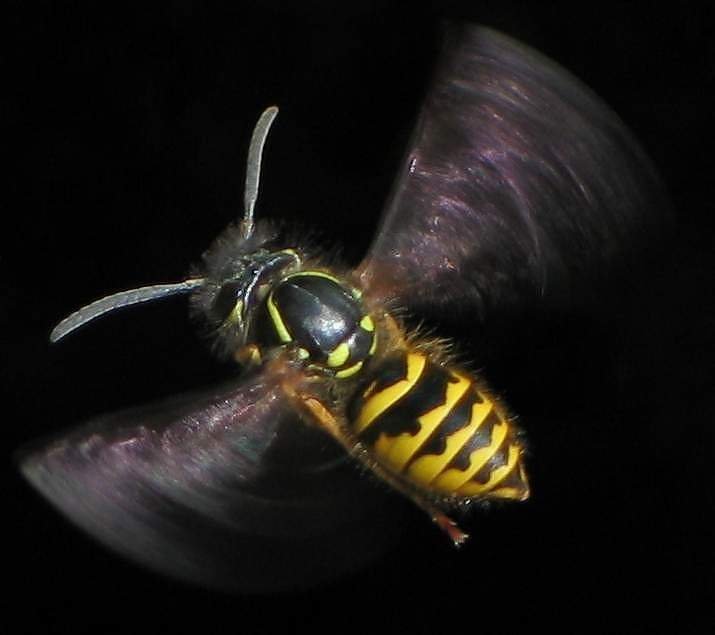
Yellowjackets cause the real trouble because they nest out of sight, and old buildings offer far more concealed void than new ones. Behind wood siding that has separated. Inside a box gutter. In the cavity behind a cornice. In a balloon-framed wall entered at a gap in the trim. In an abandoned rodent burrow in the yard, which becomes serious the moment a mower finds it. Steady traffic in and out of one specific gap is a void nest and should be treated as a structural problem.
- Open umbrella comb under a porch ceiling, bracket, or garage rafter — paper wasps.
- Large gray enclosed football in a street tree or under a high eave — bald-faced hornets.
- Traffic into one gap in siding, cornice, or box gutter — yellowjackets in a void. Do not seal it.
- Wasps from a hole in the lawn — ground-nesting yellowjackets and a genuine mowing hazard.
- Same spot every year — an unsealed void that keeps attracting new queens.
The Mistake That Puts Wasps Inside
When homeowners find yellowjackets using a gap in the siding or the cornice, the intuitive response is to seal it. It is entirely logical and it is the worst available option. A void colony has one familiar exit and a nest that may hold thousands of insects. Close it and they do not leave — they look for another way out, and in an old house the next available route is very often inward, through a plaster crack, a gap at a window casing, an old gas pipe penetration, or a balloon-framed cavity that opens into a closet.
That turns an exterior nuisance into wasps in a bedroom, which is both dangerous and considerably more expensive to resolve. The correct sequence is always treat first, confirm the colony is dead, seal afterward. And sealing does matter as a final step, because an untreated void left open will attract next year’s queens to exactly the same space.
The related mistake is the ladder, and on a two-and-a-half story Hamilton house it is a serious one. Most severe wasp injuries happen to people who were on a ladder when they got stung, and the sting is rarely the actual injury. An extension ladder against old brick, at a cornice you cannot see into, with a colony that defends a radius rather than a point, is a bad place to discover you are more allergic than you assumed.
Chimneys, Garages, and Shared Walls
Three Hamilton-specific situations come up often enough to name. Open chimney flues on houses where the fireplace has not been used in decades are regularly colonized, and because the flue connects to the interior, treatment and closure need to be handled in the right order and the damper checked. A capped flue solves it permanently and is worth doing once.
Detached garages are the second. Open rafters, no interior finish, a door that no longer seals, and infrequent entry mean colonies get large before anyone notices, and the first encounter is often somebody reaching for something on a shelf. Checking garage rafters in June, when a nest is a queen and a dozen cells, is the cheapest possible version of this problem.
Third, on the blocks where houses sit close together or share a wall, a nest in a neighbor’s cornice is functionally a nest on your property. Foraging range extends well beyond the structure, and a void that runs along a shared wall may be accessible from either side. That is worth a conversation between neighbors before it becomes a conversation about who pays for what.
Across Butler County
Fairfield to the south is newer construction with fewer concealed voids. Oxford northwest and Middletown northeast have comparable older architecture.
General service is on the Hamilton pest control page.
Frequently asked questions
Why do wasps suddenly appear everywhere in August?
The colony started in spring with one queen and grows exponentially, hitting its largest size in late summer. At the same time the workers switch from hunting protein to seeking carbohydrates, which is why they show up at porch tables and trash cans. Your property did not change; the colony did.
Should I seal the gap where wasps are going into my cornice?
No — that is the one thing not to do. A void colony that loses its familiar exit looks for another way out, and in an old house the next route is often inward through a plaster crack, a window casing gap, or an old pipe penetration. Treat first, confirm the colony is dead, then seal.
They build in the same place every single year. Why?
Because it is good real estate — protected, shaded, sheltered from rain — and because an unsealed void that hosted a colony is prime overwintering and re-nesting space. Cornice cavities, box gutters, porch ceilings, and gable vents get reused by different queens season after season. Treating and then sealing is what breaks it.
There are wasps coming out of my chimney.
Common on houses where the fireplace has not been used in years. Because the flue connects to the interior, the treatment and the closure have to be sequenced properly and the damper checked. Capping the flue afterward solves it permanently and is worth doing once.
Can I spray the nest myself?
For a small paper wasp nest you can reach from the ground, often yes. For anything requiring a ladder, anything enclosed in a wall or cornice, or anything in the ground, it is a genuinely bad idea. Most serious wasp injuries happen to people who were on a ladder at the time.
My detached garage is full of wasps.
Open rafters, no interior finish, and infrequent entry let colonies grow large before anyone notices. Checking garage rafters in June, when a nest is a queen and a dozen cells, is the cheapest version of this problem by a wide margin.
Is it worth removing a nest in October?
Usually not, if it is an exposed aerial nest — the colony dies with the first hard frosts and the nest is not reused. A void nest inside the structure is different, because that space stays attractive to next year’s queens and is worth treating and sealing.
The nest is in my neighbor’s cornice. Does that affect me?
On these lot sizes, yes. Foraging range extends well past the structure, and on shared or near-shared walls a void may be accessible from either side. It is worth raising with the neighbor early, before it becomes a discussion about who pays for what.