
Twice a summer, someone in the Miami Valley finds a beetle the size of a small mouse on their porch screen, takes the obligatory photo-with-a-coin-for-scale, and asks the internet whether Ohio has always had insects like this. It has — and the answer to the follow-up (“should I worry?”) is the most cheerful acquittal in this library. This is the giant beetle file: the eastern Hercules beetle (Ohio’s heavyweight champion), the stag beetles with their antler jaws, the rhinoceros and ox beetles of the family album, and the tropical monsters the internet keeps insisting live in your yard. What they are, what those horns actually do, why finding one is a compliment to your neighborhood’s old trees — and the two-sentence honest section on pest status, because for once, the answer is a flat no.
The Eastern Hercules Beetle: Ohio’s Heavyweight
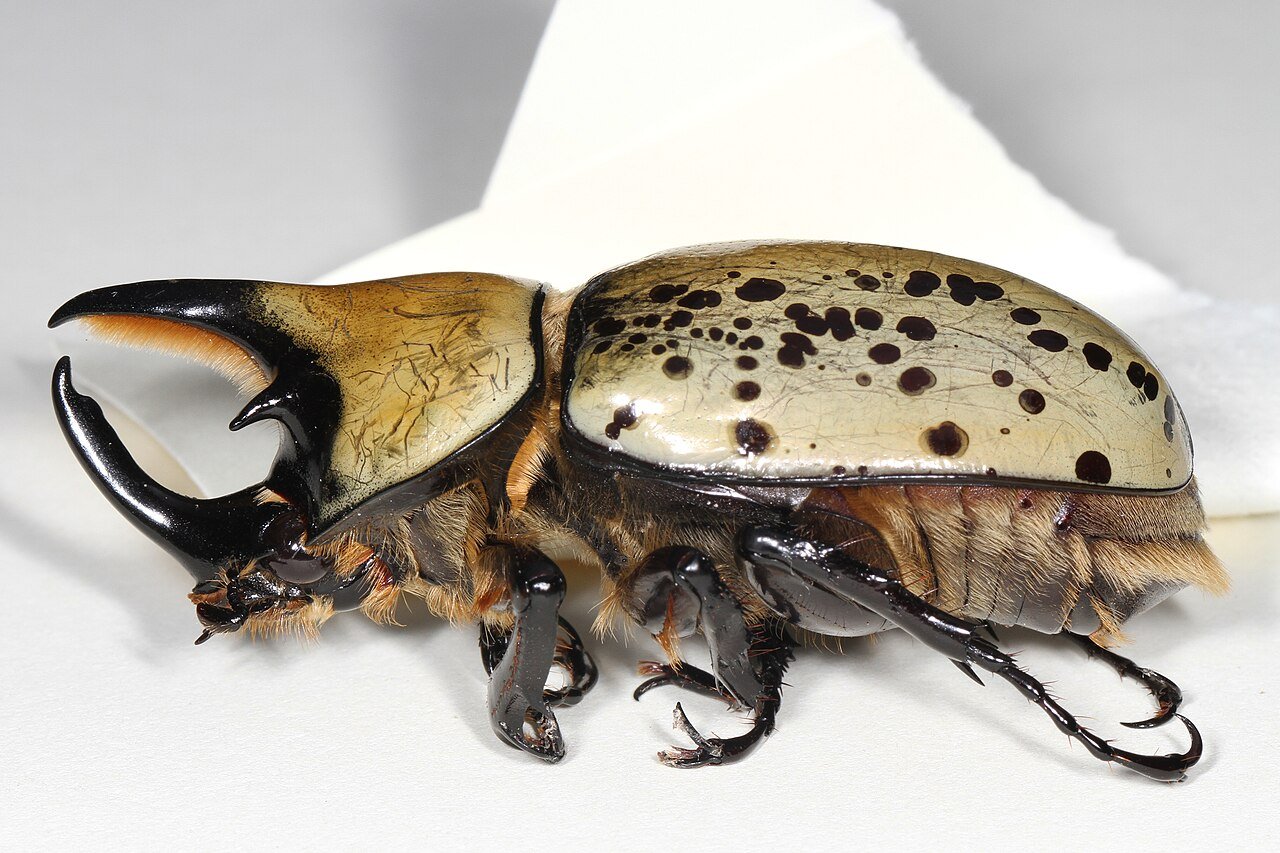
The eastern Hercules beetle (Dynastes tityus) is Ohio’s largest beetle and among North America’s heaviest insects: males reach two and a half inches of mottled olive-and-black armor topped with a pair of forward-curving rhinoceros horns. The horns are wrestling equipment, full stop — males use them to pry rivals off logs in mating disputes, and against humans they can accomplish nothing whatsoever; the beetle can’t bite meaningfully, can’t sting, and its defense strategy is a hiss of startled air and a leisurely trundle. The life story explains the rarity of sightings: larvae spend one to two years as enormous grubs inside decaying hardwood — rotting oak and ash hearts, old stumps, fallen logs — converting dead wood to soil, and the armored adults live only a few summer months, flying clumsily to lights on July nights. A Hercules on your porch means mature hardwoods with standing deadwood somewhere within a few hundred yards: the entomologist’s read is “healthy old-growth pocket,” not “infestation.”
Ohio’s biggest beetles are harmless and worth a second look. For the ones that are genuinely a nuisance indoors, see pest control in Dayton.
Stag Beetles: the Antler-Jawed Wrestlers
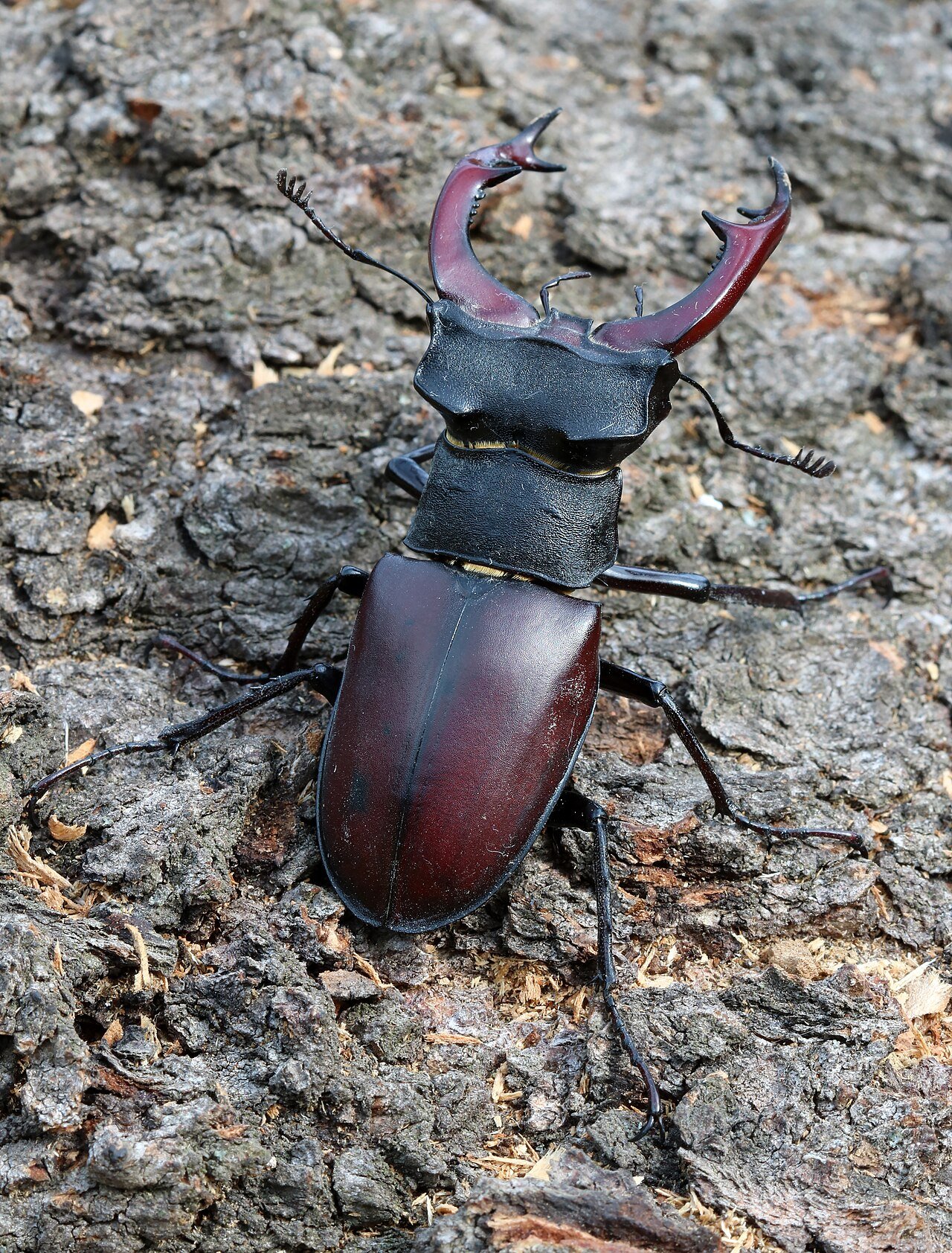
Ohio’s stag beetles — the reddish-brown giant stag (Lucanus capreolus) most commonly — carry the family’s trademark: males wear their mandibles as sweeping antlers, sometimes half their body length, evolved for the same log-top wrestling as the Hercules’ horns (the loser gets pried off and dropped, largely unharmed — beetle jousting is a gentleman’s sport). The antlers look ferocious and grip weakly; females have shorter, stronger jaws that can deliver an actual pinch if handled, in the tradition of this library’s consistent rule that the dramatic sex is the harmless one. Same biography as the Hercules: years as grubs in decaying hardwood, a summer as adults, evenings spent crashing into porch lights with the aerodynamic grace of a thrown boot. Their presence certifies the same thing — old wood decaying somewhere nearby, the woodland recycling program running on schedule.
The Family Album: Who Else Is Huge Around Here
- Ox beetle / rhinoceros beetle cousins: occasional Ohio finds — smaller-horned Dynastes relatives with the same rotting-wood résumé and the same zero threat.
- The grapevine beetle: the big amber-orange June flier that ricochets off porch lights — inch-plus, harmless, larvae in decaying wood, adults nibbling grape leaves without consequence.
- The “giant black beetle” on the patio: usually a bess beetle — shiny, inch-and-a-half, log-dwelling, famous for squeaking when picked up and for tending its young in family groups inside rotting logs. Harmless to a fault.
- Prionus and broad-necked root borers: the alarming late-summer heavyweights with spiny necks — native longhorns whose larvae work dead roots; startling at lights, structurally irrelevant.
- The internet imports to ignore: the six-inch South American Hercules (our species’ tropical big brother), Goliath beetles (Africa), and Japan’s pet-shop stag beetles — magnificent, real, and living nowhere near your zip code. The ID library’s standing rule applies: calibrate to your county, not your feed.
Do Giant Beetles Ever Need Pest Control? (No — Here’s the Whole Answer)
The honest section, at its shortest: no. Every giant on this page breeds in decaying wood — dead material already leaving the structural economy — and none of them touch sound lumber, framing, or live landscape trees in any meaningful way. They cannot infest a house (no indoor breeding substrate), they don’t bite unprovoked, they don’t swarm, and their entire annual appearance is a few humid July nights of bad navigation around your porch light. The complete management protocol: turn off the light or switch it warm-spectrum, escort stragglers off the welcome mat with a leaf, and show the kids — a live Hercules beetle on the hand is the best free zoo exhibit an Ohio summer offers. The one caveat worth a sentence: recurring giant-grub discoveries in a landscape stump or dying tree are commentary on the WOOD (it’s further gone than it looks), which is an arborist’s conversation — the beetles are just the messengers, eating the message.
If the big beetle you found doesn’t match this page — smaller, faster, indoors, or in numbers — that’s a different file: the black beetles in the house guide covers the indoor cast, and a photo to us settles anything in ten minutes. Serving Dayton and all of Montgomery, Greene, Miami, Clark, Warren, Butler, Preble, and Darke counties.
Horns, Antlers, and the Physics of Beetle Jousting
The weaponry deserves its science section, because it’s better than the folklore. Hercules horns and stag antlers are sexually selected tournament gear — grown at enormous metabolic cost, sized to advertise larval nutrition (a well-fed grub becomes a long-horned male; a lean one becomes a “minor” male who skips jousting and relies on sneak matings, a documented alternative strategy biologists adore), and used in stylized bouts with rules: grip, lever, lift, drop. High-speed studies of stag beetle bouts show the antlers’ geometry optimized for prying a rival’s grip rather than piercing anything, and losers walk away to fight again — evolution built a sport, not a war. The Hercules adds a party trick: its elytra shift from olive-yellow to near-black with humidity, a passive color change researchers have studied for materials science. And the larvae powering all this pageantry are ecosystem infrastructure: a single Hercules grub processes pounds of dead wood, and woodland soil health measurably tracks the saproxylic beetle community’s. The takeaway pairs nicely with this library’s oldest rule — the more theatrical the armament, the more ritual its purpose. Nature spends drama on courtship and efficiency on threat; the genuinely dangerous animals in your county are drab.
Finding One: the Naturalist Protocol
Since a giant beetle encounter is a once-a-summer event worth doing right: photograph it where it sits (coin for scale — the tradition is mandatory), lift it gently from below if you want the hands-on moment (they grip like tiny towing hooks; let it release itself), show every child within recruiting distance, and set it on the nearest tree trunk rather than the lawn — vertical bark is home turf and gets it off the sidewalk’s hazards. If it’s on its back and struggling (a chronic giant-beetle predicament; the armor is not built for yoga), the leaf-assist counts as your good deed. Log the find on iNaturalist if you’re the recording type — Ohio’s Dynastes and Lucanus records are sparse enough that backyard sightings genuinely contribute to range science — and know that July porch-light season is brief: by mid-August the year’s giants are done, their eggs already tucked into the deadwood that will spend two quiet years building the next ones. The whole spectacle costs nothing, harms nothing, and reliably converts one child per encounter into a person who checks porch lights hopefully every July for the rest of their life.
Why the Deadwood Economy Deserves Its Beetles
A closing word for the property owners deciding whether that back-corner stump “should” be removed: standing and fallen deadwood is the giant beetles’ entire nursery, and it’s also habitat for the woodpeckers, native bees, and predatory insects that quietly run your yard’s pest control for free. Arborists increasingly counsel leaving safe deadwood in place for exactly this reason — a stump that threatens nothing is a wildlife apartment block, not an eyesore debt. The distinction our termite pages draw matters here: deadwood BREEDING giant beetles is a closed loop that never touches your house; deadwood within foraging range of your foundation is a termite staging question worth the stump-map conversation. Same log, two different files — and knowing which file yours belongs in is precisely the kind of judgment a $99 inspection settles while the Hercules grubs sleep on undisturbed. The giants earned the benefit of the doubt; give the stump its hearing before the grinder wins by default.
The Collector’s Footnote (and the One Rule)
Giant beetles support a genuine global subculture — Japan’s beetle-keeping tradition runs to specialty shops, tournaments, and Hercules larvae changing hands for serious money — and Ohio kids regularly ask whether the porch-light find can become a pet. The honest answer: adult Dynastes and Lucanus live only weeks to a few months and are happiest finishing that span outdoors, but short-term observation (a night in a ventilated container with a slice of banana, released on the same tree tomorrow) is harmless and memory-making. The one rule that matters more each year: never ship, buy, or release non-native beetles — the exotic pet-trade species that escape become exactly the invasive stories our invasive species page chronicles. Ohio’s own giants are spectacular enough, free, and already adapted to the neighborhood; the July porch light is the only import license anyone needs.
And the summary this whole page has been building toward: Ohio’s biggest, most armored, most alarming-looking insects are woodland recyclers whose weapons are sports equipment, whose diet is dead wood, and whose appearance on your porch certifies old trees doing well nearby. In a library full of acquittals, the giant beetles may hold the cleanest record of all — the heavyweights never even committed a misdemeanor. Enjoy the July show; the light bill is the entire cost of admission.
(Season note for the eager: the reliable window is roughly July 4th through mid-August, humid still nights beating breezy ones, and rural or old-neighborhood porch lights beating new subdivisions — the beetles commute from deadwood, and deadwood follows old trees. Miamisburg’s river woods, Bellbrook’s ravines, and anywhere within a stone’s throw of a MetroPark run the best odds in our eight counties.)
One last identification safety net: if your giant was under two inches, uniformly glossy black, and moving fast along a wall — indoors especially — you’ve likely met a ground beetle or one of the household cast instead, and the black-beetles guide sorts that lineup. The true giants are unmistakable precisely because nothing else in Ohio approaches them; when you need a coin for scale, you’re on the right page.
Frequently Asked Questions
What is the giant beetle I found in Ohio?
Most likely the eastern Hercules beetle (2.5 inches, olive mottled armor, rhino horns on males) or a stag beetle (antler jaws, reddish-brown). Both breed in decaying hardwood, live a few summer months as adults, and are completely harmless — the horns and antlers are male wrestling gear.
Do Hercules beetles bite or sting?
Neither, in any meaningful way — no sting, no real bite, and the horns can’t hurt you. Their full defensive arsenal is a startled hiss and a slow walk. Female stag beetles can pinch if handled; the antlered males mostly can’t.
Why do giant beetles come to porch lights?
Adults navigate by night sky and lose the argument with artificial light during their brief July–August flight season. Warm-spectrum bulbs and motion sensors end the visits; the beetles are lost, not invading.
What do Hercules beetle and stag beetle larvae eat?
Decaying hardwood — they spend one to two years as large grubs inside rotting oak, ash, and old stumps, converting deadwood to soil. They never touch sound lumber or framing: a giant beetle certifies old trees nearby, not a structural problem.
Are giant beetles a sign of a pest problem?
The opposite — they indicate mature hardwoods with standing deadwood in the neighborhood: the woodland recycling program working. The only actionable read: repeated giant grubs in a landscape tree’s base mean that tree is more decayed than it looks — an arborist question, not a pest one.
Can I pick up a Hercules or stag beetle?
Yes — the Hercules is famously docile (kids hold them at nature centers), and male stag beetles’ antlers grip weakly. Handle females of either respectfully (stronger jaws), support from below, and put them back on wood. Best free zoo exhibit of an Ohio July.
Are the six-inch Hercules beetles online real?
Real — in Central and South America, where Dynastes hercules earns the name. Ohio’s eastern Hercules is its more modest cousin at 2.5 inches. Goliath and Japanese pet-trade beetles are similarly real and similarly elsewhere.
Do giant beetles damage gardens or trees?
No meaningful damage on either count — adults barely feed (grapevine beetles nibble leaves inconsequentially), larvae eat only dead wood. Nothing about this family belongs in a treatment plan.