
You found a small pile of what looks like coffee grounds or coarse pepper below a piece of woodwork, searched “termite droppings,” and every photo matches. Here’s the plot twist this page exists to deliver: in Ohio, a pile of pellet droppings is usually evidence against termites. The frass photos filling the internet come from drywood termites — a southern and coastal species that essentially doesn’t live here — while Ohio’s own eastern subterranean termite produces no droppings you’ll ever see, for a reason that’s genuinely fascinating. What your pile most likely is, what actual Ohio termite evidence looks like instead, and when the finding is worth a $99 professional answer: all below.
The Two Termite Digestions (This Is the Whole Page in One Section)
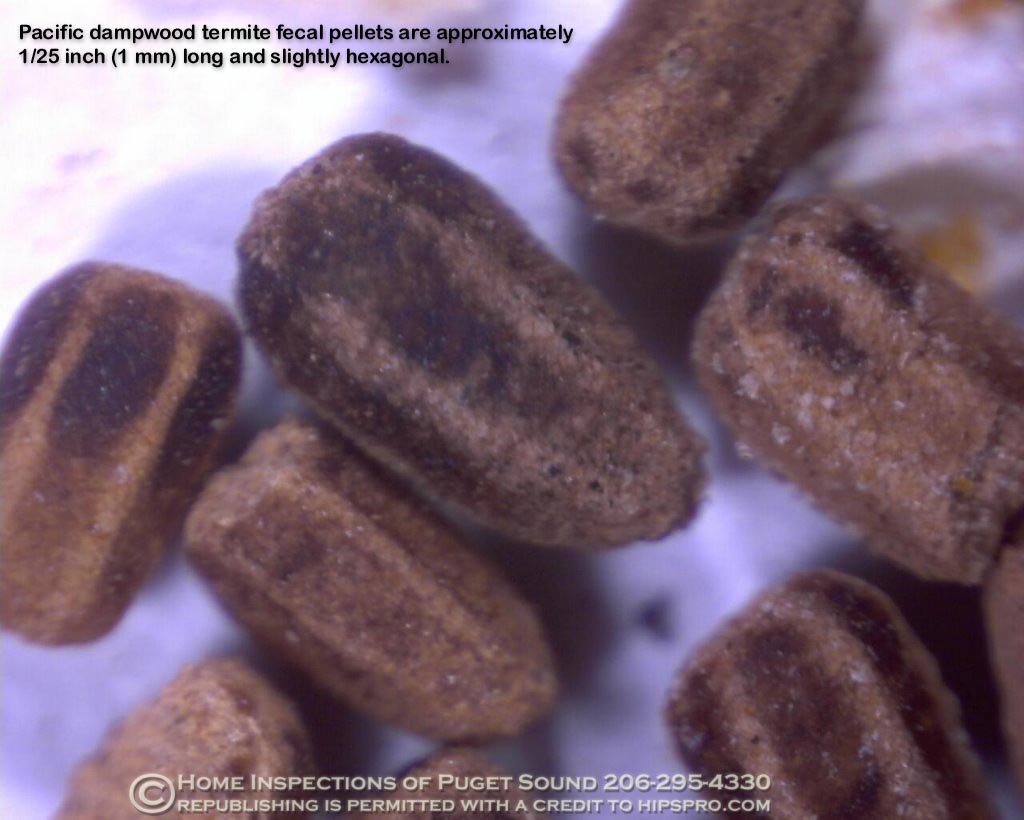
Drywood termites — Florida, the Gulf, coastal California — live entirely inside dry wood with no soil contact. Housekeeping matters in a sealed gallery, so they cut “kick-out holes” and eject their fecal pellets: dry, six-sided, sand-grain-sized granules that pile up beneath the hole like spilled coffee grounds. That’s the famous frass photo, and in drywood country it’s diagnostic gold. Eastern subterranean termites — Ohio’s species, and the one behind every local infestation we’ve ever treated — run their lives on a moisture pipeline between soil and wood, and they don’t discard feces at all: their wet, paste-like droppings are construction material, mixed with soil and saliva into the mud tubes and gallery plaster that define the species. Their droppings aren’t on your floor; they’re in the walls of their own architecture. One species exports its waste; the other builds with it. Which is why the pellet pile that would mean termites in Tampa means something else in Troy.
People who call them white ants often expect ant-like frass too; termite pellets look nothing like it.
A pellet pile usually means drywood beetles or carpenter ants rather than termites, and the difference changes the whole plan. Settling it is termite control in Dayton.
So What’s the Pile Under Your Woodwork?
- Carpenter ant frass — the #1 answer. Cone-shaped dumps of coarse, fibrous wood shavings, often with insect fragments mixed in, ejected from nest galleries above. Unlike termite pellets it looks like sawdust and fluff, not uniform granules. This finding has its own urgency — active excavation in the wood behind it — and its own page: carpenter ant evidence.
- Powderpost or other wood-boring beetle frass: flour-fine powder, talc-soft, sifting from pinhole exits in hardwood — a real wood-destroying insect finding (and one the WDI inspection covers by name).
- Plain sawdust: from construction, drilling, or friction at a sticking door — angular, bright, and smelling of fresh wood. No insect fragments, no holes above.
- Mouse droppings: the rice-grain black granules of the droppings guide — pointed ends, scattered along runways rather than piled below a hole.
- Actual drywood termite frass — the rare Ohio exception: it happens, almost always inside furniture, picture frames, or lumber shipped up from drywood country. A pellet pile emerging from grandma’s Florida dresser is the one local scenario where the internet’s photos apply — and it stays a furniture problem, not a house problem, if caught.
What Ohio Termite Evidence Actually Looks Like
Since the droppings search brought you here, trade it for the real local checklist: mud tubes — pencil-width earthen straws climbing foundation walls, piers, and sill plates (the structure built from those recycled droppings); hollowed wood that sounds papery under a knuckle rap, often with clean honeycombed galleries lined in dried mud; discarded wings on windowsills in spring — the swarmer evidence that sends more calls than any other; blistered or rippling paint over gallery moisture; and dirt in strange places — soil packed into a baseboard seam or door frame crack, the species’ signature caulk. Every one of these is worth a professional look; the full tour lives on our signs of termites page.
The Ten-Minute Frass Forensics Kit
Before anyone spends money, run the pile through four checks. Magnify it (a phone camera’s zoom works): uniform six-sided pellets = drywood-type frass (rare here — think imported wood); fibrous shavings with insect parts = carpenter ants; talc-fine powder = beetles; angular bright chips = plain sawdust. Look up: frass falls, so the story is directly above — a kick-out hole, a gallery crack, beetle pinholes, or a screw hole from Tuesday’s shelf project. Clean and wait: vacuum the pile, mark the spot with painter’s tape, and check daily — reappearance means an active producer, and the refill rate hints at colony size. Bag a sample: whatever you vacuumed or swept, keep a spoonful in a zip bag; a technician identifying frass by eye in ten seconds saves a diagnostic visit’s worth of guessing. Text us a macro photo and you’ll usually have the verdict before we’ve scheduled anything.
When the Finding Is Worth $99
Here’s the honest decision line. A pile that turns out to be sawdust or a one-time debris fall: no call needed — the tape test settles it free. Recurring piles, anything with insect fragments, powder from pinholes, or any find alongside the real termite checklist above: that’s inspection territory, because every one of those has a wood-destroying insect behind it and the differences between them (carpenter ant, beetle, termite) change the treatment completely. And if a real estate transaction is anywhere in the picture, the question answers itself: our $99 WDI inspection puts the finding on the NPMA-33 form lenders accept, covering termites, carpenter ants, and wood-boring beetles in one visit — the exact three suspects this page keeps naming. Frass questions during a sale aren’t homework; they’re disclosure items, and a $99 written answer beats a $0 guess that unravels at closing.
Found a pile you can’t explain? Send us the photo — identification is free, and the inspection is $99 if the photo earns one. Serving Dayton and all of Montgomery, Greene, Miami, Clark, Warren, Butler, Preble, and Darke counties.
Why the Internet Gets This Wrong for Ohio Readers
Search results have no geography. The pest control internet is written disproportionately from Florida, Texas, and California — drywood termite country — where frass piles genuinely are the front-line termite evidence and where the advice “found pellets? call a termite company” is exactly right. Ohio sits in a different termite world: one species, subterranean, moisture-dependent, invisible in exactly the ways this page describes. The mismatch matters in both directions. Ohioans finding pellet piles panic about termites they almost certainly don’t have — while the same homeowners can walk past a genuine mud tube on the foundation for years because nothing they’ve read taught them it was the local signature. Regional literacy is the correction: learn your own species’ evidence, discount the other region’s photos, and treat any national pest article’s “signs of termites” list as needing a local translation. Providing that translation is half of what a local inspection company is for.
The Furniture Exception, Handled Right
The one Ohio scenario where drywood frass is real deserves its protocol, because we see it a few times a year: pellets appearing beneath an heirloom dresser, a picture frame, reclaimed-lumber decor, or a wooden souvenir — almost always with a southern or coastal history. Don’t panic and don’t bomb the house: drywood colonies in furniture are self-contained, slow, and stay in the piece — Ohio’s climate and their biology don’t let them establish in the structure the way they do in Gulf-state attics. Do isolate the piece (garage or a room away from other wood), bag a frass sample, and get it identified. Confirmed pieces have real remedies short of the curb: professional fumigation chambers, heat treatment, or — for small items — a deep-freeze protocol that reliably ends the colony. The piece is savable, the house was never at stake, and the whole event costs an identification and a treatment decision rather than a structural panic.
What Subterranean “Invisible Droppings” Mean for Detection
The construction-material digestion isn’t trivia — it’s the reason Ohio termite damage so often runs years ahead of discovery. A drywood colony announces itself with housekeeping; a subterranean colony’s entire waste stream disappears into its own architecture, its workers never walk in the open, and its galleries stay sealed behind a veneer of intact paint or wood skin. The species is engineered for invisibility, which rewrites the homeowner’s job: you’re not watching for droppings, you’re auditing the handful of places the pipeline must surface — the foundation line (inside and out, spring and fall, flashlight at a raking angle for tubes), the sill plate atop basement walls, plumbing penetrations, and any wood within six inches of soil grade. Fifteen minutes twice a year, plus knowing that a spring flurry of winged swarmers or shed wings is the colony’s one loud moment. That audit habit — not pellet-watching — is what catches Ohio termites early, and it’s the same walk our inspectors do with better flashlights and a $99 form at the end of it.
Frass in a Real Estate File: One Paragraph for Agents
Because this page’s search traffic includes plenty of mid-transaction buyers: frass findings during a sale get resolved, not debated. A pellet pile noted by a home inspector goes to a licensed WDI inspector for identification, lands on the NPMA-33 with a named producer — carpenter ant, beetle, drywood (furniture), or none — and the deal proceeds on facts. The worst version of this event is the vague one: “possible insect debris noted, recommend evaluation” sitting unresolved in a disclosure packet, growing scarier with each retelling. At $99 with next-business-day service and pay-at-closing, the resolution costs less than the second phone call about the ambiguity. Agents around Dayton can book it in one minute at greaterdaytonpest.com/realtor.
File this page’s lesson wherever you keep the useful ones: in pest identification, geography is a diagnostic instrument. The same evidence reads differently by region, the internet flattens those differences, and the pile of pellets that would rightly alarm a Floridian should send an Ohioan looking up — for the carpenter ant gallery, the beetle pinholes, or Tuesday’s drill hole — before it sends them into a termite panic. And when the pile refuses to explain itself, that’s precisely what the photo-text and the $99 inspection are for.
(And a housekeeping note for word-lovers: “frass” covers all of it — insect droppings, chewed-wood ejecta, and gallery debris alike. When a technician says the word, they haven’t diagnosed anything yet; the diagnosis is which insect made it, which is the whole art this page just taught you.)
Frequently Asked Questions
What do termite droppings look like?
Depends entirely on species. Drywood termites (southern/coastal — not established in Ohio) eject dry six-sided pellets that pile like coffee grounds. Ohio’s eastern subterranean termites produce no visible droppings at all — their waste becomes mud-tube construction material. In Ohio, a pellet pile usually points away from termites.
I found piles that look like coffee grounds — is it termites?
In Ohio, probably not. The likeliest producers are carpenter ants (fibrous shavings with insect fragments), wood-boring beetles (flour-fine powder from pinholes), or plain sawdust. The rare local drywood-frass case comes from furniture or lumber shipped from the South. Magnify the pile: uniform six-sided granules vs. shavings vs. powder sorts the suspects fast.
Do subterranean termites leave droppings?
Not where you can see them — their wet, paste-like feces get mixed with soil and saliva into mud tubes and gallery plaster. Their droppings are their mortar. That’s why Ohio termite evidence is tubes, hollow wood, wings, and packed dirt — never pellet piles.
What’s the difference between termite frass and carpenter ant frass?
Termite (drywood) frass is uniform, granular, six-sided pellets. Carpenter ant frass is coarse, fibrous wood shavings — sawdust-and-fluff texture — usually mixed with fragments of dead insects, dumped in cone-shaped piles below a gallery crack. In Ohio, the carpenter ant answer is overwhelmingly more common.
Is frass dangerous to touch or breathe?
It’s not toxic, but treat any insect debris sensibly: gloves or a vacuum, and skip stirring up dust. Save a spoonful in a zip bag before cleaning — the sample identifies the producer faster than any description.
The pile keeps coming back after I vacuum it — what does that mean?
An active producer directly above: carpenter ants excavating, beetles emerging, or (from southern furniture) drywood termites housekeeping. Recurring frass is the finding that earns an inspection — the refill rate even hints at how big the operation is.
What are the real signs of termites in Ohio?
Mud tubes on foundations and piers, wood that raps hollow with mud-lined galleries, discarded swarmer wings on sills in spring, blistered paint, and soil packed into cracks where soil has no business. Pellet piles aren’t on the Ohio list.
Does the $99 WDI inspection cover frass identification?
Yes — the NPMA-33 wood-destroying insect inspection covers termites, carpenter ants, and wood-boring beetles, which are exactly the three serious suspects behind any frass find. One visit, one written answer lenders accept.