
“What do carpenter ants look like?” is the identification question with the most money riding on it in the ant world — because the answer routes between three wildly different files: the ordinary big-black-ant sighting that means nothing (a forager passing through), the structural flag that means a moisture problem is being excavated somewhere in your framing, and the termite confusion whose stakes our flying-ant pages have already priced. This page settles the look definitively: the size-and-silhouette key that names a carpenter ant at arm’s length (one smooth thorax line — the detail that does all the work), the color variations Ohio actually fields, worker-versus-major-versus-swarmer at a glance, the frass-and-gallery evidence that identifies the species when no ant shows, and the routing chart that turns each sighting type into its correct next move.
The look: size first, silhouette always
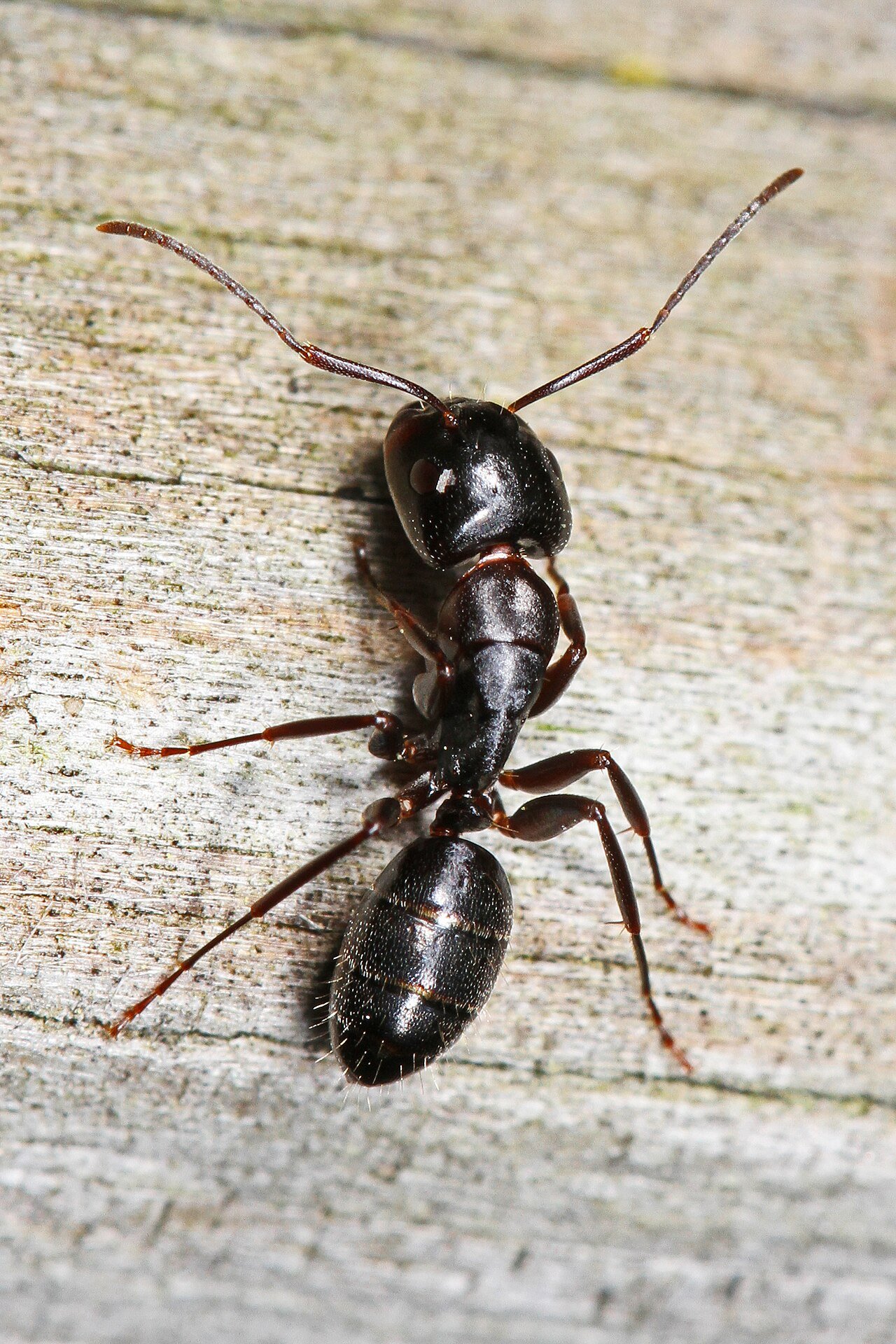
Size opens the case: carpenter ants are Ohio’s giants — workers run a quarter to a half inch (majors bigger still), which alone separates them from every kitchen-trail species; any ant that makes you look twice at its sheer bulk has entered carpenter territory. Silhouette closes it: viewed from the side, a carpenter ant’s thorax (the middle section) forms one smooth, evenly-arched curve — no dips, no bumps, no jagged profile — the field mark in the photo below and the single most reliable carpenter identifier at any size (field ants and other big look-alikes carry visibly uneven, notched thorax lines). Supporting marks: a single node (one small bump) at the waist, an evenly rounded head with elbowed antennae, and — on the eastern black carpenter, Ohio’s flagship species — a fine coat of golden hairs on the abdomen that catches light at close range. Color runs jet black for the flagship, with red-and-black regional cousins (thorax rusty, body dark) appearing often enough that color alone never decides; the smooth arch decides, every time, on every variant.
Confirming carpenter ants matters because the treatment is aimed at wood rather than a trail. That is ant control in Dayton.
The cast: worker, major, queen, swarmer
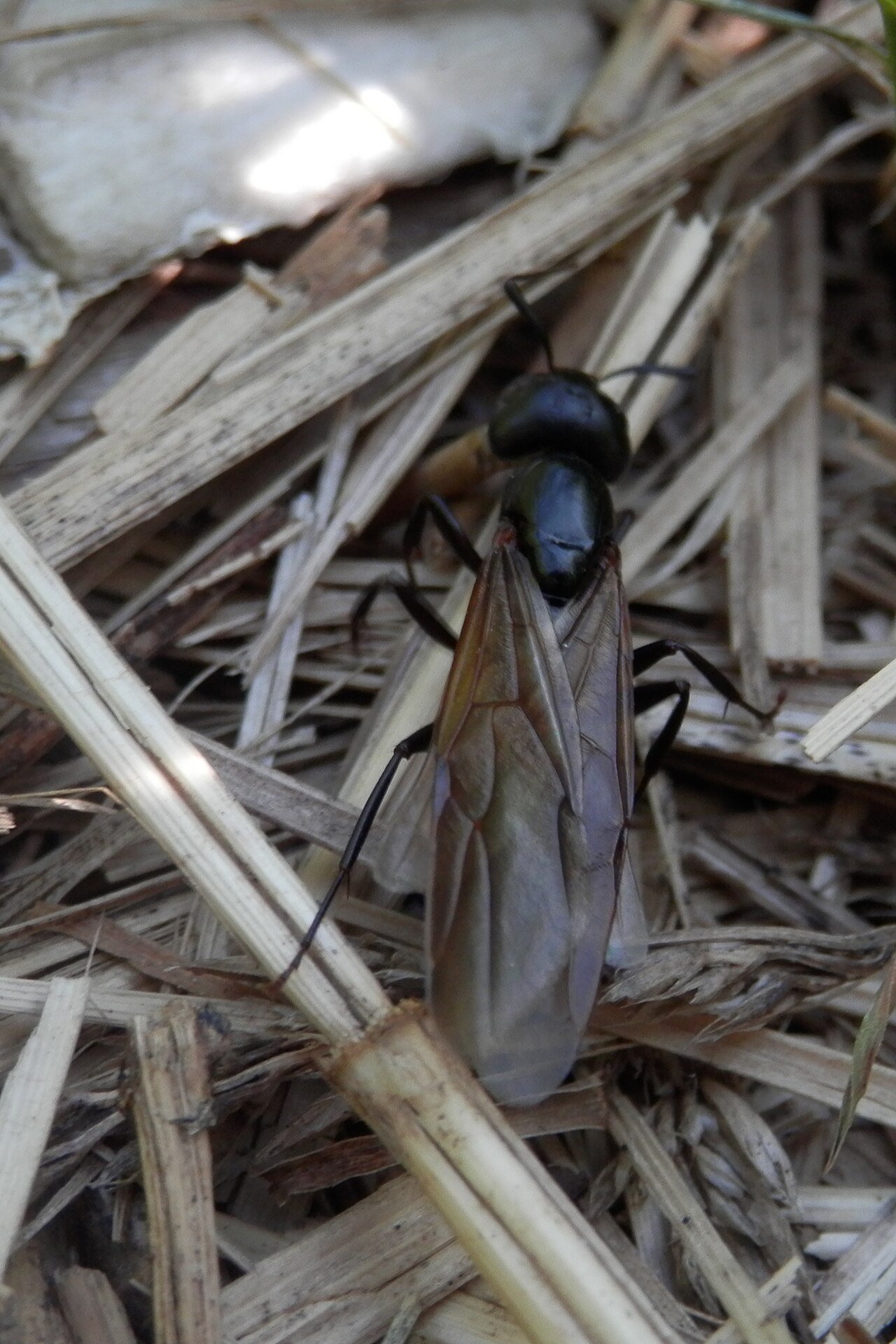
One colony fields four silhouettes worth knowing. Minor workers (quarter-inch-plus) do the foraging — the singles crossing your kitchen at night; major workers (up to a half inch, visibly larger-headed) guard and excavate — the “biggest ant I have ever seen” calls are majors; queens run three-quarters of an inch — wingless once established, and the barrel-bodied giant occasionally found wandering in spring is a newly-mated foundress seeking a nest site (a catch-and-release or dispatch decision with no colony attached yet); and swarmers — winged reproductives up to an inch with wings — fly in spring and run THE high-stakes tribunal: pinched waist, elbowed antennae, and unequal wing pairs mark the ant; the straight-bodied, equal-winged alternative is a termite and a same-week inspection, per the full comparison on our termites-vs-flying-ants page. Indoor swarmers of the ant kind still carry news — a mature carpenter colony swarms from somewhere, and “somewhere” being inside your walls is exactly what the routing chart below exists to check.
The evidence file: identifying carpenters when no ant shows
Half of carpenter confirmations happen by residue, and the signatures never overlap with the look-alikes’. Frass leads: the pencil-shaving sawdust piles below clean kick-out holes — fine wood fragments mixed with insect parts, dry and fluffy, accumulating beneath window frames, sills, and deck members; frass IS the carpenter signature (termites produce mud, never sawdust — the distinction that runs the whole wood-destroyer tribunal). Galleries confirm: carpenter excavations run SMOOTH and clean, sanded-looking chambers following the soft grain, utterly unlike termites’ mud-lined layered sheets. Sound supports: the dry rustling in quiet evening walls — excavation and colony movement — that our carpenter-ants-in-ohio page teaches the stethoscope trick for. And the calendar tell: big ants indoors in WINTER convict an in-structure nest by themselves (outdoor colonies are dormant; only an indoor colony fields January foragers) — the highest-urgency sighting in the whole file. Any two of the four together end the identification phase and start the moisture-and-nest hunt.
The routing chart: from sighting to correct next move
- One big ant, summer evening, ground floor: a forager from an outdoor colony — note it, check the fifty-foot radius (stumps, woodpiles, fence lines) per the outdoor-ants triage, and escort or dispatch the individual without ceremony.
- Several big ants, repeatedly, same room: a trail worth tracing at dusk (peak foraging) — direction and entry point map either an outdoor highway touching the house or an interior satellite nest; the full trace method lives on the carpenter-ants-in-ohio page.
- Big ants in winter, any count: in-structure nest confirmed by calendar alone — the priority inspection call, moisture map included.
- Frass piles or smooth galleries found: active excavation — photograph, leave undisturbed, and book the inspection; the pile’s location has already localized the nest for us.
- Winged giants in spring: the tribunal first (ant vs. termite marks above), then: outdoor ant swarm = census event; INDOOR ant swarm = mature in-structure colony announcing itself — inspection week.
- The wandering barrel-bodied giant in May: a foundress queen house-hunting — no colony yet, no alarm; one shoe or one cup ends the entire prospective infestation.
The bottom line
Carpenter ants look like exactly what they are — the biggest ants in the state wearing the smoothest silhouette: size that stops you, one clean thorax arch that names them, golden abdomen sheen at close range, and a supporting evidence kit (frass, smooth galleries, winter activity, wall-rustle) that identifies the species even in absentia. The look is step one of a file this library already runs deep — the species biography and nest-hunt method on carpenter-ants-in-ohio, the termite tribunal on the flying-ant pages, the moisture doctrine underneath it all — and the free photo line remains the fastest tribunal of them all: (937) 569-3330. Big, black, and smooth-backed earns the follow-up every time; everything smaller returns to the ordinary ant wing with the household’s blessing.
The look-alike tribunal: big ants that are not carpenters
The smooth-arch rule earns its keep against a real lineup. Field ants are the chief impostors — near-carpenter size, often black, and the builders of the lawn’s thatch mounds; their thorax profile carries a visible NOTCH-and-dip (the uneven skyline against the carpenter’s single arch), they never excavate structural wood, and their file is the outdoor-ants tolerance tier. Pavement ants’ majors occasionally alarm at close range but stay half a carpenter’s size with grooved head-sculpturing under any magnification. Allegheny mound ants — red-and-black mound builders of rural edges — match the two-tone cousins’ colors but carry the field ant’s notched profile and a conspicuous earthen mound no carpenter builds. And the non-ants: small black wasps walking (wing check), dark rove beetles (no elbowed antennae, no waist), and the occasional termite swarmer promoted to “big black ant” by panic — the tribunal marks acquit each in seconds. The pattern across every case: size raises the question, the thorax line answers it, and the answer routes the file — which is precisely why this page teaches a silhouette rather than a color.
One arch, one honest look, and the most expensive identification in the ant world becomes a ten-second check — run it at arm’s length, route by the chart, and let the library’s carpenter wing handle whatever the verdict opens.
Frequently asked questions
What do carpenter ants look like compared to regular ants?
Dramatically bigger — quarter to half inch against the kitchen trails’ eighth-inch crews — with the defining mark in profile: one smooth, evenly-arched thorax line (look-alike big ants carry notched, uneven profiles). Jet black in Ohio’s flagship species, with red-and-black cousins; a single waist node and golden abdomen sheen support the call.
How do I tell a carpenter ant from a termite?
They barely resemble each other as workers — carpenter ants are big, dark, and hard-bodied; termite workers pale, soft, and hidden. The confusion is swarmers: pinched waist, elbowed antennae, unequal wings = ant; straight body, beaded antennae, equal oversized wings = termite and a same-week inspection.
What does carpenter ant frass look like?
Pencil-shaving sawdust — fine, dry, fluffy wood fragments mixed with insect parts, piling below clean kick-out holes at window frames, sills, and deck members. Frass is the carpenter signature; termites produce mud instead, never sawdust, and the distinction routes the entire response.
Are big black ants always carpenter ants?
No — field ants match the size and color while carrying the notched thorax profile and a lawn-mound address; the smooth single arch separates them in one side view. The distinction matters: field ants are tolerance-tier; carpenters are a moisture flag.
What does it mean if I see one carpenter ant in my house?
Summer singles are usually foragers from outdoor colonies within the fifty-foot staging radius — note, trace if repeated, check the stump-and-woodpile perimeter. WINTER singles are different news entirely: only an in-structure nest fields January foragers, and that sighting books the inspection by itself.
How big is a carpenter ant queen?
Up to three-quarters of an inch — the barrel-bodied giant of the family, winged only until founding. A lone wandering queen in spring carries no colony yet; one cup or one shoe preempts the entire prospective nest.
What are the giant winged ants in my house?
Carpenter swarmers — up to an inch with wings — from a mature colony’s spring flight. Run the termite tribunal first; confirmed ANT swarmers emerging indoors still mean a mature colony in the structure somewhere, which is inspection-week news of its own.
Do carpenter ants have wings?
Only the reproductive caste, only seasonally — workers and majors never do. Wings on a big dark insect trigger the swarmer tribunal; wingless big-and-smooth-backed runs the standard worker file.
What color are carpenter ants?
Jet black leads Ohio (the eastern black carpenter, golden abdomen sheen included), with red-and-black species common enough that color never closes a case. The smooth thorax arch identifies every variant; color merely decorates it.
Who confirms a carpenter ant identification near Dayton?
The free photo line: (937) 569-3330 — a side-profile shot (the arch view) plus any frass photo settles it same-day, and confirmed carpenters route to the nest-hunt and moisture inspection their file requires. Big-ant photos are among our most consequential submissions; send them.
Why this identification carries the most money in the ant world
The stakes deserve their closing paragraph, because they explain the page’s existence. A missed carpenter identification compounds two ways: the STRUCTURAL way — excavation in moisture-softened framing enlarges quietly for seasons, and the difference between a first-summer nest-hunt and a fifth-year discovery is measured in sistered joists and contractor invoices; and the MOISTURE way — the nest maps a water problem (the leaking gutter, the failed flashing, the sweating pipe void) that costs its own compounding damage entirely apart from the ants announcing it. Meanwhile a FALSE carpenter identification wastes differently: field-ant mounds drenched to no purpose, ordinary foragers triggering treatment campaigns, and the classic over-response to a wandering May queen. The ten-second silhouette check — free, learnable, arm’s-length — sits between both error modes, which is as much leverage as any single glance in this library carries. Learn the arch, trust the frass, respect the winter rule — and let the biggest ant in Ohio keep being what it honestly is: the most useful early-warning system a wet piece of framing ever had.
The eight-county note runs short and familiar: the mature canopies and box-gutter blocks of Oakwood, Kettering, and the county seats file the most confirmed carpenters; the wooded ravines of Hills and Dales and Bellbrook run the densest fifty-foot staging pressure; and the farm counties’ barns and firewood economies supply the winter-sighting calls that jump every queue. Same arch, same frass, same verdict everywhere — and the same free photo line waiting on the profile shot: big, black, smooth-backed, and worth the ten seconds every single time.
Arch checked, frass filed, framing defended — the biggest ant in the book, identified at arm’s length and answered by the wing built for it.
One smooth line, read right, saves a framing bill — the cheapest structural inspection ever performed.