The bald-faced hornet holds two distinctions on the Ohio stinging-insect roster: it builds the most spectacular structure in the yard — the gray paper basketball that appears in a maple seemingly overnight — and it earns, honestly, the firmest never-DIY rule this library issues for any species. It is also, in the taxonomic fine print, not a hornet at all: the ivory-faced, black-armored builder is an aerial yellowjacket wearing a hornet’s name and defending its globe with a yellowjacket’s numbers and temperament. This page is the species’ complete file — identification, the famous nest from founding golf ball to autumn basketball, the defense radius that justifies the rules, the honest sting assessment, the free frost option for the right locations, and the professional protocol for the wrong ones — the full biography behind the shortest advice we give: admire from distance, and call before ladders.
Identification: the tuxedo among the stripes
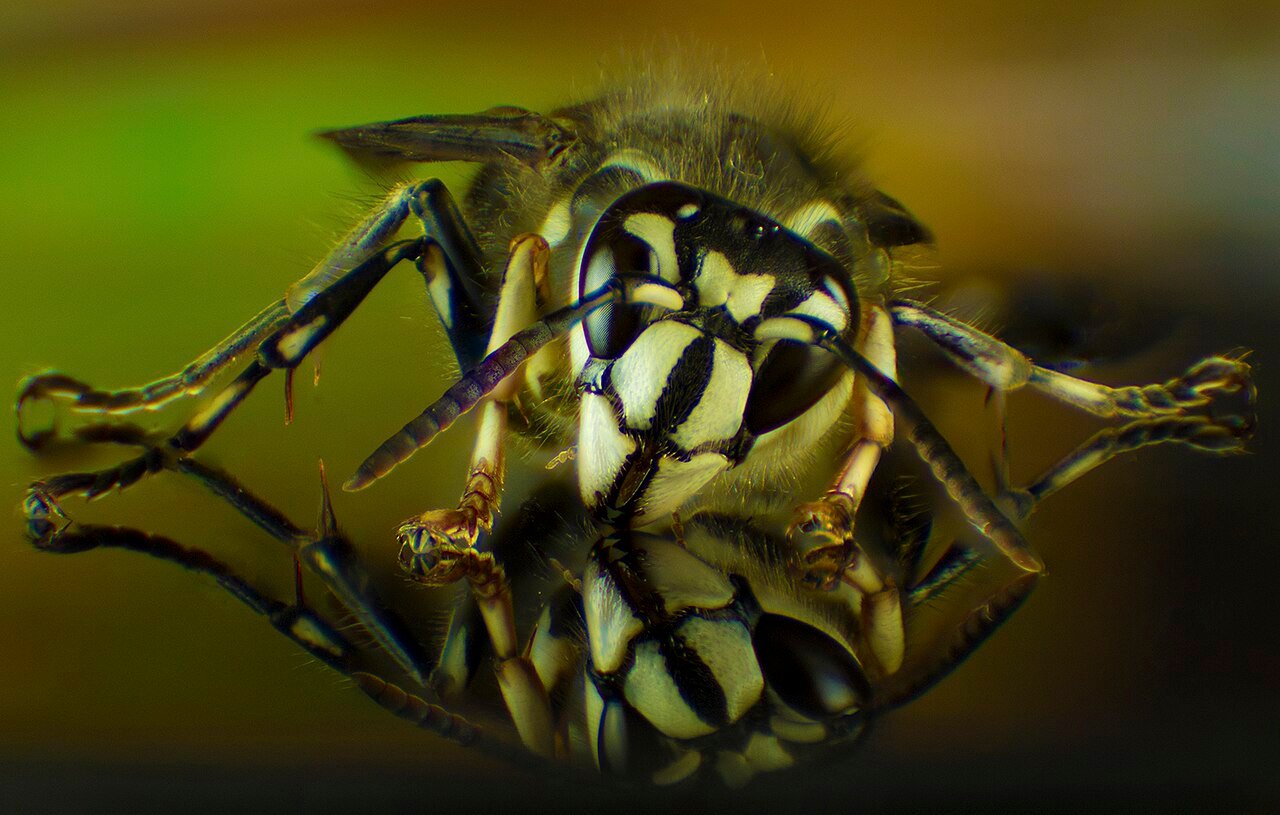
No Ohio stinging insect is easier to name: black body, ivory-white face, white-tipped abdomen — a formal-wear colorway no yellowjacket, paper wasp, or true hornet shares — at five-eighths to three-quarters of an inch, stockier than a paper wasp and larger than its ground-nesting yellowjacket cousins. The taxonomy worth a sentence: Dolichovespula maculata sits in the yellowjacket genus-cluster, making “bald-faced hornet” a double misnomer (neither bald in any useful sense nor a true hornet — Ohio’s only actual hornet is the big brown European, per the wasp-vs-hornet page); behaviorally the yellowjacket heritage is the point — colony scale, defense intensity, and the enclosed-nest architecture all run on yellowjacket firmware, aerial edition. Workers patrol flowers and hunt flies, caterpillars, and — usefully — other yellowjackets by day; the ID moment for most households is either the insect at close range (unmistakable) or, more often, the structure below.
The defense radius is exactly why this is not a ladder-and-a-can job. A bald-faced hornet globe is what wasp and hornet removal in Dayton exists for.
The globe: from golf ball to basketball in one season
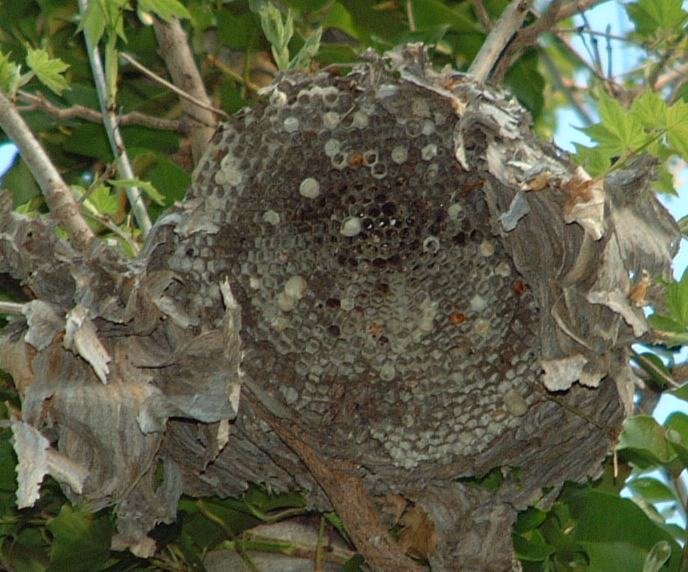
The nest is the species’ masterpiece and its calendar. May: a lone overwintered queen builds the golf-ball starter — a few cells in a paper envelope, the one moment the colony is cheap to remove. June–July: the first worker cohorts take over construction, and the globe inflates — softball, then volleyball — layering the swirled gray bands that are literal work logs (each band a different wood source, chewed and re-spat as paper). August–September: peak — basketball-plus dimensions, 400–700 workers, multiple comb tiers inside the weatherproof envelope, and the single bottom entrance streaming traffic dawn to dusk. Hard frost: total collapse — workers and males die, new queens depart for bark-and-litter overwintering, and the empty globe weathers to shreds by spring, NEVER reused. Placement runs eight-to-forty feet up in trees and on structures — but the discovery pattern is the trap: low-hung nests in dense shrubs, under deck rails, and on play structures hide brilliantly until August size makes them obvious, which is precisely when the colony inside is largest and touchiest. The Memorial Day walk-around exists for this species above all.
The defense radius: why this species writes its own rules
Every enclosed-nest species defends; the bald-faced defends FARTHER and REMEMBERS LONGER, and the file justifies the reputation. The documented package: a defended bubble extending well beyond the nest itself (a dozen-plus feet of patrolled air, versus the paper wasp’s arm’s-length tolerance), vibration triggering at range — mowers, trimmers, pressure washers, and ladder-bumps recruit defenders without any contact with the nest, the mechanism behind nearly every incident we see; guard recruitment that escalates fast (the first defender’s alarm pheromone summons the shift); pursuit measured in tens of yards; and the party trick the internet loves and emergency rooms respect — venom spraying: defenders can squirt venom at the eyes of perceived threats at short range, a genuinely rare capability that makes eye protection standard kit on our globe jobs. Add sting mechanics — smooth lancets, unlimited re-stings, 400-plus stingers on shift — and the never-DIY verdict stops being caution and becomes arithmetic. The one mercy: away from the nest, foragers on flowers are as indifferent as any wasp — the radius is the danger; the insect alone is just a tuxedoed fly-hunter.
The decision tree: frost, professional, or golf-ball window
Every globe resolves through three doors. Door one — the free frost option: high nests away from traffic (the forty-foot maple over the back fence) can simply be WAITED OUT — hard frost demolishes the colony by November, the nest is never reused, and winter’s empty globe becomes a legitimate trophy (cut it down in December and it dries into the best show-and-tell object in Ohio natural history). Location decides eligibility, not size. Door two — the professional call: anything over doorways, decks, driveways, play zones, or within mower-vibration range of routine life — our protocol runs protective-gear direct treatment at the entrance (dusk, when the shift is home), the die-off window, and removal of the accessible structure; one visit, flat-priced by situation per the wasp-removal page, sting-allergy households routed priority. Door three — the golf-ball window: May’s founding nests — queen-only, defender-free — are the one DIY-adjacent moment (a dusk aerosol on a golf ball is a different universe from an August basketball), and the spring walk-around that finds them is the cheapest bald-faced control that exists. What is never a door: daytime knockdowns, garden-hose experiments, firecrackers (annually attempted, annually regretted), and any ladder work by anyone not wearing a suit for a living.
The bottom line
The bald-faced hornet is the yard’s most impressive builder and its least forgiving tenant: a misnamed aerial yellowjacket whose ivory face, swirled gray globe, and extended defense radius all argue the same short conclusion — identify at distance, triage by location, and let frost or the suit handle every mature nest. Spring walk-arounds catch the golf balls, the free photo line triages every discovery, and the priority calendar holds slots for the collision-zone globes that cannot wait for November: (937) 569-3330. Respect the radius and the species costs you nothing but admiration; test it and it will explain itself faster than any page can.
The sting file, honestly calibrated
The species’ sting rates high-normal rather than legendary — sharper and hotter than a paper wasp’s, comparable to its ground-yellowjacket cousins’, with the danger living entirely in MULTIPLICITY: defense events deliver stings in clusters, and the medical file scales with count. Standard singles and small clusters: cold compress, antihistamine, the usual 48-hour watch. The escalators, consistent with every sting page here: systemic symptoms (hives beyond the site, wheezing, facial swelling — 911 territory), high-count events (dozens-plus stings warrant same-day medical review regardless of symptoms, especially for kids and seniors), eye exposure from the venom-spray defense (immediate prolonged flushing, then medical review), and the allergy-household standing rules — epinephrine wherever the person is, zero DIY of any wasp work, priority routing when they call. One folklore correction while we are here: bald-faced hornets do NOT hunt humans, hold grudges across seasons, or attack unprovoked at distance — every incident file we hold traces to nest proximity plus vibration or contact; the species is a homebody with a security system, not a predator of people. The radius is the whole story; outside it, coexistence is automatic.
What the colony does for the yard (the ledger’s other column)
The season’s 400–700 workers eat prodigiously, and the menu is the usual predator-guild gold: flies above all (bald-faced hornets are among the region’s heaviest fly predators — a mature globe’s daily take runs to the hundreds), caterpillars in bulk, spiders, and — the satisfying line — ground yellowjackets, which they hunt at picnic tables and nest entrances alike. Late season adds pollination-adjacent flower traffic as the sugar pivot arrives. The strategic consequence mirrors the European hornet’s file: a REMOTE globe is quietly suppressing the yard’s fly and caterpillar economy all summer — one more argument for the frost option where location allows — while a collision-zone globe’s services never outweigh its radius. Triage by address, credit the work, and let the predator-guild ledger keep both columns honest: the yard’s most dangerous tenant is also, at the right distance, one of its most productive.
Frequently asked questions
How dangerous are bald-faced hornets?
The most defense-intense stinging insect in an Ohio yard: a patrolled radius extending a dozen-plus feet from the nest, vibration-triggering at range, cluster stings, pursuit, and even defensive venom-spraying at eyes. Away from the nest, foragers are indifferent — the radius is the entire danger, and respecting it reduces the risk to zero.
Are bald-faced hornets actually hornets?
No — taxonomically they are aerial yellowjackets wearing a hornet’s name; Ohio’s only true hornet is the big brown European. The heritage matters practically: colony scale, temperament, and enclosed-nest rules all run on yellowjacket biology.
What does a bald-faced hornet nest look like?
A gray paper globe — teardrop-to-basketball, swirled with band patterns (each band a different wood source), single entrance near the bottom — hung in trees, under eaves, or hidden low in dense shrubs. Golf-ball size in May, basketball-plus by September, never reused after frost.
Should I remove a bald-faced hornet nest myself?
No — at any size beyond May’s queen-only golf ball, this is the firmest never-DIY rule we issue: hundreds of defenders, vibration triggers, and the ladder factor account for the worst sting incidents in the file. High remote nests wait for frost free of charge; everything else is our visit.
Will a bald-faced hornet nest die in winter?
Completely — hard frost kills workers and males, new queens overwinter in bark and litter elsewhere, and the abandoned globe weathers to shreds unreused. November’s empty nest is safe to remove and genuinely worth keeping as a natural-history trophy.
What happens if you get stung by a bald-faced hornet?
A hot, sharp sting with normal local swelling — treated with cold compresses and antihistamines — with the medical file scaling on count and the standard escalators: systemic symptoms mean 911, dozens of stings mean same-day review, and eye exposure from venom spray means immediate prolonged flushing.
Do bald-faced hornets attack for no reason?
Never in our files — every incident traces to nest proximity plus vibration (mowers, trimmers, ladders) or contact. The species neither hunts humans nor holds grudges; it operates a security system with a large perimeter and no interest beyond it.
What good are bald-faced hornets?
A mature colony’s hundreds of workers are heavyweight fly and caterpillar predators — and documented hunters of ground yellowjackets. A remote globe suppresses the yard’s pest economy all season, which is half the argument for the frost option where location allows.
When are bald-faced hornets most aggressive?
August through early October — peak colony size meets peak defensiveness exactly as yards see maximum use, and low-hidden nests reach discovery size. Spring colonies are smallest and mildest; the May walk-around finds golf balls instead of basketballs.
Who removes bald-faced hornet nests near Dayton?
We do, across all eight counties — dusk protective-gear treatment, die-off window, structure removal, flat-priced by situation with priority routing for collision zones and allergy households: (937) 569-3330. Photo triage first, free — and high remote globes get the honest “wait for November” verdict at no charge.
The eight-county globe census
Where the tuxedos build on our routes: the mature-canopy belts — Oakwood’s oaks, Kettering and Centerville’s old maples, the county seats’ courthouse trees — hang the highest and most eligible-for-frost specimens; the farm counties grow the region’s giants in fencerow maples and barn gables (Preble’s are the perennial size champions, per the county page’s standing note); and the newer suburbs contribute the collision-zone files — low globes in landscape shrubs, deck-rail surprises, and the play-set discoveries that jump every priority queue. The seasonal call pattern is identical everywhere: a trickle of sharp-eyed May golf-ball reports (our favorite calls — cheap, safe, early), the August discovery wave as basketballs outgrow their hiding shrubs, and the September mower-incident cluster that fills the priority calendar. The triage never changes with the geography — distance, location, frost-eligibility — and neither does the free first step: the photo, taken from respectfully far away.