
Nobody plans to become an expert in animal droppings, and then one morning there’s a scatter of dark grains in the silverware drawer and suddenly it’s the most important forensic evidence in your house. Take the promotion seriously: droppings are the single most reliable pest evidence there is — more honest than sightings (which depend on luck), more datable than damage, and specific enough that a good look at size, shape and placement names the animal with better accuracy than most eyewitness descriptions. This is the identification guide we wish every caller had read before dialing: mouse versus rat versus squirrel versus bat, roach versus mouse (the kitchen’s most expensive mix-up), raccoon versus the yard’s other visitors, what fresh-versus-old droppings tell you about whether the problem is current, the safe-cleanup protocol that the hantavirus literature makes non-negotiable, and when a photo of a dropping should skip the internet entirely and come straight to a professional. Which it always can, free: (937) 569-3330, Greater Dayton Pest & Rodent — where reading droppings is, unglamorously, a core professional skill.
Start with the big three questions
Every dropping ID runs the same three-question triage our technicians use. Size: under a quarter inch (rice grain) puts you in mouse/roach/bat territory; quarter-to-three-quarter inch (raisin to olive) means rat, squirrel or chipmunk; thumb-sized and larger moves to raccoon, opossum and the outdoor cast. Shape: pointed ends versus blunt, uniform capsules versus irregular, smooth versus segmented — each animal’s digestive signature is surprisingly consistent. Placement: the most underrated tell — scattered along walls and in drawers (mice), concentrated in latrine piles (rats, raccoons, bats), glued to vertical surfaces (roaches at density), or accumulating below one attic spot (bats under a roost). Size names the weight class, shape names the species, placement names the behavior — and behavior is what you actually treat. Hold those three questions and the gallery below sorts itself.
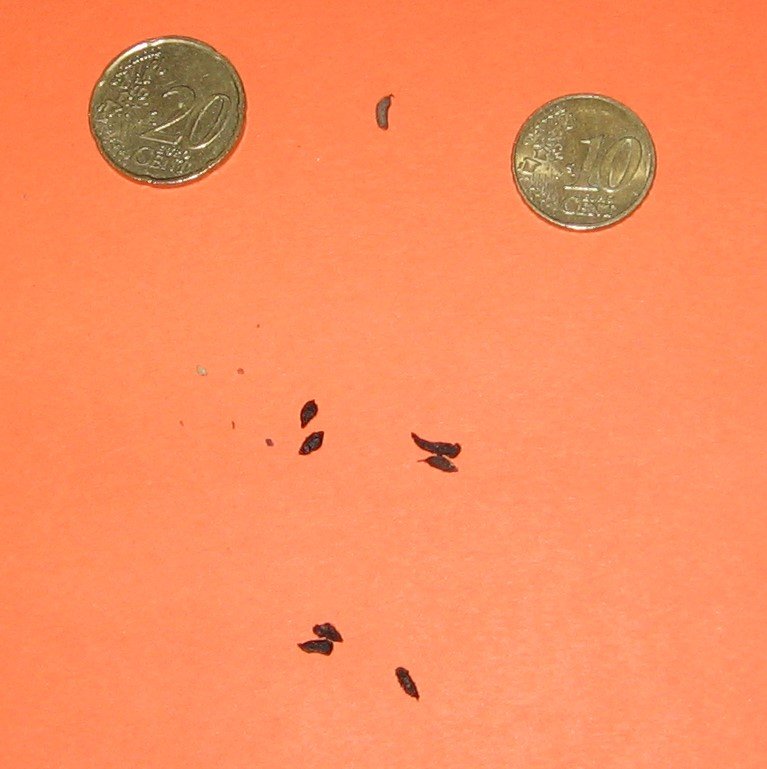
Mouse droppings: the scattered rice grains
The most common find in Ohio homes: an eighth to a quarter inch, dark brown to black, rice-grain shaped with one or both ends pointed, and — the behavioral signature — scattered, not piled. A mouse defecates on the move, 50 to 75 times a day, so droppings trace its commute: along baseboards, in the backs of drawers, under the sink, in the stove’s drip pans, along garage shelves. Density maps traffic — a drawer with three droppings is a route; a cabinet corner with forty is a harborage neighbor. Freshness is your timeline: fresh droppings are dark, glossy, soft (they smear — test with a paper towel, never bare fingers) and mean activity within a day or two; old ones are gray, dusty, crumbly and could be last winter’s news. That distinction decides everything — fresh droppings in February mean an active mouse program; old droppings during a spring clean mean a twelve-doors audit before fall, not a trap line today. One more mouse-specific tell: droppings accompanied by a faint ammonia note (urine marking) and gnaw-dust near a gap confirm the full commuter package. Count, photograph, date — then decide.
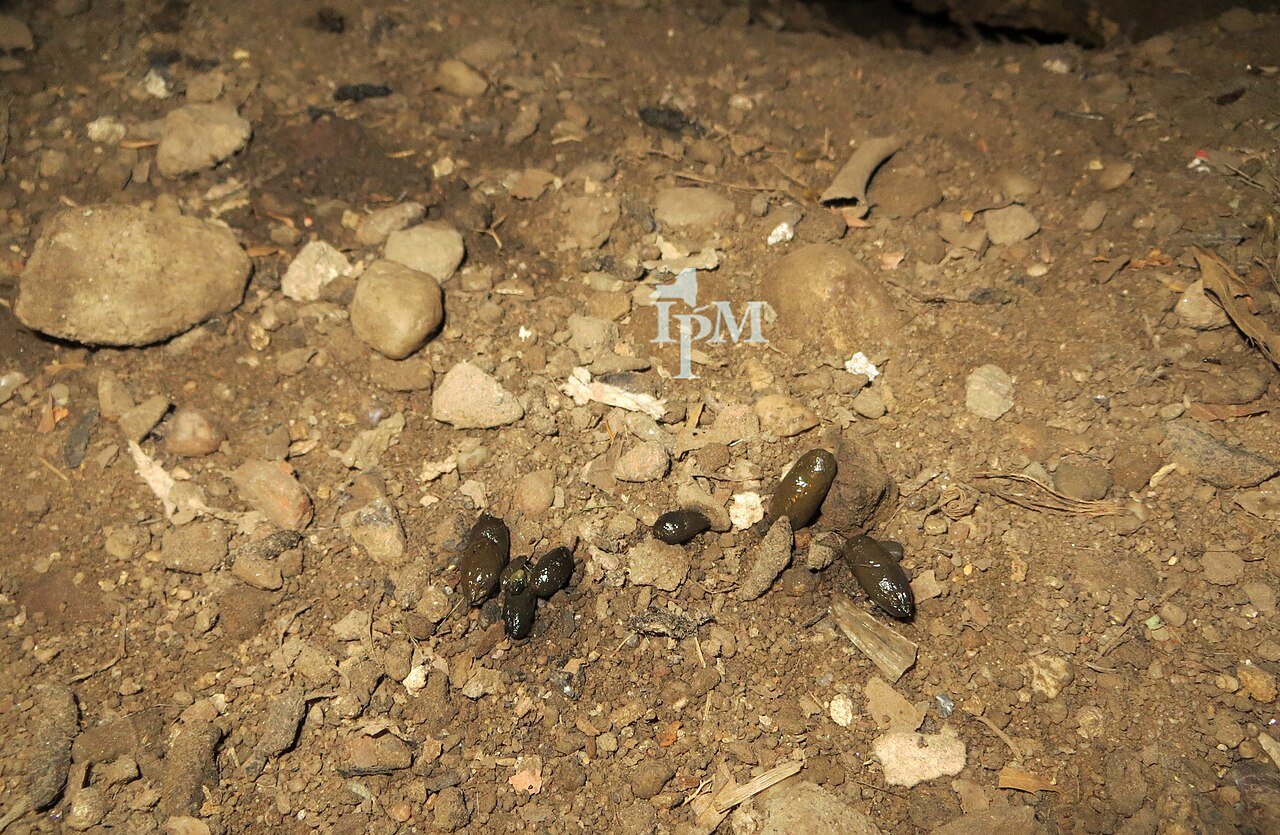
Rat droppings: the blunt capsules
Rat evidence changes the conversation’s scale. Norway rat droppings run half to three-quarters of an inch — raisin-to-olive sized — dark, thick, capsule-shaped with blunt ends, and they concentrate: rats are creatures of fixed runways, so droppings pile along walls, behind stored goods, near burrow entrances and under deck edges rather than scattering drawer to drawer. Fresh sign is dark and putty-soft; old sign grays and crumbles. Accompanying evidence seals the ID: greasy rub marks where fur has polished a repeated route, gnawing on wood and plastic with visible paired incisor grooves (rats chew structurally — wire insulation, sill corners, bin lids), burrow openings of two-to-three inches with fresh soil kicked out, and capsule droppings along the foundation outside. In our eight counties, Norway rats skew toward specific habitats: alley-and-dumpster commercial corridors, chicken-coop and livestock-feed properties on the rural routes, and neighborhoods near waterways — if your “big mouse droppings” came from a farm campus feed room or a restaurant’s back dock, think rat first and call rather than shop: rat programs are population work with exterior baiting, burrow treatment and exclusion at a structural gauge, and DIY delay is expensive precisely because rats breed and burrow faster than retail solutions scale.
Roach droppings: the pepper and the pellets
The kitchen’s great impostor, and the mix-up that costs the most when read wrong. Roach droppings come in two formats by size of roach: German cockroaches and nymphs leave “pepper” — fine dark specks like coarsely ground coffee, smeared into corners, along cabinet hinges, behind drawer boxes, concentrated near harborage; large roaches (American, Oriental) leave ridged cylinders up to an eighth inch that genuinely resemble mouse droppings — the tell is the blunt ends and lengthwise ridges (mouse droppings are smooth and pointed) plus placement: roach pellets appear on vertical surfaces and cabinet ceilings (roaches walk walls; mice don’t) and near moisture infrastructure. Why the distinction is worth real money: mouse-read-as-roach buys foggers that solve nothing; roach-read-as-mouse buys snap traps while an ootheca pipeline (the egg-case arithmetic) compounds behind the hinge line. The pepper pattern also grades severity for the treatment protocol — spreading fecal focal points mean a growing population, and their locations are literally the bait map. When the specks are too small to call: the photo line exists, the macro mode on your phone is better than you think, and the verdict is free.
Squirrel droppings: the attic’s rounded pellets
Squirrel evidence is mostly an attic-and-walls story with a distinctive calling card: three-eighths to half-inch pellets, cylindrical with rounded ends, lighter brown than rat droppings and often paling toward tan as they age, found clustered near entry points, along joists, and beneath the roofline gaps squirrels favor. Placement plus soundtrack usually completes the ID before the pellet does: squirrels are the attic’s day shift — scampering and rolling sounds at dawn and late afternoon (mice and rats run the night shift; bats are silent tenants with a different dropping entirely, below). Supporting evidence: gnawed entry holes with fresh wood exposed (squirrels chew like carpenters — clean, expanding, structural), walnut and acorn shell caches, and insulation tunnels. The response is wildlife work, not rodent baiting: never poison squirrels (illegal for wildlife in many applications, and a die-off in a wall void is a catastrophe by smell), and never seal the hole until you’re certain everyone’s out — the one-way-door exclusion our wildlife referrals run, with the same nursing-season patience the humane guide demands for mice. Spring and late-summer litters make timing everything; a February seal-out with March babies behind it is how attics become tragedies.
Bat droppings: the crumbling pile under the roost
Bat guano earns its own entry because it’s the dropping most often mistaken for mouse evidence in attics — similar size and color, entirely different meaning. The tells: guano accumulates in piles directly beneath a roost point (mice scatter; bats bombard one spot below the gable vent, chimney margin or ridge-line gap they hang above), and — the definitive field test — a bat dropping crushed with a gloved finger crumbles into glittering fragments: the insect-wing chitin that passes through a bat sparkles; a mouse dropping just smears. Staining on the entry gap (brown greasy wash below a hole bats squeeze through) and the faint high chittering at dusk complete the picture. Why the ID matters legally and medically: Ohio’s bats are protected and beneficial (a colony eats moths and mosquitoes by the pound), so the response is timed exclusion — one-way valves installed OUTSIDE the maternity season (roughly June–July when flightless pups are present; evictions then are both illegal in effect and lethal) — and guano cleanup carries the histoplasmosis caution: the fungus in accumulated guano aerosolizes when disturbed, so significant deposits mean respirators and damp-removal, not a shop vac. Small colony, small stakes; big historic-house colony, professional job — and either way the droppings called it before anyone saw a bat.
The outdoor cast: raccoon, opossum, chipmunk, vole
Yard and deck discoveries, rapid-fire. Raccoon: the serious one — blunt-ended, segmented, dog-like droppings up to three-quarters of an inch wide, deposited in latrines (repeated communal sites: deck corners, woodpile tops, sandbox edges, flat roofs). Raccoon latrines carry Baylisascaris roundworm eggs — genuinely dangerous to children and pets, persistent in soil for years — so a latrine near play areas is a treat-it-like-hazmat cleanup (boiling water, flame, or removal of the top soil layer; the eggs shrug off most chemicals) plus an exclusion conversation about the deck, chimney cap and pet-door. Opossum: similar size to raccoon but smooth, tapered and scattered singly — and the animal is the yard’s tick-eating ally; note and move on unless it’s denning under the porch. Chipmunk: mouse-like but slightly larger, oval, found near burrow entrances at stone walls and foundation plantings — a landscaping conversation, rarely a structural one. Vole: small green-brown pellets IN the surface runways themselves — the confirming detail from our moles-versus-voles diagnosis (and a reminder that moles, underground, leave no visible droppings at all — absence is evidence too). Rabbit: the unmistakable round pea-sized spheres of chewed grass, piled where they graze — garden fencing news, never structural. Every outdoor ID feeds the same question: is the animal commuting toward the building? Droppings along the foundation line are the yard’s way of forwarding your mail.
Fresh or old? Dating the evidence
The dropping’s age is half its meaning, and the read is consistent across species: fresh (hours to ~2 days) — dark, moist-glossy, soft enough to deform, strong color; recent (days to weeks) — dulling, hardening, still holding shape and color; old (months-plus) — gray-toned, dusty, crumbling at a touch, often with mold fuzz in damp spaces. The operational logic: fresh sign anywhere = active animal, current program; exclusively old sign = historical problem, verify-then-seal (monitors or a flour-dust patch on the old route for a week settles “resolved or dormant” cheaply); mixed ages along one route = long-running occupancy, which upgrades the response and, in kitchens, the sanitation stakes. Pro habit worth stealing: after any cleanup, date-stamp the zone — clean the droppings completely, note the date, and re-inspect weekly; new deposits on a cleaned stage are the clearest activity signal that exists, far better than trying to remember whether that corner always looked like that. It’s the same verify-then-close discipline that runs our exclusion programs — evidence, timeline, action, verification. Droppings just happen to be the evidence that keeps its own records.
The safe cleanup protocol (non-negotiable section)
Rodent droppings are not just gross — deer mice in particular can shed hantavirus in droppings and urine, and the documented infection route is inhalation of dust raised during cleanup. The CDC-derived protocol, which we follow on every job and you should follow at home: never sweep or vacuum dry droppings (both aerosolize exactly what must not be breathed — a shop vac without HEPA is the single worst tool for this task); ventilate the space 30 minutes first if it’s been closed up; wet everything down with disinfectant (a 10% bleach solution or EPA-registered disinfectant), soak five minutes; wipe up with paper towels wearing gloves — and an N95 respirator for any significant accumulation, attic job, or rural/outbuilding cleanup where deer mice (the higher-risk species) are likely; bag, seal, dispose in outdoor trash; wash hands and launder after. Scale honestly: three droppings in a kitchen drawer is a gloves-and-disinfectant wipe; a wall of winter accumulation in a farm outbuilding or the crawlspace of a long-vacant property is respirator territory and legitimately hirable work — heavy-accumulation cleanup is part of our rodent service for exactly this reason. The rule that covers every case: if cleanup would raise dust, stop and wet it first. No pest evidence is worth a respiratory disease.
Dropping questions, answered
Can you really tell mouse from roach droppings without a microscope?
Usually, yes: smooth-and-pointed (mouse) versus ridged-and-blunt (large roach), scattered-in-drawers versus stuck-near-hinges-and-walls, and the company each keeps — gnaw marks and nest fluff versus pepper specks and molted skins. When a photo genuinely can’t settle it, a strip of monitor traps answers in 48 hours — whatever’s making the droppings walks onto the record. Ambiguity is a two-day problem at most.
I found droppings but never see any animal. How bad is it?
That’s the normal case, not a puzzle — mice, rats and roaches are nocturnal and evasive by profession; most infestations are droppings-first discoveries. Grade by the evidence: quantity, freshness, spread. And take the inverse seriously too: seeing the animal in daylight with droppings everywhere means population pressure — the shy species only go public when it’s crowded backstage.
Are old droppings in a house we just bought a red flag?
They’re a to-do list, not a crisis: old sign plus no fresh activity means a past problem whose entry points are still unsealed. Run the date-stamp verification (clean, wait, re-inspect), then put the money into the exclusion audit rather than treatment. Buying a house with old droppings and sealing it that first autumn is honestly the best-case version of this entire page.
What about droppings I can’t match to anything here?
The photo line, genuinely — a dropping photo with a coin for scale, plus where you found it, gets a professional read in minutes. The occasional exotic (snake scat in a barn, groundhog under a shed) is exactly why the line beats the search engine: we’ve seen the whole catalog, and misreads are free to prevent and expensive to keep.
Evidence first, always
Every pest problem announces itself somehow, and droppings are the announcement most people find first and trust least. Trust them: sized, shaped, placed and dated, they name the animal, grade the problem, time the response and verify the fix — the entire arc of good pest control, written in the least glamorous medium imaginable. Photograph before you clean, clean by the protocol, date-stamp the stage, and send the hard calls to (937) 569-3330 — free ID, honest scaling, and the exclusion-first follow-through every finding on this page eventually points to. Greater Dayton Pest & Rodent, serving Dayton and all eight counties: we read this stuff so you only have to read it once.
The technician’s pocket table
- Rice grain, pointed, scattered in drawers/along walls: mouse — commuter evidence, exclusion-first response.
- Raisin capsule, blunt, piled on runways: rat — population work, call early.
- Pepper specks near hinges or ridged mini-cylinders on vertical surfaces: roach — bait map, not trap line.
- Half-inch rounded pellets + daytime attic noise: squirrel — wildlife exclusion, never poison.
- Crumbles-and-sparkles pile under one roost point: bat — timed one-way exclusion, histoplasmosis-aware cleanup.
- Segmented latrine pile on deck/woodpile/roof: raccoon — roundworm hazard, hazmat-grade cleanup, exclusion talk.
- Pea-round grass spheres: rabbit — garden fencing, nothing structural.
- Green-brown pellets inside surface lawn trails: vole — the moles-vs-voles page takes it from there.
Print that list on your memory, and the drawer discovery that started this page becomes a two-minute triage instead of a search spiral. The animals have been leaving honest records all along — this library just taught you the filing system.
Bed bug droppings: the smallest entry, appended
The guide’s finest-print addition for the bedroom searches: bed bug feces present as pepper-fleck spots — digested blood, so they smear rust-brown when dabbed with a damp swab (the field test) — clustered at harborage: mattress seams, box-spring corners, headboard screw holes, and the encasement surfaces that make them readable. Ink-dot spotting at sleep zones routes to the bed bug inspection immediately; the same specks at a window sill are usually fly spotting (no smear); and the full workup lives in the bed bug wing, one link over.
Frequently asked questions
How do I identify what pest left droppings?
Size and shape run the key: rice grains with pointed ends = mouse; raisin-sized and blunt = rat; pepper grains and coffee-ground specks in cabinets = roach; sand-grain pellets under bare rafters = bat; and larger cylinders belong to wildlife worth professional eyes. Photograph before cleanup — the evidence is the diagnosis.
What do mouse droppings look like exactly?
Dark rice grains, 3–6mm, pointed at one or both ends, scattered along walls, in drawers, and under sinks — 50–75 per mouse per day, so accumulation rate estimates population. Fresh = dark and glossy; old = gray and crumbly; the freshness read tells you whether the problem is current.
How can I tell rat droppings from mouse droppings?
Scale jump: rat pellets run 12–19mm (raisin-to-olive), blunt-ended, in smaller counts — Norway rats drop them in travelways, roof rats scatter them along elevated routes. The size difference is unmistakable side by side and changes the entire trap-and-exclusion spec.
What do cockroach droppings look like?
Species-split: German roaches leave pepper-grain specks and dark smears concentrated at harborage corners (cabinet hinges, drawer slides); American roaches leave ridged cylinders mistaken for mouse droppings — the ridges and blunt ends distinguish them. Concentration marks the harborage: bait there.
Are droppings in the attic mice, bats, or squirrels?
The attic differential: mouse pellets scatter along routes; bat guano accumulates in PILES below roost points and crumbles to shiny insect fragments when crushed; squirrel droppings run larger and barrel-shaped. Guano piles mean a wildlife-exclusion referral; the other two are our files.
Is it dangerous to clean up pest droppings?
Handle all of it with respect: never dry-sweep or vacuum rodent droppings (aerosolization — the hantavirus-precaution rule), mist with 10% bleach, wait, wipe with gloved hands into sealed bags. Bat guano in quantity adds histoplasmosis precautions — respirator territory, honestly often professional territory.
What are the tiny black specks on my windowsills?
The lineup: fly specks (dots plus tiny smears — house fly traffic), spider droppings (splatter-white with dark centers below webs), or roach pepper if concentrated in corners. Windowsill specks usually convict flies; corner concentrations convict roaches.
Do droppings tell you how bad an infestation is?
Precisely — volume, spread, and freshness are the census: one room’s worth of fresh mouse droppings = early; multi-room drifts = established; mixed fresh-and-old = long tenure. It is the first thing our inspections read and the reason we ask you not to deep-clean before we arrive.
What should I do after finding droppings?
Photograph, identify (or send us the photo — free), clean safely per the protocol above, then wipe a monitoring zone clean and re-check in 48 hours: fresh reappearance means active, silence means historical. The 48-hour test converts worry into data.
Who identifies mystery droppings near Dayton?
Text the photo with a coin for scale: (937) 569-3330 — same-day ID across the whole roster, the safe-cleanup walkthrough included, and the honest verdict when the “droppings” turn out to be mulch tracked in by the dog (a real and beloved category of call).
Which of the following are signs of a rodent infestation? (The exam question, answered)
This exact phrasing appears on food-handler and ServSafe-style exams, and the accepted answers are: droppings (the rice-grain evidence this page identifies), gnaw marks on packaging, wood, and wiring, greasy rub marks along baseboards and runways, nesting materials (shredded paper and fabric), tracks or footprints in dust, and scratching or squeaking sounds in walls, especially at night. Any one of the six counts on the test; in a real kitchen, any one of the six also means the inspection starts now — droppings are usually the first found and the most reliable, which is why this guide exists.
Not sure what you’re looking at? Start at the Ohio Bug Identification Library — every ID file on this site, indexed on one page.