Somewhere in the Miami Valley this morning, a squirrel the color of paper came down a maple trunk, and somebody stopped walking to watch it.
We are a pest control company. Our whole trade is being the people you call when something has moved into your house and you want it gone. So it is worth saying plainly, in the first paragraph, where our line is:
We stop at rats and mice. We do not exterminate squirrels — any squirrel, ever — and we are especially not going to touch a white one.
That is not sentimentality dressed up as policy. It is licensing, it is Ohio law, and it is honestly the better answer for your house anyway. This page explains all three, and then it talks about the white squirrels, because they are the best argument we have for why the rule exists.
Where our line actually is
Greater Dayton Pest & Rodent is licensed by the Ohio Department of Agriculture as a pesticide business, firm license #115079. Bryan Camden is the owner and commercial applicator, license #170858, categories 10A, 10B and 12. That licensing covers structural and household pests: insects, and commensal rodents — house mice, Norway rats, roof rats.
It does not cover wildlife. Squirrels, raccoons, groundhogs, opossums, skunks and bats sit under a different regime entirely, handled by licensed nuisance wildlife control operators, who work under the Ohio Division of Wildlife rather than the Department of Agriculture.
So when somebody calls us about scratching in the attic and it turns out to be squirrels, we do not quietly take the job and improvise. We tell them what it is, explain why we are not the right company, and point them at somebody who is. We lose the booking. We would rather lose the booking than do work we are not licensed to do — and you would rather we did, because the alternative is a company willing to treat wildlife with the wrong tools and no permit.
The same rule is on every page of this site. It is not a footnote we buried; it is the shape of the business.
Is it actually a squirrel? A five-minute diagnosis
Before anybody calls anybody, work out what you have. Squirrels, mice and rats sound different, keep different hours and get in through different places, and the difference decides which trade you need.
- Time of day is the biggest tell. Squirrels are diurnal. If the noise starts around dawn, goes quiet in the middle of the day, and picks up again before dusk, that is a squirrel. Mice and rats are nocturnal — activity that begins after the house goes quiet at night points to rodents, which is our work.
- The sound is different. Squirrels are heavy and confident: rolling, scampering, thumping, and the unmistakable noise of something rolling a nut across a joist. Mice are light and skittery, mostly scratching inside a wall cavity. Rats are heavier than mice but still move furtively.
- The entry point is different. Squirrels come in high — a gap at the roofline, a rotted soffit corner, a gable vent with failed screening, a ridge vent, or a spot where a branch overhangs the roof. Mice come in low, at the sill plate, foundation gaps or the garage door corners. If the damage is at the roofline, it is not a mouse.
- The hole is different. A squirrel entry is roughly baseball-sized with chewed, splintered edges. A mouse needs a gap about the width of a pencil.
- The droppings are different. Mouse droppings are rice-grain sized; rat droppings are closer to an olive pit; squirrel droppings are larger still and often scattered in an attic rather than along a runway.
If it turns out to be mice or rats, that is squarely ours — see our rodent control page, and the honest news there is that exclusion beats bait on nearly every house in this valley. If it is squirrels, read on, and then call a wildlife operator.
Not sure? Text a photo of the damage or the droppings to (937) 569-3330. We will tell you what you have got at no charge, including when the answer is “not us.”
The white squirrels of the Miami Valley
Now the good part.
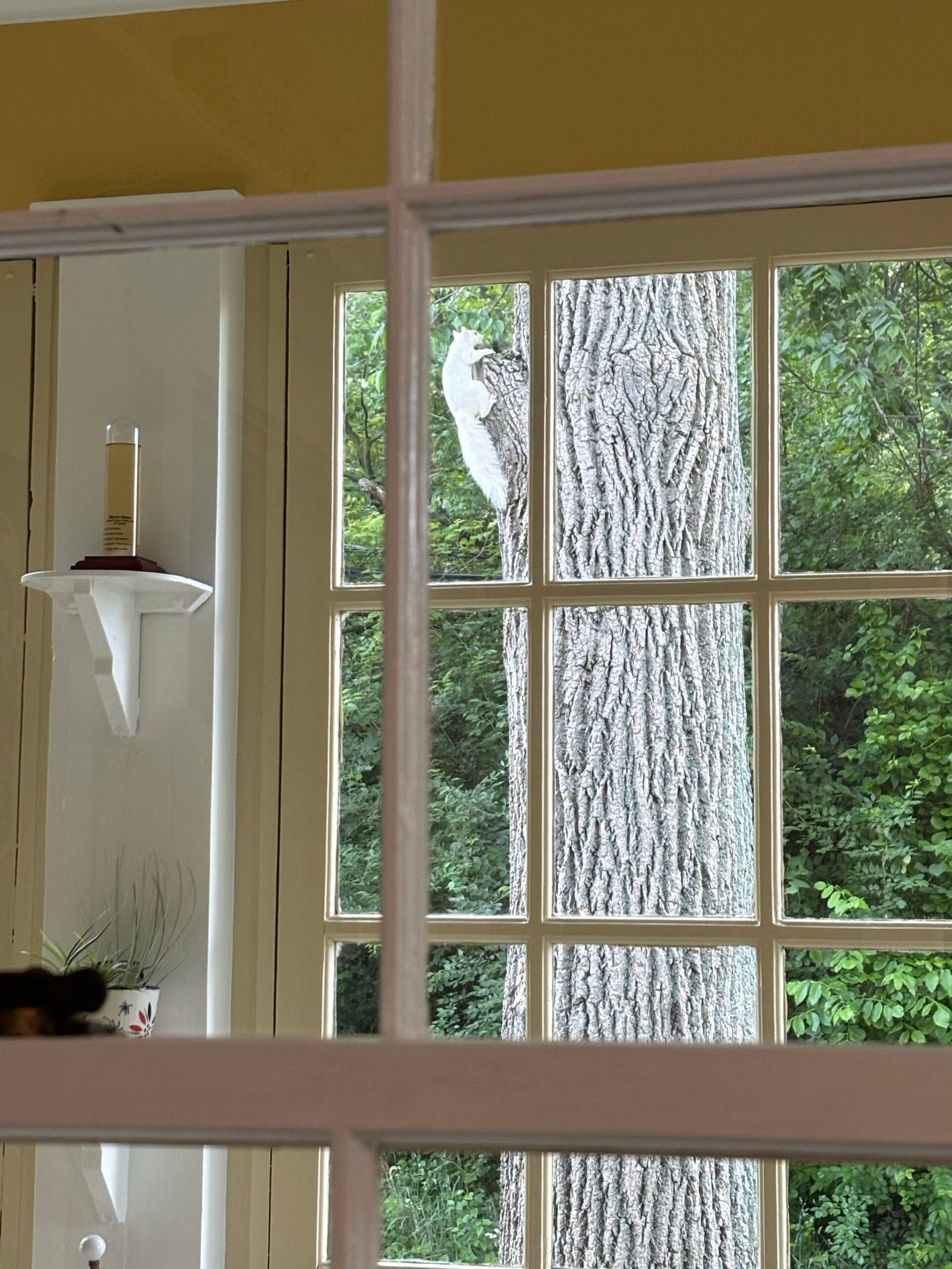
The Miami Valley has white squirrels. Not one famous individual — a genuine, persistent, decades-long thread of them, concentrated around Kettering and the Dayton neighborhoods, turning up often enough that half the people who live here have a story and the other half think the first half are making it up.
And the valley has both kinds — which most write-ups on this subject get wrong, including ours until readers sent us photographs that settled it. There are two different biological routes to a white squirrel, and the difference is visible from ten feet away:
- Albinism is a complete absence of melanin. An albino squirrel has pink or very pale blue eyes, pinkish ears and a pink nose.
- Leucism is a reduction in pigment rather than an absence of it, and critically it does not affect the eyes. A leucistic squirrel is white or near-white with dark eyes.
So look at the eyes. That is the whole test, and you can run it from a porch.
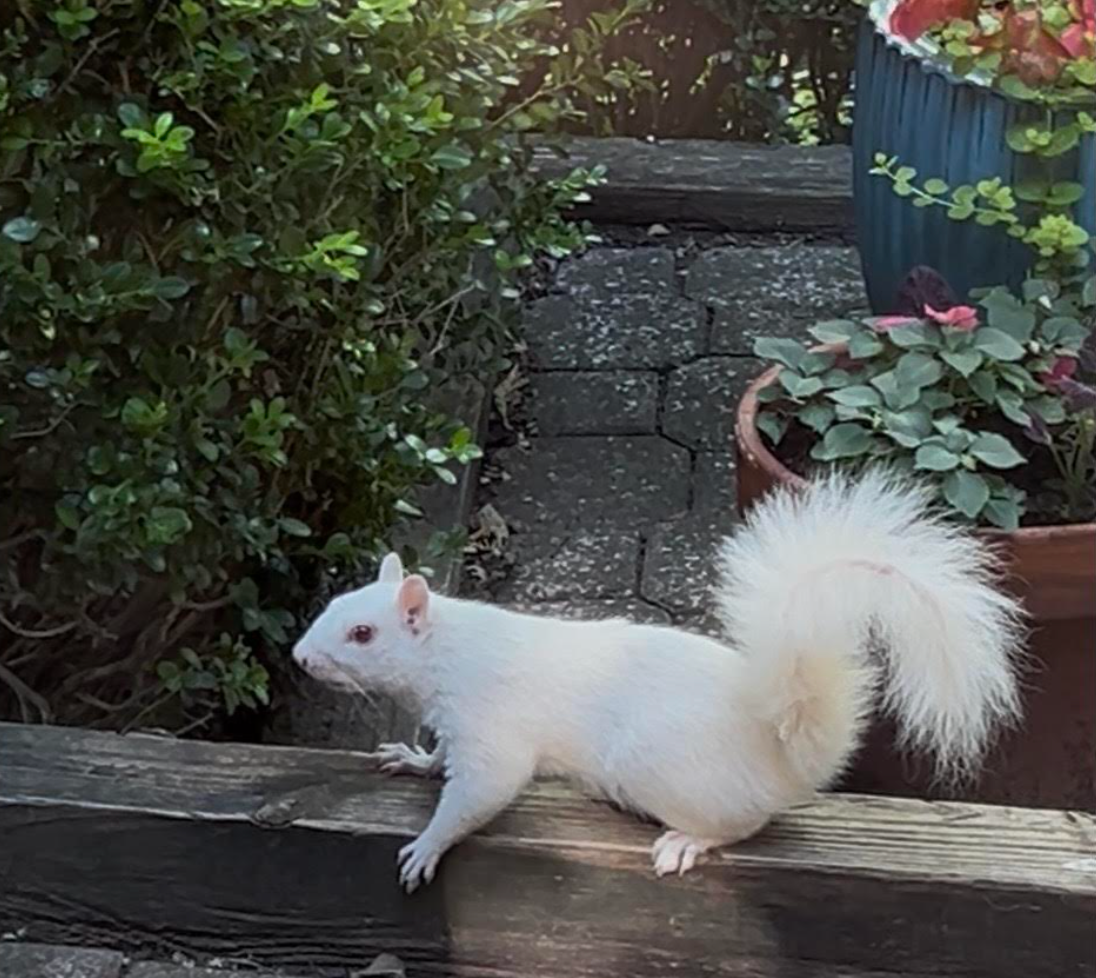
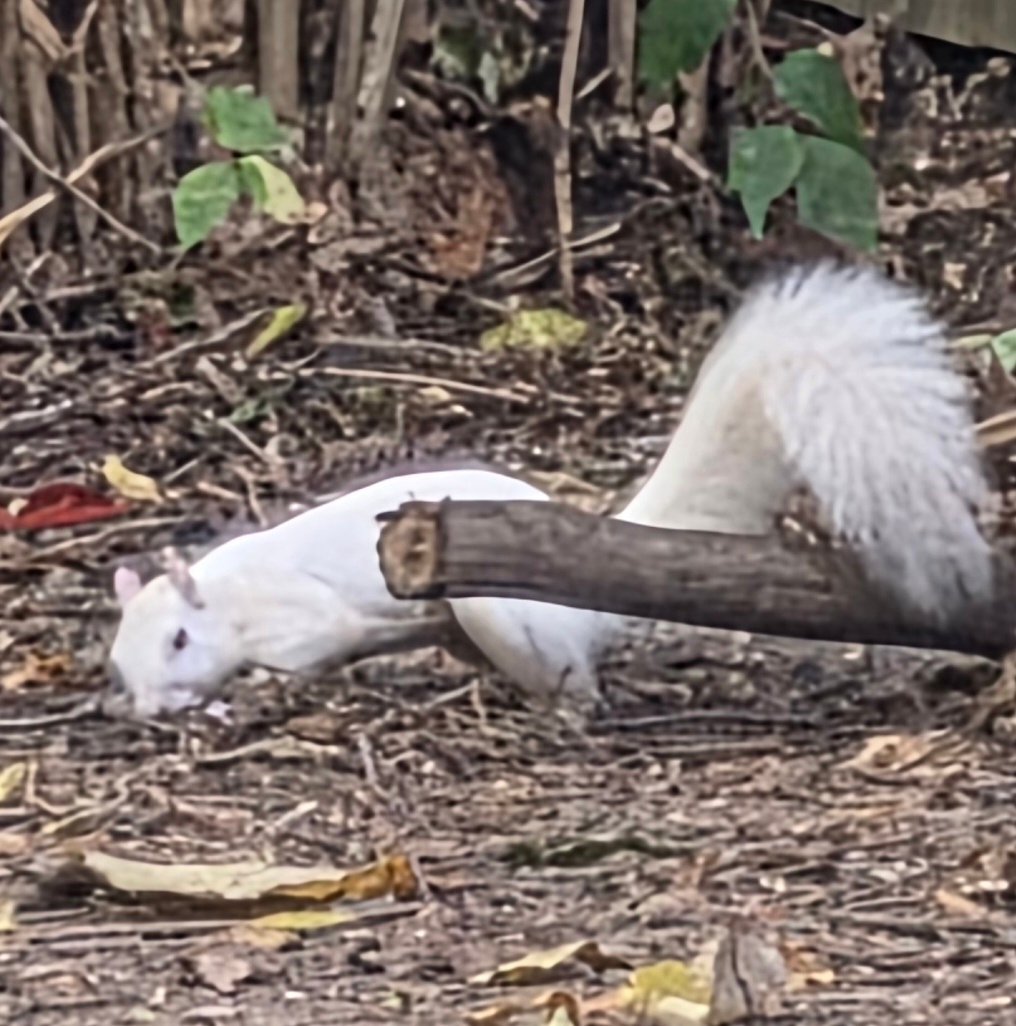
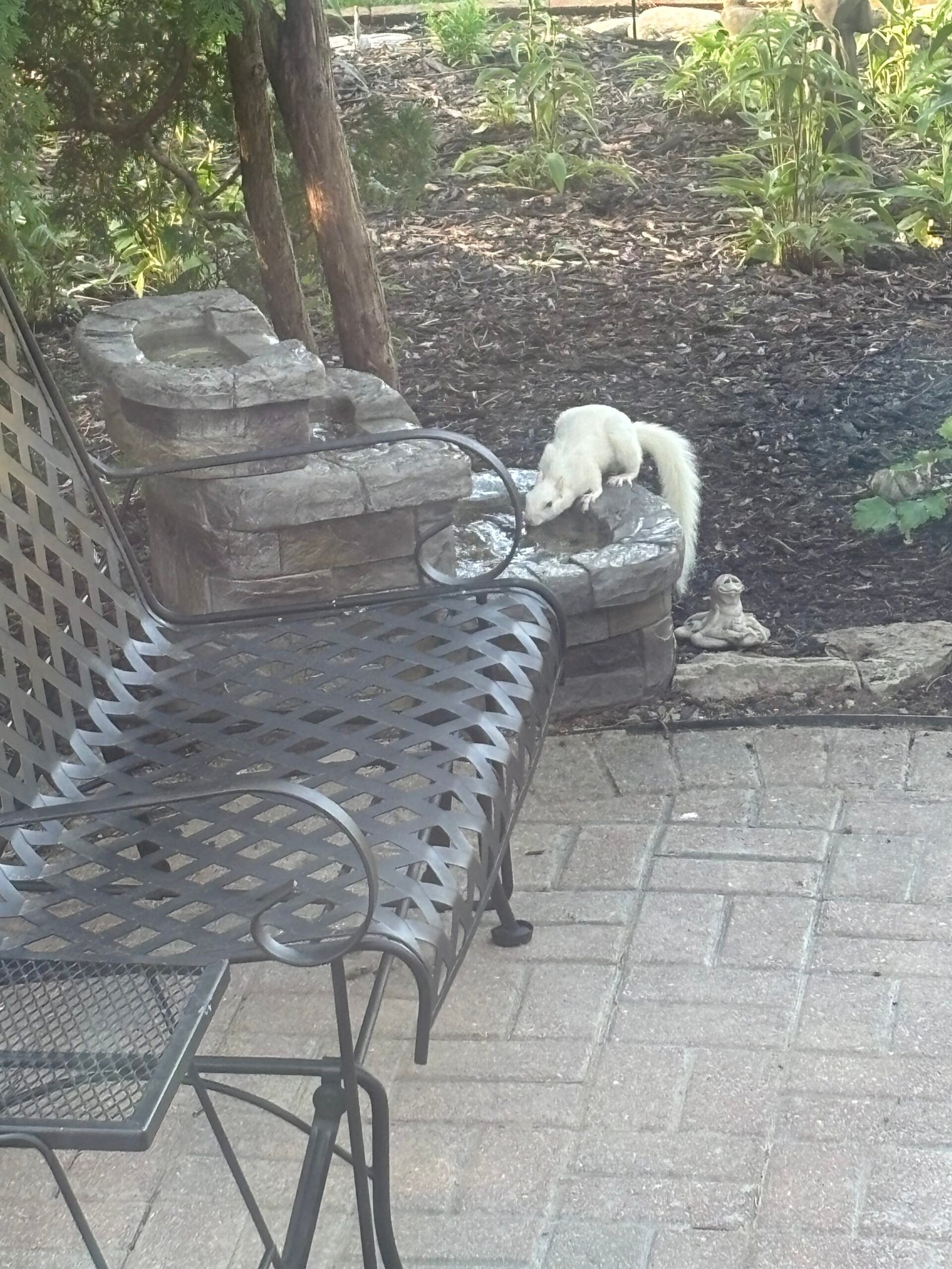
We can say the valley has both because readers photographed both. One animal, sent to us from a Miami Valley yard, has a clear pink-red eye with pink ears, a pink nose and pink feet — melanin absent everywhere it would normally show. That is a true albino. Another, photographed on Kling Drive in Dayton, is just as white in the coat but has a dark eye — pigment reduced in the fur while the eyes still made their own. That one is leucistic.
Two white squirrels, a few miles apart, two entirely different pieces of genetics. Worth knowing before you tell somebody you have seen “the albino squirrel” — you may well have seen the other one.
A note on photographs, since this comes up: a pink eye in a picture is not automatically camera red-eye. Red-eye needs a flash close to the lens firing into a wide-open pupil in dim light. In a daylight photograph, with pink ears, nose and feet to match, you are looking at the animal rather than the camera.
As for how they got here: the story people tell is that NCR founder John H. Patterson brought them to Dayton around 1910, inspired by animals he had seen travelling in Russia. We want to be careful with that one. It is repeated widely and it is a wonderful story, but it circulates as local legend rather than documented fact, and we are not in a position to verify it. Treat it as folklore that may well be true.
There is one more thing worth putting on the record. Two of the sightings sent to us came from the Hills & Dales neighborhood in Kettering — which sits on the ground Patterson gave away. In 1918 he donated hundreds of acres of that hillside to the City of Dayton rather than sell it, and had the Olmsted Brothers lay it out. We are not going to claim the legend is therefore true; folklore does not become fact because the geography is tidy. But a century after a man refused to sell a hillside, white squirrels are being photographed on it, and that is a good enough thing to notice.
If you want the full history — Patterson, NCR, the origin legend, the neighborhood-by-neighborhood sighting map and the ethics of photographing them — there is a genuinely thorough write-up of the whole subject at Ingram Insurance Group’s piece on the white squirrels of Dayton. It goes far deeper into the local history than a pest control company reasonably should, and we would rather send you somewhere good than pad this page out.
Why a white squirrel has a harder life than a gray one
There is a reason white squirrels stay rare even where the gene persists, and it is not charming.
A gray squirrel against gray bark is nearly invisible. A white squirrel against the same bark is a signal flare. Hawks hunt by sight, and a red-tailed hawk over a Kettering neighborhood is not a hypothetical. The same goes for the animal’s own eyesight if it is genuinely albino, since albinism frequently comes with impaired vision.
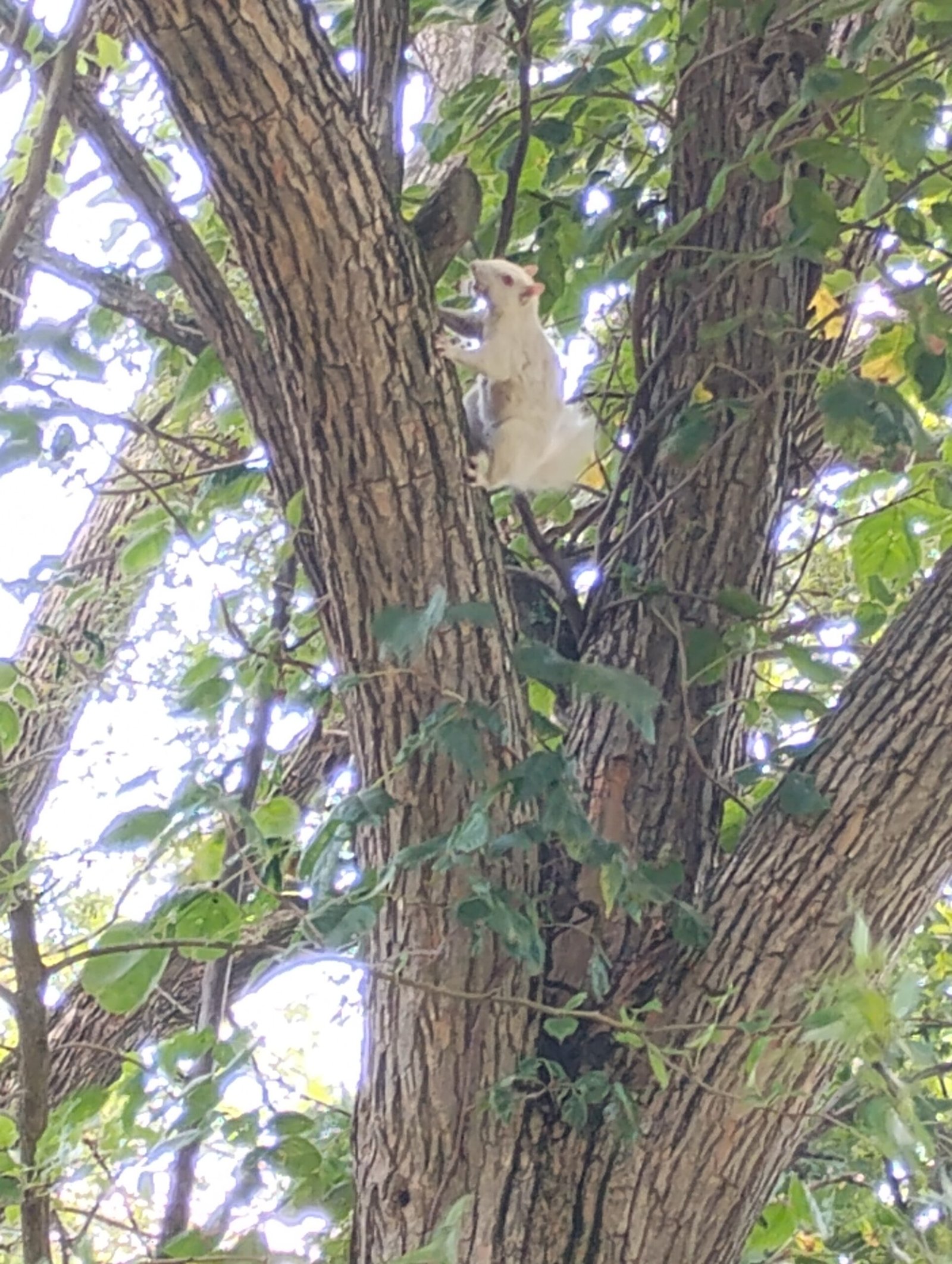
Which means the ones you see have beaten odds to get there, and a neighborhood that has them has something that took years to accumulate and can be lost quickly. That is most of why we are so firm about this. A company that treats squirrels as a line item will eventually take out a white one on a Tuesday and never know it did.
If you have them near you: enjoy them, photograph them from a distance, and do not feed them. Feeding concentrates squirrels, and concentrating squirrels near houses is precisely how they end up in soffits and attics — which is how they end up being somebody’s pest problem. The kindest thing you can do for a white squirrel is keep it wild and keep it off your roof.
A valley that keeps things
It is worth asking why a white squirrel matters to anybody at all. It is one animal. It does not do anything for you.
But the Miami Valley has always been a place that keeps things, and that habit runs deeper here than most people outside it realize.
In March of 1913 the Great Miami came out of its banks and took the valley apart. Hamilton lost more than two hundred people in a day. Dayton went under. And what this region did afterward was not move away from the river — it was petition, organize, tax itself, and build the Miami Conservancy District, five dams and a levee system that has held for a century and that most people driving over it today never think about. Springfield did its own version after 1924. Southwest Ohio decided, more than once, to engineer its way out of drowning rather than leave.
The same instinct shows up smaller. It is in the streetcar-era neighborhoods that still have their maples, because somebody kept planting them and somebody else kept not cutting them down. It is in Hills & Dales, hundreds of acres of hillside handed to the city rather than sold, laid out with help from the Olmsted Brothers — the firm behind Central Park. It is in a man who ran one of the largest companies in America and liked to say that shrouds have no pockets.
Those old maples are, incidentally, exactly why we have squirrels at all. A mature hardwood canopy over a hundred-year-old neighborhood is squirrel country in a way a new subdivision on a scraped cornfield simply is not. The trees the valley kept are the reason the animals are here.
So a white squirrel ends up being a small, unowned inheritance. Nobody’s property. Nothing anybody can sell. It exists because a neighborhood has old trees and because, over decades, enough people decided not to do anything about it. Somebody’s grandmother pointed one out from a porch on Linden Avenue. Somebody’s kid saw one on the way to school and has never entirely stopped looking for it since.
Bryan Camden runs this company. One man, one truck, one license, working out of an office on Salem Ave in the city he lives in. When somebody calls him about squirrels, he gives away the job. He is not going to be the reason a Kettering street loses the white one.
If squirrels are already in your attic
None of the above means you have to live with them. Squirrels in a structure are a genuine problem — they gnaw wiring, which is a fire risk, they foul and compact insulation, and they widen a small roofline gap into a permanent door. You are entitled to your attic back.
Here is the right way round, and it is the same logic we apply to rodents: the answer is exclusion, not killing. Squirrels are territorial. Remove the individuals and leave the hole, and the vacancy gets filled by next season — you have solved nothing and paid for it. Close the building properly and the problem ends permanently.
- Get a licensed nuisance wildlife control operator, not a general pest company. Ask to see the license. A company that will treat squirrels without one will cut other corners on your roof.
- Timing matters enormously in spring. Late winter and early spring is nesting season, and sealing a nursing female out means her young starve in your attic — which is inhumane, and which you will smell for weeks. A competent operator checks for a nest before closing anything.
- One-way doors are the humane standard. A device over the entry lets the animals leave and not return, so nothing is trapped inside and nothing is killed.
- Then seal properly, once they are out. Repair the soffit or fascia, screen the gable and ridge vents in metal, and cut back branches overhanging the roof — a squirrel can jump further than you would guess, and an overhanging limb is a bridge.
- Get the insulation and wiring looked at afterward if the occupation went on a while.
Ask us and we will tell you who we would call. We have no financial interest in the referral, which is rather the point.
And there is the law
People are frequently surprised by this: in Ohio, gray and fox squirrels are game animals, not vermin. They have a hunting season — roughly the first of September through the end of January — with a daily bag limit, and they are managed by the Ohio Division of Wildlife.
That legal status carries real consequences for a homeowner. There are rules about trapping a nuisance animal on your own property, about how long you may hold it, about where it may be released, and permits can be required before wildlife is destroyed. This is genuinely not an area to improvise in, and it is not an area where we are the experts — we are licensed for pesticides, not wildlife.
So check with the Ohio Division of Wildlife, or use a licensed operator who already knows. The short version for most households: leave the trap in the shed, call somebody licensed, and let them do it lawfully.
What we actually do
Since we have spent this long telling you what we will not touch, here is the other half.
House mice and rats are ours, and they are most of what actually gets into houses in this valley. On the old stock — Springfield, Hamilton, Greenville, Middletown, the village cores — the answer is almost never bait. Those houses are balloon-framed on stone foundations, which means a mouse entering at the sill plate in October can be in an upstairs closet by November, and it means bait alone is a subscription rather than a solution. Exclusion is what ends it: finding the actual openings and packing them with copper mesh and steel wool, which a rodent cannot chew.
You will notice that is the same answer we just gave you for squirrels, from a company that does not do squirrels. Seal the building. It is nearly always the real answer, and it is the one that does not require anything to die.
Beyond rodents: ants, roaches, bed bugs, stinging insects, spiders, fleas and termites, across eight southwest Ohio counties. Licensed by the Ohio Department of Agriculture, firm #115079.
Seen one? Send it in.
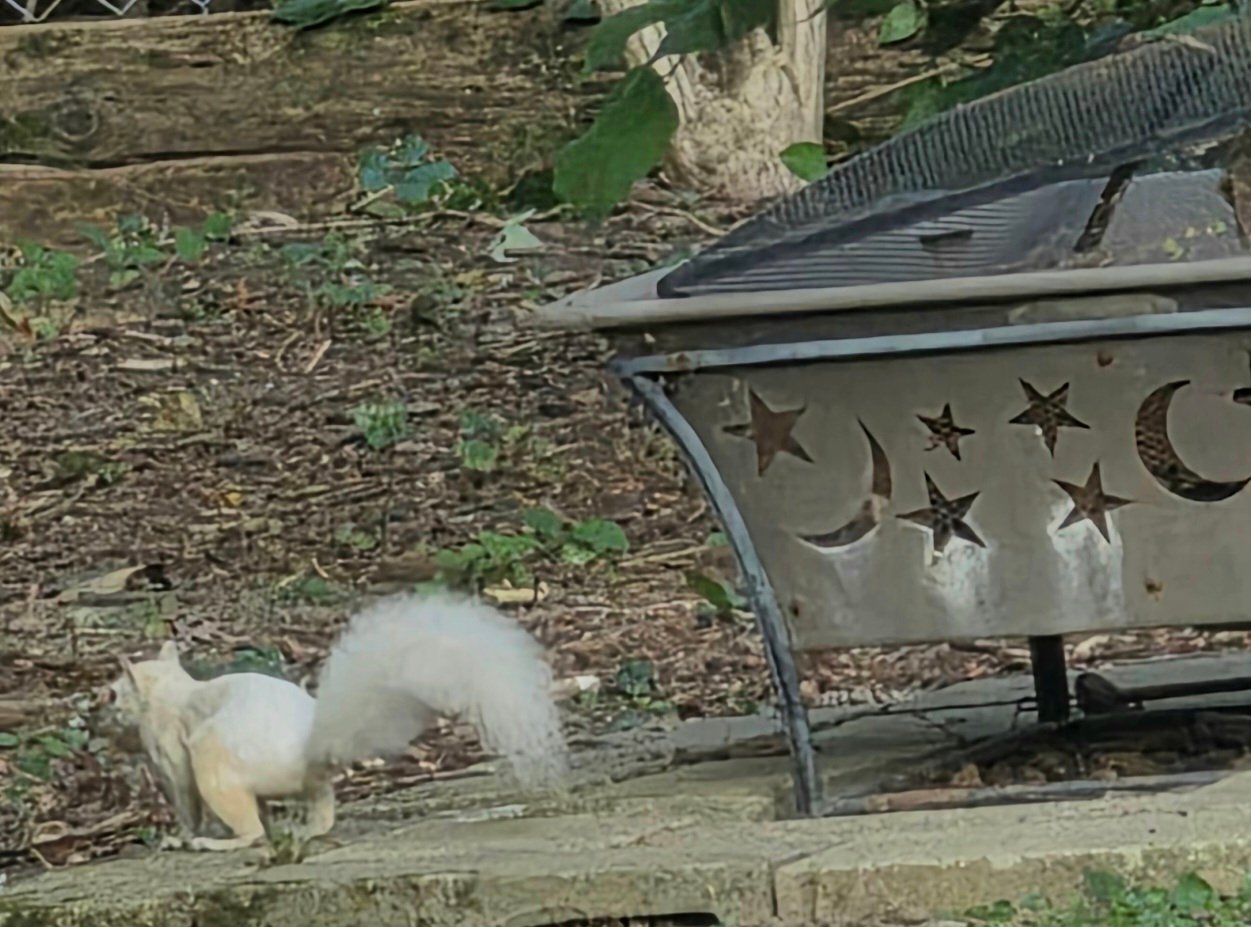
If you have a white squirrel on your street, we would genuinely like to hear about it — text a photo to (937) 569-3330. We are not collecting them and we are not coming to get it. We just think it is a good thing to know where they still are.
And if what you actually have is mice, rats or insects, that is our trade and the quote is free. Monday through Friday 8 a.m. to 6 p.m., Saturdays by appointment.
Frequently asked questions
Will you remove squirrels from my attic?
No. We are licensed by the Ohio Department of Agriculture for structural and household pests — insects, mice and rats. Squirrels and other wildlife fall under the Division of Wildlife and require a licensed nuisance wildlife control operator. Ask us and we will tell you who we would call; we have no financial interest in the referral.
How do I tell squirrels from mice in the attic?
Time of day is the biggest tell. Squirrels are active at dawn and dusk and go quiet midday; mice and rats are nocturnal. Squirrels also sound heavy — rolling and thumping — and enter high at the roofline through a baseball-sized chewed hole, where mice enter low through a gap the width of a pencil.
Are the white squirrels albino or leucistic?
Both occur here — readers have photographed each. An albino has a pink-red eye plus a pink nose, ears and feet, because melanin is absent everywhere. A leucistic squirrel is just as white in the coat but keeps a dark eye, because leucism reduces pigment without eliminating it. Look at the eye; that is the whole test.
Did NCR’s John H. Patterson really bring them here?
That is the story people tell — that he introduced them around 1910 after seeing similar animals travelling in Russia. It circulates as local legend rather than documented fact, and we are not in a position to verify it. It may well be true; we would just rather not state it as certain.
Where are white squirrels seen around here?
Most reports cluster around Kettering and the older Dayton neighborhoods — the streetcar-era streets with mature hardwood canopy. That is not a coincidence: old maples are what make a neighborhood squirrel country in the first place.
Can I just trap a squirrel myself?
Be careful. In Ohio gray and fox squirrels are game animals with a hunting season and a daily bag limit, and there are rules covering trapping a nuisance animal, how long it may be held, where it may be released, and when a permit is required. Check with the Ohio Division of Wildlife or use a licensed operator who already knows the rules.
Why does exclusion beat removal for squirrels?
Because squirrels are territorial. Remove the individuals and leave the hole open, and the vacancy gets filled next season — you have paid for nothing. Close the building properly and it ends permanently. It is the same reason we push exclusion over bait for mice.
Is there a wrong time of year to seal them out?
Yes — late winter and early spring is nesting season. Sealing a nursing female out means her young starve inside your attic, which is inhumane and which you will smell for weeks. A competent operator checks for a nest before closing anything, and uses one-way doors so nothing is trapped inside.
Should I feed the white squirrel on my street?
Please do not. Feeding concentrates squirrels near houses, and concentrated squirrels are how soffits and attics get occupied — which is how a beloved animal becomes somebody’s pest problem. Watch it, photograph it from a distance, and leave it wild.
What do you actually treat, then?
House mice and rats, ants, cockroaches, bed bugs, wasps and hornets, spiders, fleas, mosquitoes and termites, across eight southwest Ohio counties. Licensed by the Ohio Department of Agriculture, firm #115079; Bryan Camden, commercial applicator #170858.