
Every September, the same scene plays out across Ohio: a kid finds the fluffiest, most pettable yellow caterpillar imaginable on the sidewalk under a maple — and twenty minutes later a parent is searching “fuzzy yellow caterpillar rash” with one hand while running cold water over small fingers with the other. Ohio has a short but genuine roster of stinging caterpillars — larvae whose hairs and spines deliver venom or irritants on contact — and unlike most of this library’s scary-looking-but-harmless cast, these actually earn their warning. This page is the parent-and-gardener field guide: the four that matter (saddleback, io moth, American dagger, and the puss caterpillar question), exactly what contact does, the sting first-aid that works (the tape trick is real), the harmless fuzzy lookalikes that take the blame, and the honest word on when caterpillars ever become a pest-control matter.
The Rule Before the Roster: Fuzzy Means Look, Not Touch
Stinging caterpillars don’t sting the way wasps do — no aggression, no pursuit, no intent. Their defense is passive: hollow spines and specialized hairs (some venom-tipped, some merely barbed) that break off into skin on contact, like botanical fiberglass with chemistry attached. That mechanism sets the whole risk profile: every incident is a touch incident — a bare hand, a bare foot, a forearm brushing foliage, laundry that dried over a branch. Which yields the only rule a family needs: any caterpillar wearing fur, spikes, or decoration gets admired at photo distance and handled, if truly necessary, with a leaf or stick. Teach that one sentence and this page becomes trivia; skip it and September gets memorable.
Four caterpillars are worth avoiding and none need treating. For the stinging insects that do, see pest control in Dayton.
#1: The Saddleback — Ohio’s Worst Sting on Legs
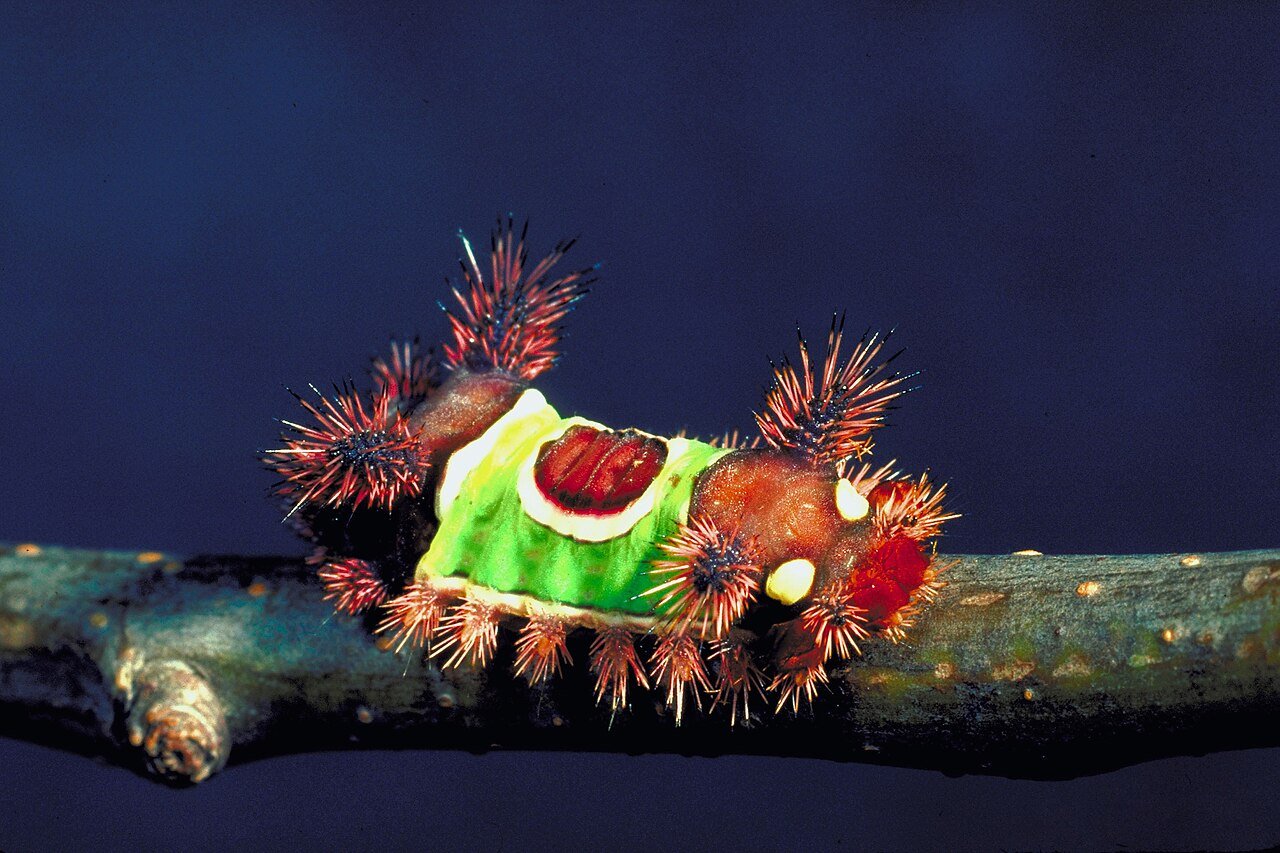
The saddleback caterpillar (Acharia stimulea) is the one that sends people to urgent care: an inch of brown slug-form caterpillar wearing a vivid green blanket with a brown “saddle” at center — beautiful, unmistakable, and bristling at both ends with venom-tipped spine clusters. Contact delivers immediate burning routinely compared to a bad wasp sting, followed by welts and sometimes hours of radiating ache, nausea, or (rarely) systemic reaction in the sensitive. They feed on dozens of plants — oaks, maples, hydrangeas, corn, blueberries — and the classic Ohio encounters are a gardener’s forearm in an August shrub and a picker’s hand in the blueberry row. Late July through September, singly, undersides of leaves: the saddleback is uncommon enough that many Ohioans never meet one and memorable enough that nobody meets two.
#2: The Io Moth Caterpillar — the Green Pincushion
The io moth caterpillar grows to nearly three inches of pale green armored in branching spine rosettes, with a red-and-white racing stripe down each side — a genuinely gorgeous animal whose sting runs a solid second to the saddleback’s: sharp burning and welts, less radiating drama, same venom-spine mechanism. Io larvae feed communally when young (a dozen pincushions marching a redbud branch is a classic sighting) on cherries, redbuds, willows, and roses. The adult is the famous eyespot moth of porch lights — and, in the family tradition of overcorrection, the adult has no working mouthparts and couldn’t harm a marshmallow. The caterpillar earns respect for exactly the weeks it wears spines, and not a day after.
#3: The American Dagger — the One Your Kid Will Actually Find
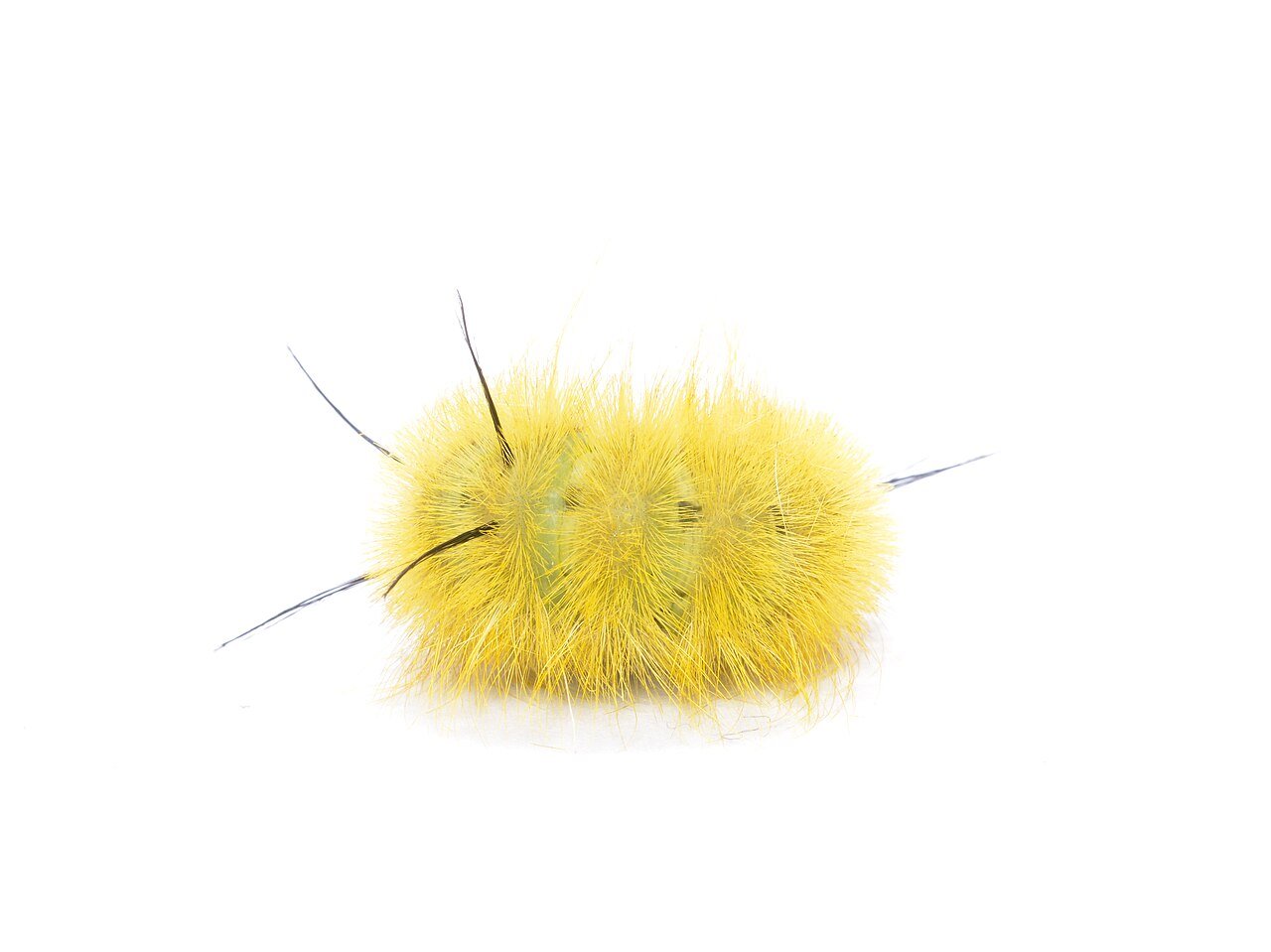
The American dagger moth caterpillar is the volume case: brilliant fuzzy yellow-white with black “eyelash” tufts, abundant under maples, oaks, and elms every late summer and fall, and engineered by appearance to be picked up by children. Its hairs aren’t venom-injectors like the spine-bearers above — they’re brittle irritants that embed and break, delivering burning, itching rash and welts that vary from trivial to miserable by individual (kids’ skin reacts worst). It’s Ohio’s most common stinging-caterpillar incident by a wide margin precisely because it’s the most touchable-looking. The sidewalk-under-the-maple encounter in September–October is the textbook case — and one calm “we don’t pet fuzzy caterpillars” at age five prevents the whole genre.
#4: The Puss Caterpillar Question (and the Southern Asterisk)
The internet’s most feared caterpillar — the puss caterpillar or “asp,” a silky toupee hiding the most potent caterpillar venom in North America — is fundamentally a southern animal: Texas through the Gulf and lower Atlantic states, where school warnings go out each fall. Ohio sits at the extreme fringe: records here are rare-to-occasional, southern counties mostly, and the average Ohioan will never encounter one. We include it for two reasons: the lookalike problem (any dense-furred “walking wig” caterpillar in Ohio deserves the no-touch rule and a photo, on the off chance), and the pattern this library keeps documenting — imported panic from other people’s ecosystems. Respect locally: saddleback first, io second, dagger by volume. Fear proportionally.
Sting First Aid: the Tape Trick and What Follows
- 1. Tape first, before washing: press adhesive tape (packing or duct) over the contact site and strip repeatedly with fresh pieces — this physically removes embedded spines and hairs, and it’s the single most effective step. Do it before rubbing or washing drives them deeper.
- 2. Then wash with soap and water, no scrubbing.
- 3. Cool and calm it: ice pack for the burn, hydrocortisone or calamine for the rash, oral antihistamine for itch and welting.
- 4. Watch for the escalation signs: spreading hives, facial or throat swelling, wheezing, nausea/vomiting after a heavy sting — emergency care, same as any sting anaphylaxis. Eye contact with hairs = medical visit, full stop.
- 5. Expect the timeline: saddleback and io burn hardest in the first hours; dagger rashes can itch for days. Marks fading over a week are normal; worsening after 48 hours suggests secondary infection worth a look.
The laundry footnote earns its place: hairs shed onto fabric keep stinging — the mystery rash from a towel that dried on the porch rail, or the shirt from the clothesline under the maple, is a documented classic. Shake and re-wash anything that shared space with a fuzzy visitor.
The Innocent Fuzzy Lineup (Who Takes the Blame)
For every genuine stinger, a dozen harmless fuzzies get executed on suspicion, so here’s the acquittal roster: the woolly bear (black-and-rust weather prophet — fully pettable, Ohio’s most beloved larva), the hickory tussock (white-and-black, mildly irritating to sensitive skin but far below its reputation), the milkweed tussock (orange-black shag on the monarch’s plant), and the giant silk moth larvae (cecropia, polyphemus — huge, green, spectacular, harmless). The sort is refreshingly simple: Ohio’s dangerous four wear either branching spines (saddleback, io) or that specific fuzzy-yellow-with-black-lashes uniform (dagger) or the furry toupee (puss, barely here). Everything else fuzzy is folklore and photo material — though the no-touch teaching rule stays universal for kids, because five-year-olds don’t key species.
Rash you can’t place, a caterpillar you’d like named before the kids resume recess, or a genuine infestation question? Send the photo — identification is free. Serving Dayton and all of Montgomery, Greene, Miami, Clark, Warren, Butler, Preble, and Darke counties.
The Ohio Caterpillar Calendar: When the Touch Risk Actually Runs
Stinging-caterpillar season is narrower than fear suggests, and knowing the window converts a year of vague worry into six weeks of specific attention. June–July: io colonies hatch and march in their conspicuous young gangs — the easiest stage to spot and relocate a redbud branch around. Late July–August: saddleback prime time, feeding solo on shrub undersides at gardener-forearm height; this is the month to wear sleeves into the hydrangeas and look before reaching into the blueberries. September–October: dagger season — mature larvae abandon the maples and wander sidewalks and driveways hunting pupation sites, which is exactly why every kid in Ohio finds one; the wanderers on pavement are the year’s main event. First frost: curtain — every stinger on this page is done, cocooned, and harmless until next summer. Practical translation for parents: one seasonal reminder at the August school-supply run (“fuzzy caterpillar season — look, don’t touch”) covers the entire risk window with a sentence.
Gardeners get a parallel calendar: the saddleback’s host list overlaps the harvest — blueberries, tomatoes’ neighbors, ornamentals at pruning height — so August pruning and picking is glove season not for thorns but for chemistry. A quick underside-scan of the branch before the bare hand goes in costs three seconds and prevents the whole story.
Why Caterpillars Sting at All (the Science That Makes Kids Care)
The mechanism is worth two paragraphs because it turns a scolding into a science lesson — and lessons stick. A caterpillar is, ecologically speaking, a walking protein bar with no speed, no flight, and weeks of exposure on a leaf; every bird, wasp, and predatory insect in the yard wants it. The family’s answers split by budget: most species bought camouflage (the green blenders), some bought bluff (fake eyespots, whip tails), and the roster on this page bought armament — urticating hairs and venom spines, essentially disposable hypodermic glassware grown from the cuticle. The spines are hollow, brittle by design, and snap at a touch to release irritant or true venom; the vivid colors and bold patterns aren’t decoration but aposematism — honest warning labels, the same signal a wasp’s stripes send — advertising the cost of contact to predators who learn fast. A blue jay makes the saddleback mistake once.
Which yields the teachable version for the sidewalk: bright, spiky, or fuzzy caterpillars are SHOWING you their warning label — reading it costs nothing, ignoring it costs a bad afternoon. Kids who learn to read aposematic signals have acquired actual field biology, and they generalize it correctly to everything from wasps to coral snakes on vacation. One September rash prevented, one naturalist possibly minted.
A closing note on proportion, because this page sits in a library full of acquittals and shouldn’t end on alarm: Ohio’s stinging caterpillars cause zero fatalities, a handful of urgent-care visits, and a September’s worth of miserable-but-brief rashes in a state of twelve million people — every incident preventable with one sentence of playground wisdom and a roll of tape in the first-aid drawer. They are also, every one of them, next year’s moths: the io’s eyespot wings, the dagger’s gray elegance, the saddleback’s tiny furry adult — pollinators and bird food and porch-light regulars. The goal was never fear; it’s the same literacy this whole library teaches — know your yard’s four genuinely spiky characters by sight, wave at everything else, and keep the tape where you can find it.
Frequently Asked Questions
What stinging caterpillars live in Ohio?
Four matter: the saddleback (worst sting — venom-tipped spine clusters), the io moth caterpillar (green pincushion, strong second), the American dagger moth caterpillar (fuzzy yellow, most common incident by far), and — at the rare southern fringe — the puss caterpillar. Everything else fuzzy is essentially harmless.
What happens if you touch a saddleback caterpillar?
Immediate burning routinely compared to a bad wasp sting, welts, and sometimes hours of radiating ache or nausea. Tape-strip the site, wash, ice, antihistamine — and treat systemic symptoms (hives, swelling, wheezing) as an emergency like any sting reaction.
Is the fuzzy yellow caterpillar poisonous?
The American dagger moth caterpillar — fluffy yellow with black lash tufts, common under maples in fall — causes burning, itching rash when its brittle hairs embed in skin. Not dangerous systemically for most people, but genuinely unpleasant, worst on children’s skin, and the #1 caterpillar incident in Ohio.
What is the tape trick for caterpillar stings?
Press adhesive tape over the sting site and strip it off repeatedly with fresh pieces BEFORE washing — it pulls out the embedded spines/hairs that keep delivering irritant. It’s the single most effective first-aid step and works for all the species on this page.
Are woolly bear caterpillars safe to touch?
Yes — the black-and-rust woolly bear is fully harmless (bristly, not stinging) and Ohio’s most beloved caterpillar. The universal kids’ rule stays “look, don’t touch” only because five-year-olds don’t distinguish species.
Are puss caterpillars (asps) in Ohio?
Barely — they’re a southern species (Texas/Gulf fame) with only rare, mostly southern-Ohio records. Any dense “walking toupee” caterpillar here earns the no-touch rule and a photo, but the average Ohioan never meets one; the saddleback is our actual heavyweight.
Why do I have a rash from laundry or towels?
Caterpillar hairs shed onto fabric keep stinging — towels and clothes dried outdoors under infested trees are a documented rash source every fall. Shake out and re-wash anything that hung near a fuzzy visitor.
Do stinging caterpillars ever need pest control?
Rarely — they’re solitary and seasonal. The legitimate cases: io or dagger clusters defoliating and raining larvae over play areas, daycare/school landscaping where the touch risk concentrates, or repeated saddleback finds in a picking garden. Those we treat surgically on the host plants — the yard-wide spray is never the answer for an insect this localized.