
“Black and orange bug” is one of the most-typed identification searches in Ohio — and one of the most answerable, because the state’s black-and-orange roster is short, distinctive, and almost entirely benign. The warning colors that trigger the search (aposematism — nature’s hazard-stripe convention, advertising foul taste to birds) turn out to protect a lineup of seed-eaters, pollinator-adjacent wanderers, and beneficial predators, with exactly one household nuisance among them and zero genuine dangers. This page runs the full lineup: the six black-and-orange regulars sorted by venue and pattern, the one that ends up in your house by the hundred (boxelder bugs — the lineup’s only file with homework attached), the beneficial members worth protecting, and the seasonal calendar that predicts which one you are looking at before the photo confirms it.
The lineup, sorted by venue
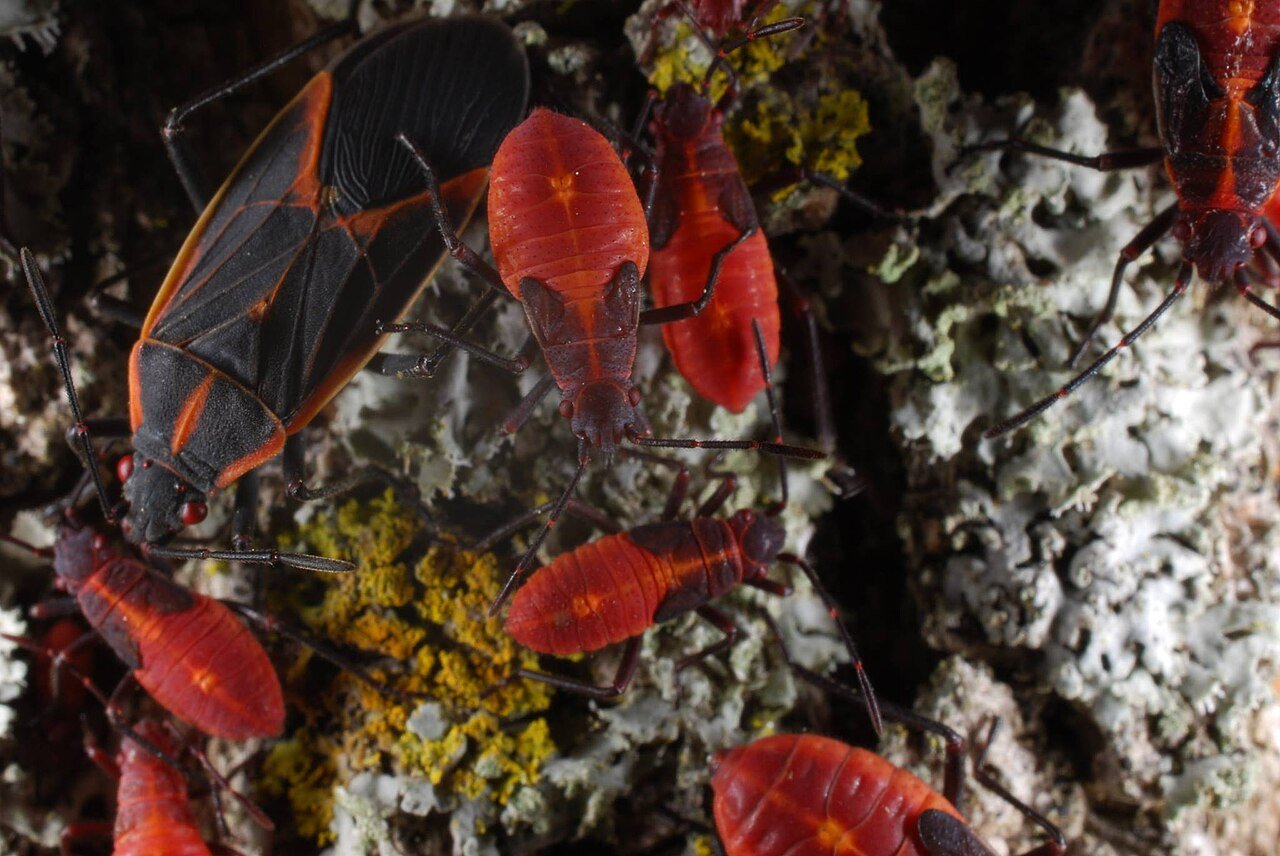
On your sunny walls, in numbers, in fall: boxelder bugs — the lineup’s star and the search’s usual answer: half-inch charcoal bugs with three red-orange racing stripes behind the head and V-ing wing edges, massing on south siding each October (their full house-invasion file, sealing calendar included, lives on the boxelder page); their NYMPHS — bright red with developing dark wings, per the photo — run the summer version of the search. On milkweed patches: milkweed bugs — the large (bold orange with a black band-and-diamond pattern) and small (orange X on black) — seed specialists that live and die on the monarch’s plant, garden-harmless and monarch-adjacent enough to deserve their protection. Trundling across lawns in spring and fall: black-and-orange “woolly” movers — the fuzzy version is a moth caterpillar (the woolly bear, the folklore winter-forecaster) and the armored version a burying or carrion beetle doing cleanup duty; both pass through, neither pests. On flowers all summer: soldier beetles — soft-winged orange-and-black “leatherwings” that pollinate and eat aphids simultaneously, among the yard’s clearest keep-list members. And the impostor check: if the “bug” carries the domed half-sphere build, it is a lady beetle variant (the Asian lady beetle’s file next door); if inch-long with a cog, yesterday’s wheel bug page claims it.
Most black-and-orange insects in Ohio are harmless. If they are coming indoors in numbers, that is a job for pest control in Dayton.
Why the colors: the hazard-stripe convention
The lineup shares its palette by evolutionary agreement: orange-on-black is aposematism — warning coloration — and in this family of cases the advertisement is TASTE, not weaponry. Milkweed bugs sequester the monarch’s same cardiac glycosides from milkweed seed; boxelder bugs carry their own foul chemistry; soldier beetles and burying beetles run defensive secretions; and birds, having sampled one, generalize the lesson to the whole color scheme — which is why the pattern persists across unrelated species (Müllerian mimicry, the honest version of the strategy) and why a few genuinely defenseless mimics ride the convention free. The homeowner’s takeaways: the colors predict INEDIBILITY, not danger — nothing in Ohio’s orange-and-black roster stings, and only handling-grade nips exist anywhere in it; the crush warning applies instead — the same chemistry that deters birds stains fabric and smells (the boxelder and milkweed files both carry the no-smash rule); and the color-logic itself becomes an ID tool — bold advertised insects moving slowly in the open are announcing protection, while the genuinely dangerous stingers of the yard (yellowjackets, per their pages) advertise with movement and defense, not leisurely display.
The one with homework: boxelder bugs, briefly
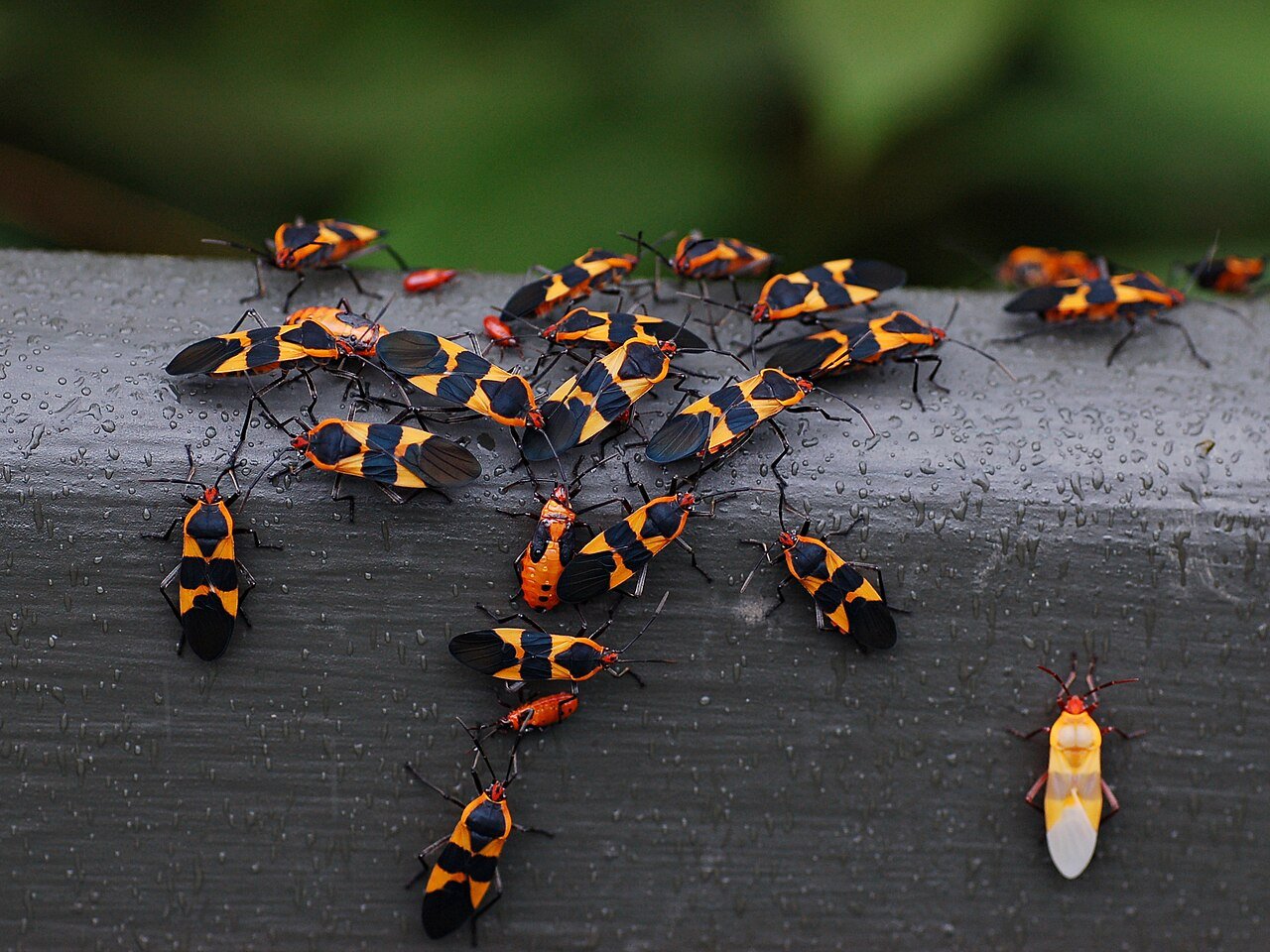
The lineup’s single household file gets its summary here and its full program next door. Boxelder bugs alone among the six treat your house as winter quarters — the fall wall-massing, wall-void overwintering, and warm-day indoor wandering that define the fall-invader guild — and their management is the guild’s standard package: Labor Day sealing (gaps, screens, sweeps, vents), soap-water knockdown for the wall masses (a garden sprayer of soapy water drops massed bugs on contact, repeatable and product-free), the September barrier for repeat-siege houses, and gentle indoor removal (vacuum with stocking filter; never smash on fabric — the stain rule). The tree question answers itself the usual way: female boxelder and silver maples within a couple hundred yards supply the population, but removal is rarely worth it — sealing achieves more for less, per the full page’s math. Every other lineup member requires precisely nothing: milkweed bugs stay on milkweed, soldier beetles on flowers, woolly bears en route to wherever woolly bears go, and the beetles to their cleanup — the rare identification page where five of six answers end in “enjoy the colors.”
The seasonal predictor: which one is it, by calendar alone
April–May: woolly bears crossing paths (overwintered, seeking pupation sites) and the first soldier beetles on early blooms. June–July: milkweed bugs clustering on pods as they form; red boxelder NYMPHS on host trees and nearby walls (the summer version of the search); soldier beetles at peak on every flower head. August–September: milkweed-bug aggregations peak (pods mature); burying beetles at their busiest; the first boxelder adults testing sunny walls. October–November: boxelder massing season proper — the sunny-wall carpets that drive the search’s annual spike — plus the last woolly bears of forecasting folklore. Winter: only one candidate remains — an indoor black-and-orange find between December and March is a boxelder straggler waking from the walls, handled per the winter-wanderer protocol. Calendar plus venue answers most photos before they are taken; the free line adjudicates the rest: (937) 569-3330.
The protect list: three members on the payroll
Half this lineup earns active protection, and the reasons bear stating. Soldier beetles are dual-role staff — genuine pollinators (goldenrod and late-summer composites especially) whose larvae hunt soil pests and whose adults graze aphid colonies between flower visits; a garden thick with leatherwings in August is running free integrated services, and any spray decision that catches them costs both departments. Milkweed bugs occupy a more nuanced seat: seed predators of the monarch’s host plant, technically competing with butterfly interests at high densities — but entomologists’ consensus keeps them off any control list (natural milkweed communities carry them fine; hand-relocation suffices for the rare precious patch), and their presence marks exactly the pollinator habitat this library keeps endorsing. Burying beetles run the yard’s mortuary service — carrion located, interred, and recycled within hours — sanitation work the household benefits from precisely in proportion to never noticing it; one Ohio member of the family (the American burying beetle) is federally endangered, which converts the whole clan’s protection from courtesy to citizenship. The woolly bear rounds out the keep-list on charisma alone — the forecast is folklore, but the moth it becomes (the Isabella tiger) and the childhood it decorates both count for something. Five of six protected or shrugged at; the lineup’s entire action item remains the boxelder’s September homework.
Frequently asked questions
What is the black and orange bug on my house?
In fall, in numbers, on sunny walls: boxelder bugs — charcoal with three red-orange stripes behind the head — the lineup’s one household file, managed by Labor Day sealing and soap-water knockdown per their full page. Bright red versions in summer are their nymphs on the way there.
Are black and orange bugs dangerous?
No member of Ohio’s orange-and-black roster stings or meaningfully bites — the colors advertise foul TASTE to birds, not weaponry. The only warnings attached are stain rules: crushing boxelder and milkweed bugs marks fabric, so the vacuum and the jar outrank the smash.
What are the black and orange bugs all over my milkweed?
Milkweed bugs — large (orange with black band-and-diamond) and small (orange X on black) — seed specialists that live on the plant and sequester its chemistry like the monarch does. Harmless to garden and butterflies at normal densities; hand-relocate from precious patches if you must.
What is the fuzzy black and orange caterpillar?
The woolly bear — the Isabella tiger moth’s larva and folklore’s winter forecaster (band width predicting severity: charming, unscientific). Crossing paths in spring and fall en route to sheltered pupation; needs nothing but right-of-way.
What are the orange and black beetles on my flowers?
Soldier beetles (“leatherwings”) — soft-winged pollinators whose adults also graze aphids and whose larvae hunt soil pests. Firmly on the protect list; their August abundance on goldenrod is a healthy-yard signature.
Why are so many warning-colored bugs orange and black?
Aposematism — the shared hazard-stripe convention: distasteful species converge on one advertisement so birds learn it once (Müllerian mimicry). The palette predicts inedibility rather than danger, which is why the whole lineup handles safely.
What is the black and orange bug in my house in winter?
A boxelder straggler — the lineup’s only overwinter-indoors member, waking from wall voids on warm days between December and March. Jar-or-vacuum removal, no sprays, and the real fix scheduled for next Labor Day’s sealing.
Do black and orange bugs bite humans?
Handling-grade nips exist at the lineup’s edges (a grabbed milkweed bug can test skin), but unhandled members neither approach nor bite people. The roster’s entire human-contact file is stains and startles.
What black and orange bug looks like a ladybug but isn’t?
Usually it IS one — the multicolored Asian lady beetle’s orange-and-black variants dominate that build; the domed half-sphere shape routes the ID to their page (and the fall-invader program). Flatter, longer builds return you to this lineup.
Who identifies black and orange bugs near Dayton?
The free photo line: (937) 569-3330 — venue and calendar usually pre-answer (walls-in-fall, milkweed-in-summer, flowers-in-August), and the verdicts run five-parts “enjoy the colors” to one-part “here is the boxelder homework.”
The identification-page doctrine, stated once for the whole genre
This page joins a family — the tiny-red-bugs, scariest-bugs, and species-versus-species keys across the library — and the shared method deserves its plain statement, because it is the fastest identification skill a homeowner can own. Color searches resolve through three sorts run in order: venue (walls, milkweed, flowers, lawn, indoors — each address hosts a short candidate list), calendar (the seasonal predictor above — most color-matched species barely overlap in time), and build (domed, flattened, fuzzy, armored — the silhouette that separates beetles from bugs from caterpillars at a glance). Three sorts, usually ten seconds, and the color that triggered the search becomes the least important clue in it — which is the genre’s quiet lesson: nature reuses palettes constantly but reuses venue-calendar-build combinations almost never. The method scales to every mystery the yard produces, it is the exact sequence the photo line runs on every submission, and it converts the anxious color-match spiral into a short, confident checklist — the same trade this library keeps offering, one identification at a time.
Five acquittals, one September assignment, and a hazard-stripe convention decoded — the orange-and-black file closes with the yard’s most colorful cast fully named and mostly thanked.
The eight-county color report
The lineup’s local geography, from the routes: boxelder pressure follows its trees — the maple-lined streets of Kettering, Oakwood, and the county seats file the heaviest fall-wall reports, with the farm counties’ farmstead maples close behind; milkweed bug sightings track the pollinator-garden boom everywhere (Beavercreek and Centerville’s monarch waystations lead the photo submissions); soldier beetle abundance maps late-summer bloom — goldenrod fencerows in Miami and Preble, prairie plantings in the newer suburbs; and the woolly bear crossings peak on every township road each October, folklore forecasts included at no charge. The winter file stays boxelder-only in every zip code, and the identification method — venue, calendar, build — runs identically from downtown Dayton to the Indiana line. The colors are county-wide; the homework, as ever, is one species and one September.
Venue, calendar, build — ten seconds, six names, five thank-yous and one caulk gun. The hazard stripes were mostly good news all along: the yard’s way of labeling what the birds already learned, now legible from the porch with the coffee still warm. Enjoy the colors; September will come soon enough.
The rest of the identification wing — the tiny reds, the scariest silhouettes, the look-alike tribunals — waits one link away for whatever the garden displays next; the method in your pocket now works on all of it.
Stripes decoded, lineup dismissed, court adjourned in living color.
May every mystery bug you meet come this well-labeled.
Orange, black, and fully accounted for.
See you at the next sighting.
Court adjourned.
In color, naturally.