
The postwar neighborhoods that make up most of Middletown share a construction detail that wasps exploit every single year: aluminum or vinyl soffit and fascia installed over the original wood in the 1970s and 1980s. That retrofit almost never sealed perfectly, and the void it created between the new panel and the old framing is a sheltered, weatherproof, completely concealed cavity running the length of the eave. It is close to ideal nesting space, and it is the single most common place we treat wasps in this city.
The Retrofit Soffit Void
When aluminum or vinyl soffit went up over original wood eaves, the installers worked to the standards of the day, which did not include sealing every seam against insects. J-channel at the wall, the joint where soffit meets fascia, the gap at a corner return, and the openings around a vent are all potential entries, and behind them sits a continuous void that no one has looked into since.
Yellowjackets find those voids reliably. A queen enters through a seam in April, and by August there is a substantial colony in a cavity you cannot see, reach, or easily treat from the ground. The visible sign is steady two-way traffic at one specific point along the soffit line — insects going in and out of what looks like a hairline gap. That is a wall or eave nest, and it should be treated as a structural problem rather than a yard problem.
The same retrofit created a second issue: it made the original wood eave invisible. Water damage, rot, and carpenter ant activity behind aluminum go unnoticed for years, and when we open a soffit to treat a wasp nest we not infrequently find the wood behind it in poor condition. That is worth knowing rather than a reason to panic, but it does mean the soffit line on these houses deserves attention generally.
Why It All Happens in August
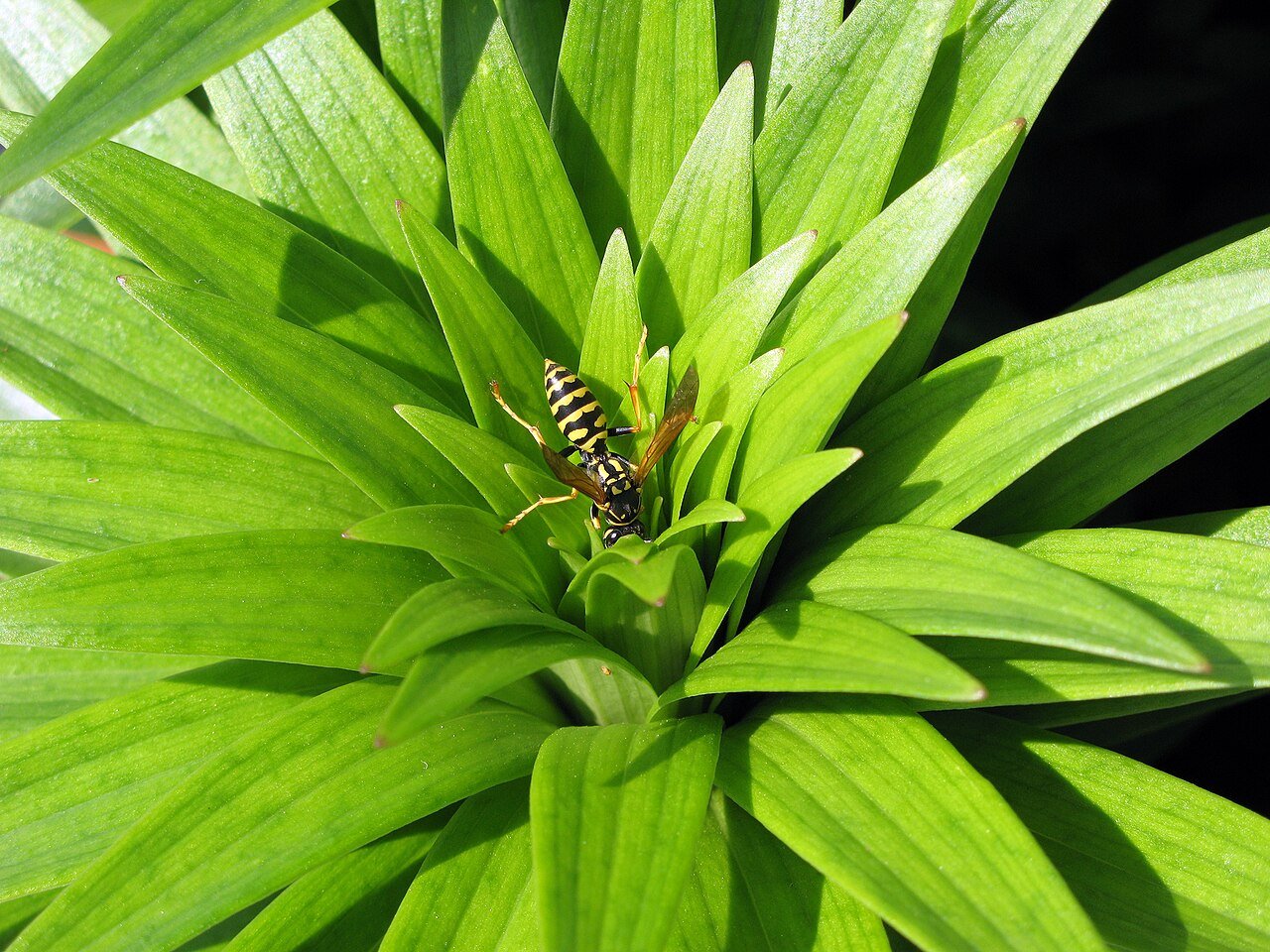
A social wasp colony begins in spring with a single overwintered queen. She builds a small nest, raises the first workers herself, and through early summer the colony is genuinely small and unnoticed. Growth is exponential from there, and by mid-August a yellowjacket colony that held a few dozen workers in June may hold several thousand. Nothing changed about your house. The colony reached the steep part of its curve.
Late summer also changes behavior in a way people feel directly. For most of the season workers hunt protein to feed larvae, and those larvae reward foragers with a sugary secretion. As the colony shifts toward producing next year’s queens that reward stops, and workers switch to seeking carbohydrates aggressively. That is why yellowjackets suddenly appear at patio tables, trash cans, and cookouts in late August after being invisible in June.
The colony dies with the first hard frosts, and only fertilized queens survive to overwinter under bark, in leaf litter, and in structural voids. That last detail matters on retrofit-soffit houses in particular: an untreated eave void that hosted a colony this year is prime overwintering and re-nesting space next year, which is exactly why the same house has the same problem in the same spot season after season.
The Three You Are Most Likely to Have
Paper wasps build the open, umbrella-shaped comb you can look straight up into, hanging from a short stalk. On these houses they favor the underside of an attached garage door frame, porch and stoop ceilings, gable vents, deck rails, playset canopies, and the inside of a grill that has not been opened in a few weeks. Colonies stay comparatively small, and paper wasps are the least aggressive of the three unless you are within a foot or two of the nest.
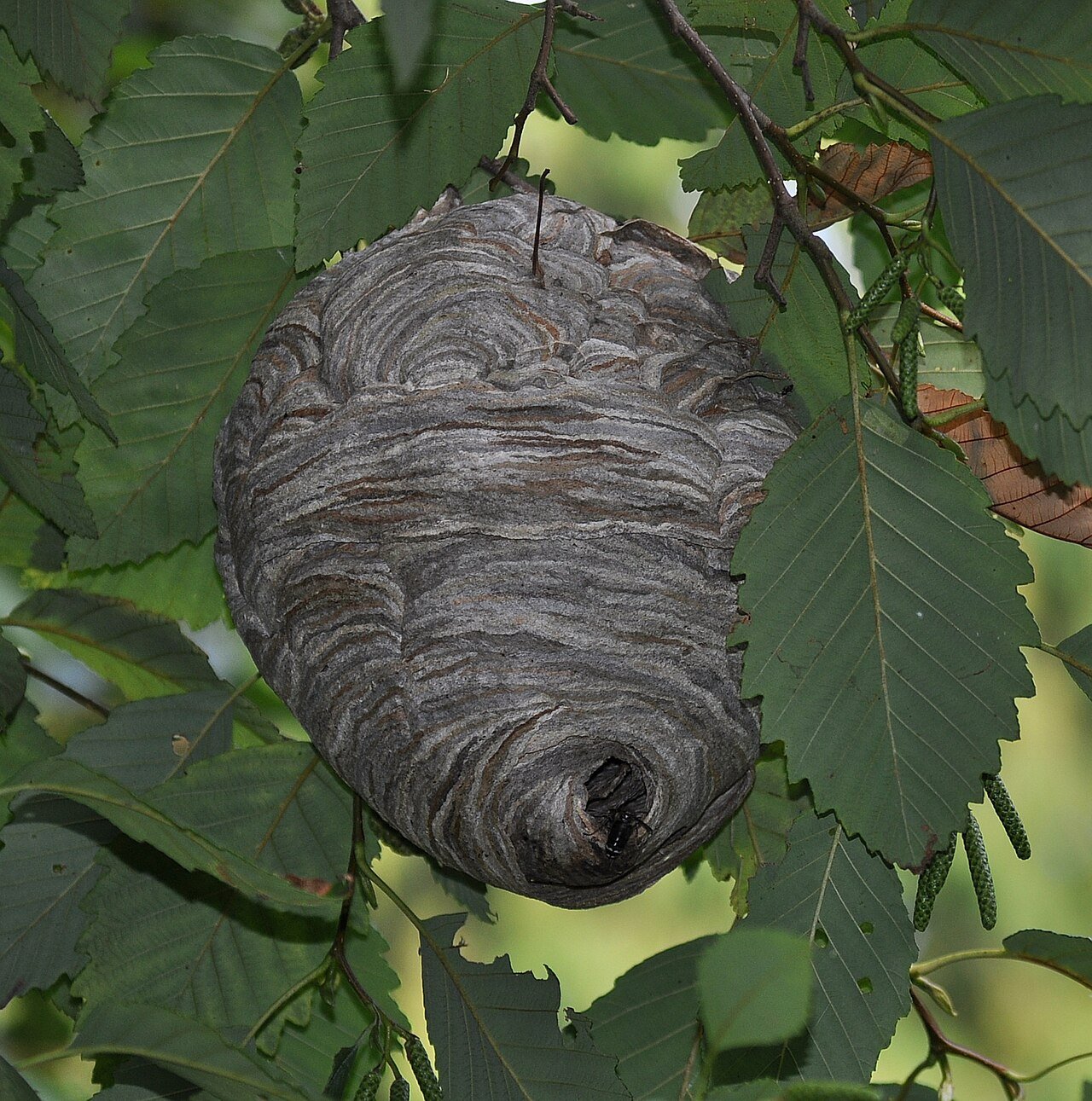
Bald-faced hornets build the large gray enclosed football. They are technically a yellowjacket, they defend a substantial area rather than just the nest, and they are the species most likely to put somebody in urgent care after a mower or hedge trimmer passes too close. On these lots they turn up in mature yard trees, in overgrown boundary hedges, and under high eaves.
Yellowjackets cause the real trouble because they nest out of sight — in the retrofit soffit void, behind siding, in a rim joist cavity, or in an abandoned rodent burrow in the lawn. The ground nests are a genuine mowing hazard, and they are frequently discovered the hard way. On lots with older lawns and open yards, they are common enough to be worth walking the yard before the first mow of the week in August.
- Two-way traffic at one point on the soffit line — a nest in the retrofit eave void.
- Open umbrella comb under a garage door frame, stoop ceiling, or grill lid — paper wasps.
- Large gray enclosed football in a yard tree or under a high eave — bald-faced hornets.
- Wasps from a hole in the lawn — ground yellowjackets, and a mowing hazard.
- Same spot every year — an unsealed void still attracting queens.
The Mistake That Puts Wasps Inside
When homeowners find wasps using a gap in the soffit, the intuitive response is to seal it. It is entirely logical and it is the worst available option. A void colony has one familiar exit and a nest that may hold thousands of insects. Close it and they do not leave — they look for another way out, and the next available route is very often inward, through a ceiling seam, a can light, an attic access panel, or a gap at a top plate.
That turns an exterior nuisance into wasps in a bedroom or a hallway, which is both dangerous and considerably more expensive to resolve. The correct sequence never varies: treat first, confirm the colony is dead, seal afterward. Sealing genuinely matters as the final step, because an untreated void left open will attract next year’s queens to precisely the same space.
The related mistake is the ladder, and it accounts for a large share of serious wasp injuries. The sting is rarely the actual injury. Standing on an extension ladder at eave height with a can of wasp spray, working on a soffit seam you cannot see into, with a colony that defends a radius rather than a point, is a poor place to discover you are more allergic than you assumed.
Across Butler County
Monroe is immediately south, Franklin and Carlisle north across the county line, and Hamilton southwest.
General service is on the Middletown pest control page.
Frequently asked questions
Wasps are going in and out of my soffit. What is in there?
Almost certainly a yellowjacket colony in the void between retrofit aluminum or vinyl soffit and the original wood eave. Those retrofits rarely sealed every seam, and the cavity behind them runs the length of the eave. Steady two-way traffic at one point is the giveaway.
Should I seal the gap?
No — that is the one thing not to do. A void colony that loses its familiar exit looks for another way out, and the next route is often inward through a ceiling seam, a can light, or an attic access panel. Treat first, confirm the colony is dead, then seal.
Why do wasps take over in August?
The colony started in spring with one queen and grows exponentially, hitting its largest size in late summer. At the same time workers switch from hunting protein to seeking carbohydrates, which is why they appear at patio tables and trash cans. Your property did not change; the colony did.
They nest in the same spot every year.
Because an unsealed void that hosted a colony is prime overwintering and re-nesting space, and different queens find it season after season. On retrofit-soffit houses this is very common. Treating and then physically sealing that specific void is what breaks the cycle.
Can I spray it myself?
For a small paper wasp nest you can reach from the ground, often yes. For anything at eave height, anything enclosed in a soffit or wall, or anything in the ground, it is a genuinely bad idea. Most serious wasp injuries happen to people who were on a ladder at the time.
There are wasps coming out of a hole in my lawn.
Ground-nesting yellowjackets, and a real mowing hazard — the nest is usually far larger than the entrance suggests. Mark the spot, keep people and mowers away from it, and have the entrance treated directly rather than trying to flood or burn it.
Is it worth removing a nest in October?
Usually not for an exposed aerial nest — the colony dies with the first hard frosts and the nest is not reused. A void nest in the soffit or wall is different, because that space stays attractive to next year’s queens and is worth treating and sealing properly.
You mentioned finding rot behind the soffit. Should I be concerned?
It is worth knowing rather than alarming. Aluminum and vinyl retrofits hide the original wood eave, so water damage and carpenter ant activity behind them go unnoticed for years. If we open a soffit to treat a nest and the wood is poor, we will tell you what we saw.