The short answer: food-grade diatomaceous earth is one of the safest substances in all of pest control — with two real caveats (your lungs, and application done wrong) that this page covers completely. DE occupies a unique spot in our library: it’s the only shelf product our myth-busting series has ever graded a pass, the one powder standing between the folklore aisle and the professional toolkit, and — used correctly — a legitimately effective desiccant against crawling insects with essentially zero toxicity to people and pets. Used incorrectly, it’s a white dust storm that irritates airways, repels the pests it was meant to kill, and coats a house in chalky disappointment. The difference is entirely technique, and technique is teachable. This is the complete DE file from Greater Dayton Pest & Rodent: what the powder actually is (fossilized algae — genuinely), how it kills without being a poison, the food-grade versus pool-grade distinction that carries all the safety weight, the thin-film application method that separates results from mess, the pet and kid questions answered straight, and the honest limits that explain why our trucks carry its professional successors. Free advice, as ever, with the free line behind it: (937) 569-3330.
What DE actually is: a fossil, a filter, and a physics weapon
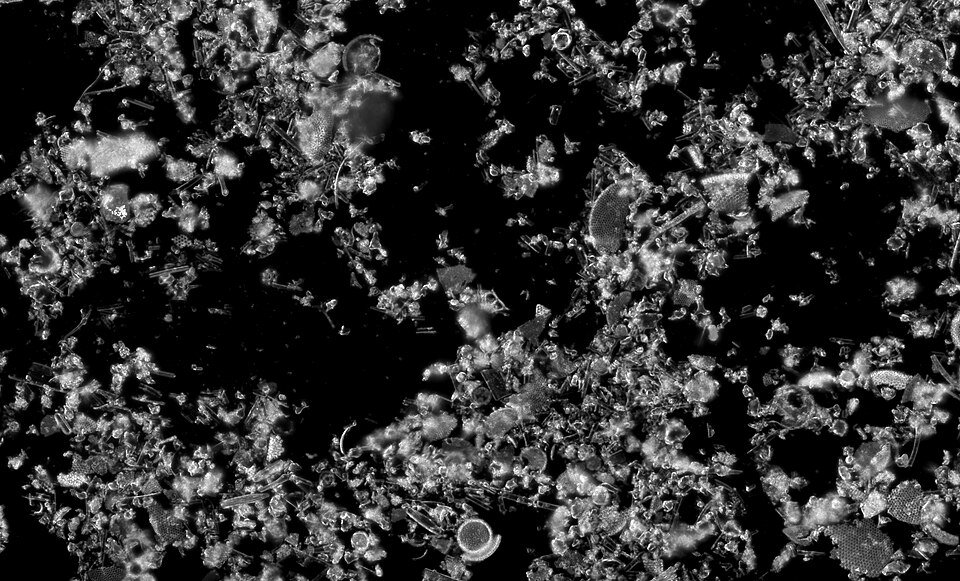
Diatomaceous earth is mined sediment made of diatoms — single-celled algae that build intricate glass-like shells of silica and have been dying into lakebeds and seafloors for tens of millions of years. The powder is those microscopic shells, crushed: to your fingers it feels like soft flour, but at insect scale each particle is a jagged silica fragment, and that scale mismatch is the entire weapon. DE kills mechanically, not chemically — the particles abrade and absorb the waxy cuticle layer that insects rely on to hold their body moisture, and a crawling insect that walks through a treated zone begins losing water through its damaged coating until it desiccates, typically over hours to days. No neurotoxin, no bait chemistry, no mode of action for resistance to evolve against — an insect cannot inherit immunity to being scratched and dried — which is why DE remains effective against the pyrethroid-resistant bed bug and roach populations that shrug off the spray aisle. The same mechanism defines the limits: DE only works on contact with crawling insects (nothing lured, nothing colony-shared, nothing airborne), it works slowly (days, not moments), and it works dry — moisture cakes the powder and blunts the particles, a caveat that matters enormously in Miami Valley basements and one the application section handles below.
Food-grade DE is safe and genuinely useful in dry, undisturbed voids, and useless everywhere else. For everywhere else there is pest control in Dayton.
The safety file: food-grade, pool-grade, and the one organ that cares
DE’s safety story is genuinely excellent and precisely bounded. Food-grade DE — the only kind that belongs anywhere near a household — is amorphous (non-crystalline) silica, so benign in ingestion terms that it’s permitted as an anti-caking agent in livestock feed and grain storage; a pet licking a treated baseboard or a toddler’s incidental contact is a non-event, and the EPA classifies it among its lowest-concern actives. Pool-grade (filter) DE is a different substance in the ways that matter: calcined at high heat, it converts a substantial fraction of its silica to crystalline form — the variety implicated in silicosis with chronic occupational exposure — and it must never be used for pest control; the bag’s label is the whole test, and “food grade” or “insecticide-labeled” are the only passing answers. The one organ with standing to object even to food-grade: lungs. Any fine mineral dust is a respiratory irritant in the air, so application is a dust-mask affair (a basic N95 suffices), asthmatic households should be doubly careful about airborne excess, and the thin-film method below exists partly because invisible applications don’t become airborne every time someone walks past. Eyes and dry skin round out the minor-irritant list. Sum it honestly: applied thin, dry, and out of the airstream, food-grade DE is safer than nearly anything else a worried household might deploy — including most of the products this series has spent pages talking you out of.
The thin-film method: application that actually works
- The golden rule — if you can see it, you used too much: insects walk around visible powder piles (DE at drift depth is repellent by texture); the lethal application is a barely-there film insects cross without noticing — think dusted, not drifted
- The right tool: a powder duster (a few dollars) or a squeeze bottle with a nozzle tip — never pouring from the bag; the duster’s puff lays the film and reaches the crevices where the method lives
- Where it belongs: crack-and-crevice country — baseboard gaps, under and behind appliances, wall-void access points, cabinet hinge lines, under-sink pipe penetrations, the box-spring interior and bed-frame joints for bed bug support duty, window-well edges, and the garage’s foundation seam
- Where it doesn’t: open floors and counters (airborne nuisance, zero strategy), damp zones (caked DE is dead DE — the Miami Valley basement caveat; fix the moisture first or choose another tool), anywhere food is prepared uncovered, and outdoors on blooms (DE cannot tell a bee from a beetle — keep it off flowers, full stop)
- Dry is everything: re-apply after any wetting, and in chronically humid spaces run the dehumidifier alliance this library keeps prescribing — under 50% humidity, DE stays sharp for months
- Mask on, film down, patience engaged: N95 during application, expect kills over days-to-weeks not hours, and leave the film working — it’s the rare product whose job is to be forgotten
DE’s honest report card, pest by pest
Bed bugs: DE’s best-known assignment and a legitimate supporting role — films in voids, frame joints, and box springs catch travelers for months, which is exactly why our professional protocol uses desiccant dusts in the same positions. The full-disclosure footnote: laboratory work (Rutgers again) found bed bugs surprisingly capable of avoiding heavy DE deposits and slow to pick up lethal doses from them — one more argument for thin films and for DE as support, never sole strategy. Roaches: solid crevice duty alongside — never instead of — the bait-and-IGR program; keep films clear of bait placements (a dusted bait dot is a repelled bait dot). Ants: kills foragers crossing films but never reaches queens; the colony math still rules, and repellent-textured piles can even trigger the budding problem — thin films only, as a perimeter assist. Fleas: useful on the dry-zone fraction (baseboard edges, under-furniture perimeters, pet-bed surrounds — light film, then launder) while the three-front program does the real work; skip the carpet-broadcast folk method, which is a respiratory event with marginal reach into the pupal layer. Silverfish, earwigs, centipedes, crickets: arguably DE’s sweet spot — slow-breeding crevice wanderers in dry zones are exactly the target the physics favors. Anything flying, anything moist-dwelling, anything already inside a wall: wrong tool; the report card’s F column exists so the A column means something.
DE questions, answered straight
Can I put it directly on my pet for fleas?
The internet says yes; we and most veterinarians say skip it — dusting a pet dries their skin, puts respirable powder exactly at nose height, achieves far less than modern vet preventives, and turns a good crevice tool into a bad grooming product. DE’s flea role is environmental edges; the pet’s protection belongs to the vet-product front where the science is overwhelming.
Does DE kill earthworms, pollinators, or the good bugs?
In treated zones, DE is indiscriminate — any small arthropod crossing a dry film takes the same abrasion, which is why placement ethics matter: indoor crevices and structural seams harm nothing beneficial (nothing beneficial lives there), while broadcast garden and bloom applications absolutely can. Earthworms, for the record, are largely unbothered (moist skin, soil contact) — but the pollinator rule is absolute: no DE on or near flowers, ever.
I sprinkled it everywhere a month ago and still have roaches. Why?
Three usual answers: visible-pile application (repelled, not treated), moisture (caked film), or — most fundamentally — a German roach colony’s reproductive rate simply outrunning a contact-only tool. DE thins traffic; it cannot collapse a breeding colony. That job belongs to the bait-and-growth-regulator program, with DE demoted to honorable crevice support — the arrangement our service page runs and the one that ends the story.
Why the professional trucks carry DE’s successors
If DE passes our audit, why do professional protocols reach for silica-gel dusts (CimeXa and kin) and other engineered desiccants instead? Because the successor products are DE’s physics refined: engineered amorphous silica carries several times DE’s moisture-absorption capacity, kills faster at lighter deposit rates, clings to surfaces (and to passing insects) electrostatically instead of drifting, and — in the head-to-head lab work — outperforms DE against bed bugs decisively at fractions of the visible residue. The relationship is exactly diagnostic of how this library thinks about tools: DE is the honest consumer-grade version of a legitimate professional mechanism — the same relationship a hardware-store snap trap has to our monitored trap lines — rather than a folk remedy wearing a lab coat, which is what separates it from everything else on the panic shelf. So the recommendation ladder runs: for the DIY-inclined household working a light problem’s crevices, food-grade DE applied by the thin-film method is a genuinely good tool and we’ll cheer you on; for an established infestation, the professional desiccants arrive inside a protocol — placement-mapped, paired with the baits and residuals that do the colony-level work, verified by monitors — and the difference in outcome is the difference this whole site keeps documenting. Same physics, different execution tier; choose by the size of the war.
The one-screen DE file
- Safe? Yes — food-grade only: amorphous silica, feed-additive benign, EPA lowest-concern; POOL-GRADE NEVER (crystalline silica, lung hazard)
- One caveat organ: lungs — N95 during application, thin films that don’t re-aerosolize, extra care in asthmatic households
- How it kills: mechanically — abrades the waxy cuticle, desiccates over days; no poison, no resistance pathway
- The method: invisible thin films via duster, crack-and-crevice only, bone-dry zones only, patience mandatory — visible piles repel and fail
- Best assignments: bed bug support dusting, dry-basement wanderers (silverfish, earwigs, crickets), perimeter seams, stored-vehicle protection
- Honest limits: contact-only (no colonies collapsed), moisture-defeated, slow, indiscriminate in treated zones — support tool, never sole strategy
- Off-limits: pets’ coats, blooms and pollinator zones, food-prep surfaces, damp basements pre-dehumidifier
- The professional tier: engineered silica dusts inside full protocols — same physics, faster, cleaner, verified: (937) 569-3330
One powder, one pass grade, one technique that decides everything — screenshot the file, buy the duster with the bag, and enjoy the rare pleasure of a shelf product this library can endorse without crossing its fingers.
The internet’s other DE claims, audited quickly
Because the powder’s cult following extends well past pest control, a rapid-fire audit of the adjacent claims keeps this page complete. “Eat it for detox/parasites/joint health”: outside our lane and inside our skepticism — human-supplement claims for DE run far ahead of evidence, and “food-grade” means safe as an additive, not beneficial as a diet; that conversation belongs to a physician, not a pest page. “Feed it to livestock/chickens for worms”: genuinely traditional and modestly supported for external parasite dusting (dust-bath amendments for poultry mites have real backing); internal deworming evidence stays thin — a large-animal vet outranks a forum. “Garden miracle powder”: as a slug-and-beetle barrier it works while bone-dry and fails at first dew — honest but high-maintenance — and the pollinator caution repeats: never on blooms. “Mix with water and spray it”: legitimate technique with a catch — wet application reaches vertical and overhead surfaces, but DE is inert until fully dry, so the method is really “paint now, weapon later,” and drying time in a humid Ohio summer can be the whole ballgame. “It kills everything, replace your exterminator”: this page’s existence answers that one — a contact-only desiccant with a moisture allergy is a fine soldier and no general. The pattern across all five: DE’s real virtues attract exaggeration the way every honest tool eventually does, and the corrective is the same evidence habit as ever — mechanism, limits, and day-thirty results over testimonials. On those terms, the powder keeps its pass grade, and its fan club keeps needing an editor: (937) 569-3330.
A Miami Valley application calendar for the pass-grade powder
Localize the tool to our climate and its year splits cleanly. Spring (March–May): the prime application window — humidity still low, basements at their driest, and the year’s crevice-film work (baseboard seams, under-appliance zones, garage foundation lines) lays down ahead of the summer insect surge; pair it with the season’s exclusion projects so the films guard freshly sealed territory. Summer (June–August): DE’s hard season here — Miami Valley humidity blunts exposed films within weeks, so summer duty narrows to climate-controlled interiors, bed-frame and box-spring support work, and the dehumidified basement that’s running under fifty percent; skip exterior applications that the next thunderstorm will cake. Fall (September–October): the strategic re-application — refresh the entry-point films exactly as the fall invader and rodent traffic begins probing the envelope, catching crawling arrivals at the thresholds all winter. Winter (November–February): the set-and-forget season — dry furnace air keeps films sharp for months, making winter DE the year’s best effort-to-effect ratio for the silverfish-and-cricket basement beat. One bag, one duster, four seasonal habits — and the rare shelf product that earns a calendar instead of a warning, which is as close to a love letter as this library writes: (937) 569-3330 for everything the powder can’t reach.
Closing thought for the collectors of odd facts: every application of DE deploys a fossil workforce — the silica shells in your duster lived as photosynthesizing algae when Ohio sat under different skies entirely, and diatoms’ descendants still generate a meaningful share of the oxygen in the breath you’re holding while you apply them (mask on, remember). It’s a fittingly humble champion for this library’s only endorsed shelf product: no patents, no reformulations, no marketing budget — just thirty-million-year-old glass doing physics in your baseboard gap, asking nothing but dryness and a thin hand. The panic shelf could learn a lot from the fossil aisle.
Where to buy it right, locally
Sourcing takes one label-reading minute: food-grade DE sells at Miami Valley farm-and-feed stores (the livestock-supplement aisle is the reliable spot, often at the best per-pound price), garden centers, and the big-box pest aisle — verify “food grade” or an EPA insecticide registration on the bag, walk past anything labeled for pool filters, and grab a bulb duster in the same trip (the application tool matters more than the brand of powder; every food-grade bag is functionally the same fossil). A few pounds is a multi-year household supply at thin-film rates — if you’re emptying bags seasonally, you’re applying visibly, and the method section above would like a word. Total investment: under twenty dollars for the library’s only endorsed shelf weapon, its applicator, and the N95 that keeps the one caveat organ happy. The rest of the arsenal — the baits, the residuals, the engineered dusts, and the judgment that aims them — rides on the truck: (937) 569-3330.
Frequently asked questions
Is diatomaceous earth safe around kids and pets?
Food-grade DE is essentially non-toxic if touched or licked — the genuine caveat is the dust: airborne DE irritates lungs (yours, kids’, pets’) during application and disturbance. The safety rule is placement: thin films in cracks and voids, never open dusty drifts across floors pets sniff.
What is the difference between food-grade and pool-grade DE?
Everything that matters: pool/filter-grade DE is heat-treated into crystalline silica — a genuine respiratory hazard never to be used for pests; food-grade stays amorphous and handling-safe. Buy the bag that says food grade; the pool store’s bag is for filters only.
How does diatomaceous earth actually kill insects?
Mechanically — the microscopic fossil shards abrade and absorb the waxy cuticle coating, and the insect desiccates over days. No chemistry, no resistance development — and also no attraction, no colony reach, and no effect at all once damp.
What pests does DE work on?
Honest grades: crawling insects crossing dry treated zones — ants (C+, workers only), roaches (C+ supporting player), silverfish and camel crickets (B− in dry voids), bed bugs (C+ as crack dust in a real protocol), fleas (C — vacuum outperforms it). It kills individuals; it has never once killed a colony.
Why didn’t DE fix my pest problem?
Three built-in limits: it only touches what walks through it, it dies with humidity (an Ohio basement retires it in weeks), and it repels when applied thick — visible drifts route insects around the treatment. DE is a supporting player miscast as a lead in most DIY campaigns.
How should DE be applied correctly?
Thin-to-invisible films via duster or squeeze bottle into cracks, voids, and along baseboards behind furniture — if you can see white piles, it is too thick to work and thick enough to repel. Mask up during application, keep pets out until dust settles, refresh after any moisture.
Is breathing diatomaceous earth dangerous?
Food-grade dust is an irritant, not a poison — coughing and irritation from application clouds, worth a mask and ventilation, without pool-grade’s silicosis file. Chronic heavy exposure is the scenario to avoid; occasional careful application is fine.
Does DE work on bed bugs?
As crack-and-void dust inside a complete protocol, modestly — studies show slow supplemental kill. As a standalone strategy: the mattress-dusting campaigns fail on eggs, harborage reach, and the repellency of visible drifts. Support role only.
Is DE safe for gardens and pollinators?
The garden caveat: DE cannot distinguish pests from bees — dusted flowers kill pollinators identically. Soil-line and non-bloom applications only, never on flowering plants; the indiscriminacy is mechanical and total.
Should I use DE or call a professional?
DE earns its $10 in dry cracks as a supporting layer; problems worth solving faster than “maybe, slowly, if they walk through it” deserve the tools that reach colonies — baits, growth regulators, and placements that do not depend on luck: (937) 569-3330 for the honest triage between the two.