
The cellar spider is the most misunderstood resident of the American basement: called “daddy longlegs” by half its landlords, credited with the world’s deadliest venom by the other half, mistaken for a brown recluse weekly on our photo line, and evicted with a broom by nearly everyone — while it quietly runs the best free pest-control operation in the house, fungus gnats and mosquitoes by the hundred, year after year in the same dusty corner. This page gives the long-legged fisherman its full and honest file: what a cellar spider actually is (and the two OTHER animals sharing its nickname), the deadliest-venom myth traced to its source and retired, the recluse confusion settled with a one-glance key, the surprising combat résumé (it hunts widows — genuinely), and the management verdict for households whose corner tolerance has limits anyway.
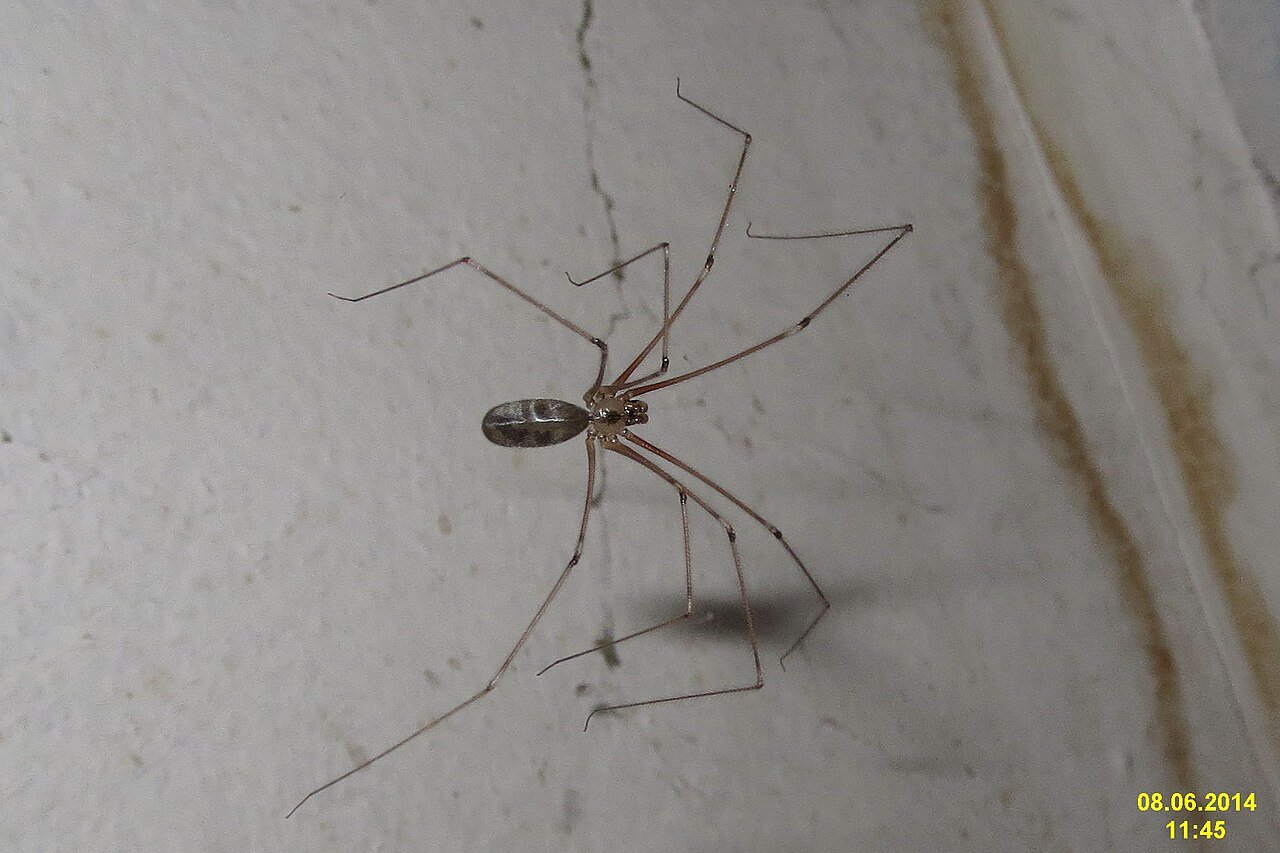
What a cellar spider is (and the nickname’s two impostors)
The long-bodied cellar spider — Pholcus phalangioides — is a true spider: peanut-shaped quarter-inch gray-tan body suspended under two inches of thread-thin legs, hanging inverted in a loose tangle web in basement corners, garages, closets, and crawlspaces, where stable humid air suits it and prey traffic feeds it. Household populations are permanent and generational — your basement’s residents likely descend from the house’s first tenants, per the winter-spiders page’s “already home” doctrine. The nickname chaos: “daddy longlegs” also covers harvestmen — the one-piece-bodied lawn wanderers that are arachnids but NOT spiders (no venom, no silk, no fangs worth the name) — and, in some regions, crane flies, which are flies entirely (our mosquito-hawk page’s client). Three animals, one name, endless confusion: this page’s subject is the web-hanging basement spider, and the folklore about to be examined belongs — wrongly — to all three.
Cellar spiders are harmless and genuinely useful, but a lot of them means a damp basement. That is where spider control in Dayton starts.
“The deadliest venom, but fangs too short”: the myth, autopsied
The legend states the daddy longlegs carries the world’s most potent venom behind fangs too short to pierce human skin — and it fails on every clause. The venom: tested directly (Mythbusters famously, toxicology formally), cellar spider venom is unremarkable-to-weak even by house-spider standards; nothing in the family ranks anywhere near medically significant. The fangs: short but functional — they demonstrably pierce human skin in provoked lab handling, producing at most a seconds-long mild burn; the “cannot bite” clause is as false as the “deadliest” one. The origin: folklore’s classic chimera — the harvestman’s no-fangs anatomy fused with the cellar spider’s spooky dangle, seasoned by the human need for the creepiest-looking corner resident to secretly be the deadliest. The verdict: a spider that cannot meaningfully hurt you, carrying a rumor that will not die, in a corner it earned honestly — the library’s acquittal formula in its purest form.
Cellar spider vs. brown recluse: the one-glance key
The confusion that fills our photo line — both are brown-ish basement spiders — dissolves at the first honest look. Legs: the cellar spider’s are impossibly long and thread-thin (leg span several times body length, always dangling in a web); the recluse’s are proportionate, slender-but-substantial, and carry it WALKING — recluses hunt on foot and sit in silk-lined retreats, never hanging inverted in tangle webs. Posture: hanging upside-down under a loose messy web = cellar spider, case closed — recluses do not build or occupy such webs, ever. Body: the cellar spider’s peanut-shaped abdomen versus the recluse’s uniform tan with the (over-hyped) violin mark; six-eyes-in-pairs remains the recluse’s technical signature, but nobody needs eye counts when the web-hang has already testified. The Ohio prior: genuine recluses are rare here; web-hanging basement browns are functionally always cellar spiders. Send the photo anyway — (937) 569-3330, free — and join the weekly parade of relieved recluse-reporters meeting their fisherman properly.
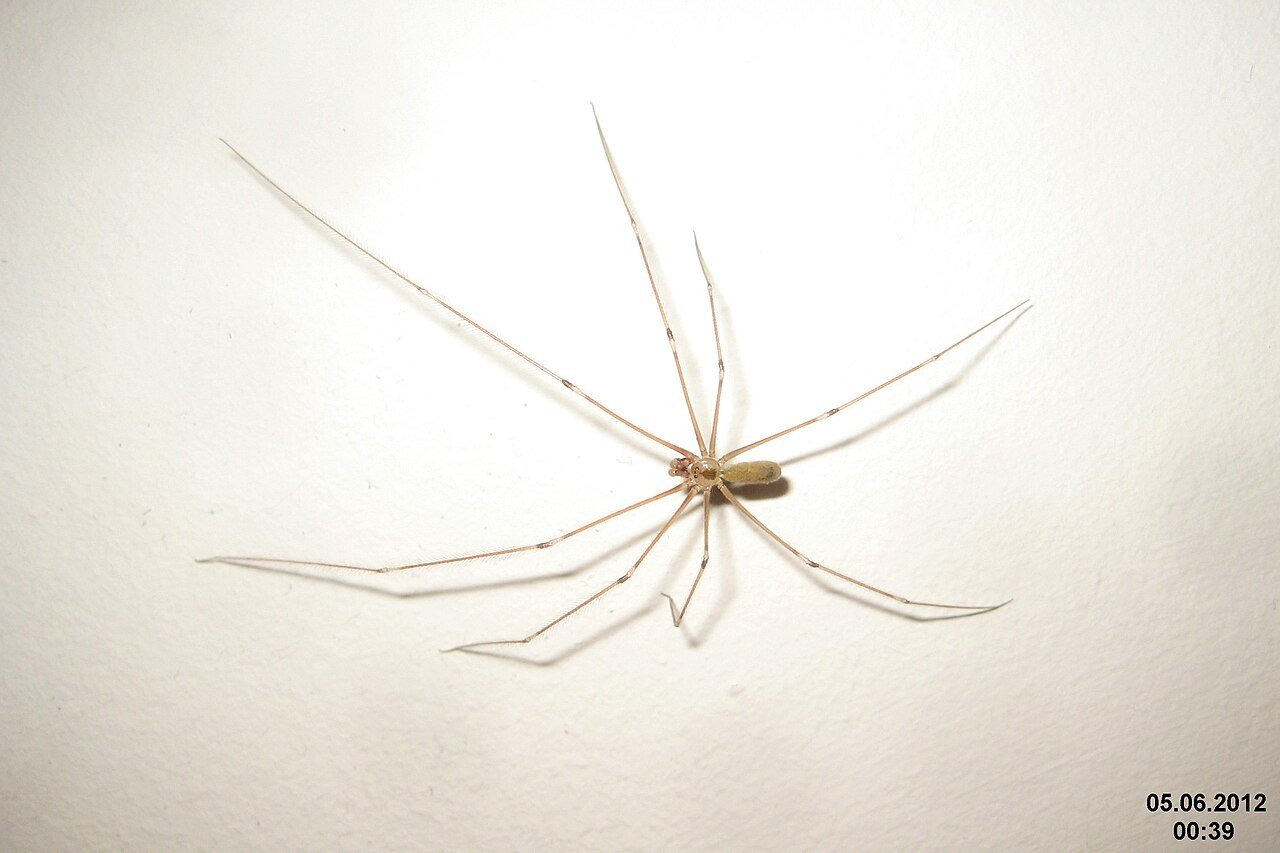
The résumé: what the corner fisherman actually does all day
The tangle web is a passive gillnet for the basement’s airborne traffic — fungus gnats above all (the damp-basement staple), mosquitoes overwintering or wandering, drain flies, moths, and the occasional roach nymph that climbs wrong. The specialist move is the famous one: cellar spiders hunt other spiders, entering rival webs, mimicking prey vibrations, and taking the owner — a documented predator of house spiders, grass spiders, and, verified repeatedly, black widows. A healthy cellar spider population is one of the honest reasons established basements so rarely host the careful species; the gangly pacifist is the corner’s apex predator. Supporting behaviors worth knowing: the whirling defense — a disturbed cellar spider gyrates its web into a blur (harmless, startling, and diagnostic); the egg-sac carry — females hold their loosely-wrapped egg bundles in their jaws for weeks (the “spider carrying a berry” photo call); and the housekeeping habit of expanding, never relocating — which is why one tolerated corner slowly becomes the building’s spider capital, and why management is really web-scheduling.
Management: the tolerance tiers
Tier one — the working corner (recommended): leave one or two low-traffic basement corners in business; the gnat-and-widow suppression is real, the spiders never leave the web to bother anyone, and the arrangement costs a dusty corner. Tier two — population control: the vacuum is the entire toolkit — webs, spiders, and jaw-carried sacs in one pass, repeated monthly; paired with the dehumidifier doctrine (dry the basement below 50% and the gnat economy that feeds the fishery collapses, taking the fishery with it — the only permanent eviction that exists). Tier three — zero tolerance: the full program from the main spider guide — dry, seal, de-web on schedule, manage the prey base — delivered DIY or as part of the plan’s quarterly rhythm. What never makes the list: sprays (contact-killing a web-hanger the vacuum reaches better) and the broom-smash that smears what suction removes clean. And whichever tier you choose, the corner’s tenant keeps its acquittal: the deadliest thing about the daddy longlegs was always the rumor.
The three daddy longlegs, formally distinguished
- Cellar spider (this page): a TRUE spider — two body segments, eight thread legs, silk tangle webs, hangs inverted indoors, mild functional venom, hunts other spiders. The basement resident.
- Harvestman (opilionid): arachnid but NOT a spider — one fused pill-shaped body, no silk, no venom glands, no web; wanders lawns and tree trunks by day scavenging. The picnic wanderer — and the actual owner of the “no fangs at all” clause the myth borrowed.
- Crane fly: an insect — six legs, wings, the “giant mosquito” of porch screens; eats little, bites nothing, dies in days. The porch bumbler, fully profiled on our mosquito-hawk page.
- The sorting rule: in a web indoors = cellar spider; walking outdoors on one round body = harvestman; flying at the porch light = crane fly. Three phyla-deep cases of mistaken identity, closed in one glance each.
The eight-county corner census
Cellar spider density maps basement humidity across our territory with hygrometer fidelity: the stone-foundation cores — Dayton, Oakwood, Kettering, the river towns — host the richest populations (and file the most recluse false-alarms, nearly all acquitted as this page’s client); the slab suburbs run lighter, their drier utility rooms supporting modest corner operations; and the farm counties’ cellars and outbuildings split the difference, with the barn population adding the occasional impressive multi-generational web complex worth photographing before the vacuum verdict. The standing pattern from the moisture guild’s every member: where the fisherman thrives, the water does too — treat dense cellar-spider country as a free humidity report, and let the dehumidifier decide how much fishing the basement really needs.
The bottom line
The cellar spider is the house’s most slandered employee: a functionally harmless, genuinely useful corner fisherman convicted by folklore of crimes (deadliest venom) it never committed and mistaken weekly for a fugitive (the recluse) it actually hunts’ cousins of. Keep a working corner if you can spare one, vacuum on schedule if you cannot, dry the basement to resize the whole operation — and retire the broom-and-rumor approach that has wronged the daddy longlegs for generations. The full household spider doctrine lives on the main guide; the winter biology on the seasonal page; and the photo line stands ready to acquit your basement’s brown suspect before bedtime: (937) 569-3330.
Life in the corner: the biography nobody asked for and everyone enjoys
A cellar spider’s career, start to finish: hatched from a jaw-carried bundle of a few dozen eggs, the spiderlings disperse only far enough to claim adjacent corner real estate — basements colonize incrementally, which is why infestations feel like “suddenly everywhere” after years of one quiet web. Adulthood runs one to two years (long by house-spider standards), spent almost entirely motionless and inverted, conserving energy between the web’s catches — the stillness that reads as spooky is a metabolic budget, not a vigil. Courtship is a vibration duet across the female’s web; combat, when rival males meet, is leg-fencing theater that rarely draws fluid. The famous whirl — the blur-spin at any web disturbance — doubles as predator confusion and the species’ single most-reported behavior on our line (“it started VIBRATING at me” — yes, and it was as scared as you were). And the endgame: cellar spiders die in their webs and are frequently eaten by their descendants, the corner recycling its own — a tidy, slightly gothic economy that has run in Ohio basements since the houses were built, and will outlast every rumor told about it upstairs.
Frequently asked questions
Are cellar spiders (daddy longlegs) poisonous?
No — the “deadliest venom, fangs too short” legend fails both clauses: tested cellar-spider venom is weak even among house spiders, and the fangs CAN pierce skin (lab-provoked bites produce seconds of mild burn at most). It is the most thoroughly debunked myth in household arachnology.
Is a daddy longlegs a spider?
The name covers three animals: cellar spiders (true web-building spiders — this page), harvestmen (arachnids but not spiders — no silk, no venom, one fused body), and crane flies (insects entirely). The indoor web-hanger is the true spider of the trio.
Are cellar spiders good to have in the house?
Genuinely — their tangle webs net fungus gnats, drain flies, and mosquitoes by the hundred, and they famously hunt other spiders, black widows verified among the prey. One working basement corner is the cheapest pest control a house can employ.
Do cellar spiders bite humans?
Essentially never unprovoked — and provoked bites (lab-handling territory) rate below bee-sting, resolving in minutes. Their entire defensive repertoire in practice is the web-whirl blur and retreat.
How do I tell a cellar spider from a brown recluse?
The web-hang answers alone: inverted under a loose tangle web = cellar spider, always — recluses walk and hide, never hang. Add the thread-thin outsized legs versus the recluse’s proportionate build, and the Ohio rarity prior, and the weekly false alarm acquits itself.
Why do daddy longlegs shake and vibrate in their webs?
The whirling defense — disturbed cellar spiders gyrate into a blur that confuses predators targeting them visually. Harmless, startling, and diagnostic: nothing else in the basement performs it.
Why is my basement full of cellar spiders?
Because it is humid and prey-rich — cellar spider density is a fungus-gnat census, and both track moisture. The dehumidifier below 50% collapses the food economy and resizes the spider population without a drop of spray.
How do I get rid of cellar spiders?
The vacuum: webs, spiders, and carried egg sacs in one monthly pass — paired with basement drying for permanence. Sprays underperform suction on a web-hanging species and stay off the honest program.
What is the cellar spider carrying in its mouth?
Her eggs — females carry the loosely-silked bundle in their jaws for weeks until hatch, releasing spiderlings into adjacent corners. The “spider with a berry” photo is expectant motherhood, and vacuuming the carrier removes the next generation with her.
Do cellar spiders really kill black widows?
Documented repeatedly — cellar spiders invade other spiders’ webs, mimic prey vibrations, and take the owners, widows included. It is one honest reason established basements with healthy cellar-spider corners so rarely host the careful species.
Corner kept or corner vacuumed, the verdict stands either way: acquitted on the venom, exonerated on the recluse, and commended on the widows — the daddy longlegs leaves this page with its record expunged and its fishing license renewed.