Let’s answer the question the search engine brought you here to ask: hobo spiders do not live in Ohio. Not rarely, not secretly, not “spreading east” — the hobo spider (Eratigena agrestis) is a Pacific Northwest species whose established American range runs from Washington and Oregon into the mountain states, and no verified population has ever been documented in Ohio. The brown, fast, funnel-web-building spider in your Dayton basement that matches every hobo photo you have scrolled tonight is almost certainly a giant house spider or a grass spider — the hobo’s close cousins, which is exactly why the photos match. This page settles the whole file: what a hobo spider actually is, why the resemblance fools everyone (including field guides), the dismantled myth of its “flesh-rotting” bite, the look-alike key that acquits your basement resident in one glance, and what to do on the vanishing chance a genuine hitchhiker turns up in your moving boxes.
What a hobo spider actually is
The hobo is a European funnel weaver that colonized the Pacific Northwest a century ago — a half-inch-bodied, long-legged, brown spider building the classic funnel-shaped sheet web in low crevices, rock walls, and building perimeters. Its infamy is largely American folklore: in Europe it lives unremarked in gardens under the name “field spider,” and even in its U.S. range it earned the “aggressive house spider” nickname mostly by sprinting toward cover (frequently, and unluckily, toward the human standing between it and the wall). Anatomically it is defined by things you cannot see without magnification — the pattern-free carapace, the light sternum markings, the specific chevron arrangement on the abdomen — which is the first clue about identification: even WITHIN its range, hobo ID from a snapshot is unreliable enough that labs ask for specimens. Outside its range, in a state with two abundant near-twins, the snapshot verdict is essentially always wrong.
Hobo spiders are not established in Ohio, so what you found is almost certainly something more ordinary. Sorting it out is spider control in Dayton.
Why your spider looks exactly like the pictures
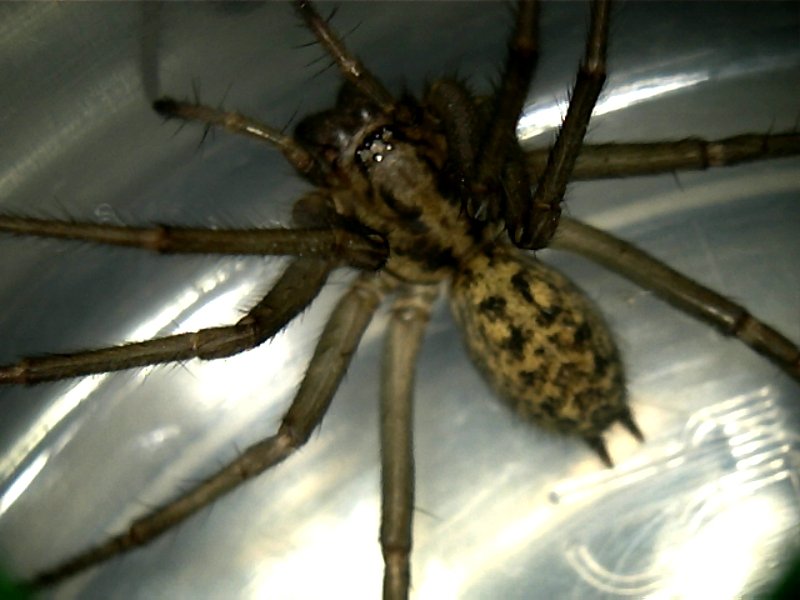
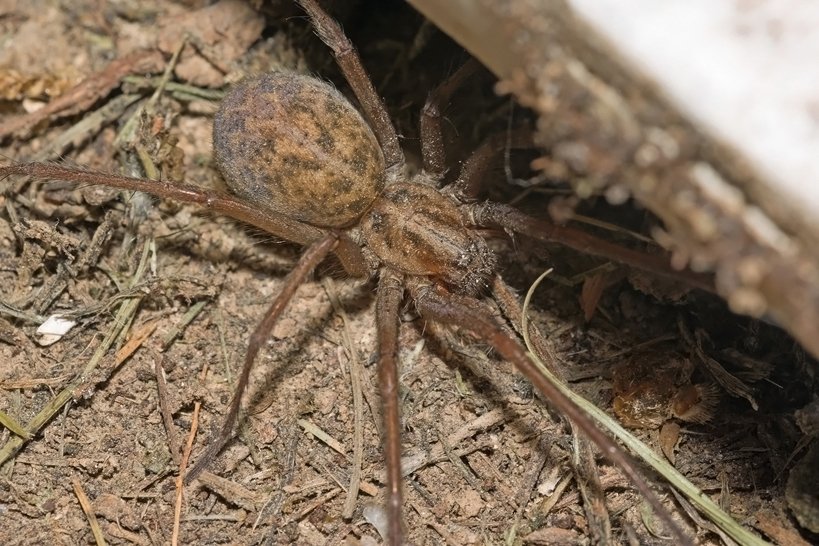
Because the pictures are of its cousins, functionally speaking. Ohio’s basements and gardens are rich in two funnel weavers that share the hobo’s whole aesthetic: the giant house spider (Eratigena atrica — same genus, dramatically larger leg span, the autumn bathtub celebrity of our spider pages) and the grass spider (Agelenopsis — the September lawn-webber, banded and quick). All three build funnel-sheet webs; all three are brown, fast, and leggy; all three sprint when disturbed. The internet’s hobo galleries are themselves notoriously contaminated with misidentified cousins, so your match-the-photo exercise was rigged from the start. The acquittal key runs on two features you CAN see: leg bands — grass spiders and most house spiders wear banded or annulated legs, while the hobo’s are plain (the detail the photo below shows); and bold dark stripes — the grass spider’s two dark carapace racing stripes are a non-hobo signature. Add geography — you are in Ohio — and the verdict arrives before the magnifier does.
The “flesh-rotting bite” myth, formally dismantled
The hobo’s medical reputation — necrotic wounds, the “aggressive house spider” of 1990s pamphlets — has been walked back by the very institutions that built it. The origin was a small number of case reports and one influential 1980s study whose attribution methods have not survived scrutiny; follow-up work found hobo venom unremarkable (Canadian populations of the same species carry no such reputation at all), documented bites with confirmed spiders healing blandly, and the CDC quietly dropping the hobo from its necrotic-bite discussions. The current mainstream verdict: the hobo bite is real, uncommon, and minor — a bee-sting-class defensive nip — and the necrotic wounds once pinned on it belong to the same differential our spider-bites guide hammers: MRSA first, always. So the Ohio reader’s position is doubly safe: the spider is not here, and even where it is, the monster version never existed. The internet’s scariest search result is a retracted rumor wearing eight legs.
The one-glance acquittal key for your basement spider
- Banded legs? Not a hobo — grass spider or house spider; case closed at the first joint.
- Two bold dark stripes on the head-plate? Grass spider — the September funnel-webber of every Ohio lawn; fully harmless.
- Enormous leg span (2–4 inches) in the tub or on the wall? Giant house spider — the hobo’s bigger, equally harmless cousin and your basement’s actual resident.
- Web is a flat sheet narrowing into a funnel retreat? Family trait, not species evidence — all three cousins build it; the web proves funnel weaver, nothing more.
- It ran at me! Toward cover, always — funnel weavers sprint for the nearest dark edge, and humans stand near edges. Speed is a family reflex, not aggression.
- Actually in Washington, Oregon, Idaho, Utah, or Montana? Different conversation — and even there, specimen-grade ID before any conclusions.
Could a hobo ever reach Ohio?
The honest hitchhiker file: individual spiders ride moving trucks and freight from the Northwest occasionally, exactly as our scorpion page documents for southern stowaways — an isolated arrival that dies without establishing. Sustained establishment would require breeding populations surviving Ohio’s ecology against two entrenched cousin species already holding the funnel-weaver niche; range biologists consider the eastern seaboard march unlikely, and decades of national spider surveys have produced no Ohio foothold. If your household just moved from Seattle and a plain-legged funnel weaver walked out of a box: trap it under a glass, photograph it, and send it over — genuinely interesting mail, and we will route confirmed oddities to the university folks who track such things. For everyone else, the box-shake habit from the moving-day checklist covers the entire realistic risk.
The bottom line
No hobo spiders in Ohio; no flesh-rotting bite anywhere; and a basement resident whose banded legs, bold stripes, or sheer size acquit it in seconds as the grass spider or giant house spider it actually is — a rent-paying insect-control professional per the household program on our main spider guide. File this one with the murder hornets, the fire ants, and the scorpions: the scary search result whose honest Ohio answer is relief, delivered with a photo line for the skeptical: (937) 569-3330 — free ID, same-day, and cheerfully in the acquittal business.
The funnel weaver family reunion: who is actually in your yard
Since the hobo question is really a funnel-weaver question, meet the family that IS here. Grass spiders (Agelenopsis) own the September lawn: their dew-silvered sheet webs carpet Ohio turf by the dozen each fall morning, each funnel holding a striped, banded-legged sprinter that lives one season, banks its eggs, and ends at frost — the annual-calendar biology our winter-spiders guide details. Giant house spiders (Eratigena atrica) run the indoor franchise: multi-year residents of basements and garages, the source of every autumn bathtub legend, and genuinely useful hunters whose leg span writes checks their bite never cashes. Barn funnel weavers (Tegenaria domestica) — the “domestic house spider” — fill the smaller crevices of sheds and cellars statewide, the modest middle sibling nobody photographs. All three: fast, brown, funnel-building, harmless, and beneficial; all three: routinely convicted as hobos by image search. The family portrait is the page’s real lesson — Ohio never lacked dramatic funnel weavers, just dangerous ones.
And the meta-lesson, one more time for the library’s running theme: the scariest names in pest search — hobo, recluse, murder hornet, fire ant, scorpion — keep resolving, in Ohio, into either absent species or slandered neighbors. The evidence habit (photo, leg-band check, free ID line) beats the image-search spiral every single time, and usually ends in better sleep rather than a service call. We remain, as ever, delighted to be the bearer of boring news.
Frequently asked questions
Are hobo spiders in Ohio?
No — no verified population has ever been documented in Ohio. The species’ established U.S. range is the Pacific Northwest and mountain states. Ohio “hobo” sightings resolve as giant house spiders or grass spiders — close cousins with the same look.
What states do hobo spiders live in?
Washington, Oregon, Idaho, Montana, Utah, Wyoming, and adjacent corners — the Pacific Northwest colonization of a European species. Eastward spread has not materialized despite decades of surveys.
Are hobo spiders dangerous?
Far less than their reputation — the “necrotic bite” attribution has been walked back by follow-up research and dropped from CDC discussions; confirmed bites run bee-sting-class. The scary version was built on shaky 1980s case reports and survives mainly as internet folklore.
What spider looks like a hobo spider in Ohio?
Two funnel-weaving cousins: the giant house spider (bigger leg span, basement resident, the bathtub celebrity) and the grass spider (banded legs, two bold carapace stripes, September lawn webs). Both harmless, both routinely misidentified as hobos by photo-matching.
How do I tell a hobo spider from a grass spider?
Legs and stripes: grass spiders wear banded legs and two dark racing stripes on the head-plate; hobos have plain legs and no bold stripes. In Ohio the geography answers first — but the leg-band check settles it anywhere in one glance.
What does a hobo spider web look like?
A flat silk sheet narrowing into a funnel retreat in a low crevice — which is a FAMILY signature, not a species ID: grass spiders, house spiders, and barn funnel weavers build the same architecture across every Ohio yard and basement.
Why is it called a hobo spider?
The name references its assumed spread along railroad lines in the Northwest — a hitchhiker’s reputation. In its native Europe the same species is an unremarkable garden resident with no fearsome name at all.
Do hobo spiders chase people?
No spider does — the “aggressive house spider” nickname came from funnel weavers sprinting toward dark cover when flushed, with humans occasionally standing along the escape route. It is a dash for the baseboard, not a charge.
What should I do if I think I found a hobo spider in Ohio?
Glass over it, card underneath, photo to us: (937) 569-3330 — free same-day ID. Recent Northwest movers with a plain-legged funnel weaver from the boxes have the one plausible story; everyone else meets their giant house spider properly at last.
What kills funnel weaver spiders in the house?
The honest answer from our spider program: nothing chemical worth buying — funnel weavers respond to the mechanical program (vacuum, dehumidifier, sealing, web removal) and mostly to being left alone as free pest control. The cup-and-card relocation remains the tool of champions.
The image-search trap: why photo-matching spiders fails
This page’s confusion deserves its post-mortem, because the mechanism repeats across every scary-spider search. Spider identification runs on characters photos rarely capture — eye arrangements, sternum patterns, reproductive structures — while photos capture exactly the traits funnel weavers share: brown, leggy, fast, funnel web. Image galleries compound it: hobo photo sets across the internet are salted with mislabeled cousins (a documented problem even in reference collections), so the anxious matcher is comparing their grass spider against… someone else’s grass spider, labeled “hobo.” The confirmation spiral does the rest — fear finds features, every brown spider grows a violin or a chevron under enough scrutiny at 1 a.m. The countermeasures are the library’s standing habits: identify by EXCLUSION first (banded legs end the hobo question; six eyes end the recluse question; geography ends both in Ohio), trust structural keys over vibes, and route genuine uncertainty to the free photo line where a specimen-trained eye applies the boring checklist. Ten seconds of leg-band inspection beats an hour of gallery-scrolling — on this spider and every one the internet will frighten you with next.
Case closed, then: the hobo stays west, the myth stays retracted, and the fast brown spider in your funnel web stays exactly what it always was — a banded-legged local doing free pest control under an assumed name. Ohio’s scariest spider search ends, as the best ones here always do, with everyone acquitted and the cup-and-card back in the drawer.
Next stop for the newly reassured: the giant house spider’s own file on our common spiders page, and the winter guide’s bathtub-stranding physics — the rest of your basement resident’s biography, no folklore included.
Sleep well — the funnel web’s tenant already went back to work.