
Do ticks fly? No — no tick has ever had wings at any life stage. Do they jump? Also no — not an inch, not ever; ticks lack the leg anatomy for jumping entirely. Do they drop out of trees onto your head? Third no — the most durable myth of the three, and the one this page will spend real time dismantling, because the tick on your scalp genuinely feels like it fell from above. What ticks actually do is in some ways more unsettling and in every way more useful to know: they ambush from knee-height vegetation and then CLIMB — patiently, upward, for as long as it takes. Understanding the real locomotion is not trivia; it rewrites where you check, what you treat, and which precautions actually work. Here is the full movement file.
What ticks cannot do (the complete list, with the anatomy)
No flight: ticks are arachnids — the wingless lineage, full stop; nothing in the group has ever evolved wings, and a “flying tick” sighting is a beetle, a louse fly, or a very bad day for a spider beetle. No jumping: jumping requires either spring-loaded leg architecture (fleas’ resilin catapults) or powerful extensor muscles (grasshoppers); tick legs are slow-twitch climbing tools with hooked claws — engineered for grip, incapable of launch. A flea covers ankle-height in one leap; a tick covers it in a determined ninety-second climb. No dropping ambushes: ticks are desiccation-fragile and host-seek from LOW vegetation where humidity holds — questing height for our species runs shin-to-knee, occasionally waist on tall grass, essentially never tree canopy. The scalp tick did not parachute; it boarded at your sock line and summited while you walked. Multiple studies have put collectors under trees in heavy tick country: the drop rate rounds to zero.
Ticks wait at leg height along the edge of a lawn, which is precisely where perimeter work earns its keep. See pest control in Dayton.
What they actually do: the quest, the board, the climb
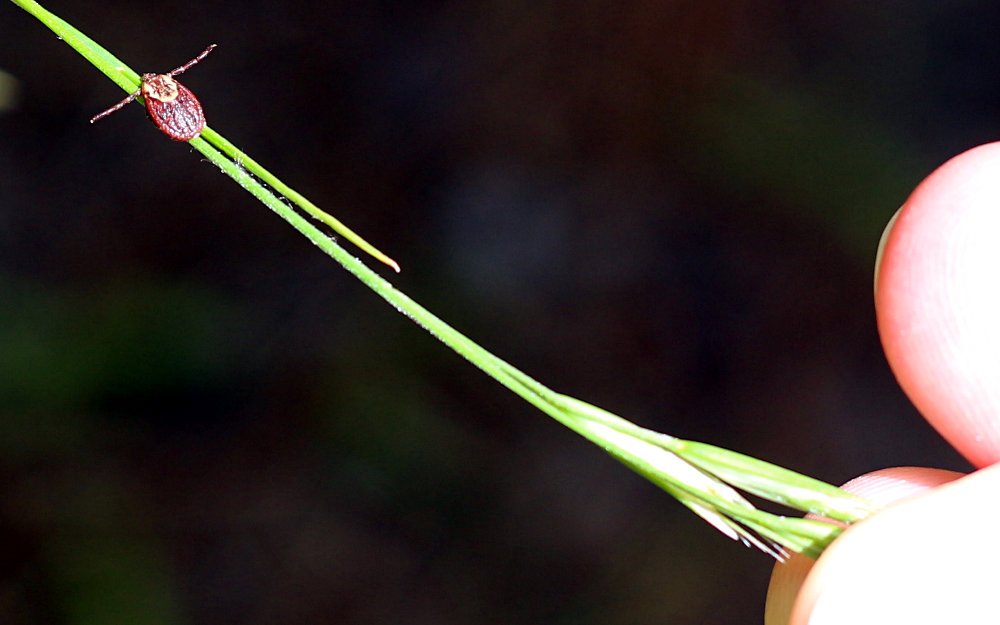
The real sequence is a three-act ambush. Act one, questing: the tick climbs a grass stem or leaf edge to its humidity ceiling, grips with its rear legs, and extends its forelegs into the air — the posture in the photo above — waiting hours or days, retreating down to rehydrate as needed. Those outstretched forelegs carry Haller’s organs, sensor pits reading carbon dioxide, body heat, ammonia, and vibration: a mammal-detection array pointed at the trail. Act two, boarding: when your leg brushes the vegetation, the tick transfers by grab — pure contact, no leap; a miss is a miss, which is why center-path walking works as prevention. Act three, the climb: once aboard, ticks head UP — a hardwired negative-geotaxis march toward thinner skin and safer anchorage: ankles to knees to waistband to scalp, unhurried, often thirty-plus minutes before attachment. That climbing window is the entire magic of the two-hour shower rule and the parking-lot pants-scan: the tick that cannot jump also does not bite fast, and the boarding-to-attachment gap is where nearly every tick encounter can still be won.
Why the tree-drop myth refuses to die
Three honest reasons, each fixable with the facts. The scalp discovery: head and hairline ticks feel like aerial arrivals — but the climb explains them completely: boarding at the ankle, an unnoticed thirty-minute ascent, attachment at the thin warm skin above the collar. The tick’s destination bias TOWARD the head is real; its route is always the elevator, never the skydive. The wooded correlation: people meet ticks in woods, look up, and infer — but the woods’ tick load lives in the knee-high understory and leaf litter, not the branches; the canopy is a desert to a humidity-chained arachnid. Seed-tick showers: brushing a larval cluster transfers dozens at once — an experience so sudden it reads as “falling on me,” when it is one branch-brush against a hatch mass at shoulder height on a sapling — the single scenario that puts ticks above the waist, and still a contact transfer, not a drop. Retire the myth and the defense re-aims where it belongs: at your boots, socks, and pant legs — the actual boarding zone — rather than at your hat.
How fast and far do ticks travel on their own?
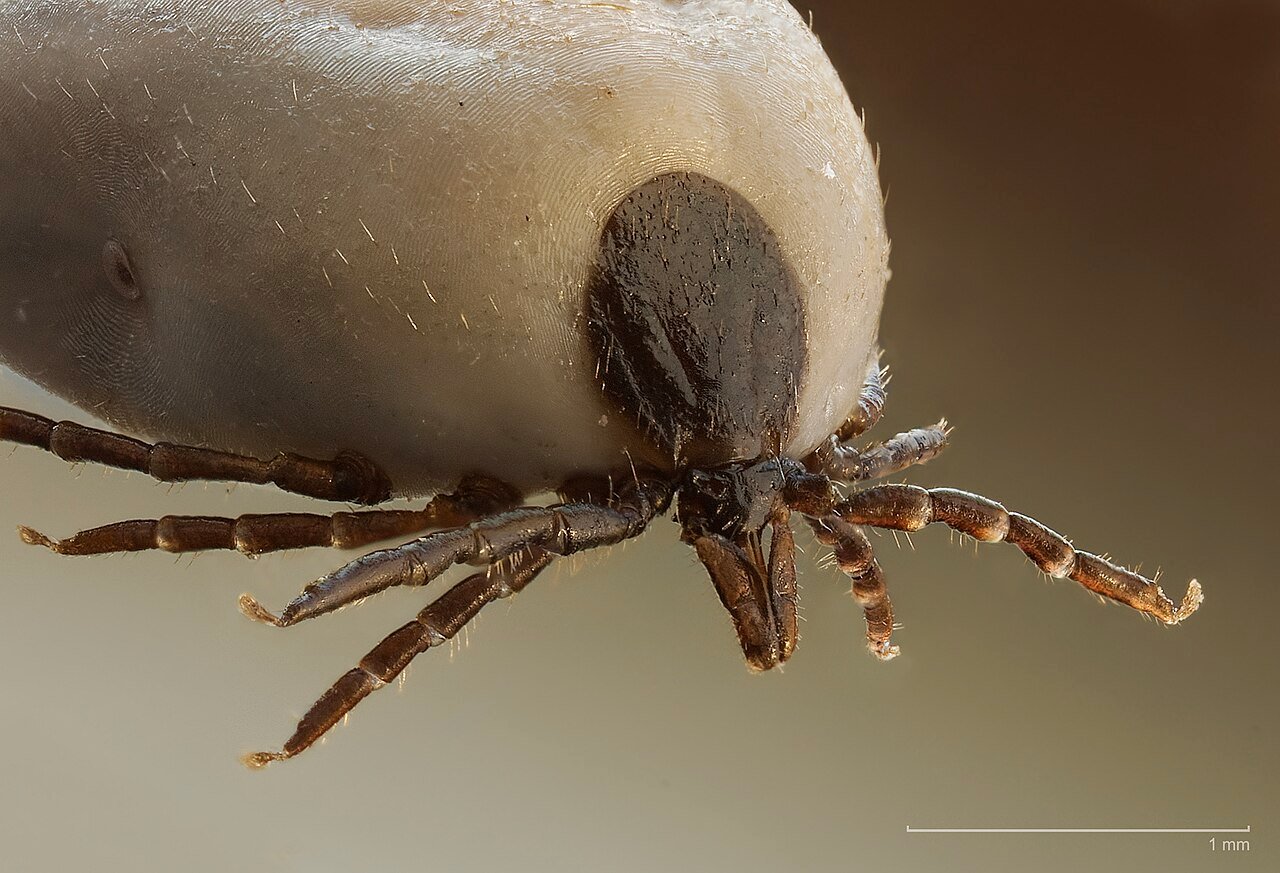
Slowly and barely — the third piece of movement biology worth owning. On the ground a motivated tick manages a few meters an hour; over a lifetime, a tick’s self-powered range is measured in tens of meters. The species’ actual transportation network is hosts: mice and chipmunks ferry larvae and nymphs through the understory, deer carry adults miles, birds import ticks across counties, and dogs deliver them to living rooms. Two practical consequences: first, a yard’s tick population maps its host traffic, not its acreage — which is why the rodent program and the deer-edge management on our ticks-in-Ohio guide ARE tick control; second, ticks do not “infest” a house the way fleas do — indoor ticks are individual arrivals via pet or pant leg, and (brown dog tick excepted) our species cannot sustain indoor populations in dry heated air. The tick found crawling on the carpet walked in on someone within the last day or two — a traceable event, not an infestation.
The movement facts, converted to defense
- They board low — so permethrin effort concentrates on boots, socks, and pant legs: the toll booth where every tick pays.
- They climb slow — so the two-hour shower, the parking-lot scan, and the hot-dryer cycle intercept most riders before attachment; speed is your advantage, not theirs.
- They cannot cross gaps — so the wood-chip barrier works, center-path walking works, and a picnic blanket’s edges matter more than its middle.
- They ride hosts — so the dog check is household defense, the mouse program is tick control, and the deer fence earns its keep on edge lots.
- They cannot persist indoors — so a found house tick means a same-week arrival to trace (walk, pet, laundry pile), not a treatment campaign to buy. Save the panic; run the trace.
The bottom line
Ticks are the slowest predators you will ever face: no wings, no jumps, no aerial ambush — just a patient climb from a grass blade you brushed, at a pace that hands every advantage to anyone who knows the rules. Guard the boarding zone, use the climbing window, manage the hosts, and the whole movement file collapses into a two-minute routine. The full species briefing lives on our ticks in Ohio guide, the visual key on what does a tick look like — and the free photo ID line stands ready for whatever just crawled across the picnic table: (937) 569-3330.
The comparison everyone actually wants: ticks vs. fleas vs. bed bugs, movement edition
The three famous hitchhikers get conflated constantly, and their locomotion files could not differ more — which is why each demands a different defense. Fleas are the jumpers: resilin-spring launches of six to eight vertical inches, ankle-boarding from carpet at leap speed — the sock test and growth-regulator carpet treatment exist because fleas cross open floor ballistically. Bed bugs are the commuters: no jumping, no flying, but determined walkers that follow CO₂ plumes across a bedroom and ride luggage between cities — interception cups and encasements work because their travel is groundbound and predictable. Ticks are the ambush climbers: stationary until you arrive, then slow vertical persistence — permethrin at the boarding zone and the timed check exploit exactly that patience. One table, three strategies: leap-proof the ankles for fleas, moat the bed for bed bugs, toll-booth the boots for ticks. The pest that cannot jump is defeated by socks; the one that can is defeated by vacuums; and the one that hitchhikes is defeated by a luggage rack — biology assigns the homework, and the homework never transfers between species.
Seed ticks: the one encounter that breaks the rules (sort of)
Once a summer we get the call that starts “they were EVERYWHERE, they had to be falling on me” — and the answer is the larval mass. A female lone star lays thousands of eggs in one leaf-litter spot; the hatch waits as a clustered mob on low vegetation; and one brush transfers dozens-to-hundreds of pinpoint six-legged larvae in a single second. It reads as rain; it is one contact event at a single bush. The response file: do not scrape wildly (you smear and miss) — lint-roller or duct-tape blotting lifts larvae wholesale, then the hot shower, then the dryer for every stitch worn. The reassurance: larvae hatch pathogen-free (infection is acquired from their first host), so a seed-tick shower is an itchy inconvenience rather than a disease event. And the prevention footnote: seed-tick sites are hyper-local — flag the spot, treat or avoid that specific margin, and the “rain” never repeats. Even the exception, examined closely, obeys the law: contact transfer, low vegetation, no flight, no jumps — just arithmetic with more digits.
Field applications: five real scenarios, movement-decoded
“A tick was on my neck an hour into the hike” — boarded at the boot in the first minutes, summited on schedule; your collar was mile marker eight, not the trailhead. Next hike: permethrin socks and a mid-hike waistband glance. “My toddler had one on her scalp after the yard” — kids’ low stature shortens the climb dramatically (knee-high grass boards a child at hip height); the bath-time head check is the toddler-specific rule, and the play-set’s move to sunny open lawn is the fix. “Ticks keep appearing on the couch” — the dog is running a shuttle service; the couch ticks walked off a warm passenger, and the vet preventive plus the door-frame check ends the route. “I found one crawling on me in the car” — boarding-to-attachment lag working in your favor: it rode a pant leg in and never attached; the parking-lot scan exists for exactly this rider. “One was on the ceiling — explain THAT” — negative geotaxis never quits: a tick that walked off a host indoors keeps climbing whatever it touches, wall included. It is lost, not hunting; it also confirms a recent warm-blooded courier worth identifying. Five mysteries, one physics engine — low boarding, upward persistence, host-powered transit — and not a wing or a leap anywhere in the case file.
Frequently asked questions
Can ticks jump like fleas?
Not at all — ticks lack any jumping anatomy (fleas carry spring-loaded resilin catapults; ticks carry slow climbing legs with grip claws). A jumping tick-like bug is a flea; a tick reaches your ankle only by direct brush contact with vegetation.
Can ticks fly?
No tick species on Earth has wings at any life stage — ticks are arachnids, a wingless lineage. Flying “ticks” are beetles, louse flies, or other insect look-alikes; the eight-legs-no-wings-no-antennae combination is definitive.
Do ticks fall from trees onto people?
No — ticks quest from shin-to-knee-height vegetation where humidity sustains them and essentially never occupy canopy. Scalp ticks board at leg level and climb (a 30+ minute ascent people never feel); collector studies under trees in tick country find drop rates near zero.
How do ticks get on you then?
Ambush and grab: they wait on low vegetation with forelegs extended (questing), detect your CO₂, heat, and vibration, transfer by direct contact as you brush past, then climb upward toward thin-skinned attachment sites. No pursuit, no leap — pure toll-booth contact.
How fast do ticks crawl?
Slowly — meters per hour at best, with a lifetime self-powered range of tens of meters. Their real mileage comes from hosts: mice, deer, birds, and dogs do the traveling; the tick just rides. On your body, the ankle-to-scalp climb typically runs 30+ unhurried minutes.
Why do ticks always end up on the head or hairline?
Negative geotaxis — a hardwired climb-upward instinct steering them toward thin, warm, protected skin (hairline, ears, scalp). The head is the destination, never the entry point; the entry was your sock line, which is where the defense belongs.
Can ticks climb walls or furniture?
Yes — the climbing instinct works on any surface, which explains the occasional wall or ceiling tick indoors: a rider that left its host and kept ascending. It signals a recent courier (usually the dog), not an infestation; our species cannot sustain indoor populations.
Do ticks move from person to person?
Rarely — an unattached tick can transfer during close contact (shared couch, co-sleeping kids), but there is no active person-to-person seeking. The meaningful transfers are host-to-house: pets and pant legs importing riders that then redistribute.
What are seed ticks and why did dozens get on me at once?
Larval ticks from a single hatch mass — thousands cluster on low vegetation, and one brush transfers dozens in a second (the “falling on me” illusion). Lint-roller removal, hot shower, hot dryer; larvae hatch pathogen-free, so it is an itchy nuisance, not a disease event.
If ticks are this slow, why are they so successful?
Patience economics: a tick needs three meals in three years and can wait months for each — ambush beats pursuit when you can afford to wait. It is also the exploitable weakness: slow boarding and slower attachment hand every advantage to the two-hour check, the treated sock, and the chip barrier.